Best RO Systems
Home › Guides › 500 GPD systems, price compared
Comparison

Four 500 GPD reverse osmosis systems, four very different prices: what the gap actually buys

We're reader-supported: buying through our links may earn us a commission at no extra cost to you. We compare published listing titles, certifications and prices — we don't run a testing lab, and nothing below is a star rating or a paraphrased review.

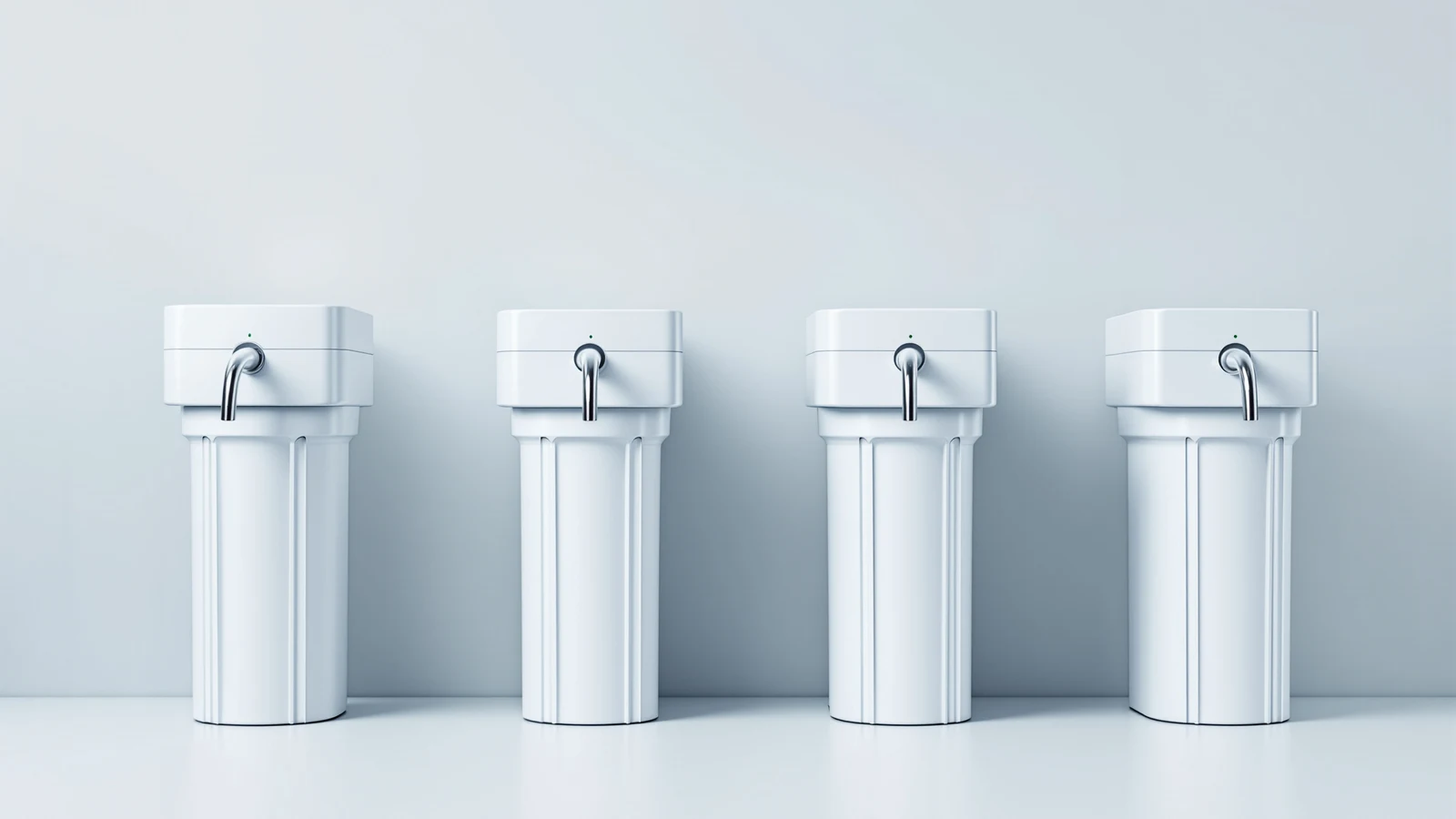
Four under-sink reverse osmosis systems, all rated 500 gallons per day, shown together to represent a price comparison

Shop for a 500 GPD reverse osmosis system and the number on the box stops being useful almost immediately. Four listings claim the identical rating — 500 gallons a day — and the cheapest of them costs $199.48 while the most expensive costs $633.60. That's not a rounding difference between near-twins; it's roughly a three-times spread for a spec that, on paper, is the one thing all four have in common. Here are the four, at the prices we recorded:

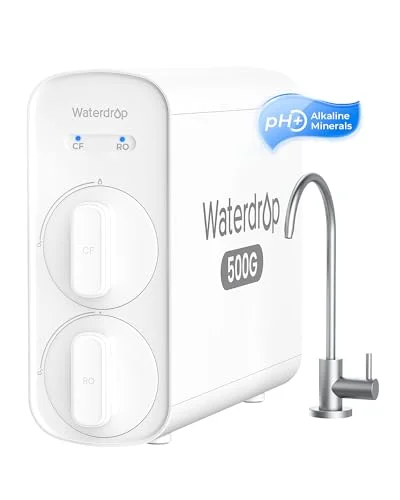
  • Waterdrop G5P500A — $199.48. 8-stage RO filtration, alkaline.
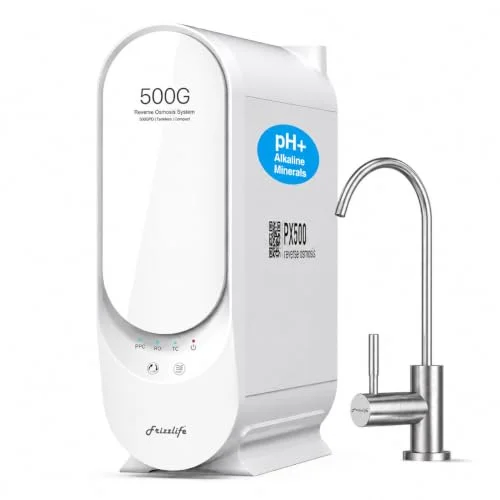
  • Frizzlife PX500-A — $329.99. Alkaline mineral, NSF/ANSI 58&53&42&372 standard, 500GPD, 8-stage, tankless, 2:1 pure-to-drain, PFAS reduction claim.
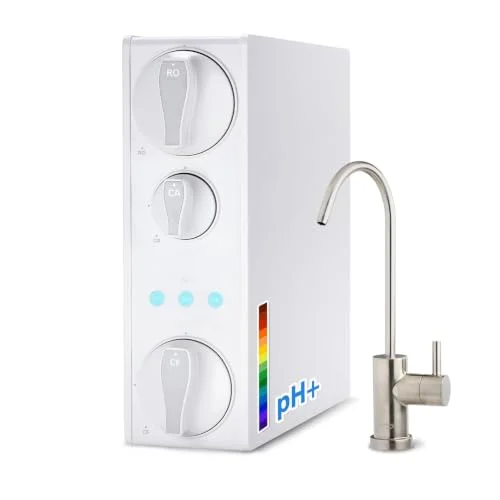
  • iSpring RO500AK — $533.99 (recorded October 22, 2026). Alkaline, NSF 58 certified, 500 GPD.
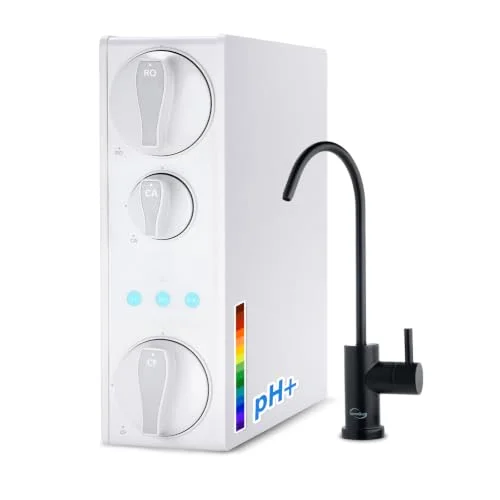
  • iSpring RO500AK-ORB — $633.60. NSF/ANSI 58 certified, 500 GPD with alkaline.

Lay the four titles side by side and a second thing jumps out before certification or stage count even enters the picture: every one of them, including the $199.48 Waterdrop, already includes an alkaline remineralization stage. That rules out the easiest explanation for the gap. Nobody is paying $404.00 extra to go from a plain system to an alkaline one — all four start from the same baseline feature, so whatever is driving this spread has to live elsewhere in the listing.

One more detail worth flagging: the Waterdrop is the only one of the four whose title doesn't spell out "500 GPD" in words. The rating is baked into the model number instead — G5P500A — following the same P-plus-capacity convention Waterdrop uses across its line, where the G3P600 and G2P600 are both 600 GPD systems named the same way. It means the "four systems, same number" framing rests on reading one model code, not four identical title strings — worth knowing if you're comparing listings and only skimming for the literal digits.

The number that isn't the story

Why "500 GPD" alone was never going to explain this

GPD — gallons per day — is a membrane throughput rating measured under specific lab conditions: a given feed pressure, feed-water temperature and TDS level, usually 77°F. It tells you how much permeate a fresh membrane can theoretically produce in a day under those conditions, not what you'll get at your kitchen sink, and it says nothing about the other seven or eight components sitting in front of and behind that membrane. Two systems can share an identical 500 GPD rating while differing completely on certification depth, stage composition, drain efficiency, included hardware and brand support — which is exactly what's happening across these four listings.

Put another way: GPD measures one component's output under test conditions, the way a car's horsepower figure says nothing about whether it has heated seats. The four listings here make that point cleanly, because the rating is the one spec where they're all telling you the same thing — and it's also the spec that explains the least of the $404.00 gap between the cheapest and the most expensive.

Reading the fine print

Certification depth: one standard named versus four

What each title actually states about third-party certification — not what the system is assumed to meet.

This is where the four listings diverge the most sharply, and it doesn't move in a straight line with price. The Waterdrop G5P500A, the cheapest of the four at $199.48, doesn't name any NSF/ANSI standard in its title at all — just "8-Stage RO Filtration, Alkaline." That's not evidence the system fails any particular standard; it's evidence the title makes no certification claim one way or the other, and a title's silence on certification isn't the same as a confirmed absence of it. If a specific standard matters to your decision, that's a question for the current listing's images and documents, not this title.

The Frizzlife PX500-A, priced in the middle at $329.99, makes the most detailed certification claim of the four: "NSF/ANSI 58&53&42&372 Standard," naming four separate standards in the title itself. That's the same four-standard pattern we found on the fuller-certified listings in Frizzlife's 800 GPD and 1000 GPD duplicate listings — the brand's house style, across capacities, appears to be stating certification depth explicitly rather than citing a single headline standard.

Both iSpring listings — the $533.99 RO500AK and the $633.60 RO500AK-ORB — name exactly one standard each: "NSF 58 Certified" and "NSF/ANSI 58 Certified," respectively. NSF/ANSI 58 is the standard that actually governs whether an RO system reduces total dissolved solids and contaminants, so citing it alone isn't a weak claim — it's the single most load-bearing standard in the category. But it is a narrower claim than Frizzlife's four-standard title, and these are the two most expensive systems here. The pattern that falls out isn't "certification scales with price" — it's closer to the opposite: the cheapest system makes no certification claim, the mid-priced system makes the broadest one, and the two priciest systems each cite a single standard. Certification wording in a title is a function of what a seller chose to put there, not a ranking of what's inside the box.

One more claim worth separating from certification entirely: the Frizzlife title also states "Reduce PFAS," distinct from the NSF/ANSI list sitting next to it, and the only one of the four titles to mention PFAS specifically. We can't say from the other three titles whether their systems do or don't reduce it — their listings simply don't make that claim either way, which is a gap in what we know, not evidence against them.
What's actually in the box

Stage count, and what's in the chain beyond the membrane

Two of the four titles state a stage count outright: the Waterdrop G5P500A and the Frizzlife PX500-A are both specified as 8-stage systems. That's a tie on the one number that's supposed to describe everything between the incoming line and the faucet — sediment, carbon, membrane, alkaline remineralization and whatever post-polish stages a brand counts toward its total. On that stated figure, the $100.00 gap between these two systems isn't a stage-count gap at all.

Neither iSpring title — not the RO500AK, not the RO500AK-ORB — states a stage count. That's worth sitting with: these are the two most expensive systems in the group, and the two whose own titles give the least information about what's in the filtration chain. We're not going to assume a number iSpring didn't publish, up or down. If stage composition matters to your decision, that's a case where the current listing's bullet points and stage diagram — not this comparison — are the place to check before buying.

The Frizzlife title adds one more chain detail the others don't state: a 2:1 pure-to-drain ratio, the rate at which the system sends water to the drain for every gallon of filtered water it produces. A 2:1 ratio is on the efficient end for a tankless under-sink system — better than the 3:1 or 4:1 ratios older designs commonly run. None of the other three titles states a drain ratio, so we can only say Frizzlife is the one listing that discloses it here.

The small gap inside the big one

Faucet finish and hardware extras: what fraction of the price gap they actually explain

The two iSpring listings isolate one variable almost perfectly. Both are named RO500AK-family systems. Both state "NSF 58"/"NSF/ANSI 58 Certified." Both are rated 500 GPD, and both carry the same Size/variant designation in our data: "NSF 500 GPD Alkaline RO." The only thing that visibly separates them is the model suffix — plain RO500AK versus RO500AK-ORB — and a $114.00 price difference, $533.99 against $633.60.

"ORB" is a finish code iSpring uses elsewhere in its catalog to denote an oil-rubbed-bronze faucet, as distinct from the brand's standard chrome or brushed-nickel finish. Neither title here spells that out — "RO500AK-ORB RO System, NSF/ANSI 58 Certified, 500 GPD with Alkaline" doesn't define what ORB stands for any more than the plain title explains the $114.00 gap. Reading the suffix as a faucet-finish code is a reasonable inference from iSpring's own naming pattern elsewhere in its line, not a confirmed spec in either title — if the finish matters to your kitchen, check the current listing's photos rather than taking the suffix as a guarantee.

What matters here is the arithmetic, not the exact finish. $114.00 is roughly 28 percent of the full $404.00 spread between the cheapest and most expensive system in this group. Even if that entire gap is purely a faucet hardware upgrade — the most generous reading — it accounts for a real share of why a 500 GPD system can cost three times as much as another. The real money still sits elsewhere: in the roughly $100 jump from Waterdrop to Frizzlife, and the much larger roughly $190 jump from Frizzlife to the iSpring pair. A faucet finish or bundled accessory is worth noticing within one brand's own family — the same pattern as matching an exact model number rather than just a brand — but it doesn't explain a cross-brand, three-times gap like this one.

What the titles don't say

Auto-flush, filter-life alerts, and the feature that isn't in any of the four titles

It would be a clean story if the two pricier iSpring systems bundled in an auto-flush cycle, a smart display or a filter-life alert the way some tankless RO systems elsewhere in this category do — Waterdrop's own G3P600, for instance, carries a faucet display that reads out TDS and filter life. None of that shows up here. Not one of these four titles — Waterdrop, Frizzlife or either iSpring — mentions auto-flush, a smart display, or a filter-life alert of any kind.

That absence is itself a useful data point. It tells you the roughly $400 gap between the cheapest and most expensive system here isn't being spent on alert technology or display hardware, because none of the four sellers put that kind of feature in the title either way. If a filter-life display or auto-flush cycle matters to you, that's a reason to look at a different tier of listing entirely, rather than assuming it's quietly included in the higher iSpring price. Within this group, the premium over the Waterdrop is concentrated in certification wording and brand, not a stated convenience feature.

Side by side

The four listings, lined up

What each title states for itself. Prices as recorded; confirm the current price before buying.

SystemPriceNSF/ANSI statedStages statedDrain ratio stated
Waterdrop G5P500A$199.48Not stated8-stageNot statedView
Frizzlife PX500-A$329.9958 & 53 & 42 & 3728-stage2:1View
iSpring RO500AK$533.9958Not statedNot statedView
iSpring RO500AK-ORB$633.6058Not statedNot statedView

Every row shares the 500 GPD rating and an alkaline stage — that's the basis for comparing all four as one group rather than four unrelated products. Certification wording, stage count and drain ratio are the columns where the titles actually diverge, and none of those three columns tracks price in a straight line.

What we'd buy

When $230 is enough, and when $500-plus earns its price

01When $230 is enough

Waterdrop G5P500A

No certification claim stated, but also the lowest commitment
$199.48 · 8-stage · alkaline · 500 GPD (by model number)

If you're on treated municipal water, don't need a documented certification list for your own records, and want the lowest entry price in this specific group of four, the G5P500A is the one that gets you to 500 GPD and an alkaline stage for under $230. What you're giving up relative to the other three is a title that states any NSF/ANSI standard or a drain ratio — not necessarily the underlying performance, but the documentation of it. If a certification claim in writing matters to you, that gap is worth closing before you buy rather than after.

Waterdrop G5P500A 500 GPD alkaline reverse osmosis system
$199.48
8-stage · alkalineCheck price →
02The middle ground

Frizzlife PX500-A

The most documented certification claim at well under either iSpring price
NSF/ANSI 58 & 53 & 42 & 372 · 500 GPD · 8-stage · 2:1 drain · PFAS reduction claim

On stated paper, this is the strongest listing in the group: four named standards, a disclosed 2:1 drain ratio, and a specific PFAS-reduction claim none of the other three titles makes — all for $100.00 more than the Waterdrop and less than either iSpring. If the certification wording in the title is doing real work in your decision, this is the listing that gives you the most of it to evaluate without paying iSpring's price.

Frizzlife PX500-A 500 GPD alkaline tankless reverse osmosis system
$329.99
8-stage · 2:1 drainCheck price →
03When $500-plus earns it

iSpring RO500AK / RO500AK-ORB

The brand and the single-standard certification, not a longer feature list
NSF/ANSI 58 Certified · 500 GPD · alkaline · faucet finish is the only stated difference between the two

Neither iSpring title states a stage count or a drain ratio, which makes it hard to argue these two earn $500-plus on stated feature count alone against the Frizzlife at $329.99. What they're selling at this price is the iSpring name and a single, well-understood certification citation — NSF/ANSI 58, the standard that governs core RO performance — plus, for the ORB listing specifically, a different faucet finish for $114.00 more than its sibling. If brand track record and a documented single-standard certification matter more to you than a fuller stated feature list, the case for either iSpring holds; if you're buying on what the title discloses line by line, the Frizzlife makes a harder case for itself at well under either price.

iSpring RO500AK-ORB 500 GPD alkaline reverse osmosis system with oil-rubbed-bronze faucet
$633.60
NSF/ANSI 58Check price →
Before you buy on the number alone

What to check before letting GPD decide it for you

This comparison is a specific, checkable illustration of a general rule that applies well beyond these four systems: a matching GPD rating tells you two systems can produce water at a similar rate, and tells you nothing else. Before using "500 GPD" as the deciding factor between any two listings, here's what we'd actually check:

  • Read the certification line as a title choice, not a scorecard. A longer list of named NSF/ANSI standards is more documentation, not automatically a better system — and a title naming no standard isn't automatically a worse one. Open the listing's images for the actual certification marks.
  • Look for a stated stage count and drain ratio before assuming either. Two of these four titles state both; two state neither. A missing number in the title is a reason to check the listing's bullet points, not a reason to assume the worst — or the best.
  • Separate a brand's naming convention from a confirmed spec. The ORB suffix reading as a faucet finish is a reasonable inference from iSpring's own catalog pattern, not a line printed in either of these two titles. Confirm hardware details like finish and included fittings in the photos.
  • Price the gap, don't just notice it. $404.00 sounds like a lot until you break it into its pieces: roughly $100 between the two cheaper systems, roughly $190 between the mid-tier and the iSprings, and about $114.00 — 28 percent of the total — between the two iSprings themselves. Most of the real money in a price spread like this sits in a handful of large jumps, not spread evenly across every feature.

None of this requires special tools. It's reading the same four titles everyone scrolls past, and doing the subtraction.

FAQ

Questions people ask about this price spread

If they're all rated 500 GPD, is the cheapest one just as good?

Not provably, and not provably worse either — the rating alone doesn't settle it. The Waterdrop G5P500A at $199.48 is the only one of the four whose title states no NSF/ANSI standard and no drain ratio, which means there's less documentation to compare against the other three, not necessarily less underlying performance. If a specific certification or a stated drain ratio matters to you, that's the real gap worth closing, not the GPD number, which all four share.

What does the "-ORB" in iSpring RO500AK-ORB mean?

iSpring uses the ORB suffix elsewhere in its catalog to denote an oil-rubbed-bronze faucet finish, as opposed to a standard chrome or brushed-nickel faucet. Neither this title nor the plain RO500AK's title spells that out directly, so it's a reasonable read of the naming pattern rather than a confirmed spec in either listing — worth checking the current listing's photos if the finish specifically matters to your sink.

Is the $114.00 gap between the two iSpring listings really just the faucet?

That's the most generous reading of it, and even taken at face value it's only about 28 percent of the full $404.00 spread between the cheapest and most expensive system in this comparison. The much larger jumps — roughly $100 between Waterdrop and Frizzlife, and roughly $190 between Frizzlife and the iSpring pair — are where the real price difference across this group actually sits.

Why does the mid-priced Frizzlife state more NSF/ANSI standards than the pricier iSprings?

Because certification against a given NSF/ANSI standard is voluntary and tested per model — a brand can choose to submit a specific SKU for testing against several standards at once, or cite a single standard it considers the most important one. Frizzlife's title names four standards; both iSpring titles name one, NSF/ANSI 58, which is the standard that governs core reverse-osmosis performance. A shorter certification list in a title isn't evidence the system was tested and failed the others — it can just mean that particular submission wasn't made.

Keep reading

Next, if you're still comparing listings