Best RO Systems
Home › Guides › T3 series compared
Comparison

Waterdrop's T3 line compared: T3-C vs. T3-M vs. T3-T, and why only one needs an outlet

We're reader-supported: buying through our links may earn us a commission at no extra cost to you. We compare published listing specifications, titles and prices — we don't run a testing lab, and nothing below is a star rating or a paraphrased review.

Three Waterdrop T3 reverse osmosis systems — T3-C, T3-M and T3-T — compared side by side under a kitchen sink cabinet

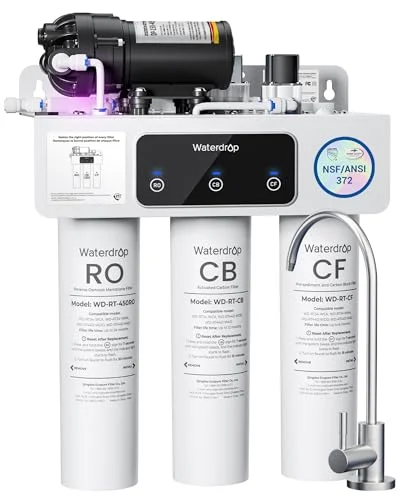
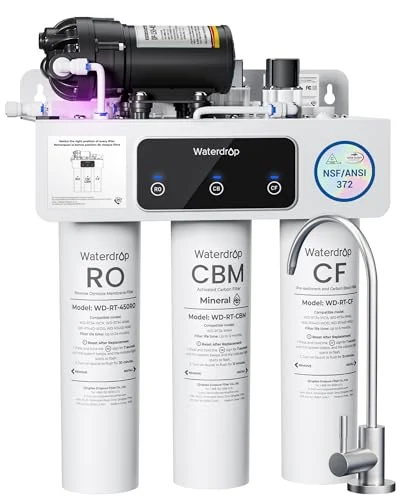
Search "Waterdrop T3" on Amazon and you land on three separate product pages that all open the same way: the same "T3" in the title, the same general under-sink reverse osmosis category, and three different suffix letters doing a lot of quiet work. The T3-T, the T3-C and the T3-M are not three unrelated systems, but they are not interchangeable either — each one is a distinct listing with its own ASIN, its own price and its own stated spec sheet, and the only way to know what you're actually buying is to read all three titles side by side rather than click the first one that shows up.

Here's the cluster, at the prices we recorded on October 22, 2026:

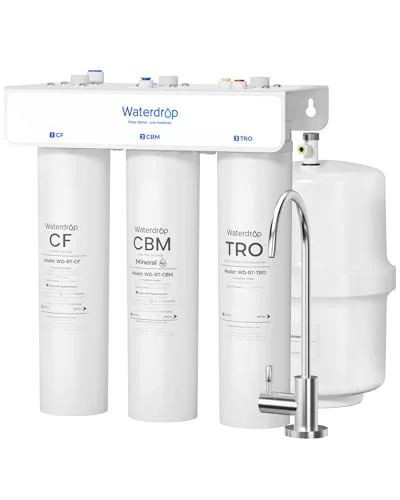
  • Waterdrop T3-T Remineralization Reverse Osmosis System, 220 GPD Faster Flow — $159.00. The cheapest of the three, and the only one rated at 220 GPD rather than 450.
  • Waterdrop T3-C RO Water Filtration System, Plug-in Required, 450 GPD — $179.00. Forty dollars more than the T3-T, with more than double the rated output — and the only listing of the three whose title flags a power requirement.
  • Waterdrop T3-M Remineralization Reverse Osmosis Water Filter, 450 GPD — $189.00. The most expensive listing, matching the T3-C's 450 GPD figure while also carrying the remineralization claim the T3-C's title doesn't make.

The closest pair, the T3-T and the T3-C, sits just over forty dollars apart. The widest gap in the line, between the T3-T and the T3-M, is a little over a hundred dollars. None of that spread is explained by the "T3" in the name — all three share it. It's explained by three specific lines in the titles: a GPD figure, a remineralization claim, and a single phrase about a plug. We'll take each one in turn, the same way we broke down iSpring's RCC7AK family and Waterdrop's own X16 listings — by comparing what each page actually states, rather than assuming the suffix letters tell the whole story.

The output number

450, 450 and 220 — what the GPD gap actually changes at the faucet

GPD stands for gallons per day, and it's a production-capacity rating, not a tap flow rate. It describes how much filtered water the membrane can produce across a full 24-hour cycle under the manufacturer's test conditions — feed pressure, temperature and the age of the membrane all move the real number — not how fast water comes out of the faucet when you turn the handle. That distinction matters here because it's the whole reason the T3-T's title can pair a lower GPD figure with the phrase "Faster Flow" without the two claims contradicting each other.

The T3-C and the T3-M both carry the higher 450 GPD rating. In practical terms, a higher daily production number means the system can refill a storage tank faster between draws and keeps up better with back-to-back demand — filling a kettle, then a pot, then a water bottle in quick succession — without the tank running dry and the tap slowing to the membrane's unassisted trickle. A kitchen that uses RO water for cooking as well as drinking, or a household larger than one or two people, is the profile that actually exercises a 450 GPD rating; a lot of single-person households never come close to taxing either figure in a given day.

The T3-T's 220 GPD rating is less than half that, which on its own reads like the weaker spec in the lineup. But its title doesn't stop at the number — it appends "Faster Flow," which is a separate claim about what happens at the moment you open the tap, not about the 24-hour total. Tankless under-sink systems generally deliver water on demand rather than drawing down a pressurized bladder tank, and a "faster flow" claim on a tankless-style listing typically points to the instantaneous delivery rate at the faucet being the design priority, independent of the daily capacity ceiling. We don't have a published gallons-per-minute figure for the T3-T to confirm exactly how that trades off against its lower GPD number, and we're not going to invent one — but the listing itself is telling you these are two different measurements, and reading "220 GPD" as simply "less good than 450 GPD" misses what the second half of the title is actually claiming.

What this means for a buyer: if your household runs the tap hard — multiple draws in a row, a family larger than two, an ice maker or coffee machine also pulling from the RO line — the 450 GPD figure on the T3-C and T3-M is the more conservative choice for not running the tank dry. If your use case is mostly filling a glass or a small pot a few times a day, the T3-T's lower daily number is less likely to matter, and its "faster flow" framing suggests Waterdrop designed it around exactly that kind of lighter, more frequent use rather than high-volume output.
What's added back

Remineralization: on two titles, missing from the third

"Remineralization" appears in two of the three T3 titles — the T3-T and the T3-M — and is absent from the T3-C's, which instead reads simply "RO Water Filtration System, Plug-in Required, 450 GPD." That's a real distinction stated plainly on the page, not a subtle one you'd need to dig for.

Remineralization is the stage that adds minerals — typically calcium and magnesium — back into the water after the membrane has stripped nearly everything dissolved out of it, including the minerals along with whatever contaminants you were filtering for. It doesn't change how thoroughly the system purifies the water; it changes what's in the water on the way out the other end, which affects taste for some people and is the reason "remineralized" and "alkaline" RO systems exist as a category alongside plain RO systems at all.

Because the T3-T and T3-M titles both state it and the T3-C's doesn't, the straightforward reading is that the T3-C ships without that stage while its two siblings include it. We'd stop short of calling that a certainty about internal hardware we haven't seen specs for beyond the title — if remineralization matters to your decision, confirm it on the current T3-C listing page before buying, the same caution worth applying to any spec a title doesn't explicitly claim. What we can say with confidence is that the listing itself gives you no reason to expect it, and a buyer choosing on price alone between the T3-C and T3-M should know that part of what the extra $70 on the T3-M may be paying for is a filtration stage the cheaper listing doesn't advertise having.

The one line item

"Plug-in Required": the single spec that actually separates the T3-C

Of the three titles, only the T3-C's states a power requirement outright: "Plug-in Required." Neither the T3-T's nor the T3-M's title makes that claim. That's the most consequential line in this entire comparison, because unlike GPD or remineralization — specs you can work around or live without — a missing electrical outlet under your sink is a hard stop on installing a system that needs one.

Under-sink cabinets are a mixed bag for power. Plenty of kitchens have a GFCI outlet back there already, often shared with a garbage disposal or dishwasher. Plenty of others have nothing — no outlet, no safe place to splice one in without an electrician, and a landlord who isn't going to authorize new wiring for a rental unit. The T3-C's title is doing you a favor by stating this plainly instead of burying it in the bullet points: before you add it to your cart, you need to know there's a reachable, code-compliant outlet in that cabinet, with enough cord length or a safe extension path to reach it.

What a plug-in requirement on a tankless or pump-assisted RO system is usually buying you, in general terms: an electric booster or permeate pump that helps push water through the membrane at a more consistent rate regardless of your home's incoming line pressure, rather than relying entirely on unassisted municipal pressure. That can mean steadier output in homes with marginal water pressure, at the cost of needing power to run it. We don't have a published pump spec for the T3-C beyond the title's "Plug-in Required" line, so we won't assign it a wattage or a pressure-boost figure we can't source — but the practical implication for your cabinet is the same regardless of the exact mechanism: measure for an outlet, not just for floor space, before this one goes on your shortlist.

The T3-T and T3-M listings simply don't make this claim, which is the basis for treating them as the no-outlet-friendly options in this lineup. That's a difference in what the page states, not a guarantee about every internal component — if a spare outlet genuinely isn't available in your cabinet, confirm the power requirements on the current T3-T or T3-M listing page before you buy, the same way you'd confirm any spec the title is silent on. Related reading if cabinet constraints are the deciding factor for you at all: our look at whether "compact" RO systems actually mean a smaller footprint covers the other half of the under-sink-fit question — space, not power.

Reading the letters

T3-C, T3-M, T3-T: letters don't rank the way numbers tempt you to assume

All three listings share "T3" as the line name, and it's worth being explicit about what that number is and isn't telling you. It identifies the product line or generation within Waterdrop's own catalog, the same way "G3" identifies a different line from "G2" on this site's homepage comparison — but a line name isn't a ranking of the specific listing you're looking at, and the letter suffix after it is doing the actual differentiating work, not the number in front of it.

Here, the suffixes -C, -M and -T don't form an obvious hierarchy the way, say, "T1" and "T2" would in SimPure's T1 vs. T2 tankless lineup, where the numeral itself signals a straightforward step up in GPD and features from one model to the next. Waterdrop's letters here read more like feature flags than generation markers: based on what each title states, -T pairs with the faster-flow framing at the lower GPD figure, -C pairs with the plug-in requirement at the plain 450 GPD spec, and -M pairs with the 450 GPD figure plus the remineralization claim. None of the three letters is the "newest" or inherently "best" version of the others; they're parallel variants built around different trade-offs, sold at the same time, at three different prices that track those trade-offs rather than tracking some underlying generational order.

This is the same pattern worth checking for on any brand's own tier naming, not just Waterdrop's: a shared base name (the "T3," the "RCC7AK," the "X16") tells you these listings belong to a family. It does not tell you that a letter or number appended to that base name is better simply because it comes later in the alphabet, is numerically higher, or costs more. The way to actually rank them is the way we just did above — line up what each title states (GPD, remineralization, power requirement) and compare those specific claims, not the suffix itself. If what you actually care about is getting the exact model your kitchen needs rather than a plausible-sounding sibling, that same discipline — matching the precise listing to your actual requirement rather than assuming a naming pattern — is the whole subject of our guide to buying replacement filters by exact model number instead of by brand.

Side by side

The three T3 listings, lined up

What we could confirm from each listing's own title and recorded price, as of October 22, 2026.

ListingPriceGPDRemineralizationPower requirement
T3-T$159.00220 GPD, faster flowStated in titleNot stated — check listingView
T3-C$179.00450 GPDNot stated in titlePlug-in requiredView
T3-M$189.00450 GPDStated in titleNot stated — check listingView

The "win" row above marks the T3-C only in the sense that it's the cheapest route to the line's higher 450 GPD rating — not an overall verdict, since it's also the one listing that requires an outlet and the one that doesn't claim remineralization. Every other cell is a difference the listing itself states, not something we inferred.

What we'd buy

Two different buyers, two different picks

Since the three listings trade off on different axes rather than ranking cleanly, the right pick depends on which constraint actually binds for you.

01No spare outlet

Waterdrop T3-M

The 450 GPD figure without the stated power requirement
450 GPD · remineralization stated · no plug-in claim on the title

If your under-sink cabinet has no outlet and no realistic path to adding one, the T3-C is off the table regardless of its price, since its title states the requirement outright. The T3-M matches the T3-C's 450 GPD figure, adds the remineralization stage the T3-C's title doesn't claim, and doesn't carry a stated plug-in requirement of its own — making it the listing in this line built for a cabinet with no spare outlet, at the cost of being the most expensive of the three. If 450 GPD isn't necessary for your household and the premium matters more than the output, the T3-T is the cheaper no-outlet-leaning alternative at 220 GPD, provided you confirm its own power requirements on the current listing first.

Waterdrop T3-M remineralization reverse osmosis water filter
$189.00
450 GPDCheck price →
02Raw speed, cheaper

Waterdrop T3-C

The same 450 GPD as the T3-M, for $70 less
450 GPD · plug-in required · no remineralization claim

If there's already a usable outlet under your sink, the T3-C gets you the line's higher 450 GPD output for $70 less than the T3-M and $40 more than the T3-T's lower-output listing. You're trading away the remineralization stage the T3-M's title claims, and you're committing to needing that outlet — but for a buyer whose cabinet already has power and who wants the fastest refill capacity in the line at the lowest price that gets you there, the T3-C is the straightforward value pick. Pair it with a standalone remineralization cartridge later if mineral taste turns out to matter to you; that's a smaller, separate purchase rather than a reason to pay the T3-M's full premium upfront.

Waterdrop T3-C RO water filtration system, plug-in required
$179.00
450 GPD · plug-inCheck price →

What we wouldn't do is pick between the T3-C and T3-M on price alone without checking which one needs power, or assume the T3-T's lower GPD number makes it the weakest listing when its own title is making a specific, different claim about flow. All three are defensible purchases for the right kitchen — the mistake is buying the letter without reading what it's attached to.

FAQ

Questions people ask about the T3 line

Are the Waterdrop T3-C, T3-M and T3-T the same reverse osmosis system?

They share the "T3" line name but are three distinct listings with different stated specs. The T3-T and T3-M titles both claim remineralization and the T3-C's doesn't; the T3-C and T3-M are both rated 450 GPD against the T3-T's 220 GPD; and only the T3-C's title states a plug-in power requirement. Treat them as related variants built around different trade-offs, not interchangeable listings of one product.

Does the T3-T's lower 220 GPD rating mean slower water at the faucet?

Not necessarily. GPD measures 24-hour production capacity, not the flow rate at the tap. The T3-T's title pairs its 220 GPD figure with "Faster Flow," a separate claim about delivery speed at the moment you open the tap rather than the daily total. The 450 GPD rating on the T3-C and T3-M matters more for keeping up with repeated back-to-back draws across a full day than for how quickly a single glass fills.

What does "Plug-in Required" on the T3-C listing actually mean for installation?

It means the system needs a reachable, code-compliant electrical outlet inside or near the under-sink cabinet to operate — most likely to run an electric pump that assists filtration. Confirm there's an outlet within cord reach before buying. The T3-T and T3-M listings don't state this requirement, which is the basis for treating them as the options for a cabinet with no spare power.

Which T3 model should I buy if I don't have a spare outlet under my sink?

Based on what each title states, the T3-M and T3-T are the candidates, since neither claims a plug-in requirement the way the T3-C does. The T3-M keeps the line's higher 450 GPD output and adds remineralization at the highest price of the three; the T3-T is the cheaper, lower-GPD alternative. Confirm power requirements on the current listing for whichever you choose, since a title's silence on a spec isn't the same as a guarantee.

Keep reading

Next, if you're still deciding