Frizzlife lists its 800 GPD and 1000 GPD systems twice: what's actually different
We're reader-supported: buying through our links may earn us a commission at no extra cost to you. We compare published listing titles, specifications and prices — we don't run a testing lab, and nothing below is a star rating or a paraphrased review.
Search "Frizzlife 800 GPD" on Amazon and you don't land on one listing — you land on two. Search "Frizzlife 1000 GPD" and the same thing happens again. Each rated capacity has a model ending in -N and a second model ending in -TAM4, both from Frizzlife, both tankless alkaline systems, both priced identically within their capacity pair. The detail that actually changes between each pair's two titles is the string of numbers after "NSF/ANSI": one listing in each pair names four standards, the other names fewer, and nothing on either page explains why.
Here are the four listings, at the prices we could confirm:
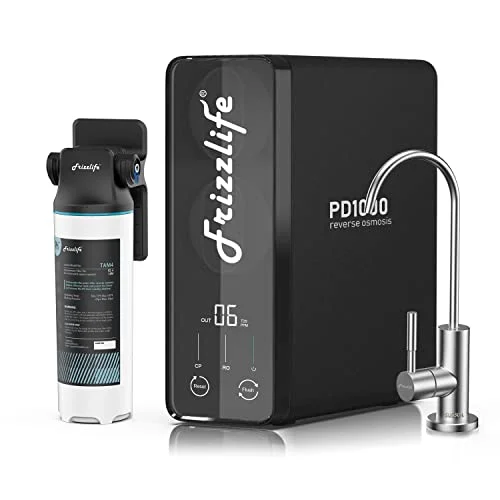
- Frizzlife PD800-N — $484.49. Title states "NSF/ANSI 58&42&372 Standard," 9-stage, tankless, 2:1 pure-to-drain, alkaline mineral pH+, smart faucet.
- Frizzlife PD800-TAM4 — $484.49 (recorded October 8, 2026). Title states "NSF/ANSI 58&53&42&372 Standard," 9-stage, tankless, 2:1 pure-to-drain, alkaline mineral pH+.
- Frizzlife PD1000-N — $569.99. Title states "NSF/ANSI 58&372 Standard," 9-stage, tankless, 2:1 pure-to-drain, alkaline mineral pH+, smart faucet.
- Frizzlife PD1000-TAM4 — $569.99 (recorded October 8, 2026). Title states "NSF/ANSI 58&53&42&372 Standard," 9-stage, tankless, 2:1 pure-to-drain, alkaline mineral pH+.
Line the two 800 GPD titles up and the certification gap is one standard: the TAM4 listing names 58, 53, 42 and 372; the N listing names 58, 42 and 372, with 53 missing. Line the two 1000 GPD titles up and the gap is wider: the TAM4 listing again names all four, but the N listing names only 58 and 372 — both 53 and 42 are missing from that title. That's not a small inconsistency to shrug off, and it's not obviously a hardware downgrade either. Before deciding which it is, it's worth working through what each of those four numbers actually certifies, which is exactly what the titles don't explain and most shoppers never look up.
Why one manufacturer ends up with two listings for the same capacity
This is the same structural pattern we've documented with iSpring's RCC7AK family and Waterdrop's X16: Amazon's catalog doesn't force a manufacturer onto one listing per product. A separate ASIN is cheap to create and carries its own price history, its own search ranking and its own review pool, independent of any sibling listing selling what is functionally the same hardware. Brands with a wide SKU lineup — and Frizzlife's own catalog runs to a dozen-plus RO models — end up with duplicates for all sorts of mundane reasons: a model refresh that kept the old ASIN live alongside the new one, a different reseller account listing the same hardware under its own suffix, or a certification re-test that got folded into a new listing instead of updating the old one in place.
The model suffixes here are a reasonable clue, even though neither title explains itself. "-N" reads like a newer or simplified designation, and both -N listings share a feature the -TAM4 titles don't mention at all: "Smart Faucet." "-TAM4" reads like an internal SKU code rather than anything consumer-facing, and both -TAM4 titles carry the fuller four-standard certification line. That pattern — one suffix pairing a named feature with a shorter cert list, the other pairing no named feature with a longer cert list — is consistent with two listings for the same underlying platform created at different points or through different channels, rather than two genuinely different systems. It's a plausible read of what's in front of us, not something either listing states outright, so we're treating it as a working explanation and not a confirmed fact.
What matters more than the why is the what: does a shorter certification line in a title mean the system itself filters less? That's the question worth answering carefully rather than guessing at.
The NSF callout in each title, and what's missing
Four numbers, four different things certified. Here's what each one actually covers.
NSF/ANSI 58 — reverse osmosis treatment systems. This is the standard that governs whether an RO system actually does what the category name promises: reduce total dissolved solids and, depending on what the manufacturer submits for testing, specific contaminants beyond TDS. All four Frizzlife listings state NSF/ANSI 58 in their title. That's the one number every listing in this comparison agrees on, and it's the standard that matters most for the system's core job.
NSF/ANSI 372 — lead content. This certifies that wetted surfaces and components meet lead-free material requirements. It says nothing about what the system removes from water; it's a materials-compliance standard, not a performance one. All four listings state 372 as well, so on materials compliance, as stated, the four listings agree too.
NSF/ANSI 42 — aesthetic effects. This standard covers reduction of chlorine taste and odor, and particulate — the things that affect how water tastes and looks rather than health-related contaminants. The PD800-N and both TAM4 listings state 42. The PD1000-N listing does not.
NSF/ANSI 53 — health effects. This is the standard tied to specific health-related contaminant reduction — the kind of claim that requires testing against named substances rather than a general aesthetic improvement. Of the four listings, only the two TAM4 titles state 53. Neither N listing does.
Put the four side by side on this one axis and the pattern is: both TAM4 titles claim all four standards. The PD800-N title is missing just 53. The PD1000-N title is missing both 53 and 42 — a wider gap than its 800 GPD counterpart, even though the two N-suffix listings otherwise read as the same tier of product at two different capacities. That asymmetry is worth sitting with for a second: if this were purely a title-writing shortcut applied consistently, you'd expect the same standard or standards to go missing at both capacities. Instead, the 1000 GPD "N" listing is missing one certification the 800 GPD "N" listing actually states. We don't have a way to confirm from the titles alone whether that's a genuine difference in what was tested for the 1000 GPD "N" unit specifically, or an inconsistency in how the two titles were written. For more on how certification wording gaps like this tend to play out across a product family, see our breakdown of which RO testing claims have real evidence behind them.
Comparing the spec sheets for an actual hardware difference
Certification wording is the headline difference, but it isn't the only line in these four titles, and the others are worth checking precisely because they're the harder numbers for a seller to misstate. Here's what's identical across all four listings, stated plainly in each title: 9-stage filtration, tankless design, a 2:1 pure-to-drain ratio, and an alkaline mineral pH+ remineralization stage. None of the four titles states a different stage count or a different drain ratio for its own capacity tier. That matters because stage count and drain ratio are exactly the kind of spec that's easy to catch if a seller quietly downgraded a unit — and across all four listings, both numbers hold steady.
The one feature that genuinely splits along the same N/TAM4 line as the certification wording is the faucet. Both -N titles state "Smart Faucet" explicitly. Neither -TAM4 title mentions a faucet type at all. We've seen this exact shape of difference before — a named feature on one listing, silence on a sibling listing — in the iSpring RCC7AK comparison, where a stated faucet finish was the one real, visible difference between otherwise identical systems. Here, "Smart Faucet" typically means a display that shows filter life or TDS at the tap, a feature some Frizzlife listings call out and others simply don't put in the title even when a system ships with one. We can't confirm from the title alone whether the TAM4 units ship without that display or simply don't name it — that's a case where the listing's own photos and bullet points, not this comparison, are the place to check before you buy.
So the honest accounting is: stage count, drain ratio and the alkaline stage are stated identically across all four listings at their respective capacities. The certification callout and the faucet-naming both vary along the same N/TAM4 split. That's a narrower, more specific pattern than "these might be different systems" — it looks like the same two hardware platforms (800 GPD and 1000 GPD), each listed twice with different title-writing choices about which features and certifications to spell out.
Price and apparent review-count differences
On price, there's no gap to arbitrage here, unlike the iSpring family we compared where three listings for one system spread by nearly $75. Both 800 GPD listings price at $484.49; both 1000 GPD listings price at $569.99. At the prices we could confirm, picking the "cheaper" listing in either pair isn't a real option, because there isn't one. That equality is a snapshot rather than a guarantee — Amazon prices move per ASIN on independent schedules, so it's worth checking both current prices in a pair before buying rather than assuming they'll stay matched indefinitely.
Review counts are a different story structurally, even though we're not going to put a number on either listing here — this site doesn't publish star ratings or review counts for any product, because we don't have verified figures we trust enough to print. What we can say, as a mechanism rather than a specific figure, is the same thing we've flagged with every duplicate-listing comparison on this site: Amazon reviews attach to the ASIN a buyer actually purchased, not to the underlying product. When the same hardware sells under two separate listings, as it appears to here, each listing accumulates its own independent review history. A buyer who bought the -N version and leaves feedback about the smart faucet display has that feedback locked to the -N ASIN; it never surfaces on the -TAM4 listing's page, even though it has nothing to do with the certification wording that's the visible difference between them.
The practical consequence is that whichever of the two listings in a pair looks "newer" or "thinner" on its page is very likely just the one fewer shoppers have landed on and bought from directly — not evidence that fewer people actually own that specific hardware, and not evidence about reliability either way. We walked through this same mechanism in more depth in our look at Amazon Renewed listings, where a listing's visible review history and a system's real-world track record can diverge for reasons that have nothing to do with the hardware itself.
What to check before assuming fewer standards means less filtration
A shorter NSF callout in a title is not, by itself, proof of a weaker system. Certification against a given NSF/ANSI standard is voluntary and per-SKU: a manufacturer pays to have a specific unit tested against a specific standard, and that testing has to be renewed and re-submitted as models change. It's entirely possible for two units built on the same hardware platform to carry different certification claims simply because one SKU was put through a particular test cycle and the other wasn't — with no corresponding change to what's actually inside the housing. It's also possible, separately, that a shorter list genuinely reflects a simplified build. The title alone can't tell you which.
Here's what we'd actually check before assuming either direction:
- Open the listing's images and documents, not just the title. NSF certification marks and the specific contaminants tested are frequently shown in a product image or a linked certificate that the title doesn't repeat. A standard missing from the title isn't the same as a standard the unit was never tested against.
- Compare the stated stage count and drain ratio first, as we did above. Those are the harder numbers to misstate without it reading as an obvious, checkable discrepancy. When they match across listings, as they do here, that's a stronger signal of shared hardware than the certification wording is a signal of a real split.
- Treat a missing standard as a question for Frizzlife's current listing, not a settled fact. If NSF/ANSI 42 or 53 certification specifically matters to your decision — say, you're weighing taste-and-odor performance or a named health-effect contaminant — confirm the current listing states it, rather than assuming either the presence or the absence carries over from what we recorded here. Amazon listings get edited after publication, including their certification wording.
- Don't assume the missing standards mean the membrane itself is different. NSF/ANSI 58 — the standard that actually governs RO performance against dissolved solids — is stated identically across all four listings. The standards that differ, 42 and 53, relate to aesthetic and specific health-effect claims layered on top of the core RO performance, not a different reverse-osmosis membrane.
None of this requires special tools — it's reading past the title to the parts of the listing most shoppers skip, which is exactly where the actual answer usually lives.
The four listings, lined up
What each listing states for itself. Prices as recorded; the TAM4 dates reflect when we confirmed them.
| Listing | Price | NSF/ANSI stated | Faucet named | Stage / drain | |
|---|---|---|---|---|---|
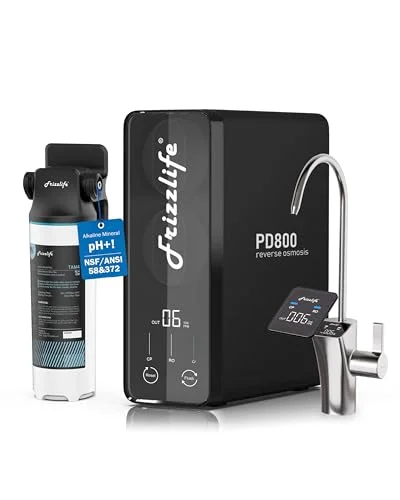 PD800-N | $484.49 | 58 & 42 & 372 | Smart Faucet | 9-stage · 2:1 | View |
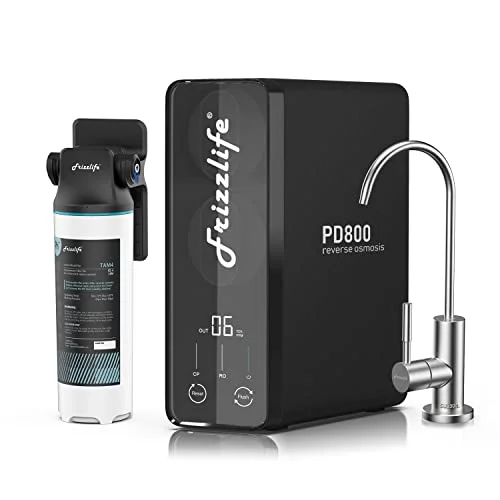 PD800-TAM4 | $484.48 | 58 & 53 & 42 & 372 | Not named | 9-stage · 2:1 | View |
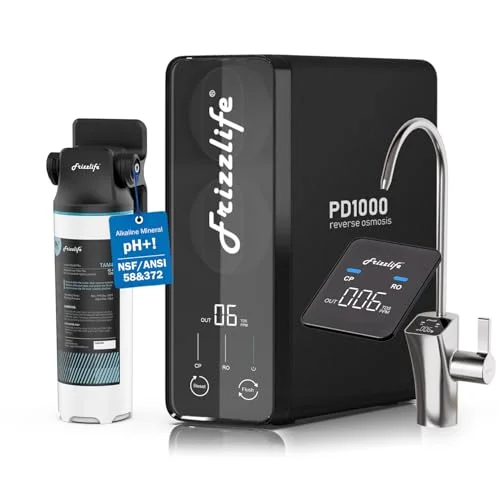 PD1000-N | $569.99 | 58 & 372 | Smart Faucet | 9-stage · 2:1 | View |
 PD1000-TAM4 | $569.98 | 58 & 53 & 42 & 372 | Not named | 9-stage · 2:1 | View |
Every row shares the same 9-stage, 2:1 pure-to-drain, alkaline mineral pH+ claims within its capacity tier — that's the basis for treating each pair as one platform listed twice rather than two unrelated systems. The certification column and the faucet-naming column are the only places the titles themselves diverge, and they diverge along the same N/TAM4 line in both pairs.
Which listing to buy when both are genuinely the same system
With price equal inside each pair, the decision comes down to two things the titles actually tell you: how much the certification wording matters to you, and whether you want a faucet with a display named in the listing. If NSF/ANSI 53 or 42 certification is something you specifically want documented in the title rather than tracked down in listing photos, the TAM4 listing is the straightforward choice at either capacity — it's the one that states all four standards up front, at the same price as its sibling. That's the lower-friction pick if certification paperwork is part of your decision, since you're not paying anything extra to get the fuller stated callout.
If having a named "Smart Faucet" in the title matters to you — and a filter-life or TDS display at the tap is a real, usable feature, not a marketing flourish — the N listing is the one that states it, at the identical price. We'd lean toward verifying the TAM4 listing's actual faucet via its photos before ruling it out on that basis, since "not named in the title" isn't the same as "doesn't have one," and it's entirely possible the TAM4 ships with a comparable faucet that its title simply doesn't call out.
What we wouldn't do is pick the N listing over the TAM4 because the TAM4's four-standard title "sounds more certified," or pick the TAM4 over the N assuming the smart faucet is missing just because its title doesn't say so. In both cases the honest move is the same one we recommend throughout this comparison: open the current listing, check the photos and the full description for the specific detail that matters to you, and buy based on what you can actually confirm rather than what either title implies by omission.
Reading the fine print that reveals shared hardware
Frizzlife's N/TAM4 split is a clean example of a pattern worth having a short checklist for, since duplicate listings show up constantly across appliance categories, not just reverse osmosis systems:
- Compare the hardest-to-fake number first. Here that's stage count and drain ratio — both stated identically across all four listings. If those match, you're very likely looking at the same underlying platform.
- Notice when certification wording differs between near-identical listings. A title naming four standards next to a near-identical sibling naming two or three is common and not automatically a red flag, but it's exactly the kind of gap worth clicking through to confirm — see our broader look at how stage counts get compared honestly across RO systems generally.
- Check whether a named feature and a certification gap move together. When they do, as with the Smart Faucet naming and the shorter NSF list both landing on the same N-suffix listings here, that's a signal the two listings were simply written at different times or by different hands, not necessarily that the hardware diverged.
- Price parity across a pair is information, too. When two listings for the same tier price identically, as these do, that tells you the split is more likely a cataloging artifact than a deliberate good/better tiering — a real tiering strategy usually shows up as a price gap, the way it did across the iSpring RCC7AK family.
None of this requires special tools — it's reading the same titles everyone else scrolls past, slightly more carefully.
Questions people ask about these listings
Are the Frizzlife PD800-N and PD800-TAM4 the same system?
Based on what each title states, they appear to be the same underlying 800 GPD platform: both state 9-stage filtration, tankless design, a 2:1 pure-to-drain ratio and an alkaline mineral pH+ stage at the same $484.49 price. The stated differences are the certification callout — the TAM4 names NSF/ANSI 58, 53, 42 and 372, while the N names 58, 42 and 372 — and the faucet, which the N listing calls a "Smart Faucet" and the TAM4 listing doesn't name at all.
Does the missing NSF/ANSI 53 on the N listings mean they filter less?
Not necessarily. NSF/ANSI 53 certifies specific health-effect contaminant reduction, and certification against it is voluntary and tested per SKU — a listing can omit it because that specific unit wasn't put through that test cycle, not because the membrane itself is weaker. The standard both N and TAM4 listings agree on, NSF/ANSI 58, is the one that actually governs core reverse-osmosis performance. If NSF/ANSI 53 specifically matters to you, confirm it on the current listing's images or documents rather than assuming the title's omission settles the question.
Why is the PD1000-N missing two standards while the PD800-N is only missing one?
We can't confirm the reason from the titles alone. Both N-suffix listings share the "Smart Faucet" naming and both omit NSF/ANSI 53, but the PD1000-N title also omits NSF/ANSI 42, which the PD800-N title does state. That asymmetry could reflect a genuine difference in what was tested for the 1000 GPD "N" unit specifically, or simply inconsistent title-writing between the two listings — the titles themselves don't say which, so we're not going to guess.
Which Frizzlife listing should I actually buy?
Since both listings in each capacity pair price identically, pick based on what you actually want documented: the TAM4 listing if you want the fuller four-standard NSF callout stated up front, or the N listing if you want "Smart Faucet" named explicitly in the title. Either way, check the current listing's photos for the detail that matters most to you before buying, since a title's silence on a feature or standard isn't proof it's absent.