SimPure's T1 vs. T2 tankless RO systems: what the jump from 400 to 600 GPD and UV buys
We're reader-supported: buying through our links may earn us a commission at no extra cost to you. We compare published listing specifications, prices and general product-class facts — we don't run a testing lab, and nothing below is a star rating or a paraphrased review.
Shop SimPure's tankless under-sink lineup and you land on two listings that, on price alone, barely look like a choice at all. The T1-400ALK runs $256.49 (recorded October 9, 2026). The T2-600A runs $234.16 (recorded October 20, 2026). That's a $1.60 spread — closer than a rounding error on most grocery runs — for two systems whose names advertise genuinely different hardware: 400 gallons per day (GPD) on one, 600 GPD on the other, and a UV stage that only one of the two names carries.
That's an unusual pricing shape. Most of the brand-family comparisons we've run on this site — iSpring's RCC7AK listings, Waterdrop's X16 faucet-finish variants — involve near-identical hardware at different prices. SimPure's T1 and T2 are closer to the opposite case: near-identical prices for hardware that isn't identical at all. The honest question isn't "why does one cost more," because almost nothing here does. It's "what, specifically, do you get for that extra $1.60," and separately, whether either tankless model is actually the SimPure product you want once you put the brand's own countertop UV unit on the table next to them.
Both model names tell you most of what their listings state outright. "T1-400ALK" reads as tankless, 400 GPD, alkaline. "T2-600A" reads as tankless, 600 GPD, and — per its full listing title — UV. Neither name mentions a stage count or a named certification standard, which matters later in this comparison. What follows works through the GPD jump, the UV stage, how both stack up against SimPure's own countertop unit, and which one actually fits a typical kitchen.
What 600 GPD actually buys over 400 GPD
GPD — gallons per day — is the industry's standard way of stating an RO system's rated production capacity, and it's worth being precise about what that number does and doesn't promise before comparing 400 against 600. Across this product category, a GPD figure is a manufacturer's rated output under a fixed set of lab conditions — typically a specified incoming water pressure and temperature — not a guarantee of how fast water will come out of your particular faucet on your particular supply line. Lower incoming pressure, colder water or a higher-TDS feed all pull real-world output below the number on the box, for any system at any GPD rating. That caveat applies equally to the T1 and the T2; neither listing states the pressure or temperature its number was measured at, so treat 400 and 600 as directional, not as a flow-rate promise.
With that caveat in place, what the extra 200 GPD is actually for is capacity under sustained or simultaneous demand, not the speed of filling a single glass. A household that uses its RO tap for drinking and cooking water — a few gallons a day, spread across several short draws — is nowhere near either system's rated ceiling, and will not notice a practical difference between 400 and 600 GPD in day-to-day use. The gap shows up when demand bunches up: filling a large stockpot in one continuous draw, running the RO line into both a kitchen faucet and a refrigerator or ice-maker line at once, or a bigger household pulling water from the system several times in the same half hour. Tankless systems make water on demand rather than drawing down a stored reserve, so a higher-rated unit is the one with more headroom before output tapers under that kind of sustained pull. That's also the framing we used when a different brand doubled its own rated GPD across listings in our look at Frizzlife's 800 GPD and 1000 GPD systems — the number on the box describes a capacity ceiling, and whether you ever reach it depends entirely on how the household actually uses the tap.
What 600 GPD does not buy is a faster first glass of water. Tankless systems deliver essentially the same near-instant start at the faucet regardless of their daily rating; GPD measures total throughput capacity, not response time. If your household's heaviest single RO draw is a one-liter kettle fill or a coffee maker reservoir, 400 GPD already has more ceiling than you'll use, and the T1 is doing the identical everyday job the T2 is, at a $1.60 discount.
Why the T2 adds UV and the T1 doesn't
The T2-600A's listing title carries "UV"; the T1-400ALK's does not. That's the one filtration-architecture difference between the two tankless models that's actually stated plainly, rather than something we're inferring from a price gap or a model suffix.
A UV (ultraviolet) stage works on a different principle than everything upstream of it in an RO system. The membrane and carbon stages remove contaminants physically — by pore size and adsorption. A UV stage instead runs water past a UV-C lamp that disrupts the DNA of bacteria and viruses that make it that far, neutralizing their ability to reproduce without filtering them out as physical matter. It's a disinfection step layered on top of filtration, not a replacement for it, and it's most commonly marketed as an added margin of safety rather than as the system's primary contaminant-removal mechanism — the RO membrane's pore size is already fine enough to exclude the great majority of bacteria and many viruses by size alone, which is why UV in this category is typically framed as "additional protection" rather than "essential."
Where that margin matters more is water sources with less certainty behind them: private wells, water with a history of boil notices, or any supply that hasn't gone through municipal treatment and monitoring. Where it matters less is a home on a consistently treated, chlorinated municipal supply, where the water reaching the RO system has already been through a utility's own disinfection process before the membrane and UV stage ever see it. Neither the T1 nor the T2 listing states a target use case this explicitly — this is general information about what a UV stage does and where it tends to matter, not a SimPure-specific claim — but it's the right lens for deciding whether the T2's UV stage is solving a problem you actually have.
What the UV stage changes in practice, day to day: nothing visible at the faucet. It doesn't change taste, doesn't change flow, and doesn't show up as a feature you interact with — it's a passive stage that runs continuously in the background. The case for paying for it is entirely about what it's insuring against, not what it improves about water you were already going to drink.
Checked against SimPure's own countertop UV unit
SimPure doesn't only sell UV in the tankless, under-sink format. The Y7P-BW — full listing name "SimPure Y7P-BW UV Countertop Reverse Osmosis Water Filter, 5 Stage RO" — is a $254.99 (recorded October 10, 2026) countertop unit that puts the same basic logic — RO membrane filtration plus a UV disinfection stage — into a format that needs no drilling, no drain saddle and no permanent plumbing connection at all.
Put all three SimPure prices next to each other and the pattern is hard to miss: $254.99 for the countertop Y7P-BW, $256.49 for the tankless T1-400ALK, $234.16 for the tankless T2-600A. All three sit within $3.10 of one another, regardless of GPD rating, regardless of install format, and regardless of whether UV is included. That's the same lesson we kept running into in iSpring's RCC7AK family and Waterdrop's X16 listings: price on a single Amazon listing tracks that ASIN's own position in the catalog — how new it is, how it's being promoted, what else in the brand's lineup it's competing against — at least as much as it tracks what's physically different inside the box. A $3 spread across a countertop unit and two structurally different tankless systems is not evidence that format and GPD don't matter; it's evidence that SimPure isn't pricing this cluster primarily on those two variables.
The genuine trade-off between the Y7P-BW and either tankless model is the one the price tag hides: installation and supply model. A countertop unit sits on the counter, draws from a reservoir you fill by hand or (on some countertop designs) a diverter that taps the existing faucet, and needs no modification to your plumbing — which makes it the only one of the three that works in a rental, a kitchen with no spare faucet hole, or a home where you don't want to commit to a permanent under-sink install. What you give up is the always-on supply: a tankless under-sink system delivers RO water on demand for as long as the line is connected, where a countertop unit is limited by reservoir size and needs refilling. If UV matters to you specifically and you don't want to install anything, the Y7P-BW's 5-stage, UV-equipped countertop format gets you the same disinfection logic as the T2-600A without a feed-valve connection. If you want that supply permanently plumbed in and don't want to refill a reservoir, the choice narrows back down to the T1 and T2.
Certification and stage count: the honest gap
Here's where this comparison has to stop short of a claim the listings themselves don't make. The Y7P-BW's own title states a stage count directly: "5 Stage RO." Neither the T1-400ALK's nor the T2-600A's listing title states a stage count at all, and neither names a certification standard — no NSF/ANSI number, no WQA mark, nothing we can point to and repeat as a verified fact about either tankless model.
That's not the same as saying the T1 and T2 lack certification or run fewer stages — a listing title leaving a spec out is common and doesn't by itself mean the spec is absent, as we've noted when the same gap showed up in other brands' listings. It does mean we're not going to assign either tankless model a stage count or a certification claim we can't source from their own pages, the way we'd flag the same gap for any brand. If stage count or a specific certification standard (NSF/ANSI 58, for contaminant-reduction performance, versus NSF/ANSI 372, for lead-free materials only — the distinction that matters most in this category, and one we go through in more depth in our explainer on why more stages isn't automatically better) is a deciding factor for you, that's a question for the current T1 or T2 listing page and its product images, not something either model name answers on its own.
What we can compare cleanly, because all three listings state it plainly, is GPD, UV inclusion, and price — which is exactly the side-by-side below.
All three SimPure listings, lined up
What each listing's own title states, at the prices we recorded.
| Model | Format | Output | UV | Stage count as stated | Price | |
|---|---|---|---|---|---|---|
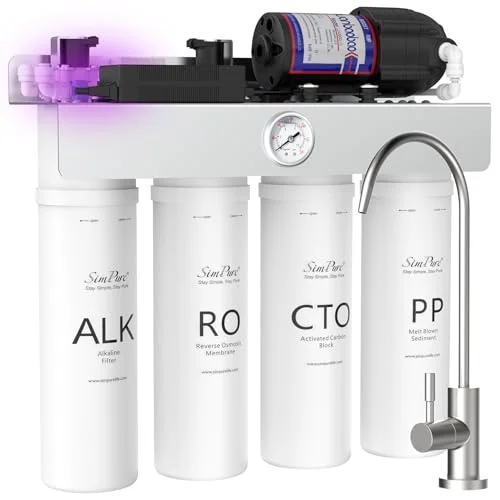 T1-400ALK | Tankless · under-sink | 400 GPD | Not stated in title | Not stated in title | $256.49 | View |
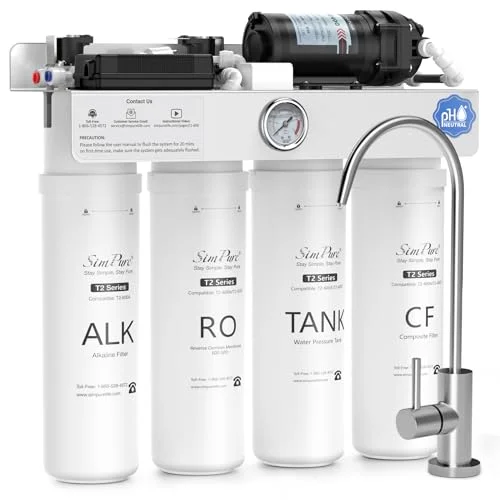 T2-600A | Tankless · under-sink | 600 GPD | Yes, per title | Not stated in title | $234.16 | View |
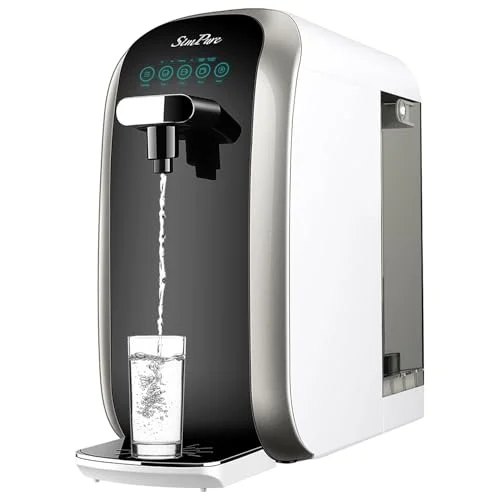 Y7P-BW | Countertop · no install | Not stated as GPD | Yes, per title | 5 Stage RO, per title | $254.99 | View |
The T1-400ALK also publishes a footprint in its listing — 15.6" × 5.3" × 15.7" — which is worth checking against your own cabinet before buying regardless of which model you lean toward; the T2-600A and Y7P-BW listings we recorded don't state a size figure, so measure the actual listing photos and dimensions rather than assuming either matches the T1's footprint. Cabinet depth is the single most common reason a tankless system gets returned, which is the whole subject of our piece on what "compact" actually means for tankless RO systems.
Which one to buy, and when the extra GPD goes unused
At a $1.60 price difference, this isn't really a budget decision — it's a question of which stated feature you actually need. Two straightforward cases cover most households.
Buy the T2-600A if either the UV stage or the higher throughput ceiling answers a real concern you have: a less-certain water source, a household that draws RO water from more than one fixture, or simply wanting the extra margin and being unwilling to pay more than $1.60 for it, which is exactly what SimPure is charging here. There's no financial reason to default to the T1 once the gap is this small — the T2 is the more capable listing for essentially the same money, on every spec both titles actually state.
Buy the T1-400ALK only if you've specifically confirmed, on the current listing, that it has a feature the T2 page doesn't — a different stage count, a certification the T2 doesn't claim, or a footprint that fits your cabinet better than the T2's unstated dimensions. Absent one of those confirmed differences, choosing the T1 over the T2 at this price gap is choosing to pay almost the same amount for less stated capability.
The case where the extra GPD specifically goes unused is the one worth naming directly: a one- or two-person household drinking and cooking with RO water from a single faucet, with no ice maker or second fixture on the line, is using a small fraction of either system's rated 400 or 600 GPD ceiling on an average day. For that household, the GPD number is not the deciding spec at all — UV, certification, and whichever system's measured dimensions clear the cabinet are. And for anyone not ready to commit to a permanent install in the first place, the Y7P-BW's countertop format delivers the same UV-plus-filtration logic at $254.99, with no plumbing decision to make at all — which, for a renter or a first-time RO buyer, can be the more useful comparison than T1 versus T2 to begin with.
Questions people ask about the T1 and T2
Is the SimPure T2-600A's extra 200 GPD worth the $1.60 price difference over the T1-400ALK?
On price alone, yes — $1.60 is a negligible premium for a higher-rated system. Whether the extra GPD itself matters depends on your household: GPD measures total daily production capacity under lab test conditions, not faucet speed, so a one- or two-person household drinking and cooking with RO water from a single tap is unlikely to approach either system's ceiling. The GPD gap matters more for larger households or multiple fixtures drawing from the same line.
What does the T2-600A's UV stage actually do that the T1-400ALK's filtration doesn't?
UV disinfection neutralizes bacteria and viruses by disrupting their DNA as water passes a UV-C lamp, layered on top of the membrane and carbon filtration both systems share. It's a disinfection step, not a replacement for physical filtration — the RO membrane already excludes most bacteria and many viruses by pore size. UV is most commonly valuable as added insurance on well water or less-certain supplies, and matters less on a consistently treated municipal supply.
Should I buy the SimPure Y7P-BW countertop unit instead of either tankless model?
If you want UV disinfection and 5-stage RO filtration without any plumbing modification — useful for renters or kitchens with no spare faucet hole — the Y7P-BW at $254.99 delivers the same UV-plus-filtration logic as the T2-600A in a no-install countertop format. The trade-off is supply: a countertop unit is limited by its reservoir and needs manual refilling, where either tankless model delivers RO water on demand for as long as it's plumbed in.
Do the T1-400ALK and T2-600A list the same certification and stage count?
Neither listing's title states a stage count or names a specific certification standard, so we can't confirm whether they match or differ on either point from the titles alone. That's unlike SimPure's own Y7P-BW countertop listing, which states "5 Stage RO" directly. If stage count or certification (NSF/ANSI 58 versus 372, for example) decides your purchase, check the current T1 or T2 listing page and its images rather than assuming parity between the two.