Amazon Renewed reverse osmosis systems: is the discount worth the risk?
We're reader-supported: buying through our links may earn us a commission at no extra cost to you. We compare published specifications, certifications and prices — we don't run a testing lab.
A "Renewed" badge on a reverse osmosis listing is doing a specific job: it is telling you this exact unit has been returned, used, or kept as excess inventory, and that it has gone through a process before coming back up for sale. What it is not telling you, on first glance, is who ran that process, how thorough it was, or whether a water filtration system is even the kind of product that process was designed for. It usually isn't — Amazon's Renewed program was built around phones, laptops and small appliances, and a tankless RO system under a cabinet is a different animal: wetted parts, a pressurized membrane, and a filter schedule that started the moment the first owner installed it, not the moment you clicked buy.
That gap between what the badge promises and what actually applies to a water system is the whole subject of this page. We're not going to tell you Renewed is a trap or a free lunch — it's neither, consistently. It's a program with real rules, applied by a seller you mostly can't see, to a product category the rules weren't written for. Buying a used reverse osmosis system off a classifieds listing and buying a Renewed one off Amazon share a lot of the same risk — a stranger's history with the unit — but Renewed adds Amazon's return policy on top, and that's worth pricing separately from the discount itself.
What "Amazon Renewed" actually means for a product like this
Amazon Renewed is a certification program, not a single warehouse. A listing qualifies as Renewed when a seller enrolled in the program — sometimes Amazon itself, more often a third-party refurbisher Amazon has vetted — takes a returned or excess unit and puts it through an inspection and cleaning process before relisting it as "like new." Amazon sets the program's baseline requirements and audits sellers against them; it does not personally open every box.
For electronics, that inspection is well-documented: a laptop gets wiped, tested on every port, checked for battery health and cosmetic wear. For a reverse osmosis system, the published Renewed standard is thinner, because the category is smaller and more mechanical than it is electronic. In practice, the inspection that matters for an RO unit is: does it hold pressure without leaking, do the stated stages power on and respond (tankless units with a smart display faucet, like the Waterdrop G2P600 Renewed, are checked for the display and flow actually working), and is the housing itself free of cracks or missing hardware. What that inspection is not generally built to verify is harder to see from outside the box: how many gallons already passed through the membrane before the first owner sent it back, and why they sent it back in the first place.
This is the detail that matters most and gets buried under the word "like new." A Renewed badge tells you the unit was checked for function and cosmetic condition at the point of resale. It does not tell you the membrane's remaining life, because nobody is running a TDS rejection test on a $200 tankless system before reboxing it — that kind of verification costs more than the unit is worth to the refurbisher. You're buying a unit that passed a functional check, not a unit with a known filter history.
The price gap in practice
The number that actually drives this decision is how much the Renewed badge saves against the identical model new — not against some other system entirely. The cleanest comparison in our own database is the Waterdrop G2P600: the same 600 GPD, NSF/ANSI 372-certified, 7-stage tankless system shows up twice, once Renewed and once new.
| Listing | Condition | Output | Certified | Price | |
|---|---|---|---|---|---|
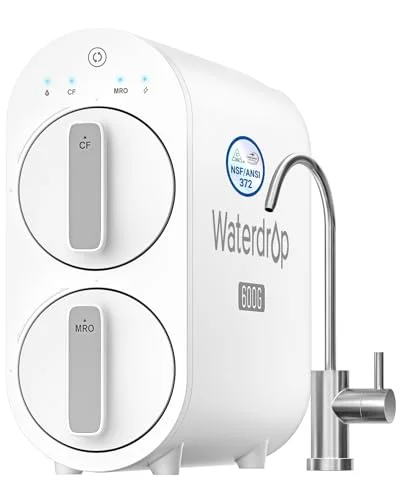 Waterdrop G2P600 (Renewed) | Amazon Renewed | 600 GPD | NSF/ANSI 372 | $199.00 | Price |
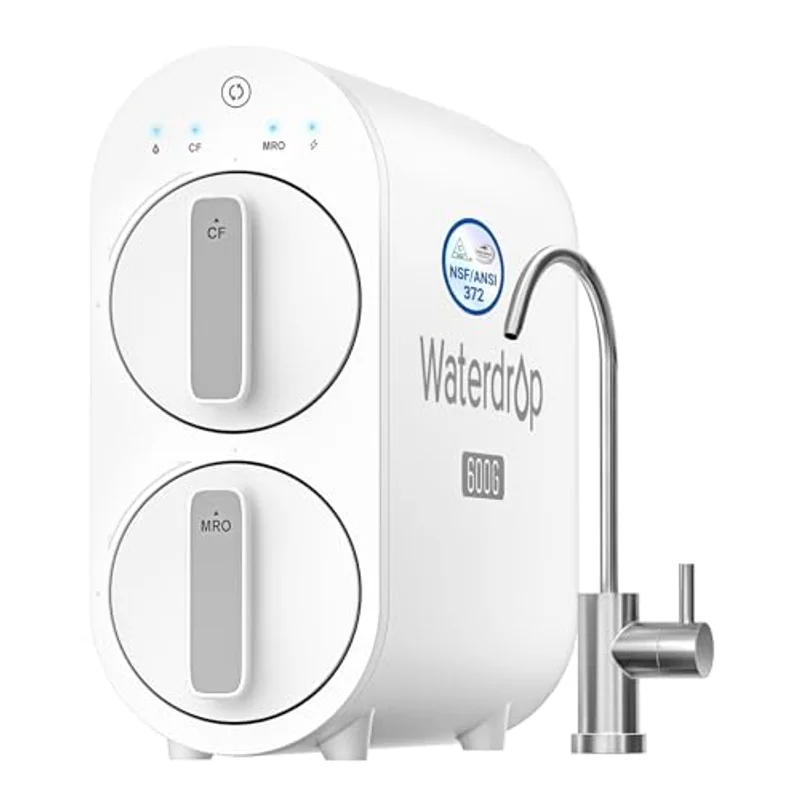 Waterdrop G2P600 (New) | New | 600 GPD | NSF/ANSI 372 | $269.00 | Price |
That's a $100 spread, roughly a third off the new price, for what is specified as the same unit. For scale, Waterdrop's other 400 GPD tankless system, the Waterdrop G2, sells new at $239.99 — meaning the Renewed G2P600 at $199.00 undercuts a smaller, lower-output new system from the same brand while matching its specified 600 GPD output and NSF/ANSI 372 material certification. On paper, the Renewed listing is the better spec for less money than either new option. (For how Waterdrop's certification and cartridge pricing stack up against the other big names, see our Waterdrop vs. iSpring vs. APEC comparison.)
Two things keep that $100 from being pure upside. First, Amazon's own listed prices move — we recorded these on the dates noted, and by the time you're reading this the gap could be smaller, or larger. Confirm both prices on the live listings before you decide the discount is worth it, because a discount that's shrunk to $40 changes the math in this article completely. Second, and more structurally: a 600 GPD tankless system is mostly cartridges and a membrane sitting in a sealed housing, not a battery or a screen that degrades on a knowable curve. The $100 you save is compensation for not knowing the membrane's exact remaining life — which is exactly why the next two sections matter more than the price tag.
What's typically replaced before resale, and what a seller is allowed to skip
Amazon's Renewed program requires sellers to meet a baseline — functional testing, a cosmetic grade, a listing that discloses the item is used and refurbished — but it does not mandate a single uniform parts-replacement checklist across every product category the way it would for, say, a certified pre-owned car. What actually gets swapped before a Renewed RO system goes back on the virtual shelf is set by the individual seller, within that baseline, and it typically breaks down like this:
- Usually replaced or reset: any consumable that's cheap relative to the unit and visibly degrades — a sediment or carbon pre-filter, if the housing was opened for inspection anyway. A reputable refurbisher has an incentive to not ship a visibly brown sediment filter, because that's the one thing a buyer will notice and photograph in a one-star review.
- Sometimes replaced, sometimes not: the RO membrane itself. This is the expensive part, and it's also the part a functional pressure test won't fully characterize — a membrane can hold pressure and still be partway through its two-to-three-year rejection life. Nothing in the public Renewed program description obligates a seller to swap it, and nothing prevents them from doing so either. This is seller-specific, and the listing almost never states it either way.
- Allowed to skip entirely: cosmetic wear that doesn't affect function — scuffs on the housing, a faded display — and, critically, any disclosure of why the original buyer returned it. "Customer changed their mind" and "unit developed a slow drain-line leak after four months" both end up as the same unit back in a Renewed box, and you have no way to tell which one you're getting from the listing alone.
The honest framing: a Renewed badge is good evidence the unit powers on, holds pressure, and isn't missing parts at the moment it was relisted. It is not evidence about the one component — the membrane — whose remaining life determines whether you got a $100 discount or a system that needs a $55-ish replacement membrane within a year of buying it "Renewed." If the listing photos or description mention a new or reset membrane specifically, that's worth more to you than the Renewed badge itself. If they don't mention it, assume they didn't. If what you actually want is simply a lower total cost without taking on resale risk, buying new from a listing that bundles a spare filter set front-loads a similar saving without the unknown membrane history.
Amazon's Renewed guarantee versus a standard manufacturer warranty
These two protections are not the same shape, and conflating them is the most common way people overestimate what they're covered for.
90 days, replace-or-refund
Amazon's stated Renewed Guarantee covers a 90-day window from delivery. If the item doesn't work as expected in that window, Amazon's guarantee is a replacement or a refund — processed through Amazon, independent of whatever the original manufacturer offers. It's fast and it's backed by Amazon's own customer service, which for a straightforward "the unit arrived leaking" problem is often simpler than a manufacturer RMA. It is also short: 90 days is well inside the window where a marginal membrane or pre-filter would normally still be behaving, and outside that window the guarantee is gone regardless of what fails next.
Longer, narrower, and often void on Renewed
A new Waterdrop system typically carries a manufacturer warranty measured in years, not days, covering defects in materials and workmanship. The catch for Renewed buyers: manufacturer warranties are frequently written to apply to the original purchaser of a new unit, and a unit sold through the Renewed program — by Amazon or a third-party refurbisher — may not carry that manufacturer coverage forward at all. Some refurbishers offer their own separate warranty in its place; whether that exists, and for how long, is set by the seller, not by Amazon or by Waterdrop, so it has to be checked on the specific listing rather than assumed.
Put side by side, the practical takeaway is this: your real safety net on a Renewed RO system is Amazon's 90-day guarantee, full stop. Anything that goes wrong after that is either covered by a seller-specific warranty you need to confirm exists before buying, or it isn't covered at all. That's a materially shorter protection window than buying new from a brand with a multi-year warranty, and it should be weighed against the discount, not treated as a footnote.
Red flags in a Renewed listing worth checking before you click buy
None of these are reasons to automatically pass on a Renewed system — they're questions the listing should answer before your money moves, and a listing that can't or won't answer them is telling you something.
- No mention of who performed the refurbishment. The badge doesn't mean Amazon's own staff touched the unit — usually a third-party seller enrolled in the program did. A listing naming the refurbisher, or stating it was inspected under the program's standard, gives you more to verify than one that just carries the badge with no detail.
- Thin Renewed-specific seller feedback. Check the seller's rating for comments about refurbished purchases specifically, not just their overall star average — strong new-item feedback with no Renewed track record is a different risk than an established refurbisher.
- Stock photos instead of the actual unit. Listings showing only the same manufacturer photography as the new listing give no visual confirmation of this unit's condition.
- No stated reason or condition grade for the return. A program doing its job usually sorts returns into a grade; a listing with zero detail beyond "Renewed" is giving the least information the program allows.
- A discount too small to matter. If a Renewed unit sits within $20–30 of the new price, you're trading unknown membrane history and a shorter warranty for less than the cost of one replacement filter set.
- No mention of the install hardware. Feed valve, drain saddle and tubing are cheap but sometimes missing from returns — confirm a complete kit is included, as you would for a used unit off a classifieds site.
Sanitizing a Renewed system before first use
Whatever inspection a Renewed unit went through, treat the first setup exactly as you would any secondhand reverse osmosis system — because functionally, that's what it is. The unit sat in someone else's cabinet, ran their tap water through its stages, and then sat again in a warehouse or shipping box before reaching you. None of that is dangerous, but none of it is sterile either, and skipping the sanitizing step is one of the more common mistakes owners make with any pre-owned filtration unit, Renewed or otherwise.
The process is the same one manufacturers already put in their change-cartridge instructions, just run once up front:
- Replace the pre-filters before first use, regardless of what the listing claims was done. A sediment or carbon pre-filter is inexpensive and is the one part you can fully verify yourself — no reason to trust an unknown filter's remaining life when a fresh one costs a fraction of what you just saved.
- Flush the system before drinking from it. Run the initial fill-and-drain cycle per the manufacturer's setup instructions — draining the first tankful or two, or running a tankless unit for its specified minutes — to clear stagnant water and loose carbon fines left from storage or shipping.
- Sanitize the housings if they were opened for inspection, which they likely were for a functional check. A food-grade sanitizing step before loading new pre-filters is the same step we'd recommend for a used system bought secondhand; skipping it is the usual explanation when water that tasted fine at setup tastes stale within a couple of months.
- Check every connection point for leaks over the first 24 hours. A Renewed unit's pressure test happened once, at the refurbisher, not under your plumbing. This is also the window Amazon's 90-day guarantee is simplest to use if the hardware itself is faulty.
- Note the delivery date somewhere durable. The 90-day guarantee is the real asset here, and it's worth proving exactly when it started.
When Renewed is worth it, and when it isn't
Worth it: when the discount against the new price is substantial — the Waterdrop G2P600 pair in our database shows roughly a third off — the listing describes an actual refurbishment process rather than just carrying the badge, the seller has visible Renewed-specific feedback, and you plan to replace the pre-filters and sanitize the housings yourself regardless of what the seller claims was already done. Under those conditions you're paying $100 less for a system whose functional baseline has at least been checked once, with Amazon's 90-day guarantee as a real backstop if the hardware itself is faulty.
Not worth it: when the discount shrinks below the cost of replacing the parts you can't verify — a fresh pre-filter set plus a cushion against an early membrane swap easily runs $50–80. It's also not worth it if a multi-year manufacturer warranty matters more to you than the upfront savings, since that coverage is frequently the thing you lose by buying Renewed. And it's not worth it if the listing won't say who refurbished it or what was checked — at that point you're buying the same unknown history as a classifieds listing, just with better photography and a 90-day clock instead of none.
The honest summary: Amazon Renewed on a reverse osmosis system is a real discount backed by a real, time-limited guarantee — not a scam and not a guaranteed bargain either. It saves you money in exchange for taking on the one risk a 90-day functional check can't fully retire: how much life is left in the membrane. Price that risk against the savings, confirm the warranty in writing before you buy, and sanitize the system on arrival like any secondhand unit, and the discount is a reasonable trade for a lot of buyers.
Questions people ask about Renewed RO systems
Is Amazon Renewed the same as "used"?
Functionally overlapping but not identically labeled. "Used" on Amazon typically means sold as-is by a third-party seller with no refurbishment claim. "Renewed" means the item went through Amazon's certification program — inspection, cleaning, and functional testing against a program baseline — before being relisted as like-new, backed by the 90-day Amazon Renewed Guarantee. For a reverse osmosis system, both categories still leave the membrane's remaining life unknown; Renewed simply adds a functional check and a short guarantee on top of that same underlying uncertainty.
Does buying Renewed void the manufacturer's warranty?
Often, yes, or it simply never applied in the first place. Many manufacturer warranties are written to cover the original purchaser of a new unit, and a Renewed listing is explicitly a resold, refurbished item — not a new purchase from the brand. Some third-party refurbishers offer their own replacement warranty, but that has to be confirmed on the specific listing; it is not guaranteed by Amazon's Renewed program itself. The Amazon Renewed Guarantee covers 90 days from delivery regardless.
Should I replace the filters on a Renewed RO system right away?
Yes. Even when a listing states the pre-filters were checked or replaced, a fresh sediment and carbon pre-filter set is inexpensive relative to the system and removes a variable you can't otherwise verify. Treat a Renewed unit's first setup the same way you would a secondhand system: new pre-filters, a full flush cycle per the manufacturer's instructions, and a sanitizing step for any housing that was opened for inspection.
How much should I expect to save buying Renewed over new?
It varies by listing, but in our own database the Waterdrop G2P600 shows a roughly $100 gap — $199.00 Renewed against $269.00 new for the identical 600 GPD, NSF/ANSI 372 system, about a third off. Prices move, so confirm both the Renewed and new listing prices before deciding; a gap that's shrunk to $20–30 generally isn't worth the shorter warranty window and unknown membrane history.