Buying a Used Reverse Osmosis System: What to Check Before You Install It
We're reader-supported: buying through our links may earn us a commission at no extra cost to you. We compare published specifications, certifications and prices — we don't run a testing lab.
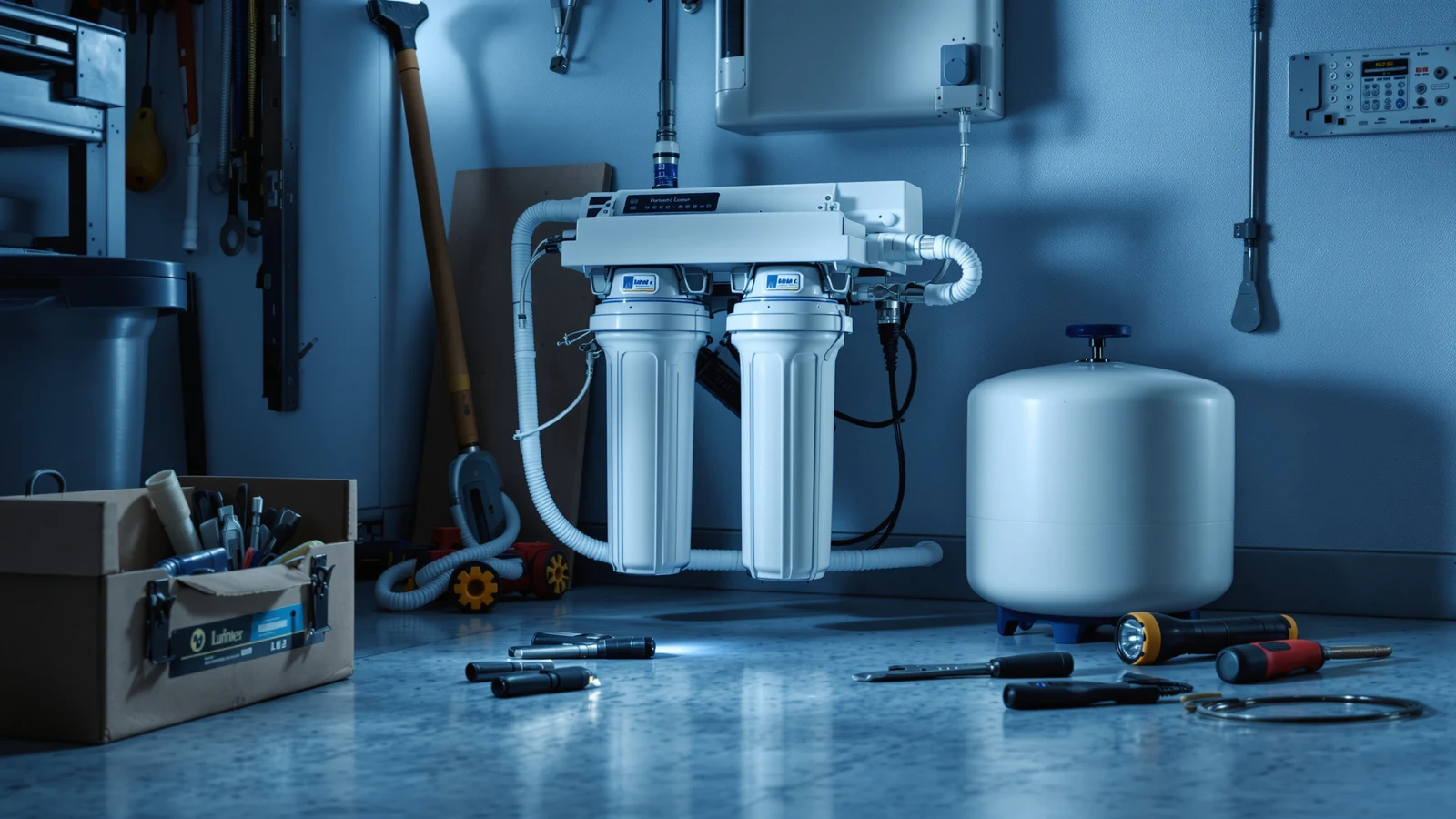
Every marketplace listing for a reverse osmosis system under $100 reads the same way: "barely used, works great, moving, must go." Some of those listings are exactly what they say. A good number of them are a renovation leftover that sat in a garage for two years, or a landlord's unit pulled out when a tenant left and never tested again before it went on Facebook Marketplace. The unit itself usually isn't the problem — the problem is that you're buying four or five consumable parts with no idea how many of them are already spent, bundled with a housing and a faucet that are effectively permanent.
That split matters because it tells you exactly what to inspect. The housings, the faucet body and the tubing routing don't wear out on a useful timescale; the membrane, the tank's internal bladder and the sanitary condition of everything that touched standing water absolutely do, and none of those show up in a marketplace photo. This is the checklist for telling the two apart before you connect anything to your cold-water line, using the parts of a used listing you actually can evaluate: the model, the membrane's likely remaining life, the tank, what's missing from the box, and whether the asking price is still a deal once you've priced in what you'll need to buy anyway.
Why these long-running models are what you'll find secondhand
Open any local marketplace search for "reverse osmosis" and the same handful of names repeat. That isn't coincidence — it's survivorship. A system that has stayed in continuous production for a decade or more has sold, by definition, far more units than one launched eighteen months ago, and every kitchen renovation, apartment move-out or upgrade to a tankless system feeds the resale pool disproportionately from whichever models sold the most in the first place. The systems you're most likely to be offered secondhand are not random; they're the bestsellers.
The iSpring RCC7 family is the clearest example of this pattern on Amazon's own catalog. The iSpring RCC7-BN is a straightforward NSF-certified 5-stage, 75 GPD under-sink system with a brushed-nickel, top-mounted faucet. Sitting right next to it in the same lineup are two alkaline 6-stage variants built on the same core design — the RCC7AK-BN in brushed nickel and the RCC7AK-BLK with a black faucet — both adding a pH-plus remineralization stage after the membrane. All three share the same patented top-mounted faucet fastening and the same standard housing architecture, which is exactly why they've stayed on the market this long: easy to service, easy to source parts for, easy to recommend. It's also exactly why they're what shows up used. If a listing shows you three vertical housings, a tank, and a top-mounted faucet handle, there's a decent chance you're looking at a system from this family or a close clone of it, which means you already know roughly what's inside before the seller tells you anything.
Knowing the family also tells you what to ask next. A 5-stage system like the RCC7-BN has no remineralization cartridge to worry about; a 6-stage alkaline system like the RCC7AK-BN or RCC7AK-BLK has one more consumable stage than a seller describing "the filters" out loud is likely to mention. If you want to see how this same core design compares against the other brands you'll run into on the used market, our Waterdrop vs. iSpring vs. APEC comparison breaks down what actually differs between the three families beyond the badge on the faucet.
The membrane: estimating remaining life without a service history
The RO membrane is the one component in the whole system that quietly determines whether the thing is worth owning, and it's the one component a seller almost never has documentation for. Membranes don't fail the way a sediment filter clogs — they slowly lose rejection as the thin-film surface fouls, which means a membrane can look, sound and flow completely normal while already performing well below a new one. A seller telling you "it still makes water fine" has told you nothing about the membrane specifically, because a dying membrane and a perfectly healthy one both make water fine right up until they don't.
Without a service history, you have three ways to get an actual read on it, and none of them require trusting the seller's memory.
- Test the ratio, not the water. A cheap handheld TDS meter costs a few dollars. Test the untreated cold tap feeding the system, then test what comes out of the RO faucet, and calculate the rejection percentage: (feed minus product) divided by feed. A healthy membrane on a certified system typically rejects somewhere in the low-to-high 90% range of dissolved solids. If the number you measure is meaningfully below that, or close to it even on first fill, treat the membrane as already partway through its life rather than fresh.
- Ask for the manufacture date, not the purchase date. A model number and a quick look at the housing or faucet casting can sometimes narrow down roughly how old the unit's core design is, but what actually matters is how long the current membrane has been installed — and if the seller can't answer that with more precision than "a while," assume it's original to whenever the system was first plumbed in, which is the least favorable assumption and the correct one to budget against.
- Look at what it's wet with, not what it's dry with. A membrane housing that's been sitting wet and disconnected for months between the seller removing it and you buying it has had time for biofilm to build on the membrane surface even if the membrane itself still has useful life left mechanically. That's a separate problem from age, and it's one more reason the sanitizing step below isn't optional.
The practical takeaway: price a used system as if you will need a new membrane in year one, because on a system with no service history, you very well might. If the asking price already assumes you're getting a membrane with meaningful life left, you're negotiating against an unknown, and unknowns should move the price, not the enthusiasm.
The tank: bladder pre-charge and rust
The storage tank is the part people check least and should check most, because a failing tank produces symptoms that look exactly like a failing membrane — slow refill, weak flow at the faucet, water that seems to "run out" fast — and chasing the wrong component wastes money twice.
Standard RO tanks hold a rubber or butyl bladder inside a steel or composite shell, pressurized with air on the outside of the bladder so it pushes stored water out at the faucet. That air charge, the pre-charge, is what you're checking:
- Drain the tank fully first. Open the RO faucet and let it run until it stops, so there's no water left inside pushing back on your reading.
- Check the air valve with a standard tire gauge. It's the same Schrader-style valve you'd find on a car or bicycle tire, usually on the bottom or side of the tank. A reasonable empty pre-charge on a typical household RO tank runs around 7 psi — well below what you'd expect looking at it, which surprises people the first time they check.
- A reading near zero means a lost charge, not necessarily a dead tank. Some tanks can be re-pressurized through that same valve with a hand pump if the bladder itself hasn't failed. If it won't hold air at all after refilling it, the bladder has likely ruptured, and the tank is scrap regardless of how clean it looks on the outside.
Then look at the shell itself. Tanks on long-running systems are commonly painted steel, and the failure point is almost always the seam at the bottom or around the fittings at the top, where moisture collects and paint wears thin first. Surface dust is nothing. A rough, bubbled, or flaking patch — especially anywhere near the bottom weld — is corrosion working from the inside out, and by the time it shows on the outside it has usually been active for a while. A tank in that condition isn't worth rescuing even if the bladder inside still holds pressure; replace it rather than install it. If the listing includes an add-on accessory like a permeate pump to speed up tank filling, it's worth understanding what that part is actually doing before you decide it's a bonus — our guide to permeate pumps covers how they work and when they're worth keeping versus replacing along with everything else.
Sanitizing before first use — never skip this on a used system
Manufacturers tell you to sanitize a brand-new system before first use, and that instruction exists for water that has never touched anything but factory-sealed plastic. A used system has an unknown history of sitting disconnected, possibly with residual water left in the tank and housings, in whatever environment it was stored — a garage, a basement, a moving truck — for an unknown number of weeks or months. Treating it like a new-in-box unit and skipping the sanitizing step is the single most common mistake with secondhand systems, and it's the one with the most unpleasant failure mode: musty, stale-tasting water for months after install, traced back to mold or biofilm that had already colonized the tank bladder and the inside of the tubing before you ever turned the feed valve on.
The sequence that matters, in order:
- Disassemble and inspect before anything touches your supply line. Pull every housing apart, drain and inspect the tank, and look inside the tubing runs for discoloration or slime, not just at the obvious parts.
- Sanitize the housings and tank with a food-grade sanitizer — an unscented household bleach solution at the dilution manufacturers typically specify for RO systems, circulated through the empty housings and tank, then flushed thoroughly before any filters go back in. Do this with the system assembled but without cartridges installed, so the sanitizing solution contacts every internal surface the water will later touch.
- Install fresh cartridges only after sanitizing, never before. A new filter set dropped into a housing that still has residual contamination just gives that contamination something fresh to grow on.
- Flush to drain before you drink from it. Run the first tank or two of produced water to waste rather than into a glass, standard practice on new installs and doubly worth doing here.
None of this is expensive or slow — it's an afternoon and a few dollars of sanitizer — but it's the step people skip because the system "looks clean," and looking clean and being sanitary are two different claims. It's also worth knowing what you're giving up by buying older hardware in the first place: newer systems increasingly ship with an auto-flush stage built in specifically to keep the membrane housing from sitting stagnant between uses, a feature a used classic-design system almost certainly doesn't have. Our guide to self-cleaning RO systems explains what that auto-flush actually does, for comparison against the manual vigilance an older unit requires for the rest of its life.
Missing parts: the faucet, fittings and manual sellers rarely include
A used RO system is frequently a system, not a kit — the box, the printed manual, the spare O-rings and the first set of filters are the things that get lost, thrown out, or quietly kept by the seller for their next install long before the listing goes up. Before you agree on a price, account for what's actually in front of you versus what the original purchase included:
- The dedicated faucet. It's a specific part number tied to the system's design — on the iSpring family above, a patented top-mounted fastening rather than a generic air-gap faucet — and a missing or damaged one means sourcing an OEM replacement, which isn't always a simple universal swap.
- The feed valve and drain saddle. The fittings that tap the system into your cold line and drain pipe are small, cheap individually, and the first things to go missing from a box that's been through a move. Without them you're making a separate hardware-store trip before install day, not a same-day job.
- Tubing and quick-connect fittings. Tubing degrades and kinks over years of being coiled in storage; even if it's present, plan to replace runs that look brittle or discolored rather than reuse them.
- The installation manual. Not essential — most manufacturers host PDFs of their manuals — but a listing that comes with the manual is a mild signal the seller kept the whole kit together rather than letting pieces disperse over time, which is worth something as a proxy for how the rest of the system was treated.
- A first-year filter set. Essentially never included. Budget for a full fresh cartridge set regardless of what the seller says was "just changed," per the membrane section above.
If completeness is the deciding factor and the listing you're looking at is missing more than the filters, it's worth comparing against simply buying new from a seller that still bundles a spare filter set in the box — our guide to RO systems that ship with a spare filter set runs the numbers on what that bundled year of cartridges is actually worth against buying the same parts separately six months in, which is the same math you're doing here in reverse.
When the used price isn't actually a discount
Here's what the same three long-running systems cost new, as of our last price check, to use as your baseline for what a "deal" actually needs to beat.
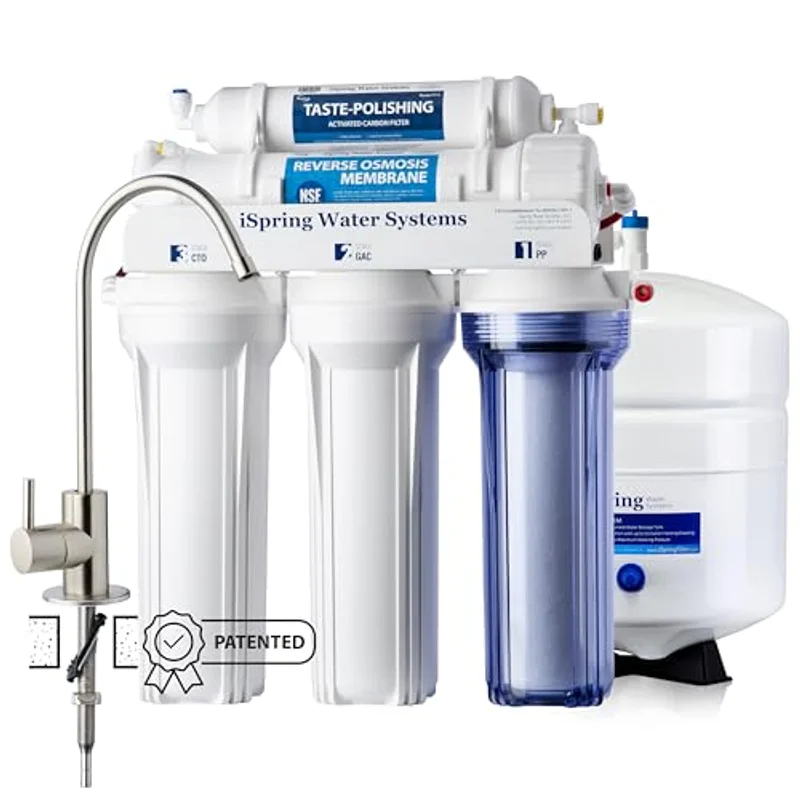
iSpring RCC7-BN
NSF certified, 75 GPD, 5-stage, brushed-nickel top-mounted faucet. The baseline system in this family — new, under warranty, with a membrane that has zero hours on it.
Check price →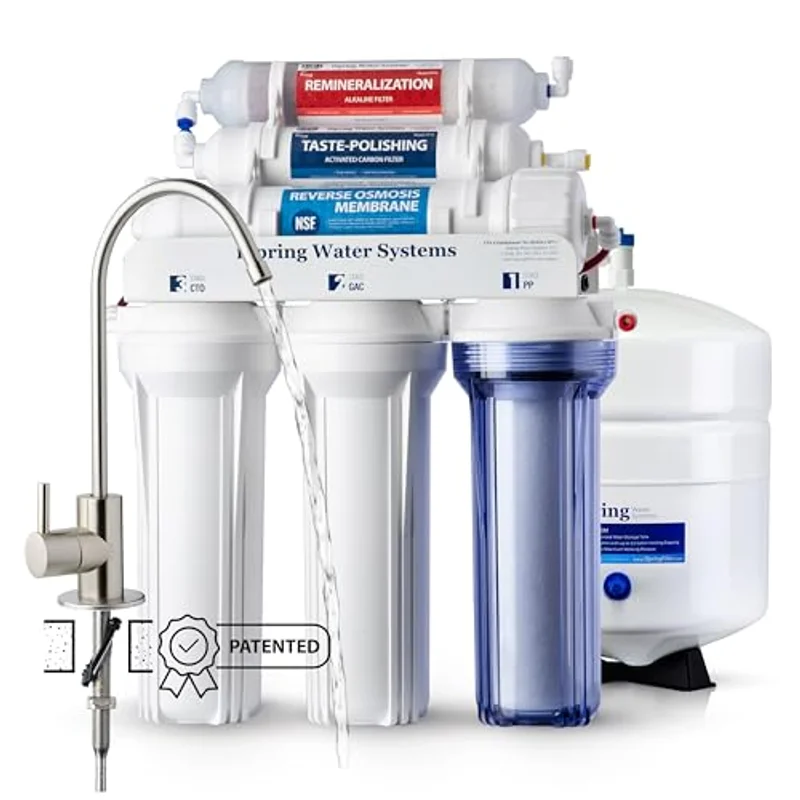
iSpring RCC7AK-BN
NSF certified, 75 GPD, alkaline 6-stage with pH-plus remineralization, brushed-nickel faucet. One stage and about $15 more than the base model, new.
Check price →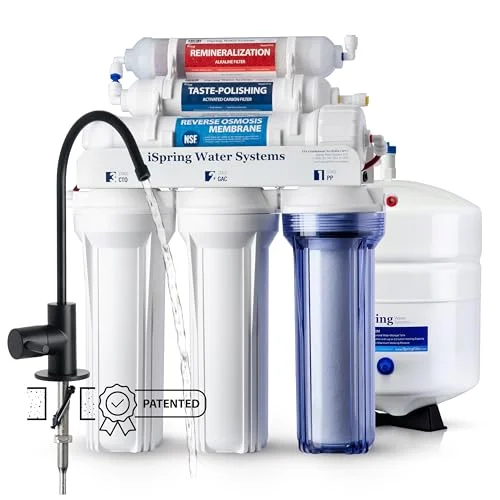
iSpring RCC7AK-BLK
NSF/ANSI 58 certified, alkaline 6-stage with pH-plus remineralization and a black RO faucet. The newest finish in the lineup, at a modest premium over the brushed-nickel version.
Check price →Now run the actual comparison. Say a listing offers a 6-stage alkaline system matching the RCC7AK-BN's description for $70, which looks like roughly a $165 discount against buying new at $234.99. Before you call that a deal, price what you're realistically adding on top: a full fresh cartridge set for a standard 10-inch housing system commonly runs somewhere in the $50 to $90 range for a year, and if the membrane has no documented history, add a membrane replacement on top of that rather than treating it as covered by the filter set, since the membrane is sold separately from the pre- and post-filters on this style of system. A missing or damaged faucet and a feed-valve kit add more, in the range of a hardware-store trip plus whatever an OEM faucet part costs to source.
Add that up and a system that looked $165 cheaper can land within $20 to $40 of the new price — minus the warranty, minus the confidence that the membrane isn't already half-spent, minus the manual, minus whatever else didn't make it into the box. That doesn't make every used listing a bad buy. A genuinely cheap unit — $30 to $50 for the full housing-and-tank assembly, with you supplying filters and a membrane regardless — can still beat new on pure parts cost, and a free or near-free system someone is hauling to the curb is free parts no matter what condition the membrane is in. What doesn't hold up is a used system priced at half of new on the assumption that it's otherwise equivalent to new. It isn't, and the gap between those two numbers is exactly the gap this checklist exists to measure before you hand over cash.
Questions people ask before buying used
Is it safe to buy a used reverse osmosis system?
Yes, with the inspection in this guide done first. The housing, faucet body and tank shell are durable parts that don't meaningfully degrade on a useful timescale. The risk is entirely in the consumables and the sanitary history: an unknown membrane, a lost tank pre-charge, and whatever sat in the lines while the system was disconnected. Sanitize before first use, replace the filters and likely the membrane regardless of what the seller says, and check the tank's pre-charge and shell for rust before you connect it to your water line.
How do I know if the membrane is still good without a service history?
Test the TDS rejection ratio rather than trusting the seller's memory: measure the untreated feed water and the RO faucet output with a handheld TDS meter, then calculate (feed minus product) divided by feed. A healthy membrane on a certified system typically rejects in the low-to-high 90% range. Without documentation, the safer assumption is that the membrane is original to the system and budget for a replacement in year one.
Do I really need to sanitize a used system before using it?
Yes, every time, with no exceptions for a system that looks clean. A used unit has an unknown storage history — how long it sat disconnected, with what residual water, in what environment — and skipping the sanitizing step is how stale-tasting, musty water from mold or biofilm in the tank bladder and tubing shows up months after install. Disassemble, sanitize the empty housings and tank with a food-grade sanitizer, flush thoroughly, then install fresh filters and flush again before drinking from it.
What's a fair price for a used reverse osmosis system?
It depends on what you're willing to replace regardless of condition. Since a full fresh filter set commonly runs $50 to $90 a year and a membrane with no service history should be budgeted for separately, a used system only becomes a clear deal once its price plus those near-certain costs lands meaningfully below buying new — new 75 GPD under-sink systems in this category run roughly $220 to $250. A used unit at $30 to $70, with you supplying the consumables anyway, is usually the better math than one priced at half of new on the assumption it's otherwise equivalent.