Comparison
Waterdrop vs. iSpring vs. APEC: How the Three Biggest RO Brands Differ
By Ilane TallUpdated October 7, 202613 min readResearch-based
We're reader-supported: buying through our links may earn us a commission at no extra cost to you. We compare published specifications, certifications and prices — we don't run a testing lab, and we don't publish star ratings or paraphrased reviews for systems we have no review data on.
Why these three names keep coming up
Open almost any roundup on this site and the same three brands fill most of the slots. Our own home page comparison of the six systems we recommend has a Waterdrop at the top for overall pick, an iSpring as the cheapest system to run, and an APEC as the pick for buy-it-and-forget-it hardware — three different brands solving three different problems, which is exactly why they keep reappearing instead of one winner pushing the other two out. That is not a coincidence of which products happened to be in stock when we wrote those pages. It reflects three different manufacturing philosophies that have each found a lane: APEC builds classic tank systems around an industry-standard parts ecosystem, Waterdrop builds sealed tankless units around its own proprietary cartridges and electronics, and iSpring sits in between, selling both — the brand shows up in the standard-housing camp with its RCC7 line and in the high-output tankless camp with systems like the one compared here.
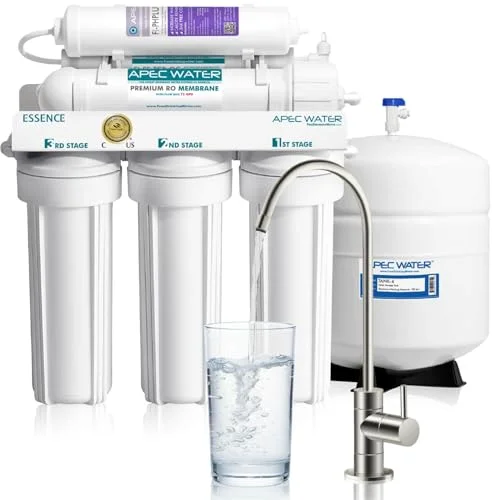
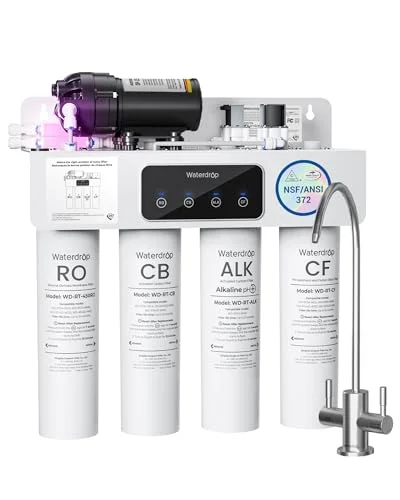
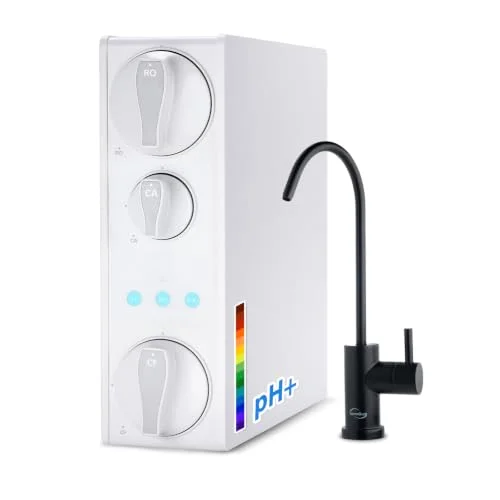
This comparison is not about which brand is "best" in the abstract. It takes one alkaline system from each — the APEC Water RO, Alkaline 6-Stage ($168.34), the Waterdrop T4-A Alkaline Mineral Tankless, Dual Flow ($229.99), and the iSpring RO500AK-ORB ($633.60) — and uses them to show where the three companies actually diverge: certification strategy, how the faucet is designed and installed, what a gallon of output costs you in dollars, whether the cartridges are commodity parts or sole-source, and the kind of support structure each brand is built around. Those differences hold up across each brand's wider catalog, which is the more useful takeaway than any single spec on any single listing.
Read the badge properly
NSF/ANSI 58, NSF/ANSI 372 and WQA — each brand leans on a different one
Line these three listings up and you get a near-perfect illustration of the three certification paths a reverse osmosis system can take. NSF/ANSI 58 is the performance standard for reverse osmosis — it certifies that a system actually reduces total dissolved solids and, depending on the scope tested, named contaminants. NSF/ANSI 372 is a materials standard: it certifies that wetted parts are lead-free and says nothing about what the membrane removes. WQA, the Water Quality Association, is not a standard at all — it's a separate third-party certifying body that tests products against those same NSF/ANSI standards and issues its own mark.
The iSpring RO500AK-ORB is the one of the three whose own listing claims the performance standard outright: NSF/ANSI 58 Certified, printed directly in the product title. That is the strongest single certification claim among the three systems here, and it is the reason iSpring leads this section rather than APEC or Waterdrop. The Waterdrop T4-A's product packaging carries an NSF/ANSI 372 mark — materials, not performance — which is consistent with how Waterdrop certifies much of its catalog; its flagship G3P600 holds both 58 and 372, but this particular alkaline tankless model is marked for 372 only, so don't assume every Waterdrop system carries the same certification its best-known model does. The APEC system leans on WQA certification instead of an NSF/ANSI mark directly in its own listing title, consistent with APEC's pattern of routing its Essence line through WQA testing rather than branding every listing with an NSF/ANSI number.
None of this means the Waterdrop or APEC systems perform worse at removing dissolved solids — reverse osmosis membranes work the same way regardless of which body signed off on the box. It means that if a specific NSF/ANSI 58 performance certification matters to your purchase decision, the iSpring is the one of these three that states it plainly, and the other two are the ones worth a closer look at the listing before you assume they carry it too.
What sits on your counter
Faucet design: one top-mounted, two standard
The faucet is the part of an RO system you touch every day, and the three brands approach it differently enough that it's worth separating from the filtration spec sheet entirely. The APEC system pairs its three-housing tank setup with a standard gooseneck faucet on its own base — the kind that goes through a dedicated hole in the sink or counter, independent of the filter housings under the cabinet. That's the classic installation most homeowners picture when they think "RO faucet," and it's also the most flexible: a standard-base faucet can usually be swapped for a different finish or style without touching the filtration unit at all.
The Waterdrop T4-A takes the opposite approach. Its dual-flow faucet is built as part of the same compact tankless unit that holds the four twist-in cartridges, mounted directly above the cartridge bank rather than installed as a separate fixture — a top-mounted design that matches Waterdrop's broader push toward single-box tankless units with everything, including the faucet head and its spout, integrated into one footprint. "Dual flow" in the product name refers to the faucet delivering two distinct water paths from that same integrated head rather than requiring two separate taps. The iSpring RO500AK-ORB lands closer to APEC's approach: it pairs its slim dial-control tower with a standalone oil-rubbed-bronze gooseneck faucet connected by its own line, rather than fusing the spout into the body of the unit.
The practical difference shows up at install time and at resale time. A standard separate faucet (APEC, iSpring here) means you're drilling or using an existing hole and can change the faucet finish independent of the filtration hardware underneath the sink. A top-mounted, unit-integrated faucet (the Waterdrop T4-A here) trades that flexibility for a tighter footprint and one less hose run — relevant if you're also weighing a system with a built-in display or control panel, since an integrated faucet and an integrated display tend to travel together on the same unit.
The number on the box
GPD at a comparable alkaline price point — and what a gallon actually costs
All three of these are alkaline systems, which is the fair basis for comparing them, but their rated output spans a wide range: the APEC is rated at 75 GPD, the Waterdrop T4-A at 450 GPD, and the iSpring RO500AK-ORB at 500 GPD. That is a six-and-two-thirds jump from the cheapest system to the fastest-rated one, and the price does not scale with it in a straight line. Dividing price by rated GPD gives a rough price-per-gallon-of-daily-capacity figure: the APEC works out to about $2.24 per GPD, the Waterdrop T4-A to about $0.51 per GPD, and the iSpring RO500AK-ORB to about $1.27 per GPD. By that measure the Waterdrop is the cheapest way to buy rated output, the APEC is the most expensive per gallon despite having the lowest sticker price, and the iSpring sits in the middle even though it carries the highest total price of the three.
That math is a starting point, not a verdict — a 75 GPD tank system and a 500 GPD tankless unit are not interchangeable even at the same price, because they solve different problems. A 75 GPD tank system makes water slowly into a bladder tank and hands it to you under stored pressure; it is plenty for a one- or two-person kitchen. Systems rated at 450 to 500 GPD skip the tank and make water fast enough to serve a busy faucet directly, which starts to matter for larger households that draw water constantly rather than a glass at a time. If your household is bigger still, or you're filling appliances as well as glasses, the next step up from these numbers is covered in our guide to 1000+ GPD systems.
On drain ratio, we have to be honest about a gap: none of the three listings for these specific systems publish a pure-to-drain ratio, and that omission is itself worth noting rather than papering over with a plausible-sounding number. Some Waterdrop and iSpring systems elsewhere in each brand's catalog do publish a ratio — the figure is typically printed per-model rather than guaranteed brand-wide — so if drain efficiency matters to your water bill or your septic system, treat its absence here as a reason to check the specific listing's specification section, not an assumption in either direction.
What you'll be rebuying
Filter housings: one industry standard, two proprietary designs
The APEC system's three visible housings are the classic vertical canister design APEC has used across its Essence line for years — the kind of hardware built around the industry-standard 10-inch by 2.5-inch cartridge size that a dozen manufacturers, not just APEC, produce replacements for. That standard is leverage for the owner: when a part wears out, you are not limited to one company's price list. It is the same housing logic behind APEC's other standard-size systems we've covered in our breakdown of generic versus OEM replacement filters.
The Waterdrop T4-A does not use that standard. Its four cartridges — labeled RO, CB, ALK and CF on the units themselves, each carrying its own Waterdrop model number — are proprietary twist-in parts sized and shaped for this unit alone, consistent with how Waterdrop's tankless line is built across the board: sealed cartridges that go in and out in a quarter turn, sourced only from Waterdrop. The iSpring RO500AK-ORB is the one that resists a simple brand-wide generalization. iSpring's classic RCC7-series tank systems do use the same 10-inch by 2.5-inch standard as APEC, which is the reputation most people associate with the brand — but this particular model is a compact tankless tower built around its own dial-selector cartridge design, not the classic iSpring housings. In other words, "iSpring uses standard filters" is true of one part of iSpring's lineup and not necessarily this one — the lesson being that brand reputation for cartridge standardization doesn't automatically transfer from one product line to another inside the same company, and the only way to know for certain is to check the specific model's own replacement-parts listing before you buy.
Support, as a pattern — not a promise
Warranty and support: three different structures
We have no review data for these specific systems, so what follows is a general description of how each company structures support across its catalog — stated as a pattern you can expect to encounter, not a guarantee that applies to any individual order. Each brand publishes its own written warranty term directly on the product listing, and that term can change between models and over time, so the current listing is the only authority on what coverage you'd actually get.
APEC sells direct as well as through Amazon and keeps an extensive parts catalogue addressable by model and stage number, a structure that lets a system bought years ago still be serviced with matching replacement cartridges — the kind of continuity a standard-housing design is built to support. Waterdrop's support is increasingly tied to its companion app and the on-unit control panels found across its tankless line, which pair filter-life tracking with a path to order the matching proprietary cartridge from inside the same interface. iSpring, the longest-established of the three brands in this category, still sells cartridges for RO systems it released over a decade ago and structures its support primarily through direct phone and email contact rather than an app. None of these are claims about which company resolves problems faster — we have not tested that, and would not publish a number we couldn't verify even if we had a favorite.