Best RO Systems
Home › Guides › Does alkaline RO water do anything
Honest take

Does alkaline RO water actually do anything?

We're reader-supported: buying through our links may earn us a commission at no extra cost to you. We compare published specifications, certifications and prices — we don't run a testing lab.

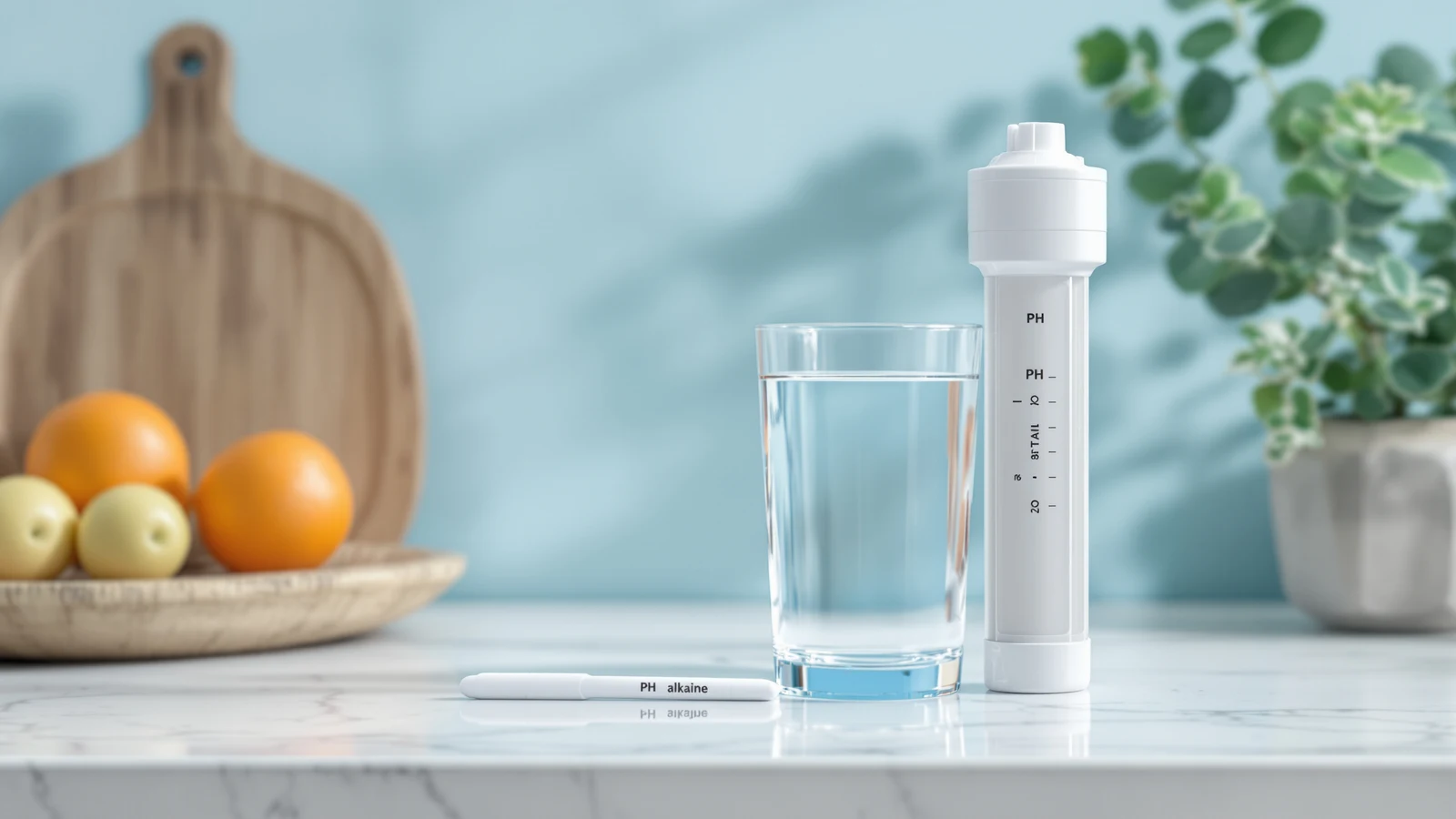
Glass of water being filled from a reverse osmosis faucet beside an alkaline remineralization filter cartridge

Every alkaline reverse osmosis system on the market is answering a problem the membrane itself creates. Reverse osmosis is brutally effective at stripping dissolved solids — that is the entire point of the technology — and it does not distinguish between the lead you wanted gone and the calcium and magnesium you might have wanted to keep. An alkaline, or remineralization, stage is the fix bolted on after the fact: a cartridge of calcite or a proprietary mineral blend that the water passes through on its way to the faucet, putting some of those minerals back and nudging the pH upward in the process.

The marketing built on top of that cartridge is where this gets complicated. "Alkaline water" copy routinely promises better taste, neutralized "acidic" bodies, slowed aging, better hydration — claims that have outrun what a $20 add-on filter can plausibly do. This page separates what the stage measurably changes from what the packaging implies, using the three biggest RO brands and the alkaline systems we can actually source specs for.

What an alkaline stage adds, in measurable terms

Strip a remineralization cartridge down to what it is: a chamber of calcite (calcium carbonate) or a blended mineral media that the water contacts briefly after the membrane. Two things happen, and only two.

pH rises. Pure reverse osmosis permeate sits close to neutral to slightly acidic — typically in the 6 to 7 range, partly because RO strips out the alkalinity (the carbonate and bicarbonate buffering) that would otherwise hold tap water near pH 7.5 to 8. A calcite stage redissolves a small amount of calcium carbonate into the water, which pushes pH up — manufacturers of alkaline cartridges commonly target a finished pH in the 8 to 9.5 range, though the actual number depends on contact time, media volume and your feed water, and is not something we can verify without a lab pH meter on the specific unit.

A small amount of hardness returns. The same reaction that raises pH reintroduces calcium, and alkaline systems with a true mineral-blend stage add magnesium alongside it. This is measured in milligrams per liter, and it is modest by design — remineralization cartridges are sized to season the water, not to turn RO permeate back into the mineral content of tap water. APEC's ROES-PH75X carries its remineralization as the sixth of six stages specifically to perform this step after the membrane has already done its job.

That is the complete, honest list: slightly higher pH, slightly more calcium (and sometimes magnesium), delivered by a cartridge that sits downstream of the membrane. Nothing in that mechanism touches hydration, metabolism, or anything happening in a body — it is a water-chemistry change, not a physiological one, and the distinction matters for everything that follows.
The taste claim: what a blind comparison would actually show

"Better-tasting water" is the single most common claim on alkaline RO packaging, and it has a real mechanism behind it — which is also exactly why it is so easy to oversell. Dissolved minerals, particularly calcium and magnesium, are a large part of what gives water body and a round mouthfeel instead of a flat, slightly metallic edge. Straight RO permeate, having almost none of those minerals, is genuinely flatter on the palate than tap water or spring water for a meaningful share of people — this is a widely reported, plausible sensory effect, not a fringe claim.

Where the marketing overreaches is treating that effect as uniform and dramatic. Taste perception of mineral content is a gradient, not a switch, and the difference an alkaline cartridge makes is small in absolute terms: it is adding back a fraction of the minerals a membrane removed, not restoring tap water's full mineral profile. Put four glasses in front of a taster — straight RO, RO plus alkaline cartridge, filtered tap water, and unfiltered tap water — and a meaningful share of tasters would correctly rank straight RO as flattest. Whether they could reliably tell the alkaline-cartridge glass apart from filtered tap water is a different, much harder bar, and it is the bar the "tastes amazing" claims are implicitly set against. We have not run that comparison ourselves — it would need controlled blind tasting we're not positioned to conduct — so treat "noticeably rounder than straight RO, closer to tap, not a transformation" as the calibrated expectation rather than a tested result.

One thing is not in dispute: cold temperature and filtration of chlorine taste and odor — which every RO system does regardless of an alkaline stage — account for most of what people register as "my water tastes so much better now." The alkaline stage is a secondary, smaller contributor layered on top of an effect the base system already delivers.

The health claims on the packaging: general information versus unproven

This is the section where alkaline water marketing does the most reaching, and it is worth sorting the claims by how much evidence actually backs them. None of what follows is medical advice — it is a map of which claims rest on established water chemistry and which rest on inference the packaging doesn't own up to.

General information, reasonably well supported: raising water's pH and adding back trace minerals is a real, measurable change to the water itself, and mineral content is a legitimate factor in how water tastes and feels. Reintroducing calcium and magnesium after a membrane has stripped them is also, in a narrow sense, restoring something closer to how most municipal and spring water arrives — RO without remineralization is the atypical state, not the normal one.

Unproven or overstated: claims that alkaline water "detoxifies," "slows aging," "boosts energy," "improves skin," or produces broad health benefits beyond what any clean, adequately hydrating water provides. These claims ask you to extend "the water has a higher pH" into "drinking it changes your body's pH or health in that specific way" — a leap the chemistry in the next section explains is not how digestion works. Where a listing or review mentions these benefits, read it as marketing copy riding on a real mechanical change, not as a documented outcome.

The honest summary: an alkaline stage changes the water. Whether that changed water does anything beyond tasting a little rounder is where the evidence runs out, and no filter cartridge — regardless of brand or price — changes that.

Stomach acid and the pH math manufacturers rarely walk through

This is the single most useful number in this entire topic, and it rarely appears on alkaline water packaging. Resting human stomach acid sits around pH 1.5 to 3.5 — strongly acidic, several orders of magnitude more acidic than even the most aggressively alkaline bottled water. The pH scale is logarithmic, so the gap between pH 9 water and pH 2 stomach acid is not "a bit more acidic," it is roughly a ten-million-fold difference in hydrogen ion concentration.

Swallow a glass of water at pH 9, and it meets an environment designed specifically to neutralize exactly that kind of input, instantly and by a huge margin. The stomach's parietal cells actively secrete hydrochloric acid to maintain that acidic environment — it is not a passive bath that a glass of alkaline water can meaningfully shift, and the body treats a transient dilution the same way it treats a glass of orange juice or black coffee passing through: a small, brief, self-correcting perturbation. Blood pH, separately, is held in an extremely narrow band (roughly 7.35 to 7.45) by the kidneys and lungs working continuously — nothing you drink moves that number, and if it did move meaningfully, that would be a medical emergency, not a wellness benefit.

This is the math that undercuts the "neutralizes your body's acidity" framing specifically, as distinct from the taste and mineral-content claims above, which survive this scrutiny because they're not claims about digestion at all. It does not mean alkaline water is bad for you — there's no indication it is — it means the mechanism advertised (raising your internal pH) is not how digestion or blood chemistry actually works, and a $20 remineralization cartridge was never going to out-buffer an organ system built to do exactly that job.

The picks, read for what their spec sheets actually promise

Three alkaline systems, checked against the claims above

All three add a post-membrane remineralization stage. None of the three publishes a verified finished-water pH or mineral count we could independently confirm, so read the stage count and certification, not the word "alkaline" alone.

01Best built

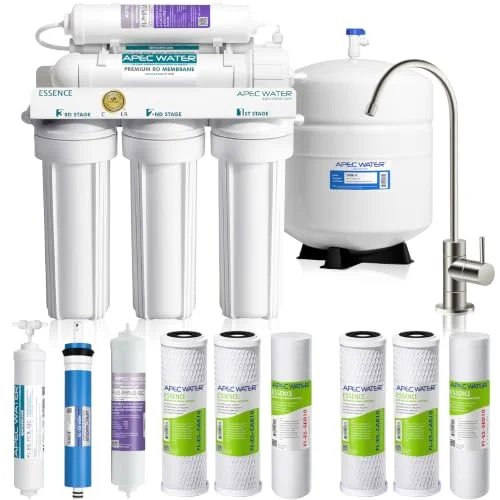
APEC Water ROES-PH75X

The alkaline stage layered onto APEC's well-regarded Essence platform
6-stage · alkaline · Value Bundle · extra filters included

This is APEC's standard ROES six-stage design — sediment, two carbon stages, membrane, post-carbon — with a sixth, remineralization stage added at the end specifically to raise pH and reintroduce calcium after the membrane. The Value Bundle pairs the system with extra filters, which matters here: an alkaline cartridge is a consumable on its own replacement schedule, separate from the sediment and carbon stages, and having spares on hand from day one avoids a mid-ownership scramble to find the right part number. APEC's spec sheet does not publish a guaranteed finished pH for this listing, so treat "alkaline" as a stage the system includes, not a number you can hold it to.

APEC Water ROES-PH75X 6-stage under-sink reverse osmosis alkaline system with extra filters
$204.21
6-stage · alkalineCheck price →
02Most stages

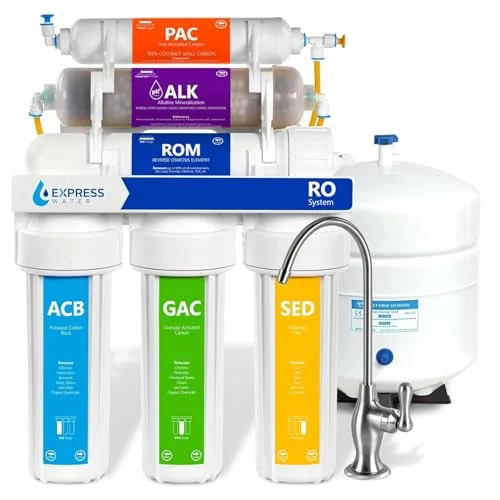
Express Water 10-Stage Alkaline RO System

For buyers who want the remineralization stage isolated, not blended in
10-stage · alkaline filter, dedicated · 50 GPD · faucet + tank

Express Water's ten-stage count is reached by splitting out stages that other systems bundle together, and the alkaline filter is listed as its own named stage rather than folded into a generic "remineralization" line — useful if you want to be able to isolate and replace that specific cartridge without touching the carbon or sediment stages around it. It is a standard tank-and-faucet layout at 50 GPD, the same basic architecture as the APEC above, with the minerals-added story being the headline difference buyers are choosing it for. As with the APEC, no verified finished pH is published for this specific listing — stage count tells you the filtration path, not the number on the other end of it.

Express Water 10-stage reverse osmosis alkaline water filtration system with faucet and tank
$228.99
10-stage · 50 GPDCheck price →
03Highest output

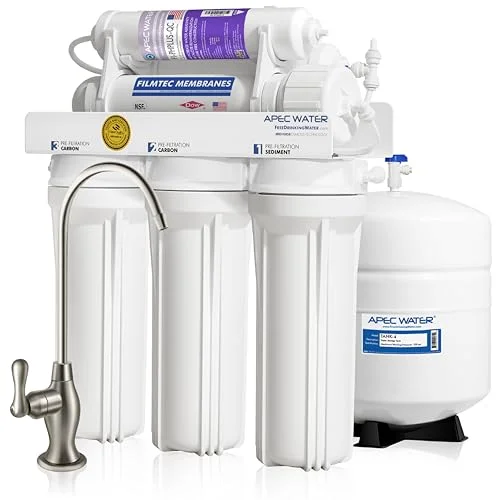
APEC Water RO-PH90

The alkaline stage for a household that drains the tank fast
6-stage · alkaline · 90 GPD · RO-PH90 (Nickel)

Same six-stage alkaline architecture as the ROES-PH75X above, built around a higher 90 GPD membrane for households that refill the tank more often — more people, more cooking use, or just a habit of drawing water faster than a 75 GPD system recovers. The RO-PH90 (Nickel) variant is the finish this listing ships in; if your kitchen hardware is a different finish, check the listing rather than assuming a match, since that's the only size/variant detail APEC publishes for this one. The remineralization stage does the same job described above: it raises pH and adds back a measured amount of calcium after filtration, nothing more.

APEC Water RO-PH90 6-stage under-sink reverse osmosis alkaline system, 90 GPD, nickel finish
$299.99
6-stage · 90 GPDCheck price →

Where the extra cartridge cost is worth it — and where plain RO is enough

An alkaline stage is one more consumable on a schedule separate from the sediment and carbon cartridges, typically budgeted at roughly the same six-to-twelve-month cadence as other post-membrane stages — add it to the running-cost math in our filter replacement cost guide rather than treating it as free once the system is bought. Whether that extra cartridge earns its keep comes down to what you're actually buying it for.

Worth it: if flat-tasting straight RO permeate is the specific thing you or your household dislikes about reverse osmosis water — the complaint that sends people back to bottled water out of habit — a remineralization stage addresses that directly and is the cheapest fix available, cheaper than switching systems or giving up on RO altogether. It's also a reasonable default if you'd simply rather your drinking water sit closer to a neutral-to-slightly-alkaline pH than the low-6s permeate a bare membrane produces, purely as a chemistry preference with no claimed health angle attached.

Plain RO is enough: if your priority is maximum contaminant removal and the lowest total dissolved solids, an alkaline stage works slightly against that goal, since it is deliberately reintroducing some of what the membrane removed. It's also the wrong purchase if the expectation is a health or digestive benefit — the stomach acid math above is the reason that expectation won't be met, and no cartridge, alkaline or otherwise, changes it. And if cost is the deciding factor, skipping the stage removes one more recurring cartridge from the yearly bill without giving up anything in filtration performance.

FAQ

Questions people ask about alkaline RO water

Does alkaline water actually raise my body's pH?

No. Resting stomach acid sits around pH 1.5 to 3.5, and the body actively secretes hydrochloric acid to maintain that environment — a glass of pH 9 water is neutralized almost immediately on contact, and blood pH is separately held in a narrow 7.35–7.45 band by the kidneys and lungs regardless of what you drink. This is general information, not medical advice.

What does an alkaline stage in an RO system actually change?

Two things: it raises the finished water's pH, typically by passing it through a calcite or mineral-blend cartridge after the membrane, and it reintroduces a measured amount of calcium (and sometimes magnesium) that the membrane had stripped out. Neither of our sourced listings publishes a guaranteed finished pH, so treat "alkaline" as a stage the system includes rather than a verified number.

Does alkaline water taste better than plain RO water?

For a meaningful share of people, likely somewhat — dissolved minerals contribute to mouthfeel, and straight RO permeate can taste flat by comparison. The honest expectation is a small improvement, not a transformation: most of what people notice as "better-tasting" RO water comes from chlorine and odor removal that any RO system provides, alkaline or not. We have not run a controlled blind tasting ourselves, so this is a calibrated expectation rather than a tested result.

Is the extra alkaline cartridge worth the added cost?

If flat-tasting RO water bothers you, or you simply prefer water closer to neutral pH, yes — it's a cheap, direct fix. If you're buying it expecting a digestive or health benefit, the stomach-acid math says that expectation won't be met. If maximum contaminant removal and the lowest TDS is the priority, a plain system without the stage works against that goal and is the simpler, cheaper choice.

Keep reading

Next, if you're still deciding