Best RO Systems
Home › Guides › Generic vs OEM filters
Buying advice

Generic vs. OEM Reverse Osmosis Filters: Do Third-Party Cartridges Actually Fit?

We're reader-supported: buying through our links may earn us a commission at no extra cost to you. We compare published specifications, listing claims and prices — we don't run a testing lab.

Generic reverse osmosis replacement filter cartridges arranged next to an open under-sink system

Open the listing for almost any reverse osmosis system's official replacement filters and the price tends to land somewhere between forty and seventy dollars for a year's supply. Search the same housing size on Amazon and you'll find sets from brands you've never heard of — MewMore, SimPure, Geekpure — running ten to twenty dollars cheaper, sometimes for the exact same five stages. The price gap is real. What actually matters is whether the cheaper cartridge is a physical match for the housing under your sink, and whether "match" means the same thing for a sediment filter as it does for the membrane.

The manufacturer's own filter costs more for reasons beyond margin: R&D that set the stage count and micron ratings, a support line, warranty exposure, and — on systems with a full NSF/ANSI certification — the testing behind it. None of that is a line item on the box, but it's priced into it.

What's physically inside the cartridge is usually less exotic. A sediment filter is spun or pleated polypropylene. A carbon stage is granular activated carbon or an extruded carbon block. A 75 GPD membrane is a thin-film composite spiral-wound element built to a common industry output rating. These are commodity components, and a third-party brand can sell the same class of media for less because it isn't carrying the system manufacturer's overhead — not because the media is necessarily worse. That's why "generic" and "inferior" aren't the same word here, and why the four sets below are worth reading closely rather than dismissing on brand name.

Standard 10x2.5 housings: the size that makes any of this possible

None of this third-party market would exist without one unglamorous fact: the classic under-sink RO housing — the vertical canister a sediment, carbon or membrane cartridge screws or slides into — comes in an industry-standard size. Ten inches long, two and a half inches in diameter. That dimension, not the brand on the faceplate, is what a cartridge maker actually needs to match. A filter built to 10x2.5 spec fits any housing built to 10x2.5 spec.

That's the mechanism behind every one of the four sets covered here. iSpring's F4AK listing states its size plainly — 10 inch x 2.5 inch — and describes the pack as built "for 5 and 6-Stage Standard Reverse Osmosis RO Systems," not for one specific model. SimPure's listing puts the housing type directly in the product name: a kit built for "Standard 10-inch 5-Stage Reverse Osmosis RO Systems." Neither company needed to know your system's brand — only the housing dimension.

The alternative — and the reason this comparison doesn't apply to every RO system — is a proprietary quick-change cartridge, the twist-and-pull format used by several modern tankless units. Those housings are shaped to one manufacturer's part, and there's no generic equivalent because there's no shared standard to build to. We cover what that format costs over time in our comparison of proprietary quick-change filters versus universal housings. If your system uses one of those, check which family you're in before you shop on price.

Read the compatibility list before you order, not after it arrives

A standard housing size gets a generic filter in the door. It doesn't automatically mean the specific set you're looking at is the right one, and the only reliable way to know is to read what the listing says about fitment — before you click buy, not after a box of cartridges that don't seat right shows up on your porch. Here's what that looks like across the four sets we could source data for.

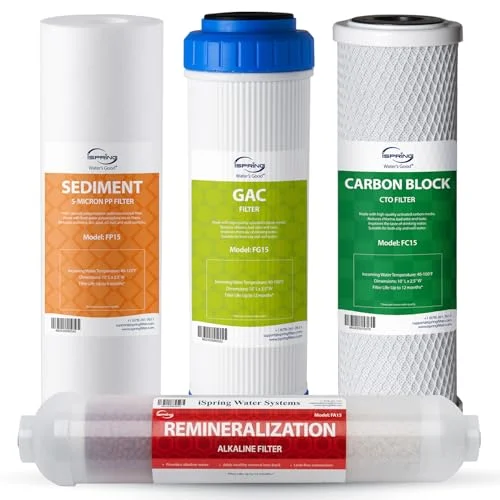
  • iSpring F4AK states its housing size in its own specifications — 10 inch x 2.5 inch — and names its target category: 5 and 6-stage standard RO systems. A claim you can check against your own housing with a tape measure and a stage count.
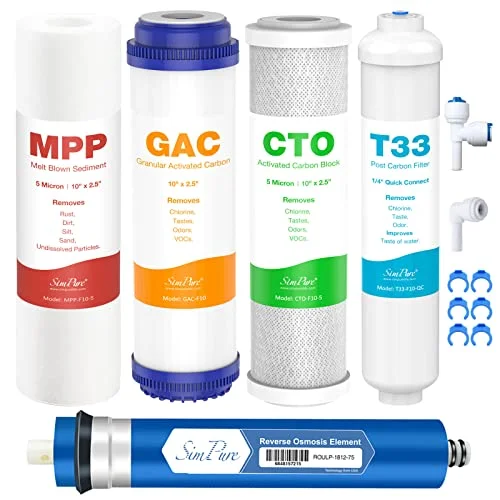
  • SimPure's product title makes the same claim a different way: built for "Standard 10-inch 5-Stage Reverse Osmosis RO Systems." The variant field just describes the box contents — a 5-piece set — so the housing-size promise lives in the title, not a separate spec line.
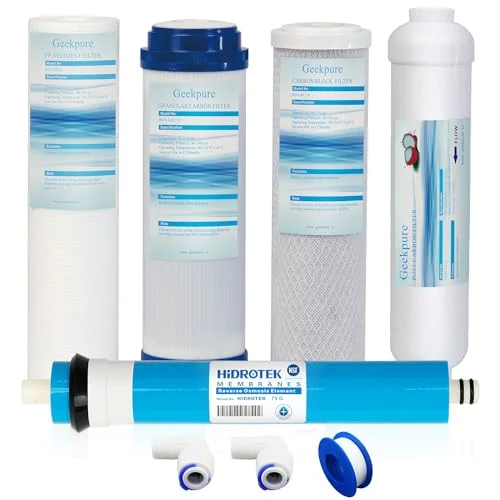
  • Geekpure's listing tells you what's boxed — 8 pieces — and that it includes an NSF-certified 75 GPD membrane. What we don't have from the data available to us is a stated housing dimension. That's not the same as "it doesn't fit a standard housing" — it likely does — but we won't assert a bowl size the listing summary didn't give us. Check the full listing before ordering.
  • MewMore's listing markets itself on stage count, GPD rating and a one-year kit framing — 5-stage, 75 GPD, twelve months of cartridges. Same rule as Geekpure: no stated bowl dimension in the data we have, so confirm the physical size on the product page rather than assuming "5-stage" alone guarantees a seat in your canisters.

The pattern worth internalizing: some listings put the compatibility claim in a structured spec field, some in the product title, some leave it in the description or Q&A. All are legitimate places for it to live. None of them is "just trust the stage count," because stage count tells you what's in the box, not what the outside is shaped like.

What goes wrong with a mismatched GPD-rated membrane

GPD — gallons per day — is the manufacturer's rated output for an RO membrane, measured under a specific set of test conditions. It's a design parameter the rest of the system is built around, particularly the flow restrictor that sets the ratio between water that becomes drinking water and water that goes down the drain. Three of the four sets here — MewMore, SimPure and Geekpure — explicitly list a 75 GPD membrane, which puts them in the same output class as most residential 5-stage systems we cover elsewhere on this site.

Drop in a membrane rated well above or below your system's original spec and the flow restrictor is no longer sized for what's coming through it. A higher-rated membrane can push more water through than the restrictor and storage setup were built to balance, shifting the reject ratio and, in some configurations, letting more dissolved solids through before the water has had time to filter properly. A meaningfully lower-rated membrane starves the system of flow — a slow-filling tank or faucet, long before anything about water quality changes. Neither failure mode is a crisis, but both are avoidable: match the GPD rating on the replacement to the rating on your original system's spec sheet, not to whichever number is cheapest that week.

This is also where generic and OEM membranes are functionally closest. A 75 GPD thin-film composite membrane from a third-party brand and one from your system's manufacturer are built to the same output target using the same category of material. GPD is the one spec worth treating as non-negotiable when you shop generic; almost everything else is more forgiving.

Certification on a generic filter versus a full-system certification

This is the distinction that gets flattened the most in casual shopping, so it's worth being precise. NSF/ANSI 58 is a certification for an assembled reverse osmosis system — the whole stack of components tested together against a contaminant-reduction standard. NSF/ANSI 372 certifies something narrower: that the materials in a component are lead-free. A component can carry its own NSF mark without that mark meaning anything about the system it eventually sits inside.

Geekpure's listing advertises its membrane as NSF-certified — a claim about that single part. It does not tell you the complete system you drop it into still holds the system-level certification your original unit shipped with. If your RO system earned NSF/ANSI 58 as a tested assembly — the way iSpring states its RCC7AK line is certified as an entire system, not stage by stage — that certification describes the specific parts that were in it when tested. Swap in a third-party membrane, certified or not, and the system in your cabinet is no longer the exact assembly the certificate refers to. It will very likely still work fine; what you've lost is the third-party paperwork proving it does.

None of the four listings here claim a full-system NSF/ANSI 58 certification, and there's no reason they should — they're replacement cartridge sets, not complete systems. The honest use of a component-level claim like Geekpure's NSF-marked membrane is as one data point about that part, not a substitute for the system certification you're partially stepping outside of by using any non-OEM part.

The arithmetic

Running the five-year cost, OEM versus generic, on one system

One classic 10-inch, 5-stage system, two paths. The OEM figures below are the same worked numbers we published in our full filter replacement cost breakdown; the generic figures come from the four sets on this page.

Take a standard 10-inch, 5-stage system and run both paths side by side. On the OEM side, we already worked this out in detail elsewhere on this site: a complete iSpring cartridge schedule — the F9K set covering every non-membrane stage annually, plus one membrane pack every two to three years — totals $401.29 over five years, or roughly $80 a year averaged out.

On the generic side, three of the four sets here are marketed as full replacements including a 75 GPD membrane — MewMore as a "1-Year Kit," SimPure as a 5-piece set through the membrane, Geekpure as an 8-piece set that also includes one. Replacing one of those complete sets every year for five years:

  • MewMore at $33.99 × 5 = $169.95
  • SimPure at $38.85 × 5 = $194.25
  • Geekpure at $38.99 × 5 = $194.95

Read at face value, that's roughly half the OEM total. But that's only fair if you genuinely need to replace the entire stack — membrane included — every single year, a more aggressive cadence than these same manufacturers, and most OEM systems profiled elsewhere on this site, actually recommend: two to three years is the norm, because a membrane loses rejection capacity gradually rather than clogging. Buying a full membrane every twelve months when the existing one still has capacity left is the calendar mistake in generic-pricing disguise.

A fairer estimate would separate the fast-wearing stages from the slow-wearing membrane and only replace the membrane every two to three years, the way the OEM math does. None of the four listings sell components broken out that way in the data we have — they're complete kits — so we can't run that split to the dollar without guessing at a per-stage price nobody publishes. That gap is itself worth stating rather than hiding: the generic sets are priced to look like a full annual replacement, and whether that beats the OEM path over five years depends on a membrane-life assumption none of these listings state. Treat "$36 versus $80" as an illustration of what the standard-housing market does to sticker prices, not a guaranteed five-year bill.

Separately, iSpring's F4AK at $36.62 isn't a fair stand-in for a full annual replacement — it's a partial set covering sediment, carbon and alkaline stages with no membrane in the box, so it compares against the non-membrane half of an OEM schedule, not a complete kit like MewMore's or SimPure's.
The four sets

What each listing actually says

011-Year Kit

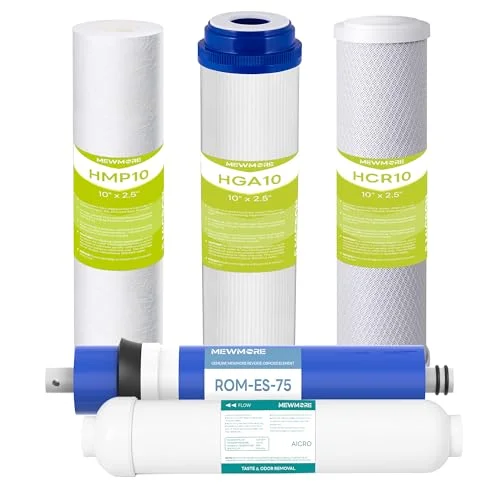
MewMore 5-Stage 75 GPD Reverse Osmosis Replacement Filter Set

Sold as a full twelve-month supply
$33.99 · 5-stage · 75 GPD · 1-year kit

The lowest sticker price of the four, and the only one marketed around a one-year cadence rather than a piece count. Worth the same skepticism as any full kit sold as an annual purchase: a 75 GPD membrane commonly lasts two to three years, not one. No stated housing dimension in the data available to us, so confirm on the product page that the cartridge sizes match your existing housings before ordering — don't rely on "5-stage" alone.

MewMore 5-Stage 75 GPD reverse osmosis replacement filter set
$33.99
1-Year KitCheck price →
02Confirmed 10x2.5

iSpring F4AK 6-Month Prefilter and Alkaline Replacement Set

A partial set — no membrane in the box
$36.62 · 10 inch x 2.5 inch · for 5 and 6-stage standard RO systems

The one listing here that states its housing size outright — 10 inch by 2.5 inch — and names its target category: 5 and 6-stage standard RO systems. The clearest compatibility statement of the four, but read the scope carefully: this is a prefilter-and-alkaline supply pack, not a complete kit. No RO membrane in the box, so it pairs with your existing membrane rather than replacing it — not a fair one-to-one comparison against a full kit that includes one.

iSpring F4AK 6-month prefilter and alkaline replacement filter cartridge set
$36.62
10x2.5 · No membraneCheck price →
03Named for standard housings

SimPure 5-Stage Reverse Osmosis Replacement Filter Set with 75 GPD Membrane

Fitment claim is built into the product title
$38.85 · 5-piece set · 75 GPD membrane · for standard 10-inch 5-stage systems

SimPure names its target housing directly in the listing title — "Standard 10-icnh 5-Stage Reverse Osmosis RO Systems" — rather than a separate spec field, a legitimate place for the claim to live, provided you actually read the title. The variant field just describes box contents (5 pieces, membrane included). As with MewMore, a full membrane bundled into an annual-style set is worth checking against your system's actual replacement interval before buying it every year.

SimPure 5-stage reverse osmosis replacement filter set with 75 GPD membrane
$38.85
5 Piece SetCheck price →
04NSF-marked membrane

Geekpure 5 Stage Reverse Osmosis Filter Set with 75 GPD NSF Membrane

The only one of the four advertising an NSF mark
$38.99 · 8-piece set · 75 GPD · NSF-certified membrane

The highest piece count of the four, and the only listing calling out an NSF certification — specifically on the membrane, a component-level claim, not evidence the assembled system still carries whatever certification it shipped with. No stated housing dimension in the data available to us, so treat "8 pieces" as what's in the box, not confirmation of fit, and check the full listing before ordering.

Geekpure 5-stage reverse osmosis filter set with 75 GPD NSF-certified membrane
$38.99
8 Piece SetCheck price →

When sticking with the manufacturer's own filters is still worth the premium

None of the above argues generic always wins. A few ordinary situations make the OEM premium the sane call.

The system is still under warranty. Some manufacturers reserve the right to decline a claim if a non-OEM part is implicated in a failure. While real warranty value remains, the premium on an official filter is cheap insurance.

Your housing uses a proprietary quick-change cartridge. That format has no generic market — there's only one seller. Our quick-change versus universal housings comparison works through what that lock-in costs over time.

You need the system-level certification to still describe what's installed. If NSF/ANSI 58 is a real factor — a landlord requirement, a well-water situation leaning on that third-party testing — the manufacturer's own parts keep the certified assembly intact. A generic membrane may perform identically; it won't come with the same paperwork.

You can't find a confident compatibility answer. If no third-party listing states a clear match for an old or obscure system — no housing dimension, no named category — that uncertainty has a cost: a return, a delay, a second order. The manufacturer's own part is built for your exact model.

The price gap is small enough that it isn't really a decision. At a five- or ten-dollar-a-year spread, the certainty of an exact-fit, manufacturer-backed part is worth more than the savings.

Outside those cases — a standard 10x2.5 housing, a system out of warranty, a clearly stated compatibility match, and a price gap wide enough to matter — a generic set explicit about its housing size and GPD rating is a reasonable substitution. The four sets above range from very explicit (iSpring's stated 10x2.5 dimension) to reasonably explicit (SimPure's title claim) to silent on fit in the data we could source (MewMore, Geekpure) — and that range is the actual decision, more than any brand name on the box.

FAQ

Questions people ask about generic RO filters

Will a generic filter actually fit my reverse osmosis system?

Almost certainly, if your system uses the standard 10 inch by 2.5 inch housing that the classic tank-and-canister systems use — that size is an open industry standard, which is exactly why iSpring's F4AK and SimPure's 5-stage kit can both build to it without needing to know your system's brand. It will not fit if your system uses a proprietary quick-change cartridge, which has no generic equivalent. Check the listing for a stated housing dimension or named system category before ordering either way.

Does a cheaper GPD-rated membrane hurt performance?

Only if the GPD rating doesn't match your original system's spec. GPD is a manufacturer-rated output figure the rest of the system, particularly the flow restrictor, is built around. A membrane rated meaningfully higher or lower than your system's original spec can shift the reject ratio or starve flow. Three of the four sets we looked at — MewMore, SimPure and Geekpure — list a 75 GPD membrane, which matches the output class of most residential 5-stage systems; matching that number to your original spec sheet is the one non-negotiable check.

Is a generic filter's certification the same as my system's certification?

No, and the difference matters. NSF/ANSI 58 certifies a complete, assembled system as tested. A component like Geekpure's NSF-marked membrane carries a claim about that single part, not about the system it's installed into. Once you swap in any non-OEM component, the system technically steps outside the exact assembly its original certificate describes, even if it performs identically in practice.

Is it ever worth paying for the manufacturer's own filters?

Yes — mainly while a system is still under warranty, if it uses a proprietary quick-change cartridge with no generic option, if you specifically need the system-level NSF/ANSI certification to remain intact, or if you can't find a confident compatibility match for an older or obscure system. Outside those cases, a generic set that clearly states its housing size and GPD rating is a reasonable substitution on a standard 10x2.5 system.

Keep reading

Next, if you're still deciding