Picks
The quietest reverse osmosis systems: non-electric vs. tankless compared
By Ilane TallUpdated November 15, 202613 min readResearch-based
We're reader-supported: buying through our links may earn us a commission at no extra cost to you. We compare published specifications, listing claims and prices — we don't physically test these systems and we don't run a testing lab.
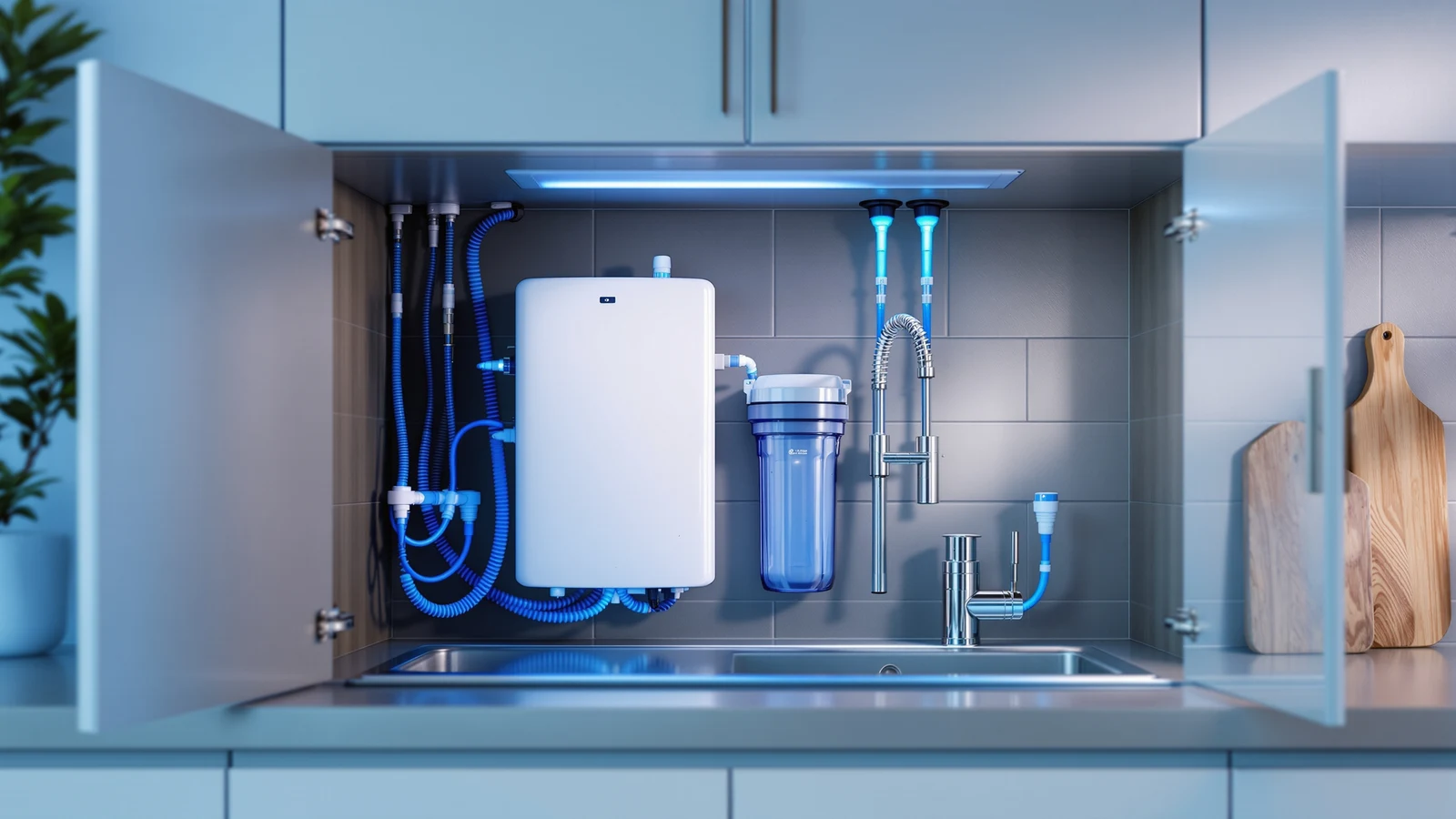
"Quiet" gets used as a one-word marketing claim on almost every reverse osmosis listing, which is exactly why it's worth unpacking into the three things that actually make noise under a sink. A classic tank-and-housings system generates sound in three distinct places. The first is the booster or delivery pump itself — the small electric motor that pressurizes water through the membrane, the part most people picture when they hear "RO system hum." The second is the storage tank refilling: a bladder inside a steel or plastic shell expanding against pressurized air, which can produce a low thump or hiss that continues after you've stopped drawing water. The third is drain flow — the continuous trickle of reject water leaving for the drain line, audible mostly as a faint running-water sound inside the cabinet rather than anything mechanical.
Most buying guides treat "noise level" as a single spec to rank systems against, when it's really a question of which of those three sources a design has engineered around — and whether it removed the source or just muffled it. That distinction is the premise of this comparison. Frizzlife's M800 and GLACIER FRESH's GFU03 take the removal route: both are built without an electric pump at all, so there's no motor to hum in the first place. Waterdrop's G2 and VonWater's 600 GPD system take the muffling route: both are tankless electric designs that still run a pump, but house it inside a sealed, compact enclosure engineered to contain the sound rather than let it radiate into the cabinet.
Neither approach is "the quiet one" in absolute terms — they're quiet for different reasons, and that difference carries real trade-offs once you get past the spec sheet.
The non-electric route
How the Frizzlife M800 and GLACIER FRESH GFU03 eliminate the pump entirely
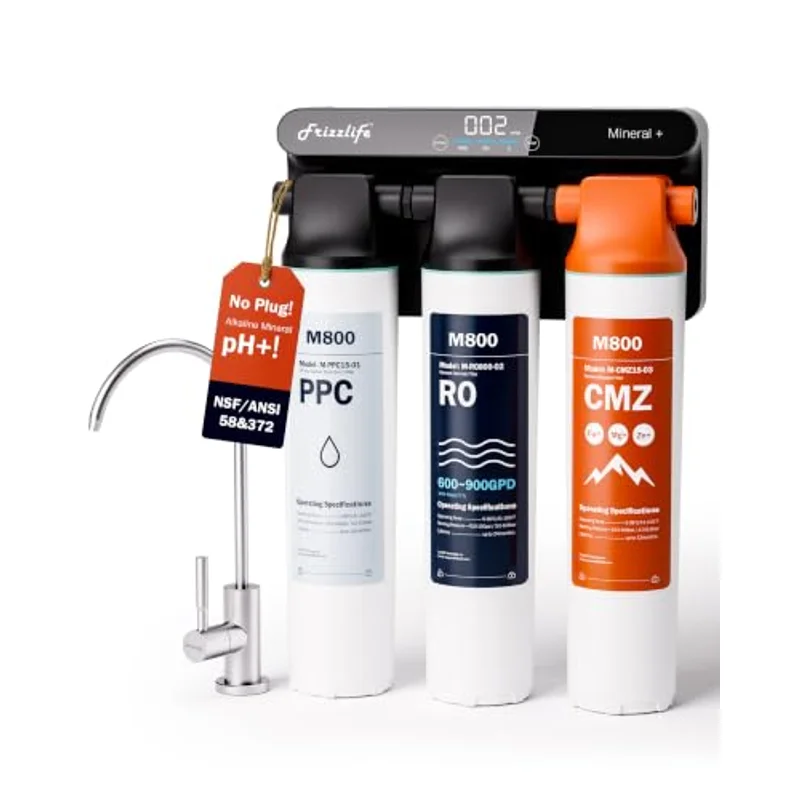
The most direct way to stop a pump from making noise is to not have one. Frizzlife markets the M800 explicitly as non-electric: a tankless reverse osmosis system rated up to 900 GPD that runs purely on the pressure already present in your home's cold-water line, with no booster motor, no power cord, and no wall outlet required under the sink. It's an alkaline mineralized system — it adds minerals back into the water after the membrane stage — built around what Frizzlife calls a "huge filter" design with an auto-flush function, and it's certified to NSF/ANSI 58 and 372, with a stated 4:1 pure-to-drain ratio. None of that is what makes it quiet, though — what makes it quiet is simply the absence of a motor. There is nothing drawing current and spinning to generate the hum that dominates most people's mental model of RO noise.
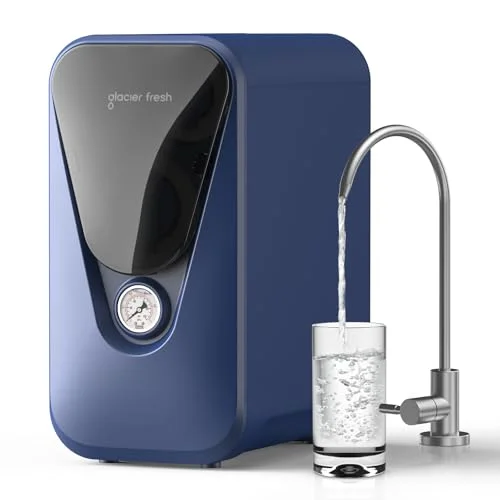
GLACIER FRESH's GFU03 takes the same structural approach from a different brand. It's sold as an "Electric-Free Reverse Osmosis Water Filter" rated at 800 GPD, in the U03-Classic configuration, at a lower price point than the M800. The branding is the point: GLACIER FRESH is making the same bet Frizzlife is — that removing the pump removes the single loudest, most constant noise source in a conventional RO install, rather than trying to insulate around it. Beyond the product name, output rating and price, GLACIER FRESH's listing doesn't publish further certification or drain-ratio figures the way Frizzlife's does, so we won't assign the GFU03 specs it hasn't stated.
What both systems share, mechanically, is that they rely entirely on your incoming water pressure to push water through the membrane. There's no pump standing between a weak supply line and a usable flow rate — which is why the trade-off described further down matters more for this pair than for the two electric systems in this comparison.
The electric route
Airtight housings: how Waterdrop and VonWater quiet the pump instead of removing it
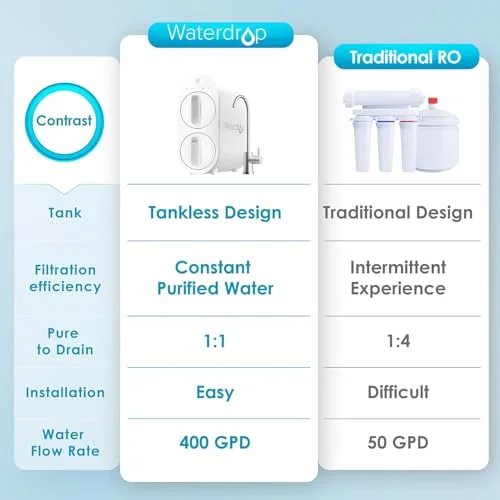
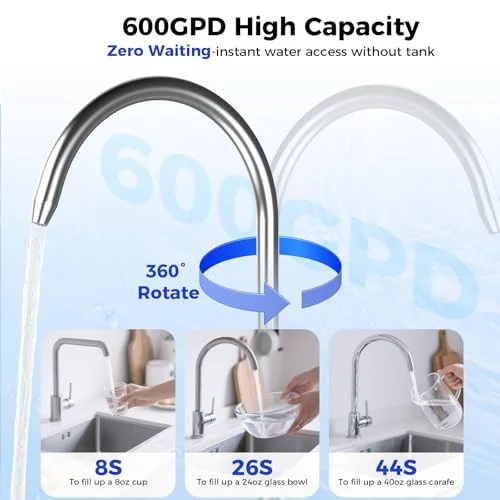
Waterdrop's G2 and VonWater's 600 GPD system solve the same noise problem from the opposite direction. Both are tankless under-sink systems — Waterdrop's G2 rated at 400 GPD, VonWater's at 600 GPD — and both still rely on an electric pump to push water through the membrane at usable pressure. Neither listing claims to have removed the motor; what both are selling instead is a compact, sealed housing engineered to contain that motor's noise rather than let it radiate freely into the cabinet the way an open tank-and-canister layout would.
The logic is architectural: a tankless design collapses what used to be three or four separate housings, a pressure tank and a web of connecting tubing into a single slim enclosure. Fewer open surfaces and fewer loose connections mean less for sound to escape through. VonWater's 600 GPD system and Waterdrop's G2 both fit that compact, tankless profile, and at $175.99 and $239.99 respectively they sit well under the price of either non-electric system in this comparison — the airtight-housing route is also the cheaper way to a quieter kitchen, on these four products.
The honest caveat: an electric tankless system quiets the pump, it doesn't silence it. There is still a motor cycling on when you draw water and off when you stop, and a sealed housing reduces how much of that cycling you hear rather than eliminating the sound at its source the way the M800 and GFU03 do. For some kitchens that distinction won't matter; for others — particularly the open-plan layouts discussed further down — it's the deciding factor.
The honest trade-off
What you give up by going non-electric
Removing the pump doesn't just remove the noise source — it removes the one component whose job is to compensate for whatever your house's water pressure isn't giving you. On a pumped tankless system, the motor can push harder when incoming pressure is marginal, holding flow roughly steady across a range of supply conditions. On a non-electric system like the M800 or the GFU03, there is nothing standing between your home's actual line pressure and the membrane. Whatever pressure the municipal supply or your well pump delivers at the kitchen cold line is the pressure the system has to work with, full stop.
In practice that means flow rate and effective output on a non-electric system are more directly tied to your household's real-world water pressure than the GPD figure on the box might suggest in isolation — a rated capacity of up to 900 GPD for the M800 or 800 GPD for the GFU03 describes what the system is capable of under adequate supply pressure, not a guaranteed number regardless of what's coming out of the wall. Homes on the lower end of normal residential pressure, longer plumbing runs from the main, or households sharing supply with other high-draw fixtures running at once are the scenarios where that dependency shows up most, as slower fill times at the faucet.
If your home's pressure is solid and consistent, a non-electric system gives you genuine pump-free silence with no meaningful downside. If you're not sure what your line pressure actually is, that's worth checking before committing to the non-electric route specifically — a pumped tankless system like the Waterdrop G2 or VonWater's unit is the more forgiving choice when supply pressure is a known unknown, precisely because it has a motor that can pick up the slack a non-electric design can't.
Putting it together
Open-plan kitchen or closed cabinet: which type to pick
If the sink is the centerpiece of an open-plan kitchen that flows into a living or dining area with no door and no wall to contain sound, the non-electric route has a real edge: there is no motor cycling on and off for a nearby conversation to pick up on. The Frizzlife M800 or the GLACIER FRESH GFU03 remove that variable entirely rather than relying on a sealed housing to keep it contained. The one thing worth confirming first is your home's water pressure, since an open-plan kitchen with marginal supply pressure is exactly the scenario where a non-electric system's flow-rate dependency shows up most.
If the system is going into a separate utility closet, a pantry, a basement feed line, or simply a cabinet with a door that closes firmly and sits away from where people gather, a sealed tankless electric system is the more practical call. The cabinet itself is already doing most of the acoustic work a non-electric design would otherwise need to do structurally, and you gain a pump that can compensate for whatever your actual water pressure turns out to be. Waterdrop's G2 and VonWater's 600 GPD unit both fit that scenario well, and at $239.99 and $175.99 respectively, the closed-cabinet route is also the less expensive one on these four products.
Either way, a quiet system paired with a poorly sealed cabinet door, or a non-electric system paired with weak house pressure, will undersell what the hardware is capable of. Match the system to the room it's going into, not just to the spec sheet.