Best RO Systems
Home › Guides › Reverse osmosis systems with leak detection
Picks

The best reverse osmosis systems with leak detection built in

We're reader-supported: buying through our links may earn us a commission at no extra cost to you. We compare published specifications, listing claims and prices — we don't physically test these systems and we don't run a testing lab.

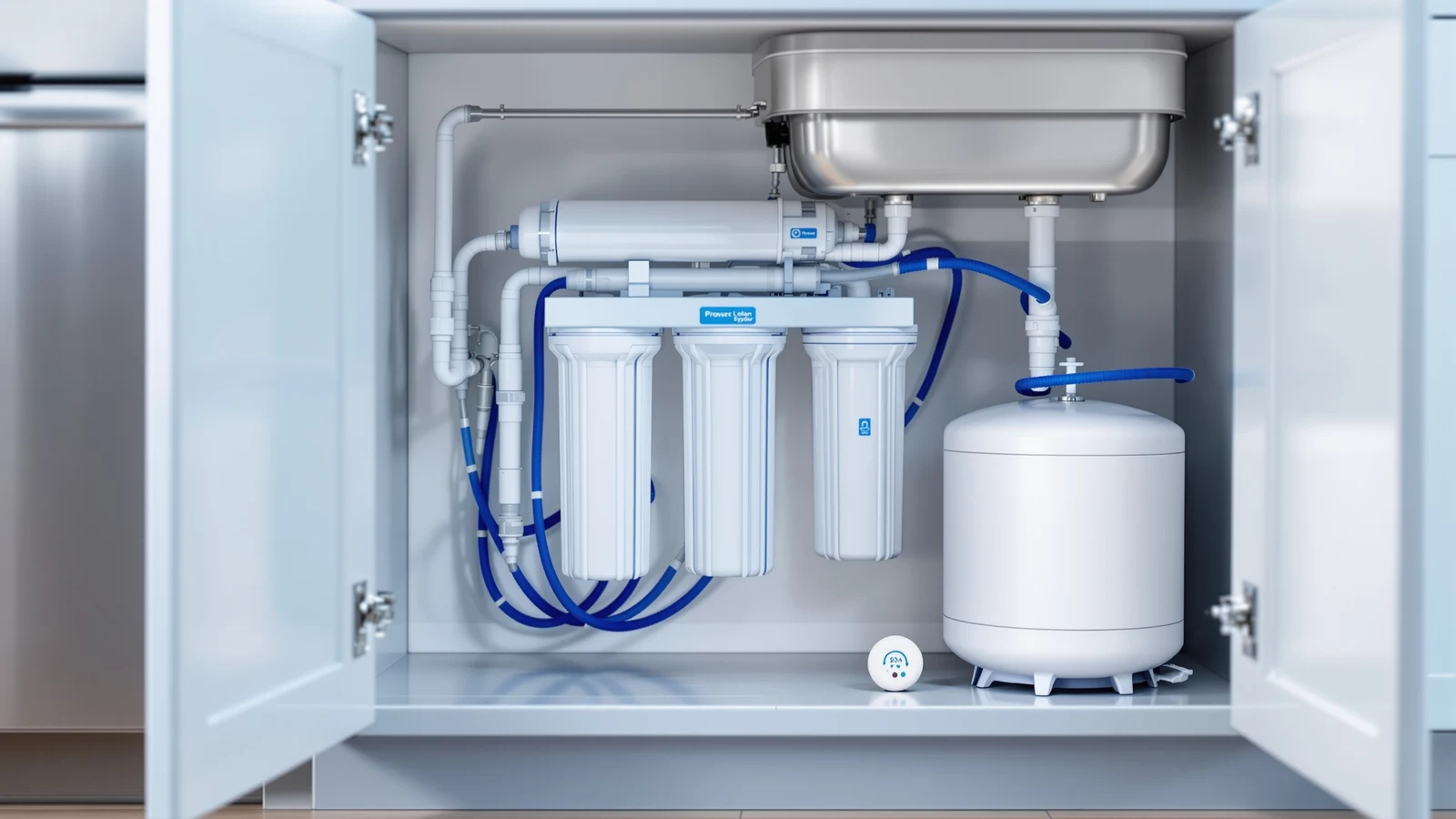
Under-sink reverse osmosis system with a water leak detector puck and shut-off valve installed on the cabinet floor

Search any reverse osmosis forum for what actually goes wrong after installation and the answer is almost never the water itself. It's the cabinet floor. A loose quick-connect fitting, a cracked housing cap, an overfilled drain saddle, a faucet adapter hand-tightened a quarter-turn short — any of them can turn an under-sink cabinet into a slow flood overnight, often in a house where nobody is standing in the kitchen to notice. Contamination complaints, by contrast, are rare and usually trace back to a neglected filter rather than the system itself.

That asymmetry is the premise of this guide. A reverse osmosis system runs on household line pressure through several threaded housings, lengths of tubing, a tank or tankless pump, and a dedicated faucet — every one of those is a joint, and every joint is a place water can find its way out instead of through. The membrane doing the actual filtering is, by comparison, one of the more reliable parts of the assembly. Manufacturers have responded in two different ways: bundle a physical sensor that catches the leak after it starts, or redesign the plumbing so there's less for a leak to come from in the first place. The five systems below split across both approaches, and knowing which one you're buying matters more than any contaminant-removal spec on the box.

Two of the five ship with a standalone leak detector and shut-off valve in the box. Two more are classic tank systems that lean on sealed canister housings and a faucet design meant to remove the single most common DIY leak point. The last is a tankless system that collapses several of those joints into one sealed circuit. None of them is a cure-all, and the section on what auto-shutoff actually stops further down is as important as the picks themselves.

In the box

Physical leak detectors: VIVA21 and Express Water compared

The most direct answer to "what if it leaks anyway" is a dedicated sensor that sits on the cabinet floor, under the system, and does one job: notice water where there shouldn't be any. VIVA21's 5-stage system is explicit about this on the listing itself — it ships with a leak detector as a named, bundled component, alongside the tank and lead-free faucet, rather than treating it as an accessory you buy separately after the fact. That makes it one of the few systems in this category where leak protection isn't an afterthought bolted onto the spec sheet; it's part of what you're paying $199.99 for on day one.

Express Water's RO5DX sits in the same conversation for a different reason. It's a conventional 5-stage, 50 GPD tank system — the same basic layout that's been the entry point into reverse osmosis for a decade — and Express Water is one of the brands in this category known for pairing that standard hardware with its own battery-powered leak detector and shut-off puck, the kind that sits in the drip tray and cuts the cold-water feed the moment it senses moisture at the cabinet floor. At $142.79 it costs ten dollars more than VIVA21 and states a 50 GPD output where VIVA21's listing publishes none — if GPD matters to your decision, verify it on the current product page before buying either one.

What both have in common is the mechanism, not the brand: a float or contact-based sensor paired to a solenoid valve on the feed line. The moment the sensor's electrodes touch water, the valve closes and the system stops pulling from the house supply. It's a different category of protection from the systems in the next section, because it reacts to water that has already escaped rather than preventing the escape in the first place.

ModelBest forLeak protectionStagesPrice
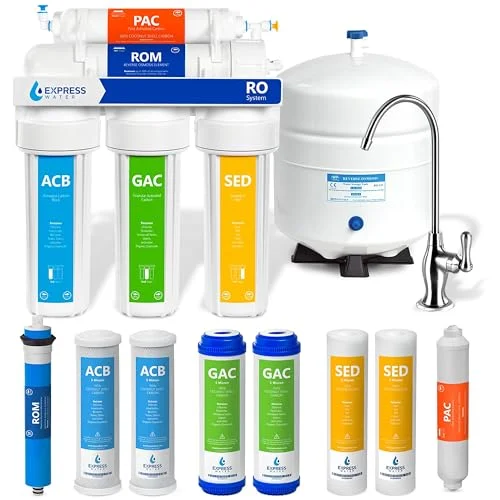
VIVA21Best bundled detectorLeak detector + tank, in the box5-stage$199.99Price
Express Water RO5DXAlso ships with a detectorDetector puck + auto shut-off valve5-stage$142.79Price
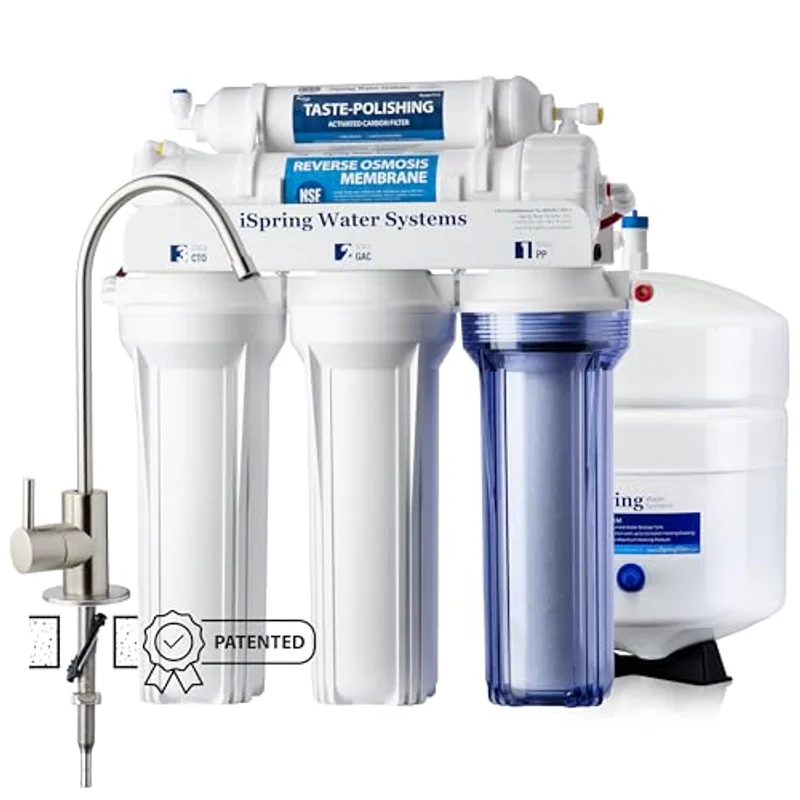
iSpring RCC7-BNBest sealed standard housingsSealed canisters, top-mounted faucet5-stage$178.49Price
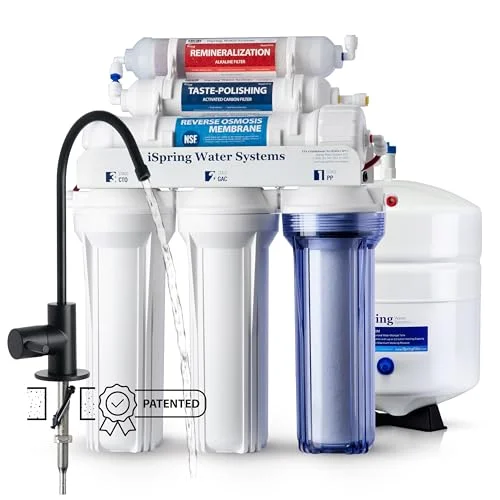
iSpring RCC7AK-BLKBest sealed + alkalineSealed canisters, same fitting design6-stage$202.49Price
Waterdrop G2Fewest leak pointsTankless integrated circuitTankless$239.99Price
A different strategy

Sealed housings and leak-resistant fittings: the iSpring approach

Neither iSpring listing in this guide states a bundled electronic detector, and we're not going to credit one that isn't on the spec sheet. What iSpring sells instead is a structural argument: reduce the number of places a joint can fail, and make the one connection most people get wrong on install day harder to get wrong.

The RCC7-BN, iSpring's NSF Certified 5-stage system at $178.49, is built around standard 10-inch by 2.5-inch canister housings — threaded caps over an internal o-ring seal, the same basic sealing mechanism used across the category, rated at 75 GPD. The detail iSpring calls out on the listing is its patented top-mounted faucet design. A conventional RO faucet is tightened from underneath the sink, by feel, often one-handed, in the dark — exactly the setup that produces a faucet base that's snug but not actually sealed. A top-mounted design lets you tighten the fastener from above the counter, where you can see what you're doing. A mis-threaded faucet connection is one of the most common leak points on a DIY install, and removing the guesswork there removes a failure mode VIVA21's and Express Water's detectors would only ever catch after the fact.

The RCC7AK-BLK carries the same housing and sealing approach up a tier: NSF/ANSI 58 certified as a complete system, a 6-stage alkaline design with a pH+ remineralization stage, and a black-finished faucet, at $202.49. The listing doesn't state a GPD output figure, so we won't assign it one. What it inherits from its sibling is the structural logic — standard housings, the same fitting discipline — applied to a system that also puts minerals back into the water after the membrane strips them out. For a detector-equipped alternative at a similar price instead, that's where Express Water's RO5DX and this pick part ways, and our comparison of entry-level brands digs further into how these tank-system fundamentals stack up brand to brand.

Worth being precise about the trade: a well-sealed housing and a correctly tightened faucet dramatically reduce the odds of a leak starting. They do nothing to alert you if one starts anyway — a cracked housing from over-tightening, a tubing kink, a drain saddle that works loose. Pairing either iSpring system with a standalone detector puck is the sensible way to get both halves of the protection the bundled systems above ship with as one purchase.
A third strategy

Tankless integrated circuits: how Waterdrop's G2 reduces leak points

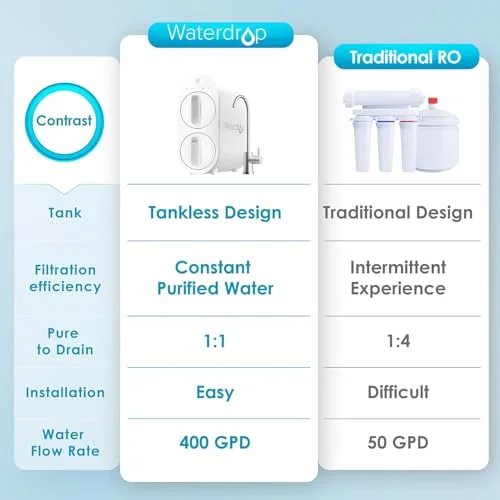
The fifth system here takes a different structural approach from either the detector-equipped pair or the sealed-housing pair. Waterdrop's G2 is a 400 GPD tankless system, priced at $239.99 — the most expensive of the five — and what separates it from a classic tank layout isn't a sensor, it's architecture. A tank system is three or four separate housings, a pressure tank, and however much tubing connects them, each joint a potential leak point in its own right. A tankless design folds most of those stages into a single sealed manifold, with filtration happening in one integrated circuit rather than a chain of discrete canisters linked by fittings.

Fewer joints is not the same claim as no leaks, and nothing about a sealed manifold protects the feed-valve connection at the cold-water line or the drain saddle on the waste pipe — those exist on every under-sink system, tankless or not, including the G2. What the integrated circuit removes is the specific failure mode of a housing cap reassembled slightly off-thread after a filter change, or tubing between two canisters that kinks and splits — the exact points where VIVA21's and Express Water's detectors exist to catch water that's already on the floor. On a tankless system, there are structurally fewer of those points to begin with. For a tankless upgrade path weighed against a tank system in this price range, our look at a competing brand's move into tankless and Waterdrop's own upgrade lineup are both useful side reading before you commit to the higher sticker price.

The picks

The five, in pick order

01Best bundled detector

VIVA21

Leak protection as a named, included part — not an upsell
$199.99 · 5-stage · tank · WQA Gold Seal to NSF/ANSI 58 & 372 · leak detector included

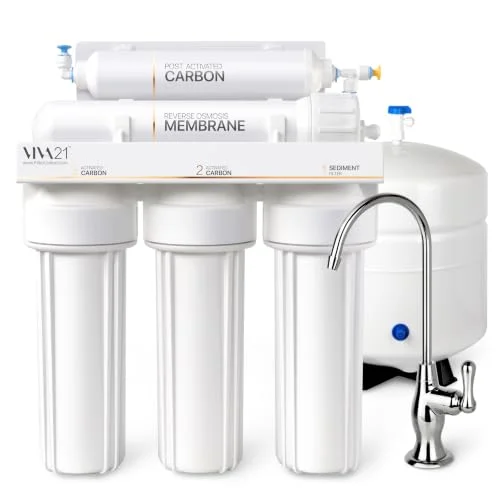
VIVA21 answers the question this guide is built around most directly: a leak detector isn't a $20 add-on to remember later, it's named on the listing as part of what ships in the box, alongside the tank and lead-free faucet. It's also certified to the two standards worth knowing apart — NSF/ANSI 58 for contaminant and TDS reduction, and 372 for lead-free materials — through WQA's Gold Seal program. The listing doesn't publish a GPD figure, so confirm flow rate on the current product page if that matters to you. For most kitchens, a certified 5-stage tank system with an included detector at $199.99 is the simplest way into this category.

VIVA21 5-stage reverse osmosis system with leak detector and tank
$199.99
Detector includedCheck price →
02Also ships with a detector

Express Water RO5DX

A stated 50 GPD tank system with its own detector and shut-off
$142.79 · 5-stage · 50 GPD · tank · detector + auto shut-off valve

The RO5DX is the second system built around the same detector-plus-shutoff logic as VIVA21, and the clearest point of comparison between the two: both are 5-stage tank systems pairing standard filtration with an included sensor, priced ten dollars apart. Where VIVA21's listing states no output figure, Express Water's does — 50 GPD, in line with the slow-fill tank-system class generally, where the point is topping off a pressurized tank rather than pushing water on demand. If a stated GPD number and a bundled detector both matter, this pick gives you both in writing.

Express Water RO5DX 5-stage under-sink reverse osmosis system
$142.79
50 GPD · detectorCheck price →
03Best sealed standard housings

iSpring RCC7-BN

Removes the faucet leak instead of waiting to detect it
$178.49 · NSF Certified · 5-stage · 75 GPD · brushed nickel · top-mounted faucet

The cheapest system here, and the strongest case for prevention over detection. iSpring's patented top-mounted faucet design lets you tighten the fastener from above the sink instead of blind underneath it — removing the single most common DIY leak point at the source rather than alerting you after it happens. At 75 GPD it outpaces both detector-equipped picks above, it's NSF Certified, and it uses standard 10-inch by 2.5-inch housings, so replacement cartridges stay in open competition rather than locked to one brand. It ships with no electronic sensor, so budget for a standalone detector puck separately if you want both lines of defense.

iSpring RCC7-BN NSF Certified 5-stage reverse osmosis system with brushed nickel faucet
$178.49
Top-mounted faucetCheck price →
04Best sealed + alkaline

iSpring RCC7AK-BLK

The same fitting discipline, with remineralization added
$202.49 · NSF/ANSI 58 Certified · 6-stage alkaline · black faucet · pH+ remineralization

Everything the RCC7-BN gets right about housing seals and faucet installation carries over here, on a system certified to NSF/ANSI 58 as a complete assembly rather than component by component. The sixth stage adds pH+ remineralization, putting calcium and magnesium back into the water after the membrane strips it out, on the same standard housing size that keeps a replacement cartridge from being locked to one manufacturer's price list. The listing doesn't state a GPD figure, so treat output as unconfirmed until you check the current page. Like its sibling, it carries no bundled detector — the leak resistance here is structural, not electronic.

iSpring RCC7AK-BLK NSF/ANSI 58 Certified alkaline 6-stage reverse osmosis system with black faucet
$202.49
Alkaline · sealedCheck price →
05Fewest leak points

Waterdrop G2

A tankless circuit with structurally fewer joints to fail
$239.99 · 400 GPD · tankless · integrated filtration circuit

The most expensive pick here, and the most structurally different approach to the same problem. At 400 GPD, Waterdrop's G2 folds the filtration stages a tank system spreads across three or four separate housings into one sealed, tankless circuit — removing the inter-canister tubing and individual housing caps that are common failure points on a classic layout, not by detecting a leak but by reducing the connections that could produce one. It still has a feed valve and a drain line like every system here, so it isn't leak-proof, and it carries no bundled sensor of its own. For a cabinet with room for a slim box and no patience for three housings to reassemble at every filter change, it's the cleanest structural bet in this lineup.

Waterdrop G2 400 GPD tankless reverse osmosis system
$239.99
400 GPD · tanklessCheck price →
Read the limits, not just the feature

What auto-shutoff actually stops, and what it can't catch

An automatic shut-off valve paired with a leak detector does one specific thing well: the moment its sensor contacts water at the cabinet floor, it closes a solenoid valve on the cold-water feed line, stopping the system from continuing to pull pressurized water into an active leak. For the scenario it's designed around — a fitting that lets go while nobody's in the kitchen — that's the difference between a damp floor in the morning and standing water by the time anyone notices. It's genuinely valuable and genuinely limited, and worth being precise about where the limits sit.

01

Location-dependent

The sensor only knows about water that physically reaches it. A leak at the back of a deep cabinet, behind a stored item, or inside a wall cavity the line runs through can go undetected if it never reaches the puck's resting spot on the floor.

02

Residual water

Closing the feed valve stops new water from entering. It does nothing about what's already in the tank, the housings and the tubing at the moment of the trip — that volume still has to drain somewhere, usually onto the same cabinet floor.

03

Battery-dependent

Most standalone detectors run on a battery, not house power. A dead battery is a silent failure: the puck looks identical whether it's armed or not, and the only way to know is to test it.

04

One point of coverage

A detector protects the cabinet it sits in. It says nothing about the supply line feeding the cabinet, the drain line leaving it, or any other fixture in the house — it is not a whole-home leak-detection system.

A detector that isn't placed correctly is decoration

Installing the detector so it actually triggers

Both VIVA21 and Express Water's RO5DX ship with a detector that only works if it's physically where water will actually go, and the single most common installation mistake is placing it somewhere convenient rather than somewhere low.

  1. Find the true low point of the cabinet floor first. Cabinet floors are rarely perfectly flat — a shim, a seam, a slight slope toward the back wall all change where a small leak pools. Pour a cup of water in the empty cabinet before installing anything and watch where it collects; that's where the sensor goes.
  2. Keep it clear of stored items. A detector tucked behind a sponge box or cleaning supplies may never get wet even as the floor around it does. Leave the area beneath the housings, tank and drain saddle empty.
  3. Route the cable with slack. If the sensor connects to a shut-off valve rather than working as a standalone alarm, leave enough slack that it isn't pulled taut by the cabinet door over months of use.
  4. Test it on install day, not after the first leak. Touch the sensor contacts to a wet cloth or a cup of water and confirm the valve closes or the alarm sounds before calling the install finished. An untested detector is a guess, not a safeguard.
  5. Put a battery-check reminder on your filter-change calendar. Most of these sensors run on a replaceable battery — a smart LED indicator, if your system has one, is a natural trigger point to check it at the same time.

None of this is specific to RO systems — it's the same logic that applies to any under-sink leak detector, including standalone accessories for the sealed-housing and tankless picks above. The hardware is cheap; the installation discipline is what makes it work. If a leak ever does get past both the detector and the shut-off, it's worth knowing what a manufacturer's warranty covers for water-damage claims — our warranty coverage comparison works through that across several brands, VIVA21 included.

How we picked

Five systems, one problem

We looked for reverse osmosis systems where leak protection is a stated, verifiable part of the product — a named bundled detector, a structural design choice the listing calls out directly, or both — rather than systems where "leak-resistant" is marketing language with nothing behind it. That's why this list splits into three strategies instead of ranking five systems against one spec.

How we compared

Research, not a lab

We're honest about this: we don't physically test these systems and we don't run a testing lab. We compare published specifications, stated certifications and current pricing, and where a listing doesn't state a figure — GPD on VIVA21 and the RCC7AK-BLK — we say so rather than guessing. Amazon no longer exposes star ratings through its product API, so you will not find invented scores, review counts, or paraphrased review sentiment anywhere on this site.

FAQ

Common questions

Is a leak really more likely than contamination with an RO system?

Based on how these systems are built, yes — mechanically. A reverse osmosis install is several threaded housings, tubing joints, a tank or tankless manifold, a drain saddle and a faucet connection, all under household line pressure. Every one of those is a place water can escape. The membrane that actually filters the water is comparatively one of the more reliable components in the chain, which is why a cabinet-floor leak is the more common real-world complaint.

What's the difference between a bundled detector and sealed housings?

A bundled detector, like the one included with VIVA21 or Express Water's RO5DX, reacts after a leak has started — a sensor contacts water and trips a shut-off valve. Sealed housings and a well-designed faucet fitting, the approach both iSpring systems in this guide take, are meant to reduce the odds of a leak starting in the first place. They solve different halves of the same problem, and neither replaces the other.

What does an auto-shutoff valve actually stop?

It stops new water from being pulled into an active leak once the sensor detects moisture, which limits the damage from an ongoing failure while nobody's watching. It does not drain the water already sitting in the tank, housings and tubing at the moment it trips, it only detects water that physically reaches its sensor, and it depends on a battery that needs checking.

Where should a leak detector puck actually go?

At the true low point of the cabinet floor — found by testing with a cup of water before anything is installed, not wherever there happens to be open space — kept clear of stored items, and tested on install day by wetting the sensor contacts directly to confirm it trips. A detector placed on a shelf or behind supplies may never contact the water it's meant to catch.

Keep reading

Next, if you're still choosing