Switching from bottled water to reverse osmosis: the actual payback math
We're reader-supported: buying through our links may earn us a commission at no extra cost to you. We compare published specifications, prices and public data — we don't run a testing lab.
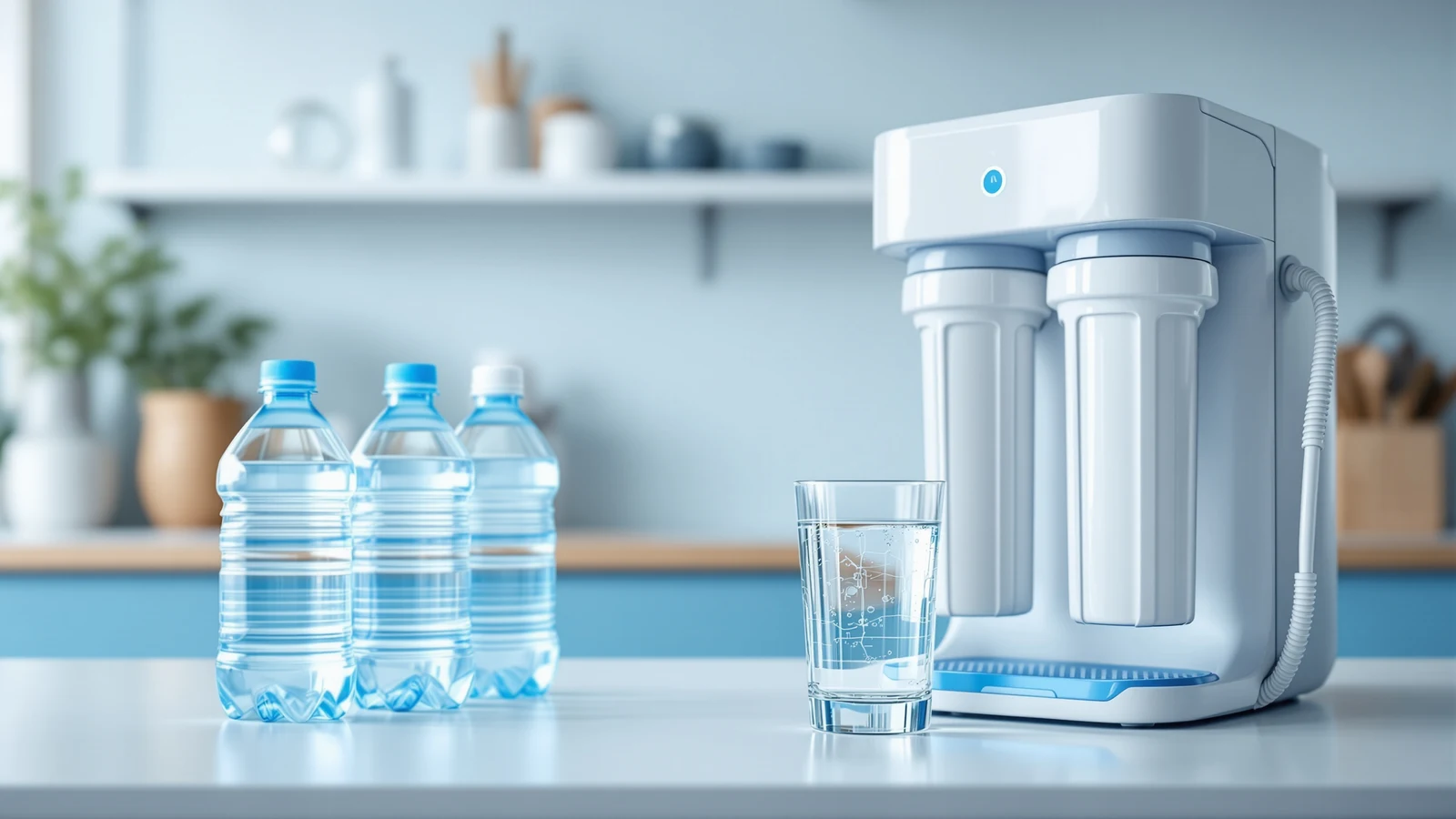
Every reverse osmosis buying guide, including the ones on this site, tells you a system "pays for itself" if you're currently buying bottled water. That's true in direction and useless in practice, because it skips the three numbers that actually decide the timeline: what you're really spending on bottled water today, what the system costs once you add installation, and what the filters cost once you own it. Those three numbers interact, and the interaction is the whole story — a cheap system with a plumber's bill can take longer to pay back than an expensive system that plugs into a wall.
This page runs the math three ways, for three real formats sold on Amazon today: an under-sink tank system you install yourself or hire out, a non-electric tankless system that skips the outlet but not the plumbing, and a plug-in countertop unit that skips the plumbing entirely. Every price below is the one we recorded for a specific listing; where we're estimating a cost that varies by household — filter life, bottled-water spend, a plumber's rate — we say so and show the arithmetic, so you can swap in your own numbers.
What a "bottled-water habit" actually costs
Before any of this math works, you need your own number, and most people have never added it up. The industry's own trade figures put average U.S. bottled-water consumption at somewhere around 45 gallons a person a year — call it a case or two of 16.9-ounce bottles a month for one person who drinks mostly bottled. At typical retail case pricing, that alone runs roughly $50 to $90 a year per person just for drinking water, before anyone in the house uses bottled water for coffee, a pet bowl, or cooking.
Almost nobody's actual spend looks like that figure, because "bottled water habit" rarely means the occasional case from the grocery store. It usually means a standing delivery service, a five-gallon jug on a countertop dispenser, or a recurring warehouse-club run for a family of three or four — and those habits run considerably higher than the per-capita number because they're bought for convenience and taste, not rationed by the gallon. For the math on this page we use three household tiers, stated plainly so you can pick the one closest to yours or substitute your own receipts:
- Light: $15 a month ($180 a year). One or two people, mostly tap water, bottled water for variety or when the tap tastes off.
- Moderate: $30 a month ($360 a year). A household that has largely replaced tap water with bottled or jug water for drinking and cooking. This is the baseline we use for the break-even table below.
- Heavy: $50 a month ($600 a year) or more. A family of four-plus on delivery jugs, or a household also buying bottled water for a coffee maker and a pet.
Write your own number down before you read any further. Every break-even figure on this page is a function of that one input, and a system that pays back in eight months for a heavy household can take three years for a light one — the comparison table doesn't change, your position on it does.
Three ways in, three sticker prices
"Reverse osmosis system" covers three genuinely different purchases, and the format decides both the sticker price and whether installation is even a line item. We priced one example of each from real Amazon listings:
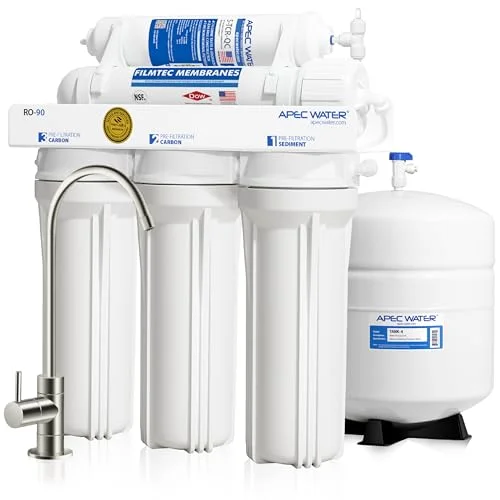
APEC RO-90
5-stage under-sink tank system, 90 GPD. Needs a cold-line connection, a drain saddle and a faucet hole — the classic install.
Check price →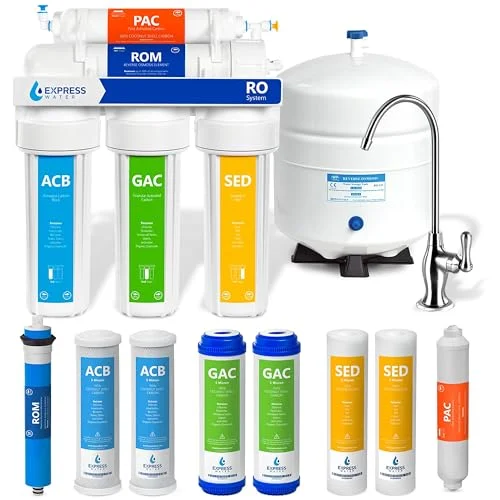
Express Water RO5DX
5-stage under-sink tank system, 50 GPD. Same installation story as the APEC, at a lower sticker price.
Check price →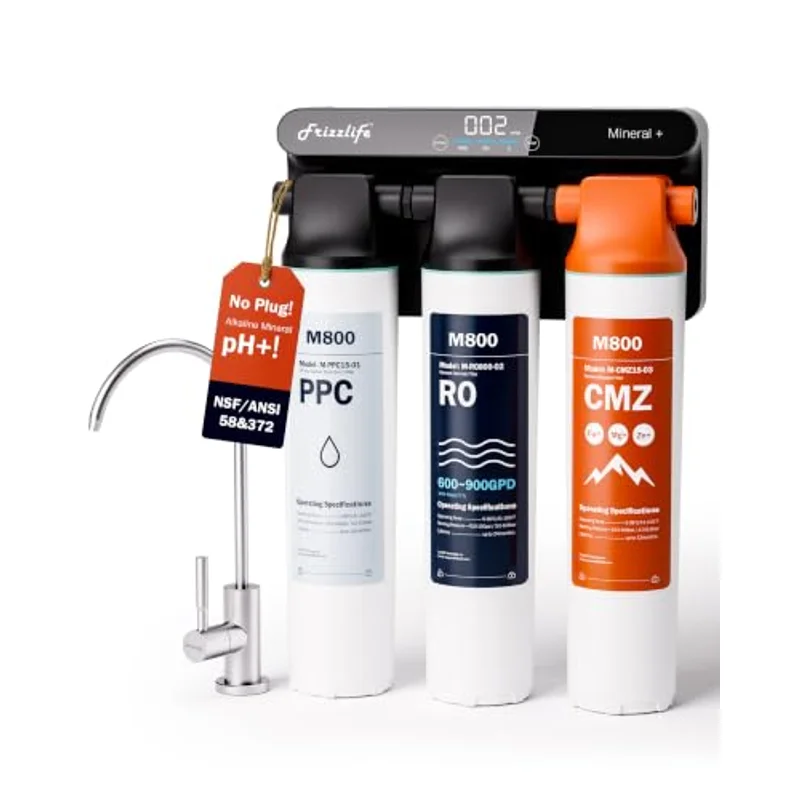
Frizzlife M800
Non-electric tankless, up to 900 GPD, NSF/ANSI 58 & 372, 4:1 pure-to-drain. No outlet needed, but still plumbed in under the sink.
Check price →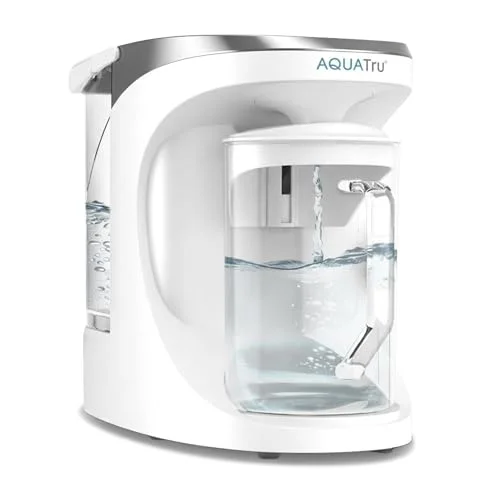
AquaTru Glass Carafe
4-stage countertop unit, fills a glass carafe. Plug it in, fill the reservoir — nothing touches your plumbing.
Check price →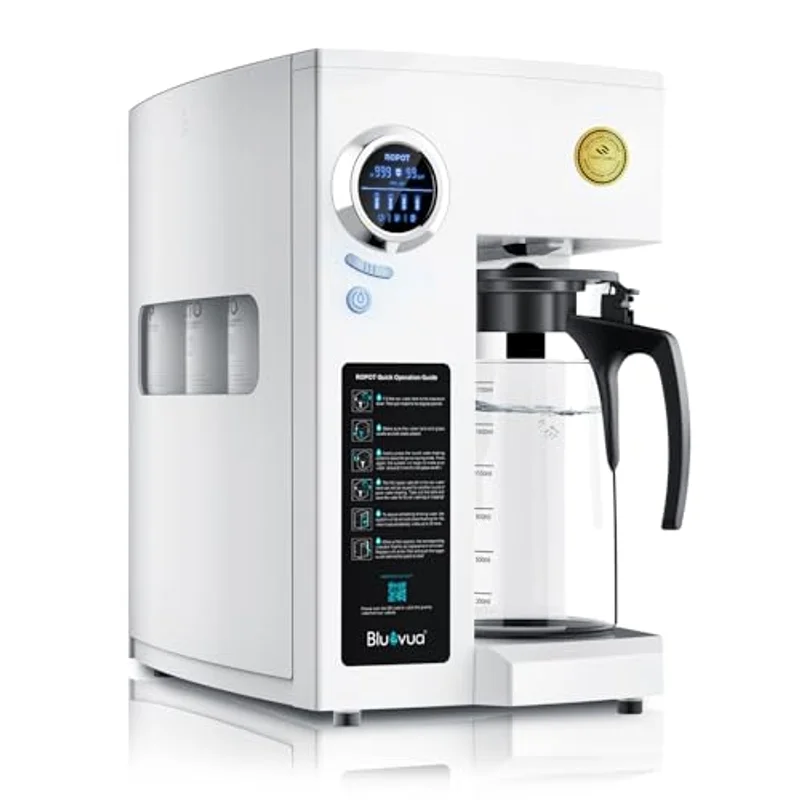
Bluevua RO100ROPOT
Countertop unit, ROPOT-UV variant. Same no-plumbing setup as the AquaTru, at the top of the countertop price range.
Check price →Read as a straight price list, the under-sink tanks look like the obvious winner: $142.79 to $209.99 against $300.00 to $317.00 for a countertop unit that does less water, slower. That reading is the mistake this whole page exists to correct, because a tank's sticker price is not what it costs to have RO water flowing from a dedicated faucet — it's what the hardware costs before anyone touches a wrench. We go through the full brand-by-brand comparison of the APEC and Express Water entry-level systems elsewhere; here, the only thing that matters is that they install exactly the same way, even though the Express Water is currently $67.20 cheaper. The real fork in the road is the one below: what, if anything, installation adds to that number.
What installation adds — or erases
This is the line item every sticker-price comparison skips, and it's the one that actually separates the three formats. An under-sink tank system and a non-electric tankless system face the same job: tap the cold-water line with a feed valve, clamp a drain saddle onto the waste pipe under the sink, and run a line to a dedicated faucet — drilled into a spare hole if the sink has one, or into the countertop if it doesn't. A reasonably handy owner does this in an afternoon with a basic toolkit they likely already own, which is the scenario most Amazon buyers are actually in: call that $0 beyond the system price. A hired plumber, when the sink has no spare hole or the counter is stone that needs a diamond bit, commonly runs somewhere in the $150-to-$300 range for this kind of job — a number worth confirming with a local quote rather than trusting any guide, including this one, to price your specific kitchen.
The non-electric part of the Frizzlife M800's name describes what it skips, not what it avoids installing: it still needs the feed valve and drain saddle, it just runs on your home's existing line pressure instead of a pump, so there's no outlet requirement to plan around. For the install-cost math, treat it exactly like the tank systems — same labor, same plumber quote if you hire one, with the one genuine advantage of not needing a free electrical outlet under the sink, which matters if yours is already full of a garbage disposal and a dishwasher cord.
A plug-in countertop system changes the equation completely by removing it: no cold-line tap, no drain saddle, no faucet hole, nothing a landlord needs to approve. You fill a reservoir and press a button. That is the entire reason AquaTru and Bluevua can charge $300.00 and $317.00 and still be the cheaper total purchase for some buyers — the $0 installation line applies whether you do it yourself or not, because there's nothing to install. It's also the reason we don't treat "no install" as automatically better: you're trading a labor cost that only happens once for a sticker price that's $90 to $175 higher than the tank systems, permanently. Whether that trade is worth it is exactly the break-even question the next section answers. One more cost worth flagging before you commit money to any of these: read the warranty terms across systems at this price point before you drill anything, because a self-install can affect what a manufacturer will cover if something leaks, and an undetected slow leak under a cabinet is the single most common complaint across under-sink systems of every brand.
Folding filters into a break-even month
The sticker price and the install cost are both one-time. The filters are forever, and they're the number that makes "pays for itself" a moving target rather than a fixed date. Replacement cartridges for standard under-sink and tankless systems typically run $50 to $90 a year depending on stage count and whether the housings are universal or proprietary; countertop units run their own enclosed cartridge sets on a broadly similar schedule, typically $50 to $80 a year. None of the five systems above publish a figure we could verify down to the cent for this specific article, so we use a representative mid-range number for each — roughly $70 a year for the under-sink tanks, $75 for the non-electric tankless, and $65 to $75 for the countertop pair — and we show it explicitly so you can substitute the real number once you own the system and can see the part numbers.
Converted to a monthly running cost, that's about $5.42 to $6.25 depending on the system — small next to a bottled-water bill, but not zero, and it's the number you subtract from your monthly bottled-water spend to get your actual monthly savings. The break-even month is simply the all-in purchase cost divided by that monthly savings. Here is the arithmetic for a moderate household spending $30 a month on bottled water, which nets $23.75 to $24.58 in monthly savings depending on the system's filter cost:
| System | Price | Filters, per year | Break-even, DIY install | Break-even, hired install (+~$200) | |
|---|---|---|---|---|---|
| APEC RO-90 | $209.99 | ~$70 | ~9 months | ~17 months | Price |
| Express Water RO5DX | $142.79 | ~$70 | ~6 months | ~14 months | Price |
| Frizzlife M800 | $289.99 | ~$75 | ~12 months | ~21 months | Price |
| AquaTru Glass Carafe | $300.00 | ~$65 | ~12 months | same (no install) | Price |
| Bluevua RO100ROPOT | $317.00 | ~$75 | ~13 months | same (no install) | Price |
Three things to notice, because they're the actual findings, not just numbers in a table. First, a self-installed under-sink tank system is the fastest payback of everything here — about six months for the Express Water RO5DX, about nine for the APEC RO-90, at a moderate bottled-water spend — purely because it carries no installation cost and a low sticker price. Second, the Frizzlife M800's non-electric design doesn't buy it a faster break-even than the tank systems; it costs $80.00 more than the APEC and $147.20 more than the Express Water for roughly the same install effort, landing its payback a few months later, at around a year. Third, and this is the one most comparisons miss entirely: the Express Water with a hired plumber (~$342.79 all-in) breaks even at almost exactly the same month as the Bluevua countertop unit that never touches a plumber at all. Installation cost doesn't just slow the tank system's payback — at $150 to $200, it can erase its entire price advantage over a zero-install countertop unit.
The countertop pair's numbers hold steady whether you do anything yourself or not, which is the actual value of "no install": not a faster break-even on paper, but a break-even that can't get worse because of your sink, your counter material, or a plumber's schedule. The AquaTru's lower sticker price next to the Bluevua gives it the faster payback of the two countertop units at the same assumed filter cost; if you want the deeper material and build comparison between a glass-carafe countertop unit and a plastic one, we cover that separately in glass vs. plastic pitcher countertop systems compared.
Where the math stops favoring reverse osmosis
Run the same division with a light household's $15-a-month bottled-water spend — netting roughly $9 to $9.58 in monthly savings once filter cost is subtracted — and every break-even number on this page roughly doubles or triples. The self-installed APEC tank stretches from about nine months to about 23 months; the Express Water, now the cheaper of the two, from about six to 16 months. The Frizzlife M800 moves to around 33 months. The countertop pair lands between 31 and 36 months — roughly two and a half to three years to recoup a purchase on a system that, realistically, you'll be replacing cartridges on the entire time. At that spend level, the honest answer is that the math is marginal at best, and a household that mostly drinks tap water already, buying bottled water only occasionally for taste or travel, may simply never clear the purchase price before the unit itself needs replacing. If your actual problem is a specific complaint about tap water rather than a full bottled-water habit, it's worth checking whether a cheaper filter that isn't reverse osmosis solves it for a fraction of the up-front cost and without the filter-replacement bill at all.
The other case where the arithmetic breaks down isn't about spend, it's about time horizon, and it mostly concerns renters. Every break-even month above assumes you keep the system long enough to reach it — which is the entire premise of the table, and the thing a lease doesn't guarantee. A plumbed-in tank or non-electric tankless system is, practically, installed into that specific kitchen: moving it means uninstalling a feed valve and a drain saddle, patching a faucet hole you may have drilled, and hoping the next place has a compatible setup, or simply leaving a system behind that someone else now benefits from. If you expect to move within the break-even window — commonly under two years on a light-to-moderate bottled-water budget — that sunk install cost doesn't get recovered, DIY or not. A plug-in countertop unit is the one format that genuinely travels: unplug it, pack the reservoir, and it works identically in the next kitchen with zero reinstallation cost, which is the real reason to pay its higher sticker price if you're a renter who expects to move before the math above has fully played out. For a renter specifically, the relevant comparison isn't which system breaks even fastest — it's which one still has value on the day you move.
Questions people ask about the bottled-water-to-RO switch
How much does the average household actually spend on bottled water a year?
Trade-group figures put per-capita U.S. bottled-water consumption at roughly 45 gallons a year, which works out to $50 to $90 a year per person on case-pack pricing alone — but most households that identify as having a "bottled water habit" spend more than that, because the habit usually means standing delivery or jug service rather than occasional cases. For the break-even math on this page we use $15, $30 and $50 a month as light, moderate and heavy tiers; add up your own receipts for the real figure, since it's the single biggest input into how fast any system pays back.
Is an under-sink tank system or a no-install countertop unit cheaper overall?
It depends entirely on installation. The APEC RO-90 costs $209.99 and the Express Water RO5DX costs $142.79; self-installed, both break even faster than any countertop unit at a moderate bottled-water spend — roughly six to nine months versus 12 to 13. But add a hired plumber at $150 to $300, and a tank system's total cost can match or exceed a $300.00 to $317.00 countertop unit that never needed one. If you're confident in a DIY install, the tank system wins on cost. If you're not, or you rent, the countertop's fixed, installation-free price can be the actually cheaper path.
Do filter replacement costs change the break-even math much?
They shift it by a few months, not by years. Across the five systems here, annual filter costs run an estimated $65 to $75 a year — about $5.42 to $6.25 a month — which only modestly narrows your monthly savings against a bottled-water bill. The one-time purchase and installation cost dominates the break-even calculation far more than the ongoing filter bill does; filters matter much more to your five-year total cost of ownership than to the month you first break even.
At what point does switching from bottled water to RO stop making financial sense?
Two situations, mainly. First, a genuinely light bottled-water spend — under roughly $15 to $20 a month — pushes every system's break-even past two years, and past two and a half to three for a countertop unit, which may exceed how long you'd keep using it. Second, moving soon: a plumbed-in tank or tankless system's installation cost is effectively lost if you move before the break-even month, since you can't take a drain saddle and a drilled faucet hole with you. A plug-in countertop unit is the one format that keeps its value when you move, which is why renters should weigh portability alongside the raw break-even number.