Reverse osmosis warranty coverage compared: what "1-year limited" actually covers
We're reader-supported: buying through our links may earn us a commission at no extra cost to you. We compare published warranty pages, listing prices and support documentation — we don't run a testing lab, and nothing below is a star rating or a paraphrased review.
Warranty length is one of the few specs on a reverse osmosis listing that is not trying to sell you anything — it is a number the manufacturer picked because it is cheap enough to honor across every unit they ship. That makes it an unusually honest signal, and also a mostly useless one for choosing between systems, because almost every brand in this category picked the same number. We pulled the published warranty terms for five systems spanning more than $200 in sticker price to see where they actually diverge, and the answer is: almost nowhere, except one.
The five systems, at the prices we recorded:
- VIVA21 5-Stage Reverse Osmosis System, WQA Gold Seal certified to NSF/ANSI 58 & 372, lead-free faucet, tank, leak detector — $199.99, recorded September 8, 2026. Under-sink.
- Express Water ROALK10D, 10-Stage Under Sink RO System, Alkaline, 100 GPD — $209.99, recorded November 10, 2026. Under-sink.
- iSpring RCC7AK-BLK, NSF/ANSI 58 certified, alkaline 6-stage system with black RO faucet and pH+ remineralization — $202.49, recorded October 29, 2026. Under-sink.
- AquaTru Glass Carafe, countertop RO system, 4-stage, removes 84 contaminants including PFOA, PFOS, lead and microplastics — $300.00, recorded November 5, 2026. Countertop.
- Bluevua RO100ROPOT (ROPOT-UV), countertop reverse osmosis water filter system — $317.00, recorded October 8, 2026. Countertop.
That is a $209.01 spread between the cheapest system here and the most expensive one. On warranty terms, it buys almost nothing: four of the five publish a standard one-year limited warranty, full stop. The outlier is the cheapest system in the lineup, not the priciest — a detail worth sitting with before you assume a bigger sticker price buys more protection.
Why almost every brand lands on the same year
One year is not a coincidence and it is not generosity. It is the point at which a manufacturer's warranty reserve, the accounting line that sets aside money for expected returns and replacement parts, stops growing faster than the failures it has to cover. Mechanical filtration hardware — housings, O-rings, valves, a pressure tank, a faucet — fails most often in its first weeks of use, from a bad seal or a cracked fitting a short burn-in period would have caught anyway. After the first year, failure rates on a well-built unit flatten out, and the manufacturer's exposure drops sharply. Setting the warranty right at that knee in the curve is standard practice across small appliances, not something specific to water filtration, and it is why a $199.99 system and a $317.00 system can both land on the identical twelve months: the number is set by failure statistics, not by what the brand charged you.
That logic holds for Express Water's ROALK10D, iSpring's RCC7AK-BLK, AquaTru's Glass Carafe system and Bluevua's RO100ROPOT alike. Each publishes a one-year limited warranty against manufacturing defects in materials and workmanship on its Amazon listing and support documentation — the standard-issue term for this entire product category, countertop or under-sink, tank or tankless, $200 or $400. If you are shopping on warranty length alone, you can stop: on these five listings, length is not a variable. What does vary — what each of those four pages gets careful, sometimes evasive, about — is what "limited" is actually limiting, and that is the part worth reading before you buy rather than after something leaks. We get into the specific exclusions further down; first, the one brand here that broke the pattern.
VIVA21's lifetime parts support
VIVA21's 5-Stage system is the cheapest of the five at $199.99, and it is the one that does not stop the clock at twelve months. Alongside the standard one-year limited warranty that covers the whole system the way its competitors' one-year terms do, VIVA21 backs the unit with lifetime parts support — coverage that keeps supplying replacement hardware components for as long as you own the system, not just for the first year.
Read "lifetime parts" for what it typically means in this category, because the name invites more generosity than the term usually delivers. It covers parts, which in a 5-stage under-sink system means hardware that can fail independently of normal wear: housing bodies, O-rings and seals, fittings, the lead-free faucet, the tank's valve assembly, and — given this unit ships with one — the leak detector itself. It is not a lifetime guarantee on the whole system, and it is not a promise to replace the consumables every RO system burns through on a schedule regardless of build quality: the sediment, carbon and membrane cartridges you're expected to buy and swap yourself every six months to three years. A "lifetime parts" program replacing your filters for free would not be a warranty; it would be a subscription, and no brand in this category runs one that way.
What it does not typically cover is just as important as what it does: labor for diagnosis or installation, return shipping on a defective part, and damage caused by anything other than a defect in the part itself — a frozen line, an improper connection, feed pressure outside the unit's rated range. Those exclusions are not unique to VIVA21; they show up, in some form, on every warranty page we read for this piece, including the four plain one-year terms below. What VIVA21 is actually offering is a longer runway on the mechanical failure most likely to show up after year three — a worn O-ring, a sticking valve — on a system that otherwise matches its competitors' coverage line for line. For a buyer planning to keep a system five-plus years rather than replace it at the first leak, that is a real, quantifiable difference, and it is the rare case in this lineup where the cheapest unit is also the one backed the longest.
The registration trap: Bluevua and AquaTru
A one-year warranty is only as good as your ability to prove when the year started, and two of the five systems here — AquaTru's Glass Carafe system and Bluevua's RO100ROPOT — put that proof behind a registration step rather than leaving it to your Amazon order history. Both brands' support pages ask you to register the unit online, tying its serial number to your name and purchase date, and both treat that record as the primary evidence if you ever need to file a claim.
This is common practice for countertop appliances sold through a marketplace rather than direct from a brand's own storefront, and the logic is defensible from the manufacturer's side: an Amazon order confirmation proves you bought a unit on a given date, not necessarily the specific serial number on your counter, especially if the product changes hands as a gift or resale. Registration closes that gap. The trap is not the requirement itself — it is how easy it is to skip. You unbox a $300.00 countertop purifier or a $317.00 one, fill the reservoir, and start drinking RO water that afternoon. The registration card goes in the recycling, and the window to complete it — a specific number of days after purchase, spelled out in each brand's own terms rather than standardized across the category — closes quietly in the background.
What's actually at stake if you miss it varies by brand and is worth reading in full on the listing's warranty section before you buy, not after the box is empty: some manufacturers will still honor a claim off a dated Amazon invoice, just with more friction and a longer back-and-forth; others treat registration as the condition that activates coverage at all. Either way, the practical fix costs five minutes: register the unit the day it arrives, while the box, the invoice and the serial number are all still in the same room. Keep a photo of the serial number sticker and your Amazon order confirmation in the same phone album. That habit matters more for a countertop unit changing hands as a gift than for a plumbed-in under-sink system that one household member installs and never moves — which is itself a reason the registration requirement tends to show up on exactly the systems built to be portable.
What "limited" excludes in practice
"Limited" is doing real work in "one-year limited warranty," and it means roughly the same three things across every system in this comparison, VIVA21's lifetime-parts extension included.
Labor. The warranty covers the part, not the time it takes to remove and reinstall it. On an under-sink system like the Express Water ROALK10D or the iSpring RCC7AK-BLK, that means a failed component is typically shipped to you and you — or a plumber you pay separately — do the swap. A countertop unit like the AquaTru or the Bluevua sidesteps most of this, since there is nothing to disconnect from the plumbing in the first place, but a component that needs professional diagnosis still isn't a cost the warranty absorbs.
Shipping. Getting a replacement part to you is commonly covered; getting the defective part or the whole unit back to the manufacturer, when that is required to validate the claim, commonly is not. On a tabletop unit the size of the AquaTru or the Bluevua, return shipping on the full system is a real line item, not a rounding error, and it is worth asking the seller or manufacturer directly whether a claim requires the whole unit back or just the failed component.
Misuse and installation error. Every warranty page we read for this piece carves out damage from freezing, feed water outside the system's rated pressure and temperature range, sediment loads the pre-filter wasn't sized for, and installation that doesn't match the manufacturer's instructions. This is the single largest category of denied claims in plumbed appliances generally, because it is the easiest for a manufacturer to verify and the hardest for an owner to self-diagnose beforehand. A cross-threaded fitting or a feed valve tapped into the wrong line doesn't look different from a manufacturing defect until someone who knows the system opens it up — one more reason the entry-level comparison between Express Water's and APEC's standard and alkaline lines is worth reading alongside this one: installation complexity tracks stage count.
Countertop vs. under-sink: does install type change what's covered
Not the warranty term — all five systems here converge on one year regardless of form factor — but it changes which exclusion you are actually exposed to, and that is a meaningfully different question. The three under-sink systems in this lineup, VIVA21's 5-Stage, the Express Water ROALK10D and the iSpring RCC7AK-BLK, all require a connection to the cold-water line, a drain saddle on the waste pipe, and typically a dedicated faucet hole. Every one of those connections is a place where "installation error" can be cited to deny a claim: a feed valve tightened past spec, a drain line without the recommended air gap, a saddle valve piercing the wrong side of the pipe. None of that is usually evidence of a manufacturing defect, and none of it is covered, but it can be hard to tell apart from one without opening the unit.
AquaTru's Glass Carafe system and Bluevua's RO100ROPOT remove that exposure almost entirely by removing the installation. A countertop unit draws from a reservoir you fill by hand and dispenses into a carafe — there is no feed valve to over-tighten, no drain saddle to misplace, no faucet hole to drill. That doesn't make the warranty broader; it makes the installation-error exclusion functionally irrelevant, because there is no install to get wrong. What countertop systems substitute in its place is the registration step covered above: the risk moves from "did you install it correctly" to "did you register it in time," a procedural risk rather than a mechanical one. If you are choosing between a plumbed system and a tabletop one partly on warranty grounds, that is the real trade: under-sink hardware trades a five-minute registration step for a two-to-three-hour install with several ways to accidentally void coverage; countertop hardware trades the install risk for a paperwork deadline.
How the five compare
Prices and terms as we recorded them. Confirm the live price and the current warranty page before buying — both can change without notice.
| System | Price | Install type | Warranty term | Registration | |
|---|---|---|---|---|---|
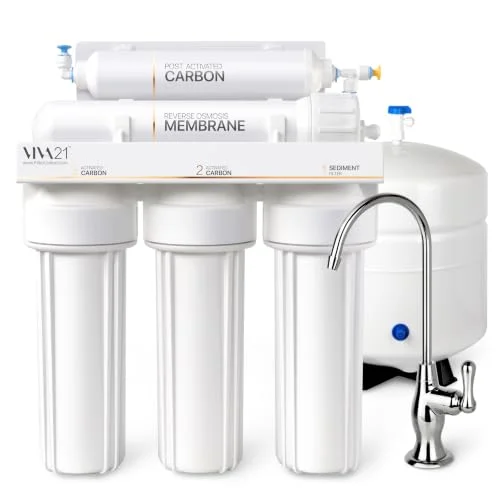 VIVA21 5-Stage RO | $199.99 | Under-sink · tank | 1-year limited + lifetime parts | Not required for base coverage | Price |
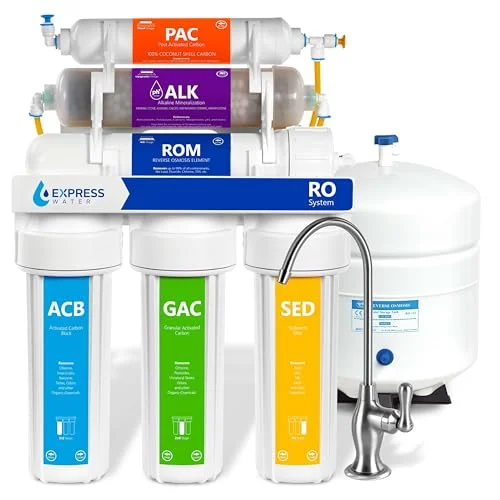 Express Water ROALK10D | $209.99 | Under-sink · 100 GPD | 1-year limited | Not emphasized on listing | Price |
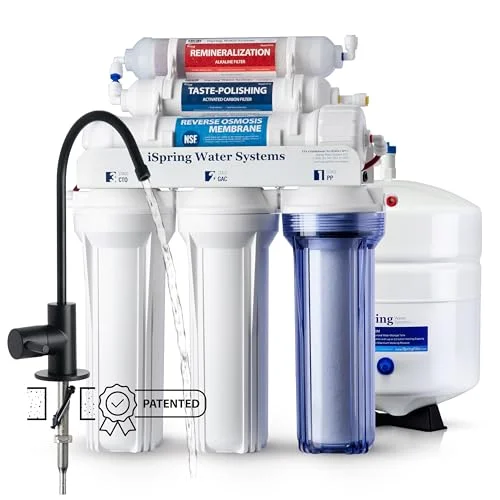 iSpring RCC7AK-BLK | $202.49 | Under-sink · alkaline | 1-year limited | Not emphasized on listing | Price |
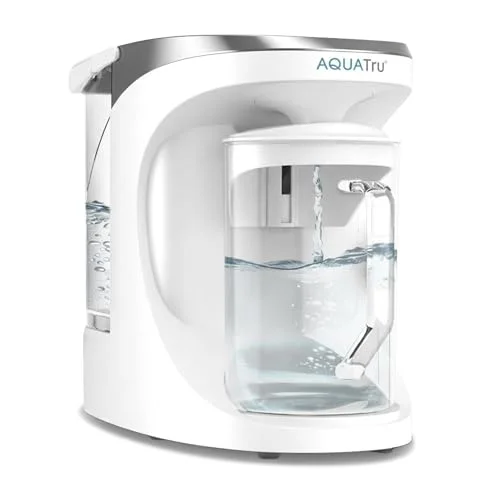 AquaTru Glass Carafe | $300.00 | Countertop | 1-year limited | Required — register the serial number | Price |
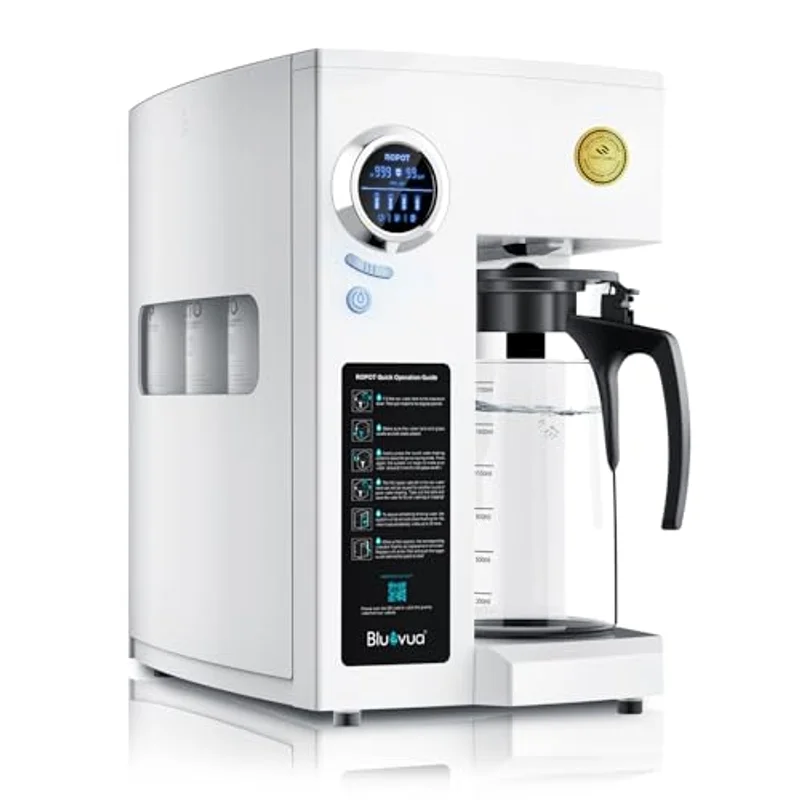 Bluevua RO100ROPOT | $317.00 | Countertop · UV | 1-year limited | Required — register the serial number | Price |
Read across that table and the warranty-term column is almost entirely dead weight — every row says the same thing except one. The columns that actually separate these five systems are install type, which decides which exclusion you're exposed to, and registration, which decides how much paperwork stands between you and honoring that term. Price, notably, predicts neither.
How to actually file a warranty claim before you need one
Every step here takes less time than the unboxing did, and all of it needs to happen in the first week, not the week something fails.
Register immediately, if the system asks for it. AquaTru's and Bluevua's countertop units both make this the load-bearing step; VIVA21's, Express Water's and iSpring's under-sink systems make it less critical since an Amazon order date is harder to dispute on a unit that never leaves the cabinet it was installed in. Do it anyway — it costs five minutes and removes the single most common reason a legitimate claim gets delayed.
Photograph the serial number and the invoice, together, same day. Not weeks later when the box is gone. A phone photo of the sticker on the unit next to the Amazon order confirmation on the same screen is the fastest evidence packet you can produce if a claim ever needs one.
Read the exclusions list once, before anything goes wrong. Every brand in this comparison publishes what voids coverage — misuse, freeze damage, feed pressure outside spec, non-standard installation. Knowing that list before you install an under-sink system changes how carefully you do the install; knowing it before you fill a countertop reservoir changes nothing about installation but still tells you what to avoid doing with the unit day to day.
Note the support channel, not just the Amazon return window. Amazon's own return policy and a manufacturer's warranty are two different clocks running on two different rules. Past Amazon's standard return period, a defect claim goes through the manufacturer's own support channel — usually a listed email or a support-portal form — not back through Amazon customer service. Save that contact when you register, not when you need it.
Keep the original packaging until the return window has closed. Some manufacturers require the unit shipped back in its original box for a warranty replacement to be processed; discovering that requirement after you've recycled the box is an avoidable cost.
None of this is specific to reverse osmosis systems — it's the same five-minute discipline that protects a warranty on any appliance. It matters more here because the failures that actually trigger a claim, a slow leak under a cabinet or a cracked housing on a counter, tend to show up quietly, months after the five minutes it would have taken to do this properly.
Common questions
Does a higher price mean a longer reverse osmosis warranty?
No — on the five systems we compared, price and warranty length don't track each other at all. Express Water's $209.99 ROALK10D, iSpring's $202.49 RCC7AK-BLK, AquaTru's $300.00 Glass Carafe system and Bluevua's $317.00 RO100ROPOT all publish the same one-year limited warranty. The only system with longer coverage, VIVA21's 5-Stage system with lifetime parts support, is also the cheapest of the five at $199.99.
What does VIVA21's lifetime parts support actually cover?
It extends coverage on hardware components — housings, O-rings, fittings, the faucet, the tank valve assembly and the system's leak detector — for as long as you own the unit, on top of the standard one-year limited warranty on the system as a whole. It does not cover consumable sediment, carbon or membrane cartridges, which every RO system requires on a routine replacement schedule regardless of brand, nor does it typically cover labor or return shipping.
Do I have to register my reverse osmosis system to keep the warranty valid?
It depends on the brand. AquaTru's Glass Carafe system and Bluevua's RO100ROPOT both ask for online registration tied to the unit's serial number, and treat that record as the primary proof of purchase date for a claim. VIVA21, Express Water and iSpring don't emphasize registration the same way on their listings. When a brand does ask, register the day the unit arrives — the window closes quietly and missing it adds friction to an otherwise valid claim.
Does a countertop system have better warranty protection than an under-sink one?
The warranty term itself is identical across both form factors in this comparison — one year, limited, on four of the five systems. What differs is which exclusion you're exposed to. Under-sink systems like the Express Water ROALK10D and iSpring RCC7AK-BLK can have a claim contested over installation error, since they involve a feed-line connection and a drain saddle. Countertop systems like the AquaTru and Bluevua remove that installation entirely, trading it for a registration requirement instead.