Comparison
iSpring's Two 7-Stage UV Alkaline Systems: Traditional UV Lamp vs. LED UV
By Ilane TallUpdated November 8, 202613 min readResearch-based
We're reader-supported: buying through our links may earn us a commission at no extra cost to you. We compare published specifications, certifications and prices — we don't run a testing lab.
iSpring sells two versions of the same 7-stage alkaline reverse osmosis system, and the listing titles make the difference look almost cosmetic: the RCC7AK-UVBN and the RCC7AK-UVBLK share the same stage count, the same alkaline remineralization stage, and the same patented top-mounted faucet design the company uses across the RCC7AK family. Both add ultraviolet disinfection as a dedicated stage. The letters at the end of the model number are the entire story: BN runs a traditional UV lamp, BLK runs LED UV, and at the prices we recorded that difference costs $20.35 — the UVBN at $267.99 against the UVBLK at $286.99.
That is not the only number worth knowing before you pick one. We also checked both against the Express Water ROALK5D, a 10-stage alkaline system from a different brand with no UV stage at all, priced at $188.99. It is not a perfect control — different brand, different stage count — but it is the closest thing in this catalogue to "the same kind of system, minus UV," and it is useful for seeing how much of the iSpring pair's price is UV at all versus everything else that comes with a 7-stage alkaline design.
One more thing worth flagging before the specifics: the two iSpring listing titles are not symmetrical about certification. The UVBN's title reads simply "NSF Certified," with no standard number attached. The UVBLK's title is specific — "NSF 58&372 Certified." We're quoting the title language as published, not independently verifying which standard the UVBN carries; if that distinction matters to your decision, check the current listing's certification details before you buy, because title text is also the kind of thing that gets tightened up over time without the product itself changing. iSpring has run this same "same core system, one letter apart" pattern before — we broke down a similar pair, the RO500-ORB and RO500AK-ORB, where the only disclosed difference was an alkaline stage rather than a UV upgrade.
What actually changes between a UV lamp and LED UV
Neither listing publishes a lamp-life figure or a wattage spec for its UV stage, so what follows is general information about how these two UV technologies behave in point-of-use water treatment — not a manufacturer specification for either ASIN. Treat it as the mechanical backdrop for the price gap, not as a claim about hours-to-failure on this specific system.
Traditional UV lamp. The conventional UV stage in under-sink systems is a low-pressure mercury-vapor lamp inside a quartz sleeve. It needs a brief warm-up — typically a few seconds — to reach full germicidal output after power-on, and it draws continuous current the entire time it's energized, whether or not water happens to be flowing past it at that instant. Mercury UV lamps also fade gradually: output drops well before the lamp visibly fails, which is why manufacturers in this product class commonly specify a calendar-based replacement interval (often annual) rather than waiting for the lamp to go dark. A dimming lamp doesn't announce itself the way a clogged sediment filter does.
LED UV. A UV-C LED is a solid-state emitter: no warm-up delay, instant on and instant off, and because it can be switched in sync with actual water flow rather than left energized continuously, its average power draw over a billing cycle tends to run lower for comparable duty. UV-C LED technology is also marketed around substantially longer rated service life than mercury lamps — commonly pitched in the tens of thousands of hours versus a lamp's roughly one-year replacement cadence — though LED output degrades with accumulated run-time too; "much longer" is not "forever." For more on how an LED indicator changes the ownership experience on an RO faucet more broadly, see our breakdown of smart LED faucet indicators, a related but separate feature from the UV stage itself.
Put simply: the lamp version is the more mature, more serviceable technology with a known annual consumable; the LED version is the newer, lower-duty-cycle technology that trades a cheap yearly part for a sealed module rated to outlast it by a wide margin.
What the $20.35 actually buys
We don't have iSpring's internal bill of materials, so we can't hand you a line-item breakdown of where that $20.35 goes. What we can do is point at the mechanical differences above and note that they line up with the price direction: LED emitters, their driver electronics, and the instant-on circuitry that lets the system fire the UV stage only when water is actually moving all cost more to engineer into a compact under-sink housing than a mercury lamp and ballast, a technology that's been commoditized in water treatment for decades. A $20.35 premium for that shift is modest compared with what LED UV commands in some other product categories, which suggests iSpring is pricing the upgrade to move volume rather than to extract a large margin on the newer tech.
What the premium is not, on the information available, is a difference in filtration stage count, alkaline remineralization, or the certified standard both systems are built to meet — the 7-stage core and the NSF 58&372 standard named in the UVBLK's title (and implied, if unconfirmed in the title text, for the UVBN) describe the same underlying system either way. You are paying for the UV technology and essentially nothing else.
The arithmetic
Isolating the UV premium against a non-UV baseline
Prices as we recorded them. The ROALK5D is a different brand and a different stage count, so treat its gap to the iSpring pair as a rough sense of "alkaline RO plus UV," not a clean UV-only number.
| System | Price | UV stage | Stages | Vs. non-UV baseline | |
|---|
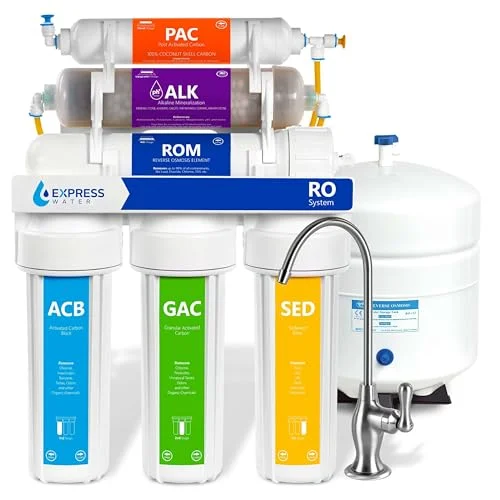 Express Water ROALK5D | $188.99 | None | 10-stage, alkaline | — (baseline) | Price |
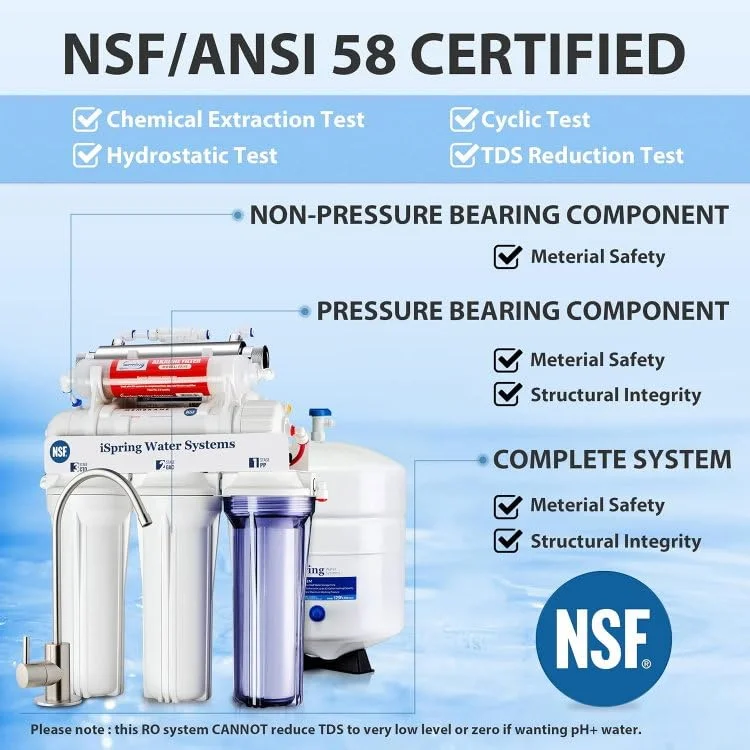 iSpring RCC7AK-UVBN | $267.99 | Traditional UV lamp | 7-stage, alkaline | +$93.15 | Price |
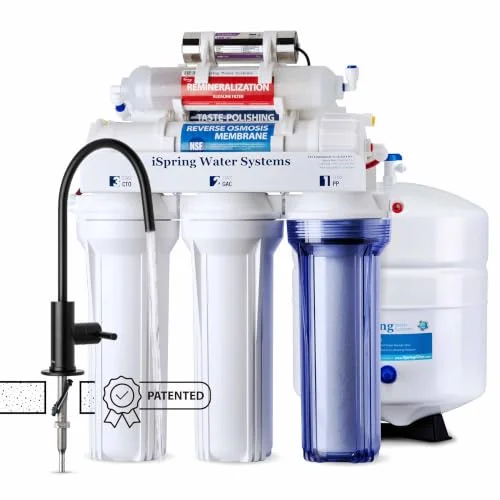 iSpring RCC7AK-UVBLK | $286.99 | LED UV | 7-stage, alkaline | +$113.50 | Price |
Read those last two numbers carefully, because it's tempting to call $93.15 and $113.50 "the price of UV" and they are not — they are the price of switching brands, going from 10 stages to 7, and adding UV, all at once. Express Water and iSpring are different companies with different component sourcing, housing designs and margins; a 10-stage system and a 7-stage system aren't counting the same filtration steps the same way. We're showing the ROALK5D because it's the closest non-UV alkaline reference point in this catalogue, not because the gap to it isolates UV cleanly.
The number that does isolate UV cleanly is the $20.35 between the two iSpring listings, because that pair holds the brand, the stage count, the alkaline stage and the faucet design constant and varies exactly one thing: the UV technology. If you want to know what LED UV costs over a traditional lamp, in this specific product family, $20.35 is the real figure. If you want to know what "alkaline RO with UV" costs over "alkaline RO without it" in general, the ROALK5D comparison tells you it's somewhere north of $90 — but that number is carrying more than UV on its back.
Replacement cost over time: the lamp bill versus the LED bet
Neither listing publishes a specific replacement-lamp SKU or price, so we can't hand you a dollar figure for either system's long-run UV maintenance the way we could for a sourced cartridge. What we can lay out is the shape of the two cost structures, because they are structurally different in a way that matters more than any single price.
A traditional UV lamp is a defined, swappable consumable. Somewhere down the line — commonly on an annual cadence for systems run continuously, per the general lamp behavior described above — you buy a replacement bulb sized to the housing and swap it in, the same category of maintenance task as changing a sediment filter, just on its own schedule. It's a known, recurring, modest line item for as long as you own the UVBN.
LED UV is a different bet. The sales pitch is a much longer stated service life, which for most ownership windows could mean the module simply outlasts the system around it — no recurring bulb purchase at all. The trade-off is that LED emitters in compact consumer housings are typically sealed, non-user-serviceable modules rather than a part you unscrew and replace yourself. If a LED UV stage does eventually underperform or fail outside its rated window, the practical fix tends to look like a system-level repair or a manufacturer service call rather than a cheap parts-store bulb swap. You're trading a small, certain, recurring cost for a larger, uncertain, deferred one — and betting that "deferred" means "never happens within how long you keep the system." Getting this kind of maintenance math wrong is exactly the trap we walk through for membranes in our replacement RO membrane buying guide: the part that's cheap to guess about is rarely the part that's cheap to get wrong.
Who actually needs a UV stage
This is general information about water treatment, not a claim about either specific system's microbial performance, which neither listing specifies. On a municipal supply, your water has already passed through centralized treatment and disinfection — typically chlorine or chloramine residual — before it reaches your tap, and the RO membrane itself rejects bacteria and most pathogens as part of how reverse osmosis works. For most city-water households, a UV stage under the sink functions as a secondary barrier rather than a primary one: insurance against regrowth inside a storage tank, a boil-water advisory you miss, or a supply interruption, rather than a response to untreated water.
Private well water is the classic case where UV earns its place rather than just adding insurance. A well has no utility disinfection step upstream of it, and bacteriological contamination — from surface intrusion, a compromised well cap, or seasonal runoff — is a real and variable risk that municipal customers mostly don't carry. If you're on a well, the UV stage is doing a meaningfully different job than it is on a chlorinated city line, and that's the context where paying extra for either UV option is easiest to justify. We go deeper on exactly when a UV stage changes the outcome, independent of the lamp-versus-LED question, in our look at UV on countertop RO purifiers.