Express Water vs. APEC: the two entry-level brands compared, standard and alkaline
We're reader-supported: buying through our links may earn us a commission at no extra cost to you. We compare published specifications, listing prices and certifications we can verify — we don't run a testing lab, and nothing below is a star rating or a paraphrased review.
Almost every "best reverse osmosis system" roundup ends up recommending one of two brands for a first-time buyer: Express Water or APEC Water. That's not an accident of marketing. Both brands build their entry-level lineups around the same classic architecture — a handful of vertical filter housings, a pressurized storage tank, and a dedicated faucet — and both price that architecture low enough that a first RO purchase doesn't feel like a renovation decision. Where the two brands actually diverge is in the details that don't show up in a headline price: stated output, housing material, faucet hardware, and how much of the alkaline step you're paying for versus how much is marketing language on the box.
This comparison lines up four listings, two from each brand, at the prices we recorded:
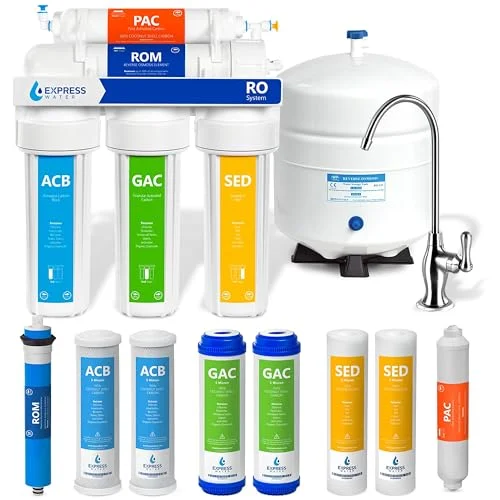
- Express Water RO5DX, 5-Stage Under Sink Reverse Osmosis System, 50 GPD — $142.79, recorded November 2, 2026. Size/variant: 5 Stage.
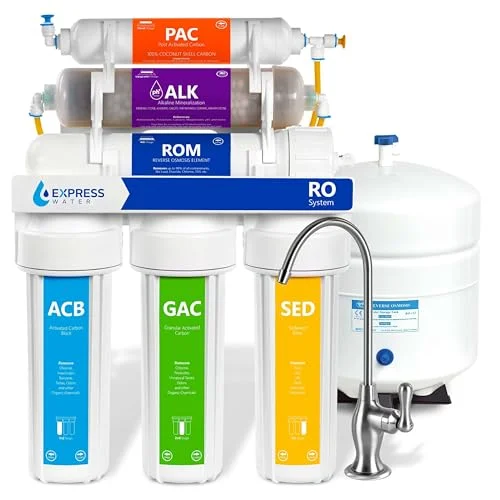
- Express Water ROALK5D, 10-Stage Under Sink RO System, Alkaline, 50 GPD — $188.99, recorded October 18, 2026. Size/variant: 10 Stage, Alkaline.
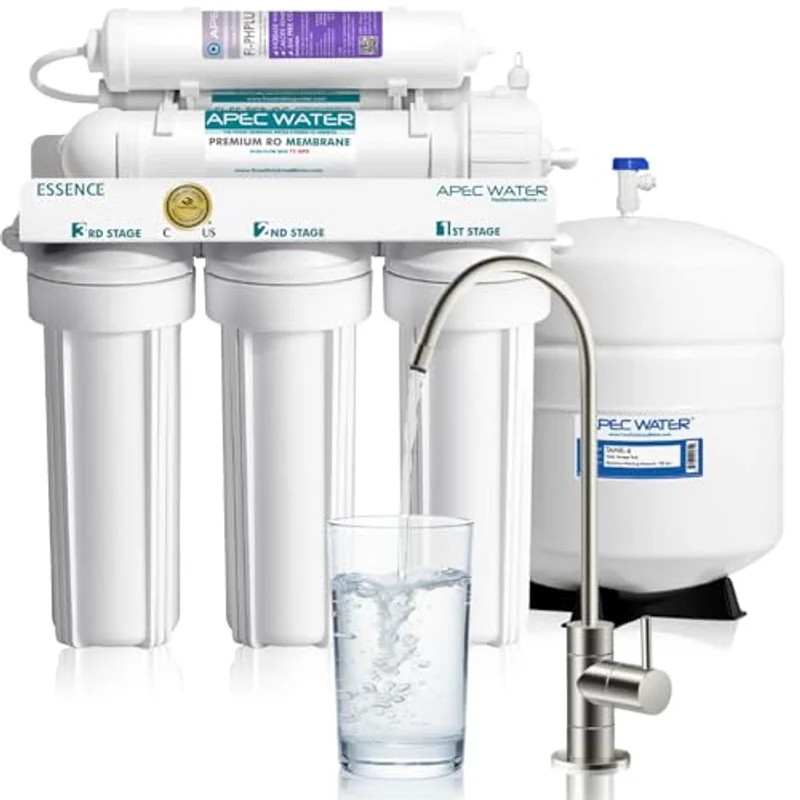
- APEC Water ROES-PH75, 6-Stage Under Sink RO System, Alkaline, 75 GPD — $180.48, recorded September 22, 2026. Size/variant: RO System.
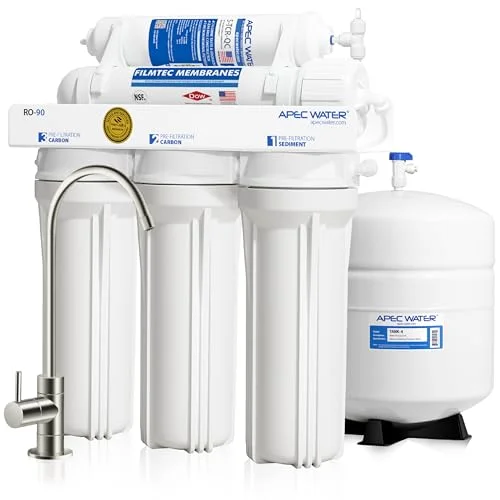
- APEC Water RO-90, 5-Stage Under Sink Reverse Osmosis System, 90 GPD — $209.99, recorded October 17, 2026. Size/variant: RO-90 (Chrome).
Lay those four side by side and a pattern falls out that most single-brand reviews miss: Express Water and APEC have effectively standardized on the same two price bands at the entry tier. The plain systems sit in the low $140s to low $210s; the alkaline systems sit $8.51 apart at $188.99 and $180.48. That's close enough that price alone won't settle this decision for you — which is exactly why the rest of this page is about what else you're buying at that price, not just the sticker.
Both brands also sell well above this tier — APEC's own move into tankless systems is a different shopping decision entirely, at a different price point and a different cartridge economy. What's covered here is specifically the tank-and-housings entry tier, because that's where a first-time buyer is actually choosing between these two brands.
RO5DX's 50 GPD against RO-90's 90 GPD
Strip the alkaline stage out of the picture and you're left with each brand's plain workhorse: Express Water's RO5DX and APEC's RO-90. Both are 5-stage systems — sediment, two carbon stages, membrane, post-carbon polish — with no remineralization step and no extra housings beyond the standard four. That makes them the cleanest apples-to-apples pair in either brand's catalogue, and the first place this comparison gets concrete: the RO5DX is $142.79 and the RO-90 is $209.99, a gap of $67.20 on the prices we actually recorded.
What that $67.20 buys, on the numbers printed on each listing, is output: the RO5DX is rated at 50 gallons per day, the RO-90 at 90 gallons per day, nearly double. Both figures are the same kind of number — a manufacturer's rated capacity at an assumed feed pressure and temperature — and neither listing states the exact test conditions behind it, which is worth knowing before you treat either figure as a promise about your own kitchen. We work through why a GPD rating and a faucet's real fill speed aren't the same claim in the section below, and the short version is that a 90 GPD rating doesn't mean water comes out of the faucet twice as fast — it means the system can refill its tank roughly twice as quickly once the tank runs low, which matters more to households drawing water back-to-back than to someone filling a single glass.
The RO-90's "(Chrome)" size/variant line is the one concrete hardware difference either listing states outright: it specifies a chrome-finished faucet, where the RO5DX's variant field simply reads "5 Stage" with no faucet finish called out. If the faucet's finish matters to your sink's existing hardware — matching a chrome gooseneck versus a brushed-nickel one, say — that's a real, documented difference between the two, not a guess on our part.
Neither listing's title states a named third-party performance certification the way the alkaline pair below does, so we're not going to assign one here that isn't printed. Both are standard four-housing, membrane-plus-tank systems at the entry tier; the GPD rating and the $67.20 price gap are the two things we can confirm separate them.
What $188.99 and $180.48 actually buy
Move to the alkaline tier and the price gap all but disappears: Express Water's ROALK5D is $188.99, APEC's ROES-PH75 is $180.48 — $8.51 apart on the prices we recorded. Unlike the plain pair above, these two systems aren't a clean spec-for-spec match, and it's worth naming the difference rather than smoothing it over for the sake of a tidy comparison.
The ROALK5D's own title states 10-Stage, and its size/variant field confirms 10 Stage, Alkaline — the highest stage count of any system in this comparison, at a GPD rating still printed as 50 GPD, the same as its non-alkaline sibling. The ROES-PH75's title states 6-Stage, with a size/variant field that just reads "RO System" rather than confirming a stage count independently, and a GPD rating of 75 — half again the ROALK5D's rated output. So for essentially the same price, Express Water is selling more stages at lower rated output, and APEC is selling fewer stages at higher rated output. Stage count and GPD aren't the same axis, and a buyer chasing one number over the other should know which one they're actually optimizing for.
What accounts for Express Water's higher stage count isn't necessarily more filtration media doing more work — manufacturers count stages differently, and some brands count a mineral cartridge's separate media types as individual stages where others bundle them into one. Neither listing's title breaks down what each of its stages specifically is, so we're not going to assert that "10" beats "6" in any functional sense; we're stating what each title claims and leaving the inference to you. Our look at a different brand's alkaline-versus-plain pair runs into the same counting inconsistency, which suggests it's a category-wide labeling habit rather than something specific to either brand here.
One thing both listings share: an alkaline stage remineralizes water after the membrane has stripped it, adding back calcium and magnesium for taste and for the small mineral contribution to an otherwise near-empty glass of water. Whether that matters to you is a separate, personal question, not a performance claim either brand's title actually makes — this is general information, not medical advice. The real decision this pair surfaces isn't which brand's alkaline system is "better" on these numbers; it's whether the dollar you'd spend either way should go toward Express Water's extra stages or APEC's higher rated output, since the price doesn't force a tradeoff for you.
Filter housing and faucet design differences
A GPD number and a stage count are the figures that sell a system at the point of purchase. The housing and faucet are what you live with every time you change a cartridge or fill a glass, for as long as you own the thing — and this is where the two brands' entry-level hardware choices are worth naming plainly, based only on what each listing documents.
The one hardware detail we can confirm with certainty across this set is the RO-90's chrome faucet finish, stated directly in its size/variant field. That's a small thing until you're trying to match an existing sink's hardware finish, at which point it's the only detail in either brand's listing that tells you what you're actually getting before it arrives. The RO5DX's and ROALK5D's variant fields don't state a faucet finish at all, and the ROES-PH75's variant field is simply "RO System" — so for three of these four listings, faucet finish is a question for the full product listing or the Q&A section, not something this comparison can confirm from the fields we treat as authoritative.
Beyond finish, a dedicated RO faucet's bigger practical differences are mechanical, not cosmetic: how it mounts through the sink deck, whether the air gap is built into the spout or sold separately, and how easily the mounting nut tightens from above versus requiring a wrench underneath. None of the four listings in this comparison state those mechanical details in the fields we're treating as authoritative here, which is the honest limit of what a listing title and a size/variant field can tell you — it's also exactly the kind of detail a smart LED faucet indicator doesn't help with either, since a light that reports filter life says nothing about how the faucet itself was built. If a specific mounting detail is a dealbreaker for your sink, that's a question for the current listing's own installation photos or Q&A section, not something either brand states up front at this price tier.
What we can say with more confidence is about the housings themselves, which is where the stage-count difference from the section above actually lives. More stages, as in the ROALK5D's 10-stage design, generally means more individual housings or a bundled multi-stage cartridge doing several jobs in one canister — and either approach changes how much cabinet space the system needs and how many separate parts you're tracking at filter-change time. Neither listing's title specifies overall system dimensions, so if cabinet depth is tight, that's the one measurement worth confirming on the current listing before ordering either brand's system.
GPD claims vs. real counter-fill speed at this tier
Every system in this comparison states a gallons-per-day rating, and at this entry tier that number does a lot of marketing work it isn't really built to do. A rated output of 50, 75 or 90 GPD describes how much water a system's membrane can produce over a full day under the manufacturer's assumed test conditions — not how fast water comes out of the faucet when you turn the handle.
That distinction matters because every tank-based system in this comparison, all four of them, stores pre-made water in a pressurized tank rather than producing it on demand. When you open the faucet, you're drawing down water that was already made and stored, at a flow rate set by the tank's internal bladder pressure and the faucet's own aperture — not by the membrane's GPD rating. The membrane's job happens afterward, quietly refilling the tank in the background, and that refill is the only place the GPD rating actually shows up: a 90 GPD membrane refills an emptied tank roughly twice as fast as a 50 GPD membrane does, all else equal, which matters if you draw several glasses back-to-back or run the system hard during meal prep, and matters far less if you're filling one glass at a time with hours between draws.
So the RO-90's near-double GPD rating over the RO5DX is a real, documented difference — it's just a difference in recovery time between draws, not a difference in how fast the faucet fills a cup on a single pour. A replacement membrane's own rated GPD has to match a system's original rating for this same reason; swapping in a mismatched one changes exactly this recovery behavior, which is the whole subject of our guide to matching a replacement membrane's GPD number.
None of the four listings here states an actual faucet flow rate in gallons per minute or a cup-fill time, so we can't put a stopwatch number against any of them from the data we have. What we can say, based on how tank-based RO systems work generally, is that the GPD figure on the box is the wrong number to use if what you actually care about is how long you'll stand at the sink waiting for a glass — tank size and faucet aperture decide that, and neither is the spec being advertised on any of these four listings.
All four, lined up
What each listing's title, price and size/variant field state. Confirm the live price before buying — Amazon prices move.
Which brand for a first RO system, and when to skip alkaline entirely
Four systems, two brands, and on the numbers we recorded, no single one of them is simply "better" than the rest — each pair trades a different thing for a different dollar. Here's how we'd actually decide, broken into the two questions that matter.
Plain system: RO5DX or RO-90. If your household draws water a glass at a time with gaps between draws, the RO5DX's $142.79 and 50 GPD rating is the more sensible buy — you're not paying $67.20 extra for a faster tank refill you'll rarely notice. If you regularly draw several glasses back-to-back, fill a kettle, or run the line into an ice maker or coffee machine, the RO-90's 90 GPD rating and its documented chrome faucet earn the $67.20 premium through faster recovery between draws, not through any claimed difference in filtration.
$67.20 is still worth sitting with for a second before you default to the cheaper option. For a system you'll own for years, the one-time difference between $142.79 and $209.99 amortizes to a few dollars a year — closer to noise than to a real budget constraint for most households. The better question is usage pattern, not sticker shock.
Alkaline, or skip it. At a dollar apart, ROALK5D versus ROES-PH75 isn't really a price decision — it's a question of whether you want the alkaline stage at all. Skip alkaline entirely if your priority is simply clean, low-TDS water and you don't have a specific reason to care about remineralized output; the plain RO5DX or RO-90 gets you there for less money and one less set of cartridges to track at change time. Choose alkaline if the taste of remineralized water matters to you, or if you specifically want calcium and magnesium added back after the membrane strips them — and if you do, the decision between Express Water's 10-stage, 50 GPD ROALK5D and APEC's 6-stage, 75 GPD ROES-PH75 comes down to whether you'd rather have more stages at lower rated output or fewer stages at higher rated output, since the dollar between them won't make the choice for you.
What we wouldn't do is let the stage-count number alone decide this. "10-Stage" reads like more filtration than "6-Stage," but neither listing breaks its stages down enough to confirm that each one is doing distinct, meaningful work rather than splitting a single cartridge's media into counted parts. GPD, price and the one faucet-finish detail the RO-90 states outright are the facts we can actually stand behind here; stage count is a number worth questioning rather than a number worth optimizing.
Questions people ask about Express Water and APEC's entry tier
What's the actual price gap between Express Water's RO5DX and APEC's RO-90?
On the prices we recorded, the RO5DX was $142.79 (November 2, 2026) and the RO-90 was $209.99 (October 17, 2026) — a gap of $67.20. The RO-90 also carries a near-double rated output, 90 GPD against the RO5DX's 50 GPD, which is the main documented difference between the two.
Is a higher GPD rating the same as faster water at the faucet?
No. All four systems in this comparison store water in a pressurized tank, so the flow rate you feel at the faucet is set by the tank and faucet, not by the membrane's GPD rating. The GPD figure describes how quickly the membrane refills the tank between draws — a 90 GPD system recovers roughly twice as fast as a 50 GPD one, which matters most to households drawing several glasses back-to-back.
Does Express Water's 10-Stage ROALK5D filter better than APEC's 6-Stage ROES-PH75?
Not something either listing's title lets us confirm. Stage count isn't a standardized measurement — some brands count a single cartridge's different media as separate stages, where others bundle them into one. The ROALK5D is rated 50 GPD and the ROES-PH75 is rated 75 GPD at an $8.51 price difference, so the honest comparison is stages-versus-output, not a simple "more stages wins."
Should a first-time buyer get an alkaline system or skip it?
Skip it if your priority is simply low-TDS drinking water — the plain RO5DX or RO-90 does that for less money and fewer cartridges to track. Choose an alkaline system if you specifically want the taste or mineral content of remineralized water added back after the membrane strips it; that's a personal preference, not a performance claim made on either brand's listing, and it's general information rather than medical advice.