Comparison
APEC's first tankless system: how the ROTL-600-PH-A stacks up against the category leaders
By Ilane TallUpdated November 4, 202613 min readResearch-based.
We're reader-supported: buying through our links may earn us a commission at no extra cost to you. We compare published specifications, stage counts and prices — we don't run a testing lab, and nothing below is a star rating or a paraphrased review.
APEC has spent the better part of two decades selling exactly one kind of reverse osmosis system: a tank-based unit with three, five or six stages, housed in a row of vertical canisters under the sink, with a pressure tank taking up the rest of the cabinet. The Essence ROES-PH75 we've covered elsewhere on this site is the archetype — heavy housings, a calcium remineralization stage, long-life cartridges, and the kind of parts catalogue that still has a listing for a ten-year-old model. That formula built the brand's reputation, and it is a tank-based reputation specifically: the thing APEC has been reliably good at is the format every tankless competitor has spent the last several years trying to replace.
The APEC ROTL-600-PH-A is the brand's answer to that competitor category — its first tankless, under-sink, 600 GPD system, and the "TL" in the model number is not subtle about what it's claiming. It arrives into a field that is no longer new. Philips already sells a tankless unit built on an entirely different membrane platform, and two systems we track closely here — the Frizzlife M800 and the Waterdrop G2P600 — have been selling at this exact output rating for a while. Both of those systems run more filtration stages than APEC's new entry, at a lower price. That is the whole tension in this comparison, and it is worth sitting with before any brand loyalty gets involved: a company that is excellent at one format entering a different one does not automatically carry its reputation across the format line. The hardware is different, the stage count is different, and on paper the new system is behind two systems it is priced above.
None of this means APEC built a bad system. A 3-stage tankless unit can be a perfectly reasonable product for the right kitchen. It means a buyer comparing listings has to actually read the stage count and the certification claims on this one, rather than assuming APEC's tank-based track record transfers automatically to a format the brand has not sold at scale before.
Reading the listing
What 3 stages leaves out compared to the 6-to-9-stage tankless designs already in this catalogue
The APEC ROTL-600-PH-A's own title states it plainly: 3-Stage Water Filter System with pH+. That is a short stage count for a tankless system in 2026. For comparison, the Frizzlife M800 we recommend elsewhere on this site runs a considerably longer filtration path, and the Waterdrop G2P600 — a 600 GPD tankless unit at the same output rating as APEC's new system — is built around seven stages. Stage count is not a perfect proxy for water quality, and a well-engineered 3-stage design can still reject what it's rated to reject. But stage count is a reasonable proxy for how many separate jobs a system is doing before the water reaches your glass, and three is fewer jobs than six, seven, eight or nine.
What typically lives in the stages a short system skips: a dedicated post-carbon polish stage after the membrane, which exists to catch any taste the membrane itself doesn't address; a second carbon block ahead of the membrane, which gives chlorine two chances to be removed instead of one before it reaches the thin-film composite that free chlorine is known to degrade; and in several longer designs, a remineralization stage separate from whatever pH-adjustment stage is present. A 3-stage system with a pH+ addition is, by simple arithmetic, doing sediment filtration, the membrane itself, and the pH+ stage — which leaves little to no room in the stage count for a second carbon pass or a standalone post-filter polish. We don't have APEC's internal stage-by-stage breakdown beyond what the listing states, so we are not going to guess at exactly which of those jobs got folded together or dropped. What we can say with confidence is that a buyer putting this system next to a 7-stage or 9-stage tankless competitor at the same output rating is comparing a shorter filtration path to a longer one, and the listing title is the place that comparison starts.
This is also where the pH+ branding matters to read correctly rather than skim past. "pH+" describes what one stage does — raising the water's pH, typically through a mineral or alkaline media — not how many stages exist upstream of it. A system can carry an alkaline or pH-adjustment designation and still be short on general filtration stages, in exactly the way we found when comparing two iSpring 500 GPD listings that differed by a single alkaline stage and nothing else. The lesson transfers directly here: a single added stage is a specific, nameable feature, not evidence that the rest of the system is equally well-equipped.
The arithmetic that should give you pause
Price versus stage count: the ROTL-600-PH-A costs more than two systems with more filtration ahead of the membrane
Put the three listings side by side and the pattern is blunt. The Frizzlife M800 is $289.99, NSF/ANSI 58 and 372 certified, rated up to 900 GPD, non-electric, and runs a longer filtration path than APEC's new system before and after the membrane. The Waterdrop G2P600 is $269.00, NSF/ANSI 372 certified, rated 600 GPD — identical to APEC's new system — and runs seven stages against APEC's three. The APEC ROTL-600-PH-A is $334.31: the most expensive of the three, at the same 600 GPD output as the Waterdrop and well under the Frizzlife's higher rated ceiling, with the shortest stage count of the three by a wide margin.
Lay that out as a single sentence and it's the finding of this whole comparison: APEC's tankless debut is priced $41.68 above the Waterdrop G2P600 and $50.69 above the Frizzlife M800, while running fewer filtration stages than either one. That is not automatically disqualifying — we'll get to what the ROTL-600-PH-A is actually buying with that premium in the next section — but it inverts the pattern buyers usually expect, where more stages correlates with a higher price. Here the system with the fewest stages costs the most.
Smart Replacement Reminder and Easy DIY Install/Maintenance are the other two things APEC's own title foregrounds, and they're worth taking at face value: a usage-based reminder is a genuinely useful feature, in the same category as the gallon-based filter-life counters we've praised on the Waterdrop G3P600 and the Frizzlife M800's TDS display. But a reminder telling you when to change a 3-stage set of filters is not the same claim as a longer filtration path doing more separate jobs on the water before that reminder ever fires. The two features solve different problems, and only one of them is about what's actually being filtered out.
What's actually different
pH+ as the ROTL-600-PH-A's one differentiator, and what that single stage is worth alone
Credit where it's due: neither the Frizzlife M800 nor the Waterdrop G2P600 listing states a pH-adjustment or alkaline stage. The Frizzlife adds minerals back and the Waterdrop does not carry that designation in its title at all. APEC's pH+ stage is a real, specific thing the other two don't claim, and if alkaline or pH-adjusted water matters to you specifically, it is the one feature on this page that genuinely separates the three systems rather than just restating output and price.
What it's worth in isolation, going by the standalone remineralization cartridge market we've priced elsewhere on this site: Waterdrop's own inline MNR35 remineralization add-on, which plumbs onto the outlet of most existing under-sink RO systems, runs about $29.99 and lasts nine to twelve months. That's the going rate for bolting pH-adjustment or remineralization onto a system that doesn't already have it — roughly $30 a year, added to whatever system you already own. APEC's ROTL-600-PH-A premium over the Waterdrop G2P600 is $41.68, and over the Frizzlife M800 it's $50.69. Both premiums are in the same rough neighborhood as a year or two of a standalone pH-adjustment add-on, which is one honest way to frame what the extra money is buying: it's paying, up front and built-in, for roughly the cost of retrofitting the feature onto a cheaper system yourself — not for a system that also happens to out-filter its tankless competitors.
That framing cuts both ways. If you specifically want alkaline or pH-adjusted water and don't want to manage a separate add-on cartridge on a different schedule, paying for it built into the system you're already buying is a reasonable trade, and it's the trade APEC is explicitly selling. If you don't care about pH adjustment at all, the ROTL-600-PH-A's premium is buying you a feature you won't use, on a system with fewer general-filtration stages than two competitors that cost less. The stage count doesn't change based on whether pH+ matters to you; only the value of the premium does.
Side by side
The three listings, lined up
Prices and specs as stated in each product's own listing. Confirm the live price on Amazon before buying — these move.
| System | Format | Output | Stages | Certified | Price | |
|---|
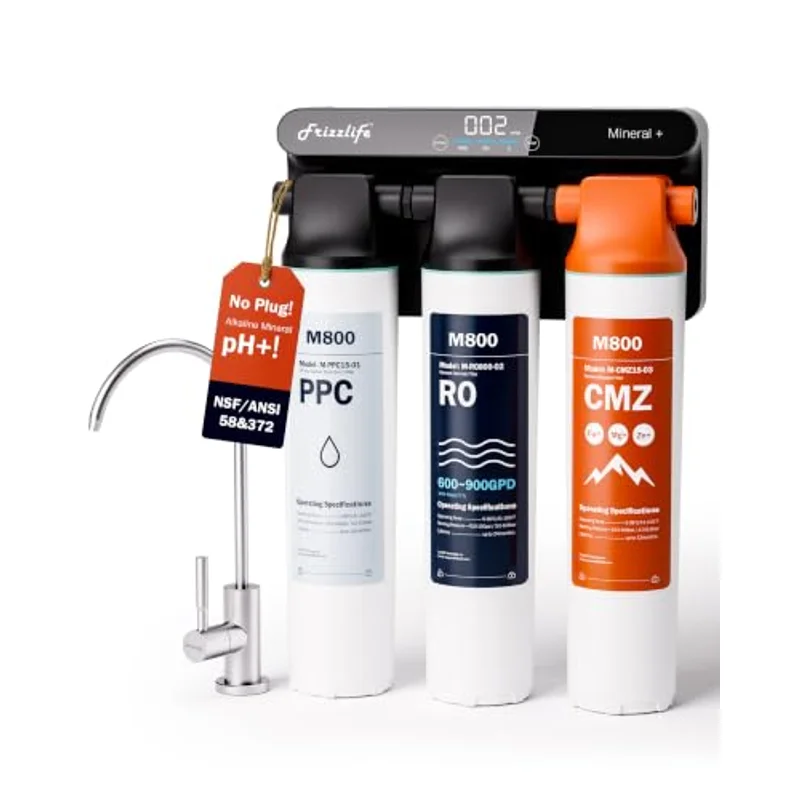 Frizzlife M800 | Tankless · non-electric | up to 900 GPD | Longer path, pre- and post-membrane | NSF/ANSI 58 & 372 | $289.99 | Price |
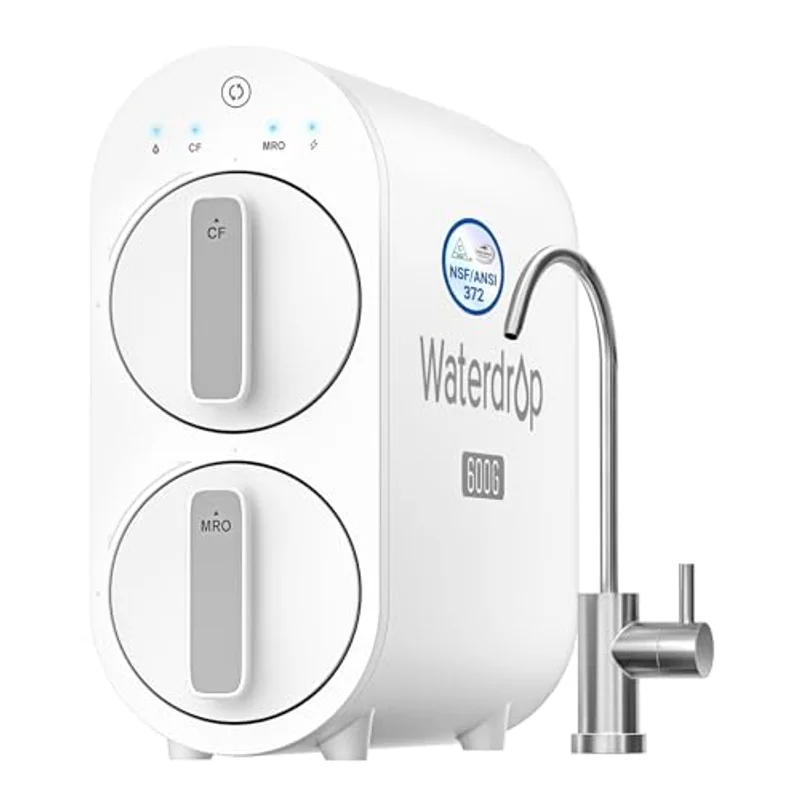 Waterdrop G2P600 | Tankless · under-sink | 600 GPD | 7 | NSF/ANSI 372 | $269.00 | Price |
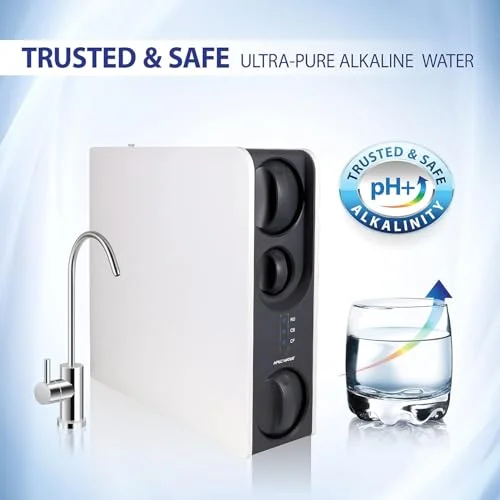 APEC ROTL-600-PH-A | Tankless · under-sink | 600 GPD | 3, with pH+ | See listing | $334.31 | Price |
The highlighted row isn't a recommendation — it's the system this page is about. Fewest stages, highest price, and the one genuine differentiator is the pH+ stage covered above. We did not see a certification number stated on the ROTL-600-PH-A listing beyond the pH+ naming itself; check the current listing directly for whatever certification language it carries before assuming it matches the NSF/ANSI 58 or 372 claims the other two make explicitly.