The 4.72-Inch-Wide RO System: What ANGEL's Ultra-Slim Tankless Unit Gives Up for Cabinet Space
We're reader-supported: buying through our links may earn us a commission at no extra cost to you. We compare published listing specifications and prices — we don't run a testing lab, and nothing below is a star rating or a paraphrased review.
Most reverse osmosis listings describe cabinet fit with an adjective: compact, slim, space-saving. The ANGEL X2 does something narrower and more checkable — it puts an exact measurement in the title itself. "4.72" Slim RO Filter" and "Ultra-Slim 4.72"" both appear in the product name, not buried three bullet points down in the description. At $256.49, rated 700 GPD, with 9-stage filtration, NSF/ANSI 372 certification, a 0.5 GPM flow spec and a 2.5:1 pure-to-drain ratio, the X2 is also one of the more fully specified tankless listings in this catalogue. The width claim is the one that's easiest to verify with nothing but a tape measure, which is exactly why it's worth checking against the two systems most people would compare it to.
The first is the Waterdrop G6A6 Compact Alkaline Mineral Reverse Osmosis System — "Compact" sits right in the name, the same way "Slim" sits in ANGEL's — at $189.99 for the same 600 GPD rating class. Its listing does not state a width figure we could record. The second is the Waterdrop G3P600, a plain tankless 600 GPD unit at $399.00, also without a stated width in the specification we sourced. Three tankless systems, one real number between them, and a $209.01 price spread from cheapest to priciest. When a listing doesn't publish a width, we don't invent one from a photo — we say so directly instead.
This isn't a new problem for the category. We've made the same point about a different spec on a different system before — three tankless systems rated near 800 GPD that disagreed sharply on stage count despite an identical headline number. Width is turning into its own version of that fight: a dimension that used to be an afterthought on a tank-and-three-housings system is now something a tankless brand will print on the box in inches, specifically because it's the one spec that doesn't require you to trust the seller's judgment of what counts as "compact."
Four things worth knowing before you compare a width number
Width isn't depth
A system can be narrow side-to-side and still project far forward from the wall. A single inches figure in a title rarely tells you which dimension it's describing — check the full dimension string, not just the headline number.
"Compact" is marketing, not a measurement
A word has no units. Two systems can both call themselves compact while differing by several inches in actual cabinet footprint — the word alone tells you the brand wants you to think it's small, not how small.
GPD is a daily average
A 700 GPD rating describes a 24-hour theoretical total under test conditions, not the speed water leaves the faucet when you fill a glass. The two numbers can move in opposite directions on a narrower housing.
Certification describes materials or performance, not size
NSF/ANSI 372 certifies that a system's wetted parts are lead-free. It says nothing about contaminant reduction, and nothing at all about how many inches the housing takes up.
ANGEL's 4.72 inches against the G6A6's unstated "compact"
Put the two listings next to each other and the asymmetry is immediate. ANGEL's X2 states a width of 4.72 inches, twice, in the product title — once as a plain dimension and once with "Ultra-Slim" attached to it. The Waterdrop G6A6 states "Compact" in its own name, attached to the words "Alkaline Mineral Reverse Osmosis System," and the specification we sourced for it does not include a width figure at all. Both brands are making the same pitch — this will fit where a bulkier system won't — but only one of them is making a claim you can hold a tape measure up to before you buy.
That doesn't make the G6A6's claim false. A system can genuinely be small without a brand choosing to print the exact dimension on the listing; plenty of compact products on Amazon put dimensions in a separate specifications table rather than the title, and we weren't able to source that figure for this one. What it means practically is that a buyer comparing these two on "which one is actually narrower" has one real number to work with and one unverifiable adjective. If cabinet width is the deciding factor — and for a lot of under-sink installs it's the single tightest constraint in the project — check the G6A6's current listing and photos for a stated dimension before assuming it undercuts the X2's 4.72 inches. It might. The listing we have simply doesn't say.
There's also a price gap worth sitting next to the width question. At $189.99 the G6A6 is $66.50 cheaper than the $256.49 ANGEL X2, and it adds an alkaline mineral stage to its name that the X2's listing doesn't claim — the X2's title describes 9-stage RO filtration and TDS reduction, not remineralization. A buyer choosing between them is weighing a stated 4.72-inch footprint and a 9-stage count against a lower price and a mineral-stage claim with no cabinet dimension attached. Which trade-off matters more depends on which constraint binds in your own kitchen — and only one of those two is something the listing itself lets you verify in advance.
0.5 GPM: does a slimmer housing mean a slower fill?
The instinct is reasonable: shrink the box and you'd expect to shrink whatever's moving water through it. ANGEL's own listing heads this off directly by pairing the 0.5 GPM figure with the words "Fast Flow" in the same spec line — the brand is explicitly arguing that 4.72 inches of width did not cost it flow rate. We have no independent way to confirm that claim beyond the number ANGEL published, and we're not going to; this is a comparison of stated specifications, not a lab result.
What we can do is put the number in context using math anyone can check. A continuous 0.5 GPM tap would move 30 gallons an hour, or 720 gallons over 24 hours — close to, and slightly above, the X2's own 700 GPD rating. That rough consistency is a reasonable sign the two published numbers aren't contradicting each other, even though GPD and GPM measure different things: GPD is a theoretical daily total under test conditions, while GPM at the faucet reflects instantaneous flow, which real-world incoming pressure, temperature and filter condition all push around. The two figures agreeing in rough order of magnitude is useful, but it isn't proof of real-world fill speed in your kitchen.
The honest gap here is that neither the G6A6 nor the G3P600 listing we sourced states a GPM figure, so there's no direct flow-rate number to set against ANGEL's 0.5 GPM. Both are rated 600 GPD, lower than the X2's 700 GPD, which hints at a system sized for somewhat less daily throughput — but a GPD rating isn't a substitute for a stated faucet flow rate, and we won't present one as if it were. If instant fill speed matters as much as cabinet width, that's worth asking the seller directly on the two listings that don't publish the number.
Stage count holds at 9 — what that means inside a 4.72-inch case
The number that would normally move when a housing shrinks is stage count, because each stage is physically a cartridge, a membrane or a coating that has to live somewhere inside the case. ANGEL's listing states 9-stage RO water filtration on the X2 at 4.72 inches wide — the same stage count other tankless systems in this catalogue carry at a standard footprint, not a reduced count traded for the narrower housing. Whether that number holds up to the same scrutiny as "compact" is itself a fair question, since stage counts across this category are counted differently brand to brand, and a listed number can include coatings or housings alongside functional filtration stages. We're reporting what ANGEL's own listing states, not independently verifying each of the nine.
What a stated 9-stage count inside a slim case tells you, without needing to verify each individual stage, is something about internal layout. A wider housing has room to array cartridges side by side; a narrower one has to stack them vertically, nest them concentrically, or use flatter cartridge geometry than a standard 10-inch canister. None of that is stated in ANGEL's listing, so we won't describe the X2's internal arrangement as if we'd opened one — but the trade-off is real as general category information: fitting more stages into less width usually means a denser layout, and a denser layout typically means a cartridge change that's less like swapping a standalone canister and more like working inside a sealed assembly. If service access matters as much as footprint, confirm it on ANGEL's current listing and installation photos before assuming the two specs come free of any trade-off.
The NSF/ANSI 372 certification stated for the X2 is also worth being precise about, because it's easy to let a long stage count imply a long certification list. NSF/ANSI 372 certifies that a system's wetted components are lead-free — it does not certify contaminant reduction performance the way NSF/ANSI 58 does. A 9-stage count and a 372 certification are both real, stated facts about the X2, but they answer different questions: one is about how many filtration steps the water passes through, the other is about what the hardware is made of. The listing we sourced does not state an NSF/ANSI 58 certification, so we won't claim one.
Where the extra width on the G3P600 actually goes
The Waterdrop G3P600 is the odd one out in this three-way comparison, and not because it's wide — its listing, like the G6A6's, simply doesn't state a width figure we could record. At $399.00, it's also the most expensive of the three by a comfortable margin: $142.51 above the X2 and $209.01 above the G6A6. If width isn't the stated differentiator, the price gap has to be explained by something else, and the honest answer is that we can only point at what the G3P600's listing in this comparison actually states — a plain tankless 600 GPD system — rather than reach for specifications from elsewhere that weren't part of the data we sourced for this piece.
That's a narrower claim than some buying guides would make, and it's deliberate. It would be easy to pad this section with stage counts, drain ratios or certification numbers pulled from memory of the category in general, but that would mean asserting a spec for this specific listing that we don't have in front of us. What we can say with the numbers we do have: a $399.00 tankless system without a stated width or stage count, sitting well above a $256.49 system that states both, isn't automatically the better buy on cabinet-fit grounds — it's a system whose case for its price has to rest on something other than the one spec this page is organized around. Waterdrop's own G3P600 listings have shown a price gap inside one model line can come down to a faucet finish and little else, a useful caution against assuming a higher number always buys more hardware.
If exact cabinet width is the deciding factor for you specifically, the practical takeaway is to treat the G3P600 the same way we're treating the G6A6: check the current Amazon listing's full specification table and the installation photos for a stated dimension before assuming either one is narrower or wider than ANGEL's stated 4.72 inches. A $399.00 price tag is not a width measurement, and neither is a $189.99 one.
The three tankless systems, on what each listing actually states
Prices as we recorded them on November 19, 2026. Confirm the live price and current listing text before buying — all three move independently on Amazon.
| System | Price | GPD | Stated width | Stages stated | Flow / drain stated | |
|---|---|---|---|---|---|---|
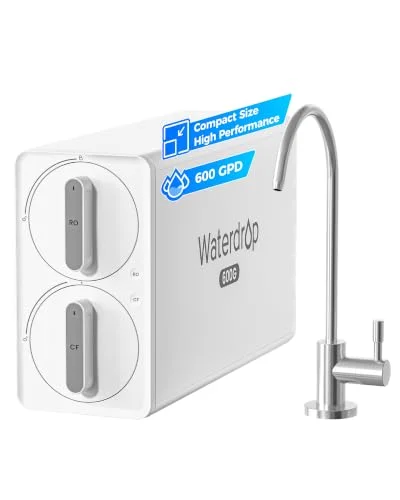 Waterdrop G6A6 | $189.99 | 600 | Not stated | Not stated | Not stated | View |
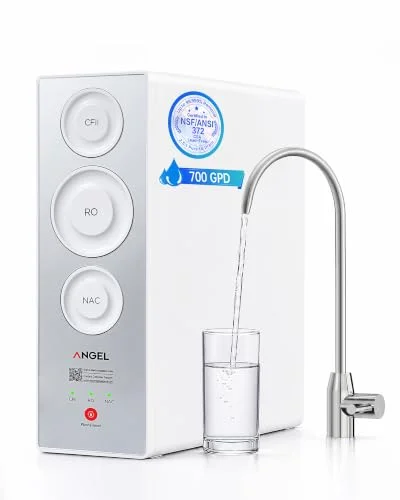 ANGEL X2 | $256.49 | 700 | 4.72 in | 9 | 0.5 GPM · 2.5:1 drain | View |
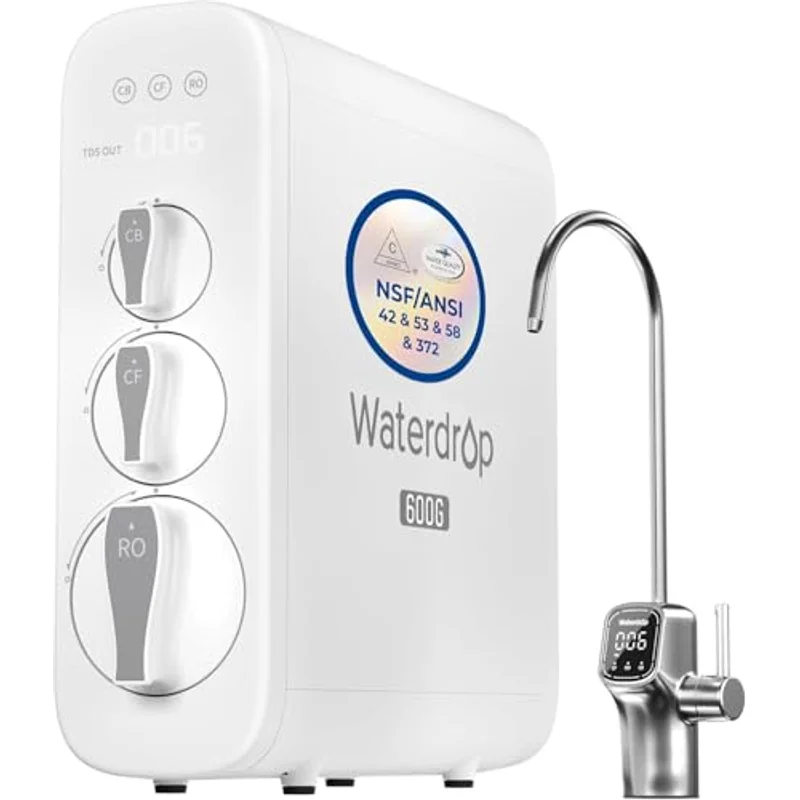 Waterdrop G3P600 | $399.00 | 600 | Not stated | Not stated | Not stated | View |
Read "Not stated" as a gap in the listing we sourced, not as proof the system is actually wide, stage-poor or slow. The one pattern this table does support directly: the only exact cabinet-width figure, the only stated stage count and the only stated flow and drain ratio among these three all belong to the system in the middle of the price range, not the most expensive one.
Measuring your own cabinet before trusting a product photo's sense of scale
A listing photo of a slim tankless unit sitting next to a sink is doing a job: making the box look small relative to the cabinet around it. Camera angle, lens choice and the width of the staged cabinet in the photo can all exaggerate how roomy the result looks. None of that is dishonest exactly — it's a product photo, not a measurement — but it's also not a substitute for knowing the number for your own space. A stated 4.72 inches is only useful once you know what you actually have to fit it into.
- Measure the narrowest point, not the widest. Cabinets taper around drain pipes, shut-off valves and the P-trap. Measure side-to-side at the tightest gap the system has to slide past, not the open floor space in the middle.
- Measure depth separately from width. A system narrow side-to-side can still project deep enough to hit the back wall or the garbage disposal. If a listing states only one dimension, treat the others as unknown.
- Leave clearance for door swing and cartridge access. A unit that fits the static footprint but can't have its panel opened, or cartridges twisted out, isn't actually serviceable where you've put it.
- Account for the valve handles, not just the pipes. A shut-off valve's handle needs room to turn. Fit the box flush against it and you may lose the ability to operate the valve.
- Write the numbers down before you shop. Width at the narrowest point, available depth, height to the sink basin. Compare all three against a listing's full specification table — not just the headline dimension — before assuming a product clears your cabinet.
This is the same discipline that applies to any spec claim in this category, not just width. We've made the point before when pricing out bulk replacement filter packs and when checking what a plumbing brand's first RO listing did and didn't disclose: a number you can verify against your own situation beats an adjective you have to take on faith, every time. "Ultra-slim 4.72 inches" is a real, checkable claim. "Compact" is a word. Measure before you buy either one.
Questions people ask about ultra-slim tankless systems
How wide is the ANGEL X2 reverse osmosis system?
ANGEL's own listing states 4.72 inches, and repeats the figure twice in the product title — once as a plain dimension and once paired with "Ultra-Slim." It's one of the few tankless listings in this catalogue that puts an exact width number in the title rather than describing fit with a word like "compact" or "slim."
Is the Waterdrop G6A6 actually narrower than the ANGEL X2, since it's called "Compact"?
We can't say, because the G6A6 listing we sourced doesn't state a width figure at all. "Compact" is the manufacturer's word, not a measurement. The G6A6 may well be narrower than the X2's stated 4.72 inches — it may also not be. Check the current listing's full specification table for a stated dimension before assuming either way.
Does a slimmer RO housing mean slower water flow?
Not according to ANGEL's own numbers: the X2 states 0.5 GPM paired with "Fast Flow" at a stated width of 4.72 inches. A continuous 0.5 GPM tap works out to roughly 720 gallons over 24 hours, in the same range as the X2's 700 GPD rating, so the two published figures are broadly consistent. Neither the G6A6 nor the G3P600 listing we sourced states a GPM figure for direct comparison.
Does the ANGEL X2's narrow case mean fewer filtration stages?
No — ANGEL's listing states 9-stage RO water filtration at the stated 4.72-inch width, the same stage count other tankless systems in this catalogue carry at a standard footprint. Fitting that many stages into a narrower case likely means a denser internal layout, which can affect how cartridges are accessed for replacement, but it isn't reflected as a reduced stage count on the spec sheet.