Best RO Systems
Home › Guides › Bulk filter packs
Running costs

Buying RO Filters in Bulk: Does a 2-Year, 19-Cartridge Pack Actually Save Money?

We're reader-supported: buying through our links may earn us a commission at no extra cost to you. We compare published listing details and prices — we don't run a testing lab, and nothing below is a star rating or a paraphrased review.

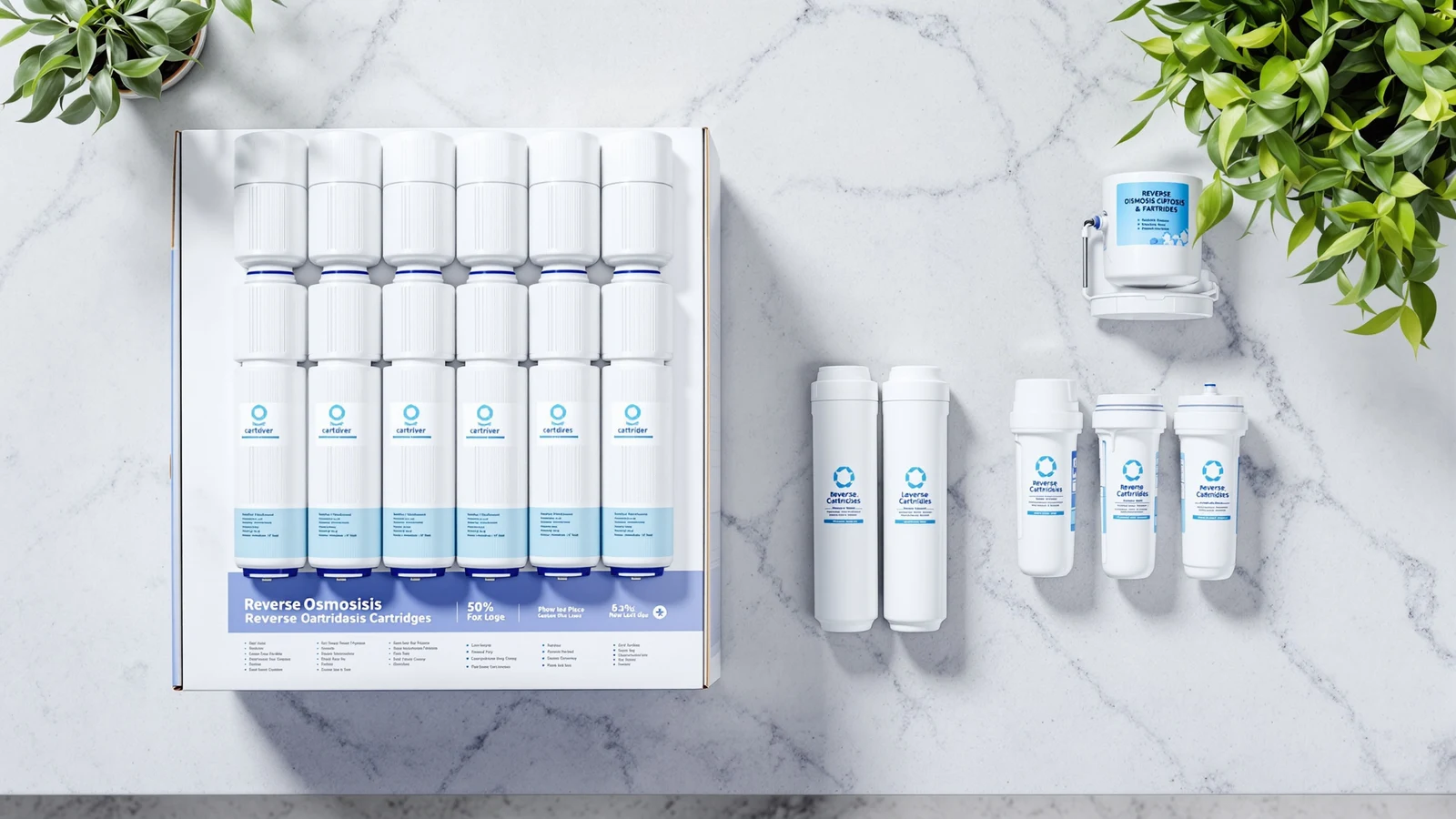
Stacks of reverse osmosis replacement filter cartridges in sealed bulk packaging next to a single five-piece filter set

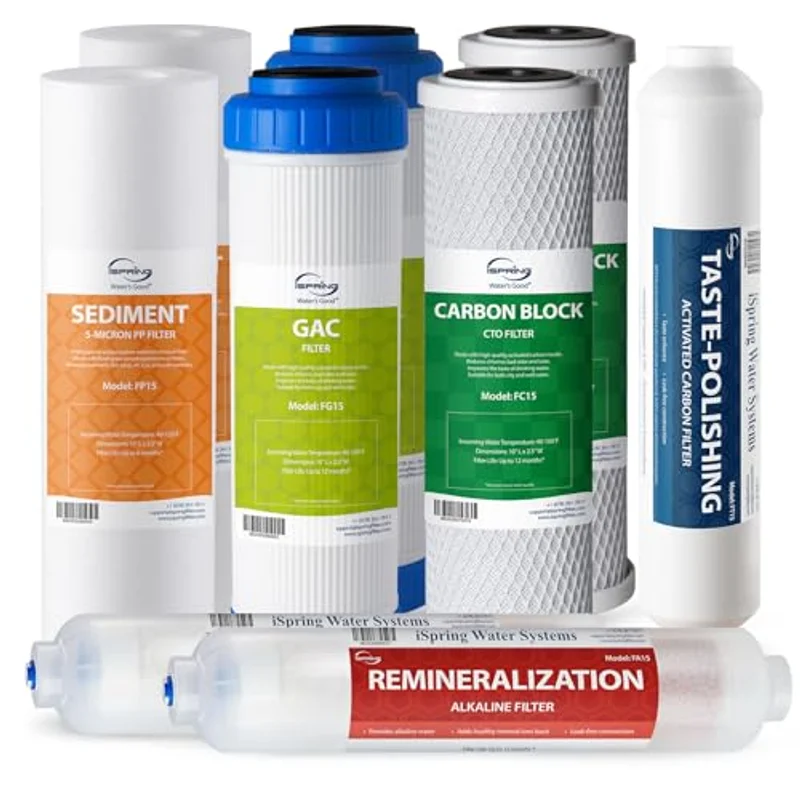
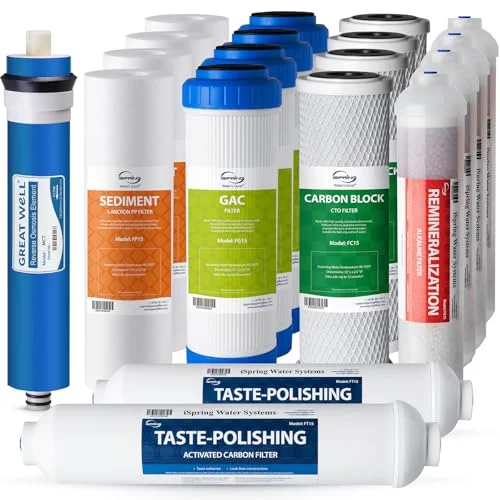
iSpring sells the same cartridge economics three different ways. There's the F5-75, a five-piece set for a plain 5-stage system that includes the membrane. There's the F9K, a nine-piece set for a 6-stage alkaline system that covers a calendar year but leaves the membrane out. And there's the F19K75, a nineteen-piece set that claims to cover two years on a 6-stage system. Same brand, same general cartridge families, three very different unit sizes — and three very different upfront prices: $46.49, $61.99 and $131.99.

The question a $139 bulk pack is actually asking you to answer isn't "can I afford this today." It's "will this be the cheaper way to own filters over the next two years, or am I just prepaying for cartridges I could buy later for the same price, with some of them going stale in a drawer in the meantime." That's a per-month question, not a sticker-price question, so that's how we're answering it — using only the counts, prices and stage targets each listing actually publishes.

Why RO cartridges are sold in multi-piece packs instead of one at a time

An under-sink RO system doesn't age on one clock. A sediment filter and a carbon block are typically rated six to twelve months; an alkaline remineralization cartridge sits in a similar window; the RO membrane itself is the outlier, routinely rated two to three years because it's losing rejection capacity rather than physically clogging. If a manufacturer sold each of those separately, you'd be placing three or four small orders a year just to keep one system running — more shipping boxes, more plastic dunnage, more chances to forget one stage and run it past its rated life.

Bundling the stages that come due around the same time into one SKU solves that, and it does something else that matters more than convenience: it keeps the components matched. iSpring's 6-stage alkaline systems are certified to NSF/ANSI 58 as a complete assembly, not stage by stage, and a system certification describes a specific combination of parts. A multi-piece pack sold as "the 1-year set" is iSpring telling you which parts belong together for that stretch of time, rather than leaving you to improvise a schedule from individually listed cartridges that may not be the ones the certification was tested with.

The bulk pack takes that logic one step further. Instead of packaging "what's due this year," the F19K75 packages "what's due across two years" into a single purchase and a single box — a real shipping saving for iSpring. The question for the buyer is whether any of that saving gets passed through, or whether you're simply paying twice the one-year price to store half the cartridges for an extra twelve months.

The arithmetic

Pricing the single set, the 1-year set and the 2-year pack per month of use

Each pack covers a different window, so the sticker price alone tells you almost nothing. Dividing by the number of months each one is rated to last is the only fair comparison.

iSpring F5-75 five-stage reverse osmosis filter replacement pack

F5-75 — 5-stage, 1 year

$3.87/mo

$46.49 ÷ 12 months. Five cartridges for a plain 5-stage system, membrane included — the only one of the three that bundles a membrane without any ambiguity about it.

Check price →
iSpring F9K one-year alkaline reverse osmosis replacement filter set

F9K — 6-stage, 1 year

$5.77/mo

$61.99 ÷ 12 months. Nine cartridges for a 6-stage alkaline system, explicitly without the RO membrane — that's a separate purchase on its own two-to-three-year cycle.

Check price →
iSpring F19K75 nineteen-count two-year reverse osmosis replacement filter set

F19K75 — 6-stage, 2 years

$5.79/mo

$131.99 ÷ 24 months. Nineteen cartridges for the same 6-stage platform as the F9K, rated to cover two years rather than one.

Check price →

The first thing those three numbers tell you is that the F19K75 is not a steep discount on paper. At $5.79 a month it is, if anything, a hair more expensive per month than the F9K's $5.77 — not the kind of gap that alone justifies committing to two years of filters at once. If the comparison stopped there, the honest conclusion would be "the bulk pack buys convenience, not savings."

It doesn't stop there, because the two packs aren't actually selling the same thing. The F9K is explicit that its nine cartridges do not include a membrane. Count what two years of the F9K's cartridge mix would look like: iSpring's own description of the set is two sediment filters, two granular activated carbon filters, two carbon block filters, one post-carbon polish and two alkaline mineral cartridges — nine pieces for one year. Double that for two years and you get eighteen pieces, with the membrane still not accounted for either time.

The F19K75 ships nineteen pieces for that same two-year, 6-stage window — one more than the doubled F9K math produces. That extra cartridge is the whole story. A single additional piece, on a system whose membrane is rated for roughly the same two-to-three-year span the pack is sized for, lines up with exactly where a membrane would sit in the schedule. iSpring's own naming convention backs this up: the "75" suffix on the F5-75 marks a pack that bundles a 75 GPD membrane, and the F19K75 carries that same suffix. The listing itself doesn't spell out "membrane included" in so many words for the 19-count set, so treat this as a strong inference from the count and the name rather than a confirmed line item — but it's the only arithmetic that makes the extra piece make sense.

Assume that inference holds, and the real comparison isn't "$139 once vs. $138.48 twice for the same eighteen cartridges" — it's "$139 once, membrane included, vs. buying the membrane separately." The cheapest sourced route to a replacement iSpring 75 GPD membrane is the F5-75 pack at $46.49, even though four of its five cartridges are sized for a different, 5-stage system and go unused on a 6-stage setup. Stack that against two years of F9K: $61.99 × 2 = $138.48, plus $46.49 for a membrane pulled from a mismatched pack, comes to $184.97 — against the F19K75's $131.99. That's a $45.97 gap over two years, or roughly $1.91 a month, in the bulk pack's favor, and it's the only scenario in this comparison where buying ahead clearly wins on price rather than just on fewer trips to checkout.
What's actually inside a 19-count pack versus a basic 5-piece set

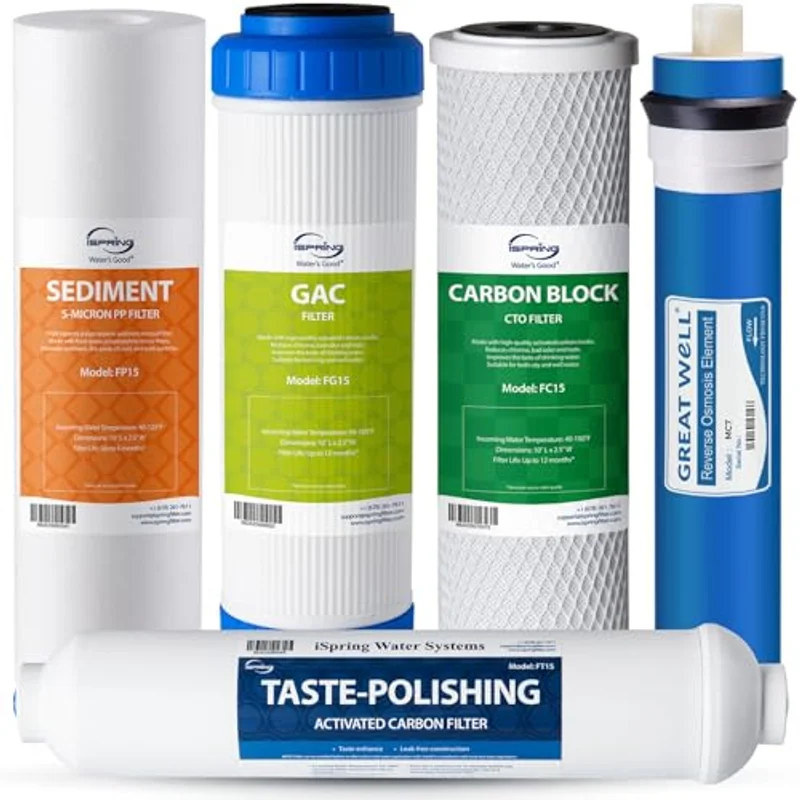
The piece count alone obscures more than it reveals, because the two packs aren't built for the same system. The F5-75's five pieces are sediment, granular activated carbon, carbon block, the 75 GPD membrane, and a post-carbon polish — the complete stage lineup for a plain 5-stage system, with nothing left over and nothing missing. It's a self-contained annual order: buy one, install five cartridges, done for the year.

The F19K75's nineteen pieces are built for a 6-stage alkaline system, which carries one more stage category — the alkaline mineral cartridge — than the 5-stage lineup has. Doubling the F9K's published nine-piece, one-year composition (two sediment, two GAC, two carbon block, one post-carbon, two alkaline) gets to eighteen pieces for two years. The nineteenth, as above, is almost certainly the membrane the two-year window is timed around.

So "19-count" isn't nineteen of one thing, and it isn't a bigger version of the 5-piece set — it's roughly four complete years' worth of pre- and post-filtration stages for a 6-stage system, compressed into a two-year box, plus one membrane. Anyone comparing packs by cartridge count alone is comparing two different systems' worth of parts as if they were the same unit. They aren't interchangeable between the F5-75 and the F19K75 either: a 5-stage system has no alkaline stage to fill, and a 6-stage system's housings aren't sized for a stray 75 GPD membrane sold loose in a 5-stage set that already has its own.

Shelf life: do unopened cartridges degrade sitting in a drawer for two years?

None of these three listings publishes a shelf-life figure for an unopened cartridge, so nothing below is an iSpring claim about these specific packs — it's general guidance for the product class, and it's the reason the "buy once, forget it" math above comes with a caveat.

Sediment filters are the most inert piece in any pack. They're spun or pleated polypropylene doing nothing until water runs through them, and sitting sealed in a drawer for two years is unlikely to change much about how they perform on day one of use. Granular activated carbon and carbon block stages are a different story: GAC adsorbs odors and moisture from the air around it even through retail packaging, and carbon left in a hot, humid, or sun-exposed space for an extended period can lose some of its adsorption capacity before it's ever installed. That's a reason to care about where a bulk pack sits for two years, not a reason to avoid buying one.

The RO membrane is the cartridge worth being most careful with, and it's also the one piece in the F19K75 that the whole bulk-pack savings case depends on. Thin-film composite membranes are commonly shipped in a preservative solution inside sealed packaging specifically so they don't dry out; a membrane that's been opened and allowed to dry can lose performance in a way that isn't reversible by re-wetting it. The practical takeaway isn't "don't buy the bulk pack" — it's "leave the membrane in its original sealed wrapping until the month you're actually going to install it," which is the same advice that applies to a membrane bought on its own.

Storage conditions that matter more than most buyers assume

01

Temperature swings

A garage, attic or uninsulated shed puts cartridges through heat and cold cycles no indoor closet sees. That stresses plastic housings on pre-wrapped cartridges and isn't where a two-year supply should sit.

02

Direct sunlight

UV exposure degrades plastic packaging and housings over time even before a cartridge is installed. Keep bulk packs in their shipping box, out of a sunlit window or a garage with a skylight.

03

Humidity

A damp basement or an under-sink cabinet without ventilation invites moisture into carbon media and can promote mold on anything not fully sealed. A dry interior closet beats either.

04

Keep it sealed, use oldest first

Leave every cartridge in its original wrapping — especially the membrane — until the month you're installing it, and if you ever end up with two partial packs, use the older stock first.

The picks

Which pack to buy, and when buying the smaller one twice is the smarter move

012-year bulk

iSpring F19K75

Best when a membrane is due inside the two-year window
$131.99 · 19 count · 6-stage · 2-year coverage

On the count math above, this is the pack to buy if your 6-stage system's membrane is somewhere in its two-to-three-year life and due before the two years are out. Priced against buying the F9K twice plus a separate membrane, it's the only option here that comes out ahead on dollars rather than just on fewer orders — by roughly $46 over the full stretch. The trade-off is holding nineteen cartridges, including the membrane, in storage for up to two years, so where you keep the box matters.

iSpring F19K75 nineteen-count two-year reverse osmosis replacement filter set
$132
19 count · 2-yearCheck price →
02Buy twice instead

iSpring F9K, bought in two separate years

Best when your membrane isn't due yet, or your plans aren't settled
$61.99 each · 9 count · 6-stage · 1-year coverage

If your membrane still has a year or more of life left when the two-year clock would start, buying the F19K75 means paying for a membrane you don't need yet and then storing it. Two separate F9K orders a year apart cost almost the same — $138.48 against $131.99 for the matching eighteen non-membrane pieces — without tying up a membrane in a drawer or committing to a system you might replace, move away from, or stop using before year two. It's also the better call if your household runs through filters faster than the printed schedule assumes: a heavy-use home can burn through a "1-year" set in closer to eight or nine months, which makes a 2-year pack an unreliable two-year supply in practice.

iSpring F9K one-year alkaline reverse osmosis replacement filter set
$61.99
9 count · 1-yearCheck price →
03Different system

iSpring F5-75

The one to buy if your system is 5-stage, not 6
$46.49 · 5 count · 5-stage · includes membrane

This isn't a smaller version of the other two — it's the complete annual set for a different system entirely, and the only one of the three where the membrane's inclusion isn't an inference. At $3.87 a month it's also the cheapest per-month figure here, which mostly reflects that a 5-stage system has fewer stages to cover, not that it's a better deal in isolation. It doubles as the cheapest sourced way to buy a lone replacement 75 GPD membrane if you need one off-cycle, accepting four spare cartridges you won't use on a 6-stage system.

iSpring F5-75 five-stage reverse osmosis filter replacement pack
$46.49
5 count · 1-yearCheck price →

The short version: buying further ahead only pays off when the extra piece in the bigger box is something you were going to buy separately anyway. Here, that's a membrane — and the moment your actual replacement timeline doesn't match the pack's two-year assumption, the smaller set bought twice is the same money, less storage risk, and no commitment to a system or a schedule you haven't locked in yet.

Related reading

More on the real cost of keeping an RO system running

The bulk-pack question is one slice of a bigger running-cost picture. Our full filter replacement cost breakdown prices cartridges system by system rather than pack by pack; systems with the longest filter change intervals looks at brands stretching the cycle through hardware rather than box size; and the bottled-water payback math runs the same per-month logic over a system's full purchase price. If warranty length factors into your buy-ahead decision, check what a 1-year limited warranty actually covers before stocking two years of parts for one year of coverage — and for how two entry-level brands price standard versus alkaline sets, see Express Water vs. APEC compared.

FAQ

Questions people ask about buying filters in bulk

Does the 2-year, 19-count pack actually save money over buying the 1-year set twice?

Only if you need a membrane inside that two-year window. On the numbers here, the F19K75 at $131.99 is barely more per month than the F9K ($5.79 vs. $5.77), but its nineteenth cartridge lines up with a membrane the F9K doesn't include at all. Priced against buying the F9K twice ($138.48) plus a separately sourced membrane ($46.49), the bulk pack saves about $45.97 over two years. If your membrane isn't due yet, that saving doesn't apply.

Do unopened RO filter cartridges degrade sitting in a drawer for two years?

Sediment filters hold up well in sealed storage. Carbon stages can lose some adsorption capacity if stored somewhere hot, humid or sun-exposed for a long stretch. The RO membrane is the most sensitive piece — it's typically shipped in a preservative solution to keep it from drying out, and that packaging should stay sealed until the month you install it. None of the three listings here publishes a specific shelf-life figure, so this is general guidance for the cartridge class rather than a manufacturer claim about these exact packs.

What's actually different between a basic 5-piece set and a 19-count bulk pack?

They're built for different systems, not different sizes of the same system. The F5-75's five pieces cover a complete 5-stage system for a year, membrane included. The F19K75's nineteen pieces cover a 6-stage alkaline system — which has an extra stage category the 5-stage system doesn't — for two years, working out to roughly double the F9K's nine-piece, 6-stage annual set plus one additional cartridge that the count suggests is the membrane.

When does it make more sense to just buy the smaller pack twice?

When your membrane still has life left and won't need replacing inside the two-year span, when you're not committed to keeping the same system for two full years, when your storage space runs hot, humid or sun-exposed, or when your household uses water fast enough that a "1-year" set doesn't actually last a full year for you. In any of those cases, two smaller orders a year apart cost about the same as the bulk pack and avoid tying up unused cartridges — including a membrane — for months you might not need them.

Keep reading

Next, if you're still deciding