Best RO Systems
HomeGuidesCountertop vs under-sink
Comparison

Countertop vs under-sink reverse osmosis: the renter's decision

We're reader-supported: buying through our links may earn us a commission at no extra cost to you. We compare published specifications, certifications and prices — we don't run a testing lab.

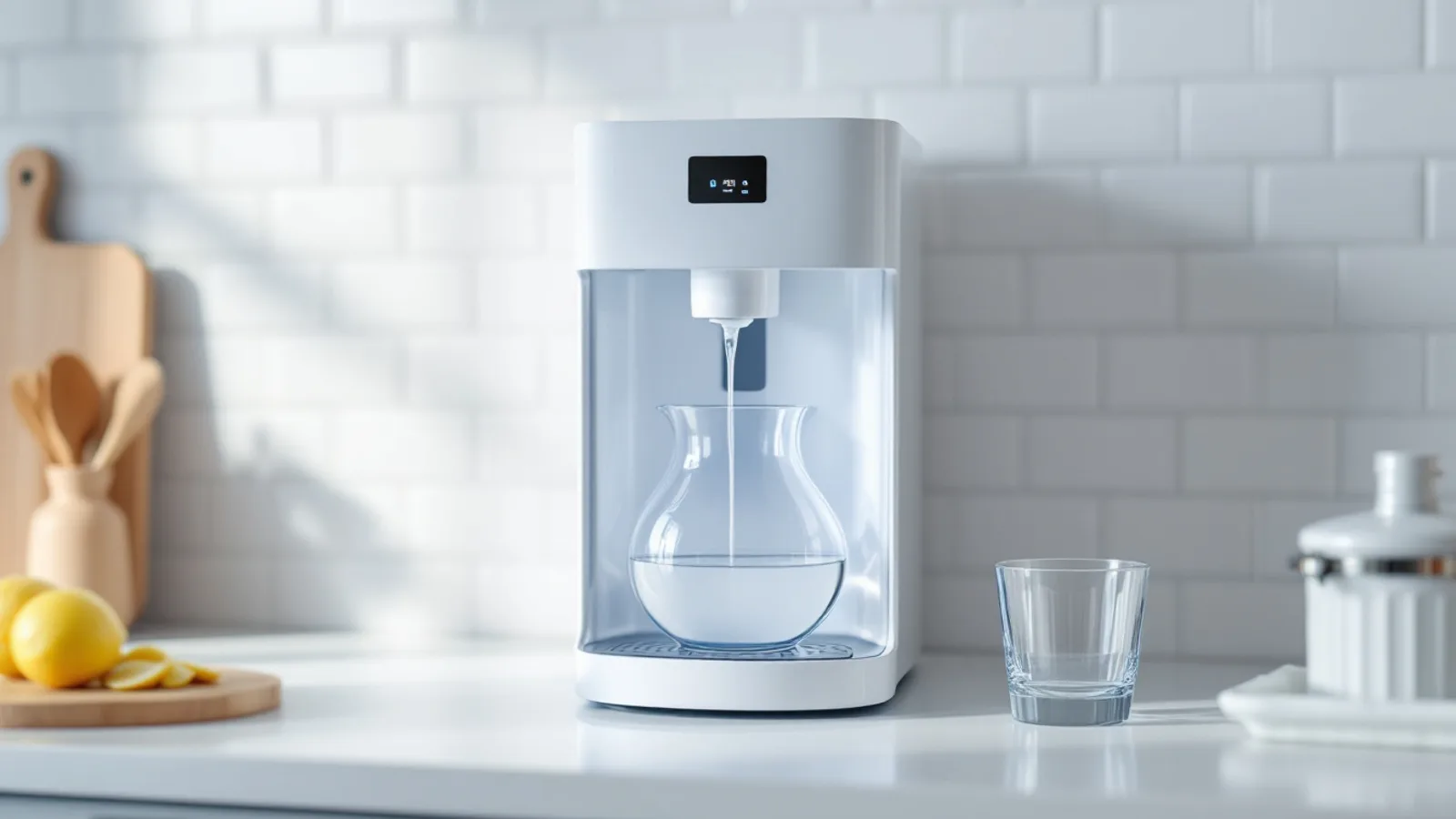
Countertop reverse osmosis water purifier with a glass carafe standing on a kitchen worktop next to a sink

Every buying guide for reverse osmosis quietly assumes something, and our own guide to the best RO systems is no exception: that you are allowed to make holes in your kitchen. A standard under-sink installation means a feed valve clamped onto the cold-water supply, a saddle clamped onto the drain pipe, and a dedicated faucet coming up through the sink deck or the worktop. If you own the place, that is one careful Saturday. If you rent, it is a conversation with somebody who has no particular reason to say yes.

Countertop reverse osmosis exists for that situation, and for three others that come up just as often: a cabinet already full of a garbage disposal and a pull-out bin, a stone worktop with no spare hole, and a household of one or two people who are about to move anyway. It is a real answer, not a consolation prize — but it costs you things nobody puts on the box.

What a countertop RO system actually is

Strip away the styling and a countertop unit is four parts: a reservoir you fill by hand from the tap, a pump, the same reverse osmosis membrane chemistry used under the sink, and somewhere for the clean water to land — usually a carafe or a short dispensing spout. It plugs into a normal kitchen outlet. No feed valve, no drain saddle, no tubing, no hole, no tools.

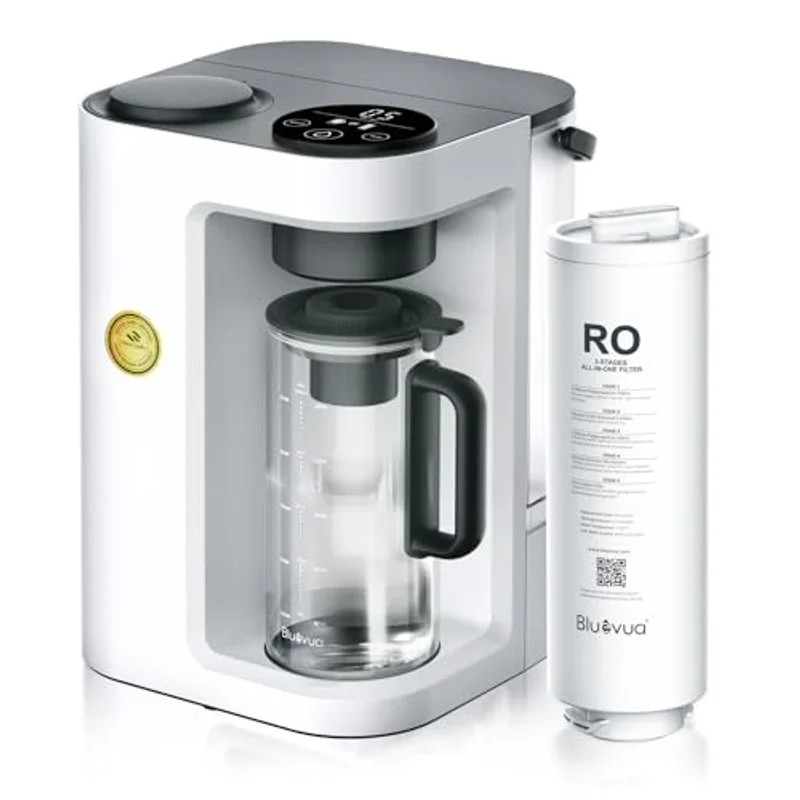
The membrane is the part people assume must be a downgrade, and it generally isn't. Bluevua specifies a 0.0001-micron RO membrane in the RO100ROPOT — the same order of pore size the under-sink systems quote — and the countertop models wrap the usual sediment and carbon stages around it, plus a UV lamp and a remineralization stage. The RO100ROPOT-Lite is a 7-stage design built around a 5-in-1 cartridge; the fuller RO100ROPOT is a 6-stage design. Both store the finished water in a high-borosilicate glass carafe rather than a plastic tank, which is one of the few areas where the countertop format is straightforwardly ahead of a plumbed system with a bladder tank.

What differs is not the filtration but the logistics: how water gets in, how it comes out, and what happens to the portion the membrane rejects. Everything below follows from those three. Operation itself is deliberately dull: fill the reservoir, choose a volume on the LED panel, and it runs a cycle. It occupies about as much worktop as a drip coffee maker and needs an outlet within cord's reach.

The four things you give up

These are the trade-offs, in the order people actually feel them.

1. On-demand supply. A plumbed system is connected to your house's water. The Waterdrop G2P600 is rated at 600 gallons per day and fills a 200 ml cup in about eight seconds, indefinitely, without you doing anything. A countertop unit can only give you what you poured into it. If you cook with filtered water, fill pet bowls and run a coffee machine, you will be at the tap refilling several times a day. This is the biggest behavioural difference and the one people underestimate.

2. Worktop space, in the room where space is scarcest. An under-sink system hides. It may eat most of a cabinet, but nobody looks at your cabinet. A countertop unit lives permanently on the surface you also want for chopping, draining and the toaster. Measure that space before you buy, not after.

3. Capacity sized for one or two people. Bluevua positions the RO100ROPOT-Lite for one to two people, and that is worth reading as a limit rather than as sandbagging. For a couple it is comfortable. For a family of four, the refill cycle stops being a background chore and becomes a job somebody has to own.

4. Certification, usually. This is the subtle one, and it matters because certification is the only independent statement about a system anyone gets. Both Bluevua countertop models are certified by WQA against NSF/ANSI/CAN 372 and additionally tested by SGS. NSF/ANSI 372 covers lead-free materials — what the machine is made of — not what it removes from your water. The certification that speaks to performance is NSF/ANSI 58, covering TDS reduction, and here only the iSpring RCC7AK-BN carries it, as a whole system rather than a component.

Be precise about that word usually, though. Going under the sink buys you no performance certification by itself: the Waterdrop G2P600 also carries NSF/ANSI 372 only. NSF/ANSI 58 is available under the sink and effectively is not on the counter — so if it is your decision-maker, it points at a plumbed system, and at a specific one.

What you get in return

Four things, and for a renter they are not small.

It moves house with you. Unplug it, empty the carafe, put it in a box. Moving an under-sink system means draining a tank, disconnecting a feed valve, removing a drain saddle and leaving a faucet hole behind — or leaving the whole system for the next tenant and buying another.

There is nothing to undo when the lease ends. No capped hole in the sink deck, no clamp on the drain, no line item on a move-out inspection, no argument about whether a modification was authorised. The apartment is exactly as you found it.

Installation is measured in minutes. Bluevua's cartridges go in with a three-second twist and the rest of setup is a rinse cycle. Waterdrop puts self-installation of the G2P600 at 30 minutes, which is a genuinely good number for a plumbed system and still assumes you are happy shutting off an angle stop and working on your back — we walk through what that job actually involves in our under-sink installation guide.

There is no drain saddle sitting behind a cabinet door. An RO install puts several permanent water connections where a slow drip goes unnoticed. A countertop unit has no plumbing connection at all — the worst it can do is spill its own reservoir, in plain sight, on a surface you can wipe. It also needs no outlet inside the cabinet, which is where some under-sink projects die: Waterdrop's G3P600 spec sheet requires under-sink electricity.

Where the waste water goes — the part you will handle by hand

Reverse osmosis works by pushing water against a membrane and rinsing the rejected dissolved solids away in a separate stream. Every RO system produces that stream; the only question is who deals with it.

Under the sink, nobody does: the reject line runs into the drain saddle and down the waste pipe. The Waterdrop G2P600 runs a 2:1 pure-to-drain ratio, so two cups of filtered water send one cup away, and Waterdrop notes that where you can capture it, that water is fine for mopping floors, washing a car or doing laundry.

On the counter, capturing it is not optional — it is the design. The reject water collects inside the unit, in a tray or in the same reservoir compartment, and you pour it out. Bluevua leans into this on the RO100ROPOT, describing the leftover water from a cycle as not really wastewater since it stays available for other household uses. Fair framing, and also a chore. The ratios are respectable: Bluevua quotes 3:1 filtered water to waste on the RO100ROPOT-Lite and 2:1 pure-to-drain on the RO100ROPOT.

Be blunt with yourself about the consequence, because it decides whether the machine is still on your worktop in a year. The theme that repeats across owner reviews of countertop purifiers: the filtration satisfies people, and the manual water handling — refill in, reject water out, several times a week, forever — is what they grumble about.

The four systems this decision comes down to

Two countertop units and the two under-sink systems people weigh them against — one tankless, one tank. Prices move on Amazon, so confirm the live price before buying.

SystemFormatInstallOutputCertificationPrice
Bluevua RO100ROPOT-LiteCountertop · 7-stage · UVPlug in — noneReservoir-fed, 1–2 peopleWQA against NSF/ANSI/CAN 372$219.00Price
Bluevua RO100ROPOTCountertop · 6-stage · UVPlug in — noneReservoir-fed, carafeWQA against NSF/ANSI/CAN 372$317.00Price
Waterdrop G2P600Under-sink · tanklessPlumbed · 30 min claimed600 GPDNSF/ANSI 372$299.00Price
iSpring RCC7AK-BNUnder-sink · tank · 6-stagePlumbed · afternoon75 GPDNSF/ANSI 58, whole system$198.76Price
01Counter · start here

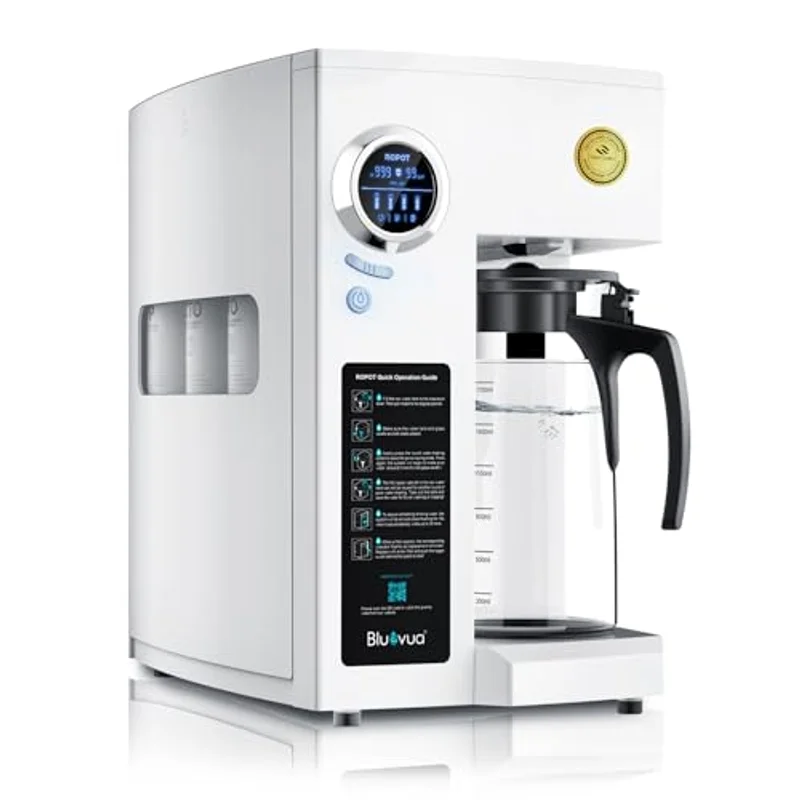
Bluevua RO100ROPOT-Lite

The lowest-friction way into RO water
Countertop · 7 stages · UV · remineralization · 3:1 filtered-to-waste · yearly filter

The model that makes the renter's case. Seven stages built around a 5-in-1 cartridge with a UV lamp and a remineralization stage, an LED panel showing live water quality and remaining filter life, and a borosilicate glass carafe instead of a plastic tank. Bluevua rates the filter for one replacement a year, puts the running cost at $0.22 a day, and positions the unit for one to two people — specification worth taking at face value. Certification is WQA against NSF/ANSI/CAN 372 for lead-free materials, plus SGS testing; no NSF/ANSI 58 performance certification, as on almost no countertop unit.

The theme that repeats across owner reviews: it ended the bottled-water delivery, and setup was finished in the time it took to rinse the carafe.

Bluevua RO100ROPOT-Lite countertop reverse osmosis water filter with glass carafe
$219
Countertop · no installCheck price →
02Counter · fuller

Bluevua RO100ROPOT

The same idea with longer service intervals
Countertop · 6 stages · UV · 0.0001 μm membrane · 2:1 pure-to-drain

The step up is not about filtration stages — it is about how often the machine asks something of you. Bluevua rates these filters at 12 to 24 months against the Lite's yearly change, adds a power-saving standby mode, and lists the same UV lamp, remineralization stage and glass carafe. The published contaminant list covers TDS, PFOA, PFOS, chlorine, fluoride, arsenic and lead; certification is again WQA against NSF/ANSI/CAN 372 with SGS testing. Two honest notes: it costs $98 more, and its 2:1 pure-to-drain ratio is less efficient than the Lite's quoted 3:1, so you empty the reject water slightly more often, not less.

The theme that repeats across owner reviews: the display and the long filter interval are what make it feel like an appliance rather than a project.

Bluevua RO100ROPOT countertop reverse osmosis water filter system with UV stage
$317
Countertop · no installCheck price →
03Cabinet · tankless

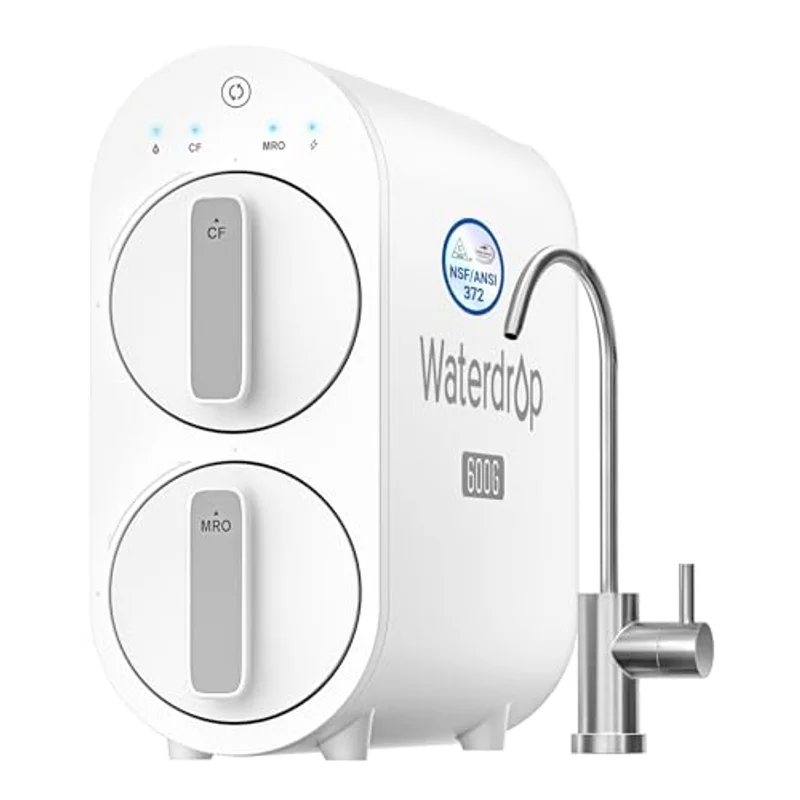
Waterdrop G2P600

What you move to the moment you own the kitchen
NSF/ANSI 372 · 600 GPD · 2:1 drain · 7 stages · tankless

If the counter is the compromise, this is what it is measured against. No storage tank; 600 gallons a day of on-demand flow; a 2:1 drain ratio handled entirely by the plumbing; twist-in cartridges that swap in three seconds, with filter-life indicators on the housing. Waterdrop says a confident owner can install it in 30 minutes, and two filters come in the box. Read the certification carefully, though: the G2P600 carries NSF/ANSI 372 for lead-free materials, not NSF/ANSI 58 performance. Being under the sink guarantees nothing by itself.

The theme that repeats across owner reviews: the flow rate is the thing people notice first, and the absence of a tank is what they notice every time they open the cabinet.

Waterdrop G2P600 tankless under-sink reverse osmosis system
$299
Tankless · 600 GPDCheck price →
04Cabinet · certified

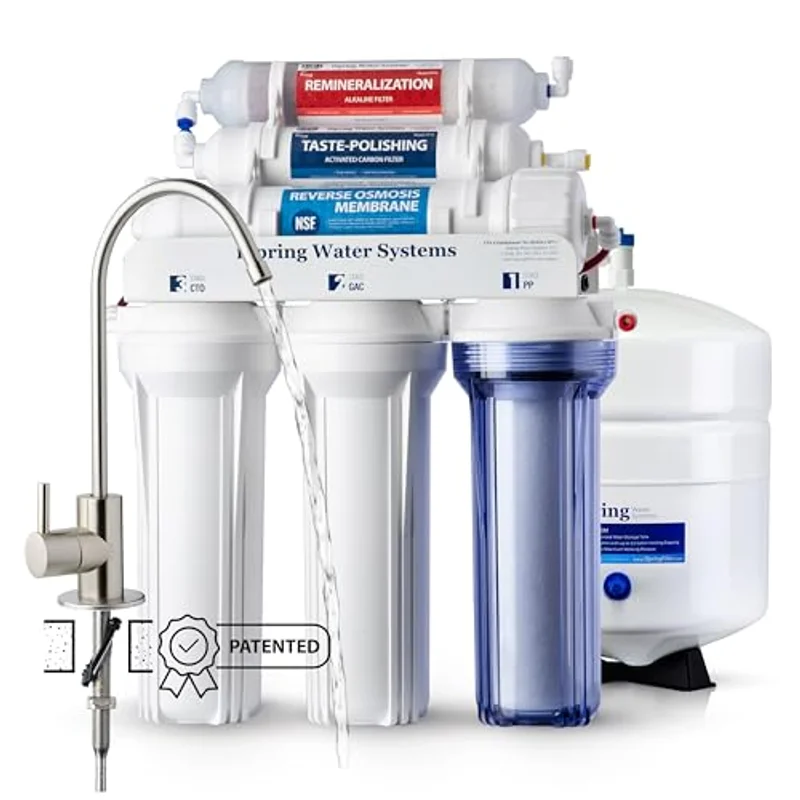
iSpring RCC7AK-BN

The one that answers the certification question
NSF/ANSI 58 · 75 GPD · 6 stages · alkaline · universal cartridges

If you want an independent statement about performance, this is the system here that has one: the RCC7AK is certified to NSF/ANSI 58 as a complete system, not a component. The published reduction figures are specific — 93 to 98% TDS, 96 to 99% PFAS, over 98.9% lead, over 97.4% fluoride. It runs standard 10-inch by 2.5-inch cartridges, so replacements are cheap and never proprietary; the transparent first housing lets you watch the sediment load build; the top-mounted fastener means you tighten the faucet from above rather than on your back. The cost is space: three housings plus a pressure tank is most of a cabinet.

The theme that repeats across owner reviews: the install takes an afternoon, and the universal cartridges are why people are still happy with it years later.

iSpring RCC7AK-BN 6-stage alkaline under-sink reverse osmosis system
$199
Tank · NSF/ANSI 58Check price →

The landlord question, answered practically

Before you ask, know exactly what you are asking for. A standard under-sink RO installation alters three things, and they are not equally reversible.

A feed valve on the cold-water line. The system taps the cold supply at the angle stop, usually with a compression adapter that sits between the stop and the existing supply line. This is the most reversible of the three: close the valve, unscrew the adapter, reconnect the original line. Nothing is drilled and nothing is cut.

A drain saddle on the waste pipe. The reject line reaches the drain through a saddle clamp on the sink tailpiece, with a small hole drilled through the pipe wall underneath. The clamp comes off in a minute; the hole is permanent. In practice it is still reversible, because a tailpiece is an inexpensive standard part — buy the replacement with the system and the restoration is already in the cupboard.

A hole for the dedicated faucet. This is the one that usually is not reversible, and it is what landlords actually object to. A cap can hide an unused hole in stainless steel, but a hole cored through granite or quartz is there for the life of the slab. Stone plus no spare opening means a diamond core bit, a template, and a mistake that cannot be undone — a decent argument for the counter even if you own the place.

Two pieces of practical advice. First, check whether the hole already exists: a great many kitchen sinks ship with a spare opening for a side sprayer or a soap dispenser, blanked off with a chrome cap or hidden under an accessory you never use. Look along the back edge of the sink deck and underneath before you assume drilling is required — this one check settles the question more often than people expect.

Second, if you do need permission, ask in writing and be specific: the three alterations above, which parts you will restore and how, and an offer to leave the system in place if they would prefer. Landlords refuse a vague request to modify plumbing far more readily than a precise, reversible one. If the answer is still no, the countertop route is not a downgrade — it is the option that keeps the decision yours.
Cost over the time you will actually own it

Sticker prices mislead here. The useful question is what a system costs over the length of a lease you can see the end of. Here is the arithmetic, with every assumption stated, at the prices we recorded.

Bluevua RO100ROPOT-Lite, $219.00. Bluevua specifies one filter replacement a year and a running cost of $0.22 a day — $80.30 a year at 365 days. Over a two-year lease: $219.00 + $160.60 = $379.60. Over five years: $219.00 + $401.50 = $620.50.

iSpring RCC7AK-BN, $198.76. The matching iSpring F9K one-year cartridge set is $69.24 for nine cartridges — two sediment, two granular carbon, two carbon block, one post-carbon and two alkaline. Over two years: $198.76 + $138.48 = $337.24. Over five: $198.76 + $346.20 = $544.96. One honest addition: the F9K contains no RO membrane, which is replaced every two to three years and bought separately — the six-month iSpring F6K75 set, $87.69, is the pack that does include a 75 GPD membrane.

Waterdrop G2P600, $299.00, and Bluevua RO100ROPOT, $317.00. We have no recorded replacement-cartridge price for either, so we will not invent a yearly figure. For scale, the comparable front filter for Waterdrop's G3 series is $29.99 for six months or 550 gallons — the right order of magnitude for proprietary twist-in cartridges.

Two conclusions. Over a two-year lease, the countertop route lands roughly $42 above the cheapest certified under-sink route — close enough that money is not what decides it, especially once you count the fitting job at the start and the restoration job at the end that the countertop unit does not have. Over five years the gap widens the other way, because of cartridges: universal 10-inch housings are cheaper to feed than proprietary ones, year after year. We break that down in our filter replacement cost guide, and neither figure counts the bottled water you stop buying — the calculation we run in is reverse osmosis worth it.

So: counter or cabinet?

Stay on the counter if any of these describe you:

  • Your lease has two years or less to run, or you expect to move within that window.
  • The cabinet under the sink is already full — garbage disposal, pull-out bin, water softener, storage you actually use.
  • The worktop is granite or quartz and the sink has no spare hole. Coring stone is the one alteration you cannot walk back.
  • One or two people drink the water — the capacity Bluevua designed the RO100ROPOT-Lite around.
  • There is no outlet inside your sink cabinet and you would rather not pay the premium for a non-electric tankless system to work around it.

Go under the sink if any of these do:

  • You own the place, or you have written permission and a landlord who is genuinely relaxed about it.
  • The household is three or more people, or you cook and make coffee with filtered water.
  • You want water without ever thinking about a reservoir, a carafe or a tray of reject water again.
  • NSF/ANSI 58 performance certification is your deciding criterion — it exists under the sink and effectively does not on the counter.
  • Worktop space is the scarcest thing in your kitchen, which for small kitchens it usually is.

If you have landed on the cabinet, the next fork is tank versus tankless — a question about space and electricity, worked through in tankless vs tank reverse osmosis. Either way, reverse osmosis takes dissolved minerals out along with everything else dissolved; the systems here add some back with a remineralization stage, explained in does reverse osmosis remove minerals. That is general consumer information, not medical advice.

One last note on how to read the above: we don't run a testing lab and we don't physically test these systems. Everything here comes from published specifications, stated certifications, recorded prices and a close reading of what owners report — particularly critical reviews, where the trade-offs surface first.

FAQ

Questions renters ask us

Do I need my landlord's permission for a countertop RO system?

No. A countertop unit alters nothing about the property: you fill it from the tap, it plugs into an ordinary outlet, and it leaves with you. Permission matters only for an under-sink system, which adds a feed valve on the cold line, a drain saddle on the waste pipe and a hole for a dedicated faucet. The first is fully reversible, the second by replacing an inexpensive tailpiece, and the hole generally is not — especially in granite or quartz.

Does a countertop reverse osmosis system waste water too?

Yes. Rinsing dissolved solids off the membrane is how the process works, so every RO system rejects a share of the water it processes. The difference is where it goes: an under-sink system sends it down the drain line and you never see it, while a countertop unit collects it inside the machine and you pour it out by hand. Bluevua quotes 3:1 filtered water to waste on the RO100ROPOT-Lite and 2:1 pure-to-drain on the RO100ROPOT, and notes the collected water is still usable around the house.

Are countertop RO systems certified like under-sink ones?

Usually not in the same way, and the distinction matters. Both Bluevua countertop units are certified by WQA against NSF/ANSI/CAN 372, which covers lead-free materials, with additional SGS testing. NSF/ANSI 58 is the standard that certifies contaminant and TDS reduction performance, and among the systems here only the iSpring RCC7AK-BN carries it as a whole system. Being under the sink is no guarantee either — the Waterdrop G2P600 also holds only NSF/ANSI 372.

How many people can a countertop RO system realistically serve?

One or two. Bluevua positions the RO100ROPOT-Lite for one to two people, which matches the format's constraint: the machine can only deliver what you poured into its reservoir, so a larger household means refilling several times a day and emptying the reject water more often. For three or more people, or if you cook and make coffee with filtered water, an on-demand plumbed system such as the 600 GPD Waterdrop G2P600 fits better.

Keep reading

Next steps, either way