Best RO Systems
HomeGuidesTankless vs tank
Comparison

Tankless vs tank reverse osmosis: which belongs under your sink?

We're reader-supported: buying through our links may earn us a commission at no extra cost to you. We compare published specifications, certifications and prices — we don't run a testing lab.

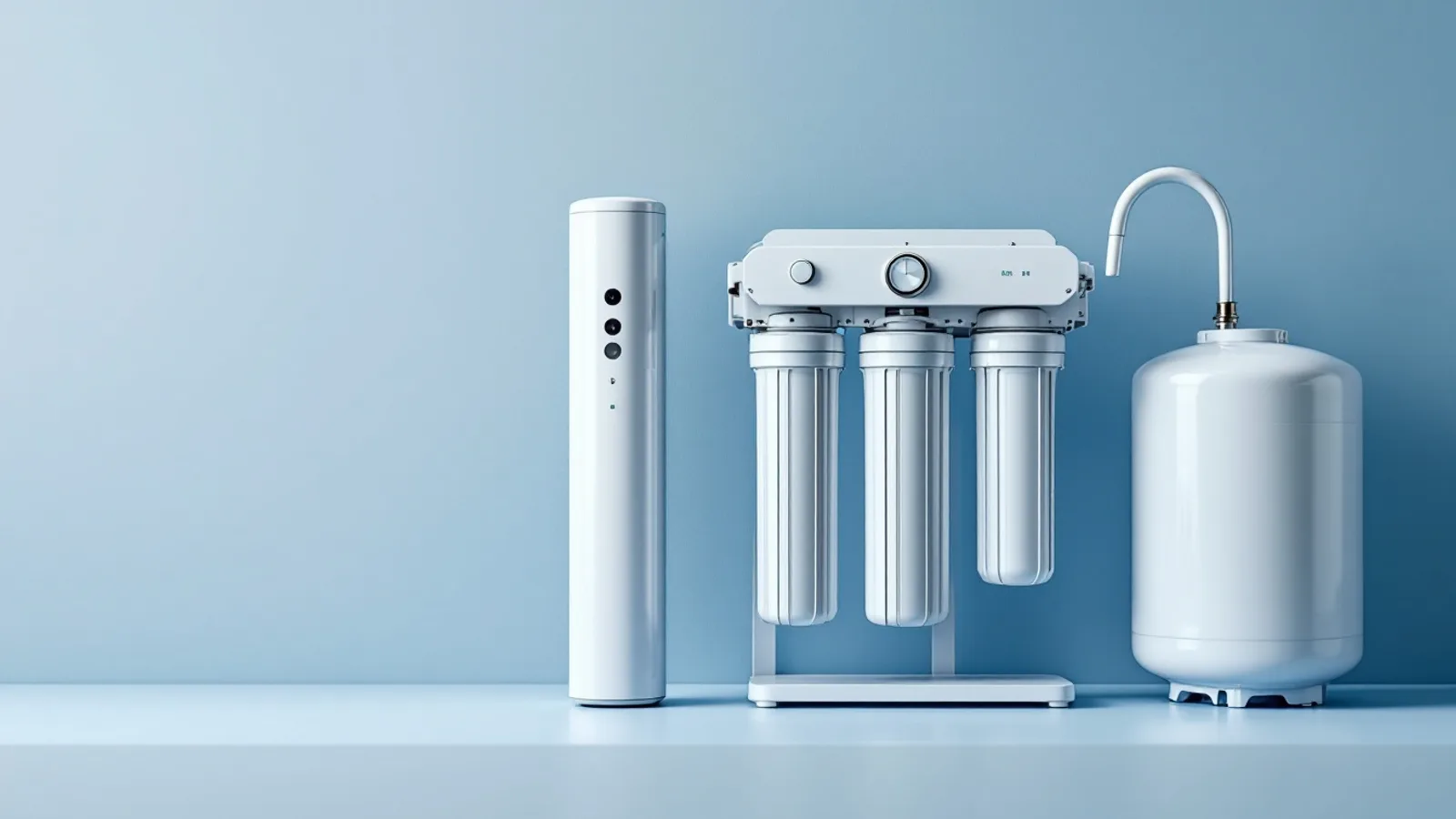
A slim tankless reverse osmosis unit beside a classic three-housing system with a white pressure tank inside a kitchen cabinet
How they differ

Two machines, the same membrane

Strip the marketing off both categories and the same component is doing the same job: a semi-permeable membrane that lets water molecules through and sends most of the dissolved solids down the drain. Tankless and tank systems do not filter differently. They differ in when the water gets made, and everything you will actually notice — flow at the faucet, space in the cabinet, the plug, the taste of the first glass of the morning — follows from that.

A tank system makes water slowly and stores it. Its membrane is rated at 75 gallons per day — divide by the 1,440 minutes in a day and that's about 0.05 gallons a minute, roughly one 8-ounce cup every 72 seconds. Nobody stands at a sink for a minute and a half, so the system doesn't ask you to: it pushes its trickle into a bladder tank, a steel drum with an air-charged rubber bladder inside, and that stored pressure is what fills your glass. The tank isn't an accessory; it's the only reason a 75 GPD membrane feels usable.

A tankless system deletes the tank by making the membrane fast enough to serve you directly. It does that with a booster pump that raises pressure at the membrane face well above what your house supplies — and a pump needs electricity, which is why nearly every tankless unit ships with a cord and expects an outlet inside the cabinet. The Waterdrop G3P600 is rated at 600 GPD, eight times the classic membrane: 600 ÷ 1,440 is about 0.42 gallons a minute, an 8-ounce cup in roughly nine seconds. Waterdrop's own specification claims eight seconds for that cup, so the marketing number and the arithmetic agree — rarer than it should be.

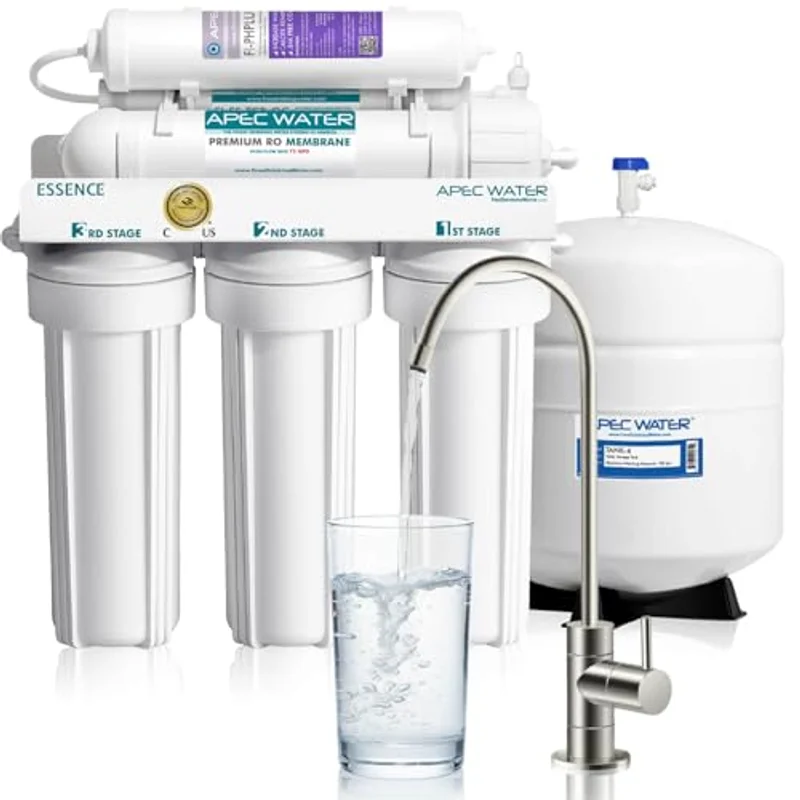
Which brings up the figure everyone quotes and nobody defines. GPD is a rating, not a promise. Output is measured under standard conditions — a set feed pressure, a set water temperature, a set level of dissolved solids — and all three move in your house. Cold water is more viscous and passes a membrane more slowly, so the same system makes noticeably less in February than in August; low incoming pressure does the same to an unpumped unit. APEC publishes a feed pressure window of 40 to 85 psi for the ROES-PH75 for exactly that reason. Treat GPD like a car's fuel economy sticker: good for ranking two products, not a guarantee.

One consequence matters more than the rest. A tank system's rating describes how fast it refills. A tankless rating describes how fast it pours. Same unit, different meaning.

At a glance

The six systems this comparison keeps returning to

Three tankless, three tank-based. Prices are what we recorded and they move — confirm the live price before buying.

ModelDesignRated outputDrain ratioCertificationPrice
Waterdrop G3P600Tankless · needs an outlet600 GPD2:1 pure to drainNSF/ANSI 58 & 372 (also 42)$439.00Price
Waterdrop G2P600Tankless · needs an outlet600 GPD2:1 pure to drainNSF/ANSI 372 only$299.00Price
Frizzlife M800Tankless · non-electricup to 900 GPD4:1 pure to drain (claimed)NSF/ANSI 58 & 372$299.99Price
iSpring RCC7AK-BNTank · 6-stage alkaline75 GPDNot publishedNSF/ANSI 58, whole system$198.76Price
APEC ROES-PH75Tank · 6-stage alkaline75 GPDNot publishedWQA certified system$239.99Price
iSpring RCC7-BNTank · 5-stage, no alkaline75 GPDNot publishedNSF/ANSI 58$219.96Price
The practical constraint

Cabinet space settles this more often than filtration does

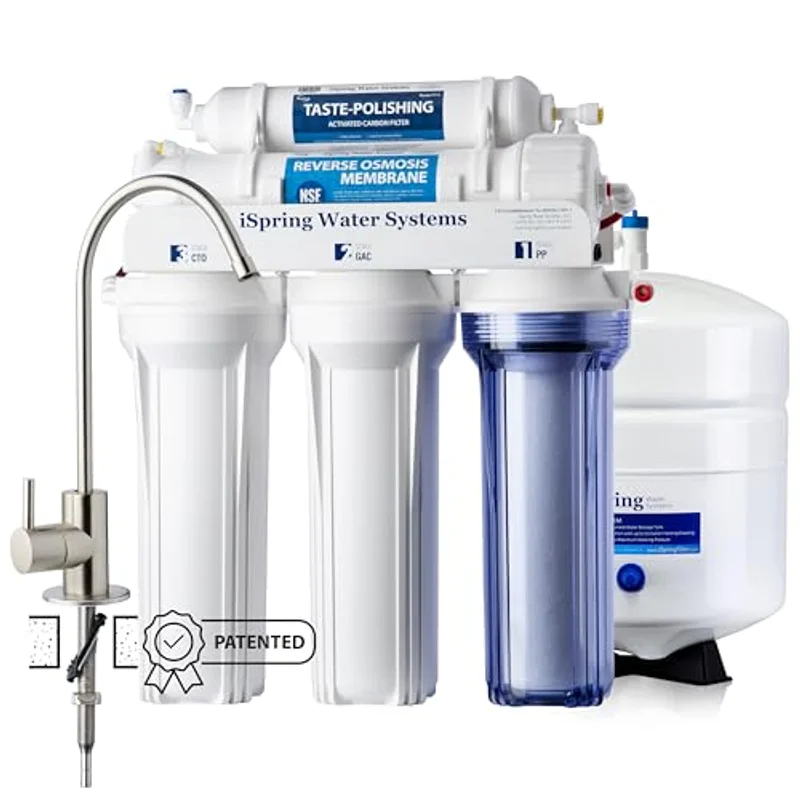
People arrive expecting a debate about water purity and leave having decided with a tape measure. That's the correct order. A tank system isn't one object: it's three vertical filter housings on a bracket, a pressure tank standing on the cabinet floor, and the tubing between them. The housings need clearance below them too, because changing a cartridge means unscrewing the sump and lowering it straight down — try that with six inches of headroom and you'll do it once. A tankless unit is a single sealed box with the cartridges plugged into the front. Waterdrop claims its design saves about 70% of the space a conventional system needs; that's a manufacturer's figure rather than one we measured, but the shape of it is right when you're deleting a drum the size of a small propane cylinder.

The catch is that slim boxes are tall boxes. Frizzlife publishes the M800 at 14.5 inches long by 5.1 wide by 19.7 high, and puts a pre-purchase warning about it in the first line of its own listing — which tells you how many people found out after unboxing. Measure from the cabinet floor to the underside of the basin, not to the countertop.

Then measure the depth you can actually use, which is never the depth of the cabinet. The P-trap steals a band of space front to back; a garbage disposal usually eats one whole side; shut-offs and supply lines own the back wall. What's left is typically two pockets either side of the drain. A tankless box often fits one; three housings and a tank need both, plus the floor between them. Open the cabinet with a tape before you read another specification — our installation guide walks the clearances in the order you'll meet them.

Day to day

What comes out of the faucet, and what sits in the tank between glasses

A tank system's flow is genuinely good, right up until it isn't. The bladder delivers stored water under air pressure, and as the tank empties that pressure falls, so the last of the tank comes out visibly slower than the first. Drain it completely and you're back to the membrane's real speed: at the rated 75 GPD that's about 3.1 gallons an hour, so restoring a few gallons takes the better part of an hour in ideal conditions and longer with cold winter feed water. Not a defect — the design working as intended — but it bites households that draw a lot at once.

Tankless flow is the opposite: unspectacular and flat. There's no reservoir to run down, so the tenth glass pours like the first. Both 600 GPD Waterdrop units quote an 8-ounce cup in eight seconds, and the arithmetic above backs that up. If your kitchen habit is filling bottles and a kettle rather than sipping a glass at a time, that's the difference you feel daily.

The honest counterweight: a tankless system stops the instant the power does. No pump, no water, nothing in reserve. A tank system in the same outage still hands you whatever was stored — a few gallons, no electricity required. If your grid drops for hours at a stretch, that's a real point on the tank's side, and no pumped design answers it.

Storage has its own cost, and it's why many long-time tank owners switch. Water in a bladder tank sits. In a household drawing two or three glasses a day, what you pour has rested in a rubber bladder for hours, and reviewers consistently note a flat or faintly plastic taste from tanks that turn over slowly; draw heavily and the tank turns over constantly and the issue disappears. A tankless system makes water at the moment you ask, so the question never arises — a genuine advantage, though a modest one. It's a freshness difference, not a safety one, and anyone selling it as more is overselling. The practical fix on a tank system is to use the faucet more and flush the first glass of the day.

Taste has a second driver common to both: RO strips dissolved minerals along with everything else, and mineral-free water tastes flatter to most people. That's why four of the six systems here add an alkaline or remineralization stage after the membrane — see our guide to RO and minerals.

01Tankless case

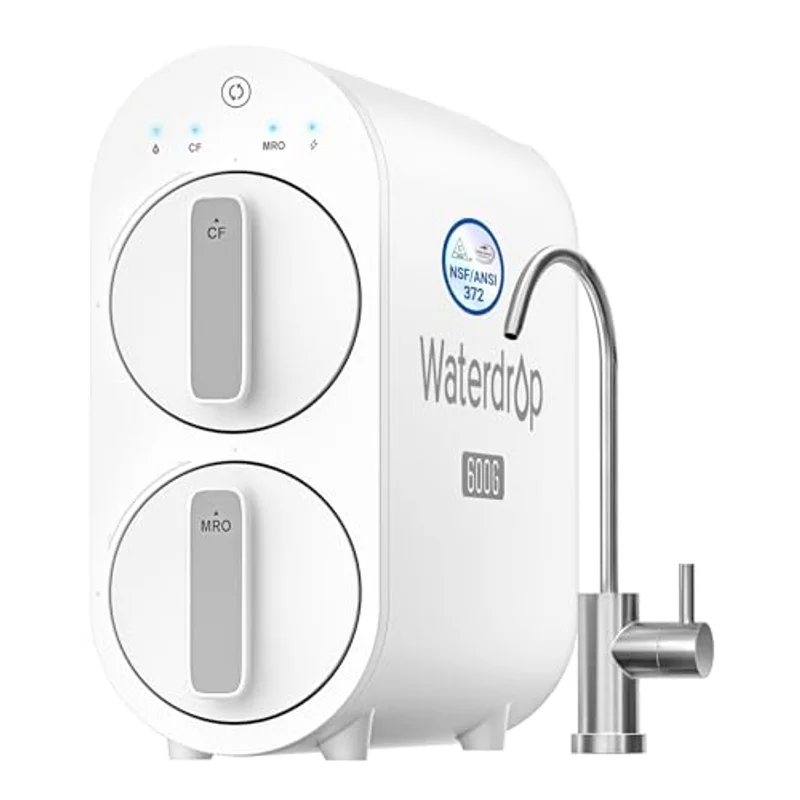
Waterdrop G3P600

The tankless argument at its strongest
NSF/ANSI 58 & 372 · 600 GPD · 2:1 drain · 8 stages · needs an outlet

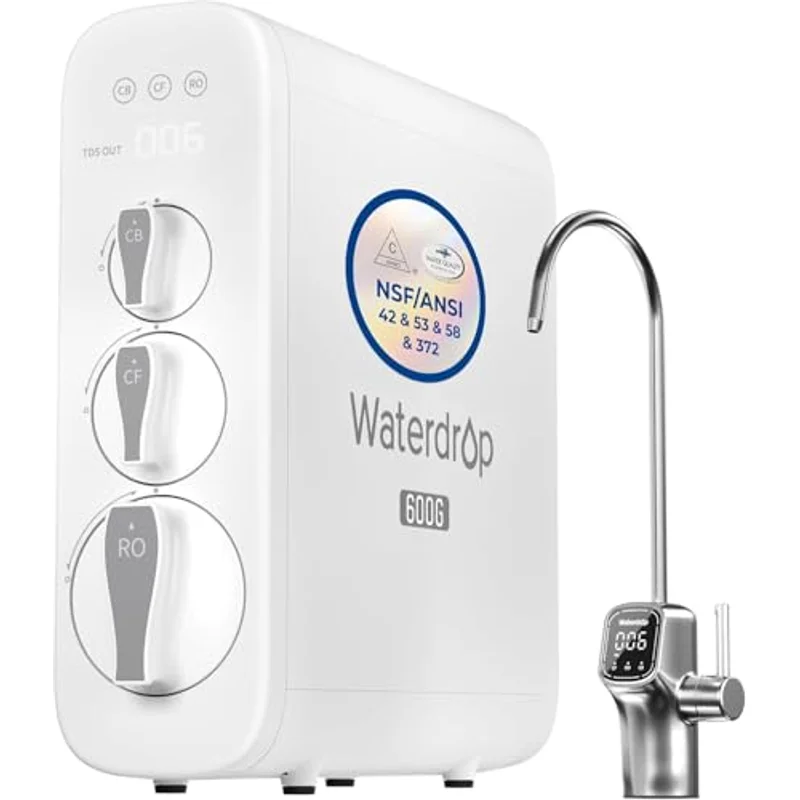
The unit that makes the tankless case without asking you to give up anything except an outlet and the price. Certified to NSF/ANSI 58 for TDS reduction — the performance standard, not just the materials one — with 372 for lead-free materials and NSF 42 for chlorine, taste and odor. In the cabinet it's one slim box, the faucet shows live TDS and filter life, and a cartridge change is a twist with the system still bolted in place. The costs are honest ones: proprietary filters, a cord that has to reach power, and $439.00.

The theme that repeats across owner reviews: it vanishes into the cabinet, and the display ends the guesswork about when a filter is due.

Waterdrop G3P600 tankless reverse osmosis system with smart display faucet
$439
Tankless · 600 GPDCheck price →
The water you pay for twice

Drain ratio, converted into gallons you can actually picture

Every RO system sends water to the drain. It has to: the membrane needs a continuous cross-flow to sweep away the minerals it just rejected, and without it the membrane would foul within weeks. Be careful which way round a maker quotes the ratio — the same "4:1" can mean four gallons wasted per gallon made or four made per gallon wasted, and both appear in this category.

Older tank systems are typically the bad direction, three or four gallons to the drain per gallon into the tank. Neither iSpring nor APEC publishes a ratio for the systems here, which is itself a small piece of information. Both Waterdrop tankless units publish 2:1 in your favour, and the Frizzlife M800 claims 4:1 pure to drain — the best figure in this group by a wide margin.

In gallons, with the assumption stated up front — a household drawing 2 gallons a day for drinking and cooking, so 730 gallons a year: at Waterdrop's 2:1 that costs 365 gallons to the drain; at the M800's claimed 4:1, about 183; at an older 3:1-against system, 2,190; at 4:1 against, 2,920 gallons, four times what you drank.

Price it, and treat the rate as yours to check: at $0.01 per gallon combined water and sewer — a placeholder, since US rates vary enormously by city and your bill is the only authority — the gap between 4:1 against and 2:1 in favour is about 2,555 gallons, roughly $26 a year. Real, and several times that in an expensive water district, but for most people still smaller than the annual filter bill. Use the drain ratio to break a tie between systems you already like; don't let it override cabinet space or certification.

Where it stops being an accounting exercise is on a septic field or a low-yield well. Sending an extra 2,900 gallons a year into a leach field is a different conversation from paying for it, and a 2:1-or-better ratio earns its premium immediately.

02Value tankless

Waterdrop G2P600

The same footprint and flow for $140 less
NSF/ANSI 372 · 600 GPD · 2:1 drain · 7 stages · needs an outlet

The G2P600 keeps what you feel — 600 GPD of flow, no tank, the same 2:1 drain ratio, twist-in cartridges, an install Waterdrop puts at 30 minutes — and drops what lives on the spec sheet. Be precise about the one that matters: it holds NSF/ANSI 372 for lead-free materials, not the NSF/ANSI 58 performance certification its sibling has. If your water is municipally treated and you're buying for taste, chlorine and convenience rather than a contaminant you've had tested, $299.00 buys most of the flagship.

The theme that repeats across owner reviews: it does the same everyday job as the flagship, and the missing display is what people notice least.

Waterdrop G2P600 tankless under-sink reverse osmosis system
$299
Tankless · 600 GPDCheck price →
Read the badge properly

Certification is where this category hides its differences

Tank versus tankless tells you nothing about certification — both designs contain certified and uncertified systems, and the badges look similar enough that the distinction rarely survives a product listing intact. NSF/ANSI 58 is the reverse osmosis performance standard: a system certified to it has been verified by an accredited body to reduce total dissolved solids, and, depending on the listing's scope, named contaminants too. It is the only badge here that says anything about what leaves the faucet. NSF/ANSI 372 is a materials standard certifying that wetted parts are lead-free — necessary, but a length of lead-free pipe would satisfy it. WQA isn't a standard at all; it's the Water Quality Association, a separate certifying body that tests products against those same NSF/ANSI standards, so a WQA badge means third-party assessment happened and you read the listing to learn against which standard.

Applied to the six systems here:

  • The Waterdrop G3P600, $439.00 — NSF/ANSI 58 for TDS reduction, 372 for lead-free materials, plus NSF 42 for chlorine, taste and odor. The fullest set in this comparison.
  • The Waterdrop G2P600, $299.00 — NSF/ANSI 372 only. Materials, not performance: same drain ratio and output as its sibling, no performance certification behind it.
  • The iSpring RCC7AK-BN, $198.76 — certified to NSF/ANSI 58 as a complete system, a distinction iSpring makes deliberately, because a maker can certify one component and imply the whole assembly.
  • The APEC ROES-PH75, $239.99 — a WQA certified system; third-party, different body, with the manufacturer's own contaminant claims sitting alongside rather than inside that certification.
  • The Frizzlife M800, $299.99 — stated as independently tested and certified against NSF/ANSI 58 and 372, both standards, on a non-electric unit, which is unusual.
  • The iSpring RCC7-BN, $219.96 — certified to NSF/ANSI 58.

The pattern worth keeping: the cheapest route to a performance-certified system here is a tank system. The RCC7AK-BN carries NSF/ANSI 58 at $198.76 — less than the G2P600, which doesn't. If certification is what you care about most, the tank-or-tankless question is downstream of it.

Year two onward

Running cost and serviceability, where the tank systems quietly win

The purchase price is the smaller half of what an RO system costs you. Cartridges are the other half, forever, and this is the one area where the older design holds a structural advantage no amount of engineering closes.

Tank systems use standard 10-inch by 2.5-inch housings. That size is an industry convention rather than a brand's property, so the cartridges are a commodity and priced like one. iSpring's F9K one-year set is $69.24 for nine cartridges — a full year for a 6-stage system, alkaline stage included, membrane excluded because a membrane lasts two to three years and is bought separately. The 5-stage F5-75 pack is $55.09 and does include a 75 GPD membrane. APEC's FILTER-SET-ES pre-filter set is $25.46 for a sediment filter and two carbon blocks, changed twice a year on the ROES series.

Tankless systems use proprietary twist-ins, bought from one company at one company's price. Waterdrop's G3-N1CF front filter is $29.99, rated for six months or 550 gallons, so budget two a year plus the less frequent membrane — about $60 a year before the membrane, against roughly $25 to $70 for a standard-housing system depending which stages are due. You're trading real money for real convenience: a twist-in change takes seconds with no tools, while a sump means shutting the feed valve, catching the water and finding the housing wrench. The full picture, system by system, is in our filter replacement cost guide.

Serviceability in year six is the part almost nobody compares. A system built from standard parts stays alive because nothing in it is unique: any 10-inch sediment filter fits, any 75 GPD membrane fits, a weeping housing takes a cheap O-ring, a dead tank is a generic tank. The plainest example here is the iSpring RCC7-BN at $219.96 — same NSF/ANSI 58 certification, five stages instead of six, nothing exotic to fail, no power needed anywhere in it. Sealed tankless units are the opposite: when the pump or the electronics stop, there's no O-ring to buy, because the box is the part. Neither is wrong, but if you intend to keep a thing running for a decade, weigh that alongside the sticker price.

03Tank case

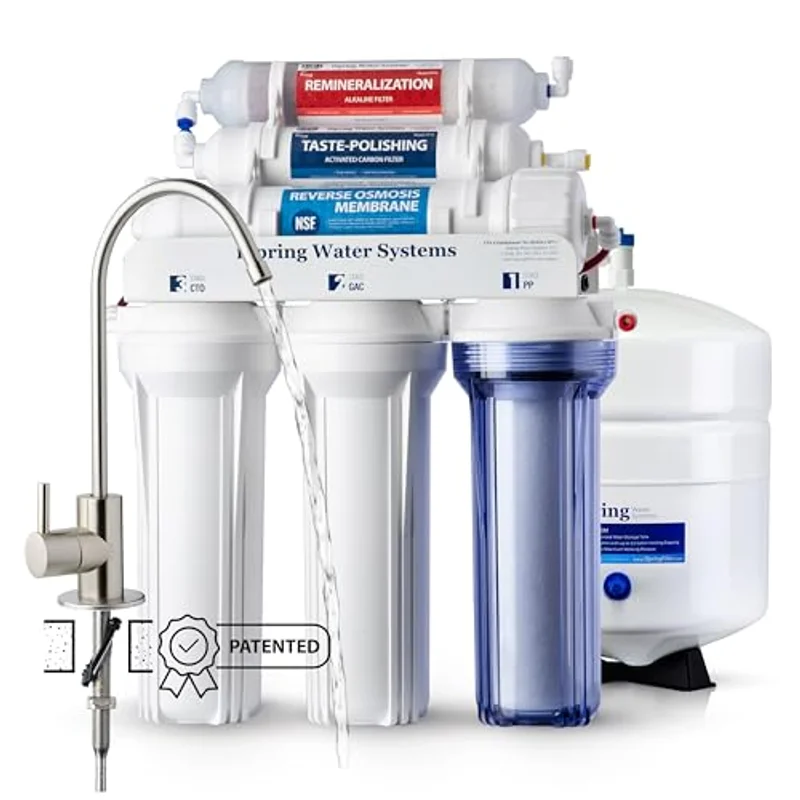
iSpring RCC7AK-BN

The cheapest performance-certified system here
NSF/ANSI 58, whole system · 75 GPD · 6 stages · alkaline · tank

The tank design's best current argument: certified as a complete system to NSF/ANSI 58, with published numbers behind it — 93 to 98% TDS reduction, 96 to 99% PFAS reduction, over 99.7% asbestos — at $198.76, undercutting every tankless unit here. The alkaline stage puts calcium and magnesium back after the membrane, the transparent first housing shows the sediment load without opening anything, and the top-mounted faucet fastener means you tighten from above the counter instead of on your back. It wants space in return: three housings, a tank, and a Saturday afternoon.

The theme that repeats across owner reviews: the install takes longer than the listing suggests, and the standard cartridges make it cheap to live with afterwards.

iSpring RCC7AK-BN 6-stage alkaline reverse osmosis system with storage tank
$199
Tank · 6-stageCheck price →
04Plainest

iSpring RCC7-BN

Five stages, no alkaline, nothing unusual to fail
NSF/ANSI 58 · 75 GPD · 5 stages · no power needed · tank

The RCC7AK without the two remineralization stages, and for some buyers the subtraction is the feature: fewer cartridges to rebuy, fewer connections to leak, the same certification. iSpring publishes 80 to 90% TDS reduction and up to 98% lead reduction for it. One oddity — at $219.96 it sits above the 6-stage RCC7AK-BN as we recorded them, the kind of inversion Amazon pricing produces regularly. Check both, because on specification the alkaline model is the better buy unless you want the simpler stack.

The theme that repeats across owner reviews: it is unglamorous, it keeps working, and the parts are still on the shelf years later.

iSpring RCC7-BN 5-stage under-sink reverse osmosis system with brushed nickel faucet
$220
Tank · 5-stageCheck price →
The third option

The non-electric exception, and the prerequisite it carries

The tankless category exists because a booster pump can push water through a membrane fast enough to serve directly, and pumps need power. Which is why the most common reason people end up with a tank system isn't preference — it's that there's no outlet in the cabinet, and adding one means an electrician.

The Frizzlife M800 resolves that. It produces on demand with no storage tank and no cord, running on the line pressure your house already supplies. No pump also means no pump noise, which owners of pumped units notice at 6 a.m. more than they expect to. It's certified against NSF/ANSI 58 and 372, adds calcium, magnesium and zinc back after the membrane, displays TDS and filter life, and claims the best efficiency here at 4:1 pure to drain.

The prerequisite is the flip side of the same design. With no pump, the system has exactly the pressure you give it, so incoming line pressure stops being a background detail and becomes the thing that decides what you get. If your house runs low — old plumbing, a top floor, a long run from the street, a well cycling near its cut-in point — a non-electric unit makes water more slowly than its rating suggests, and the "up to 900 GPD" in its own name is doing a lot of work in that "up to". An inexpensive hose-bib gauge settles it in two minutes, before you spend $299.99.

Read that in reverse and it explains where pumped units win. A booster pump manufactures its own pressure, so an electric tankless system is the most tolerant of a weak supply, not the least. Low pressure plus no outlet is the one combination this category handles badly — and there a tank system, which fills slowly regardless and doesn't care how long it takes, stays the sane answer.

05No outlet

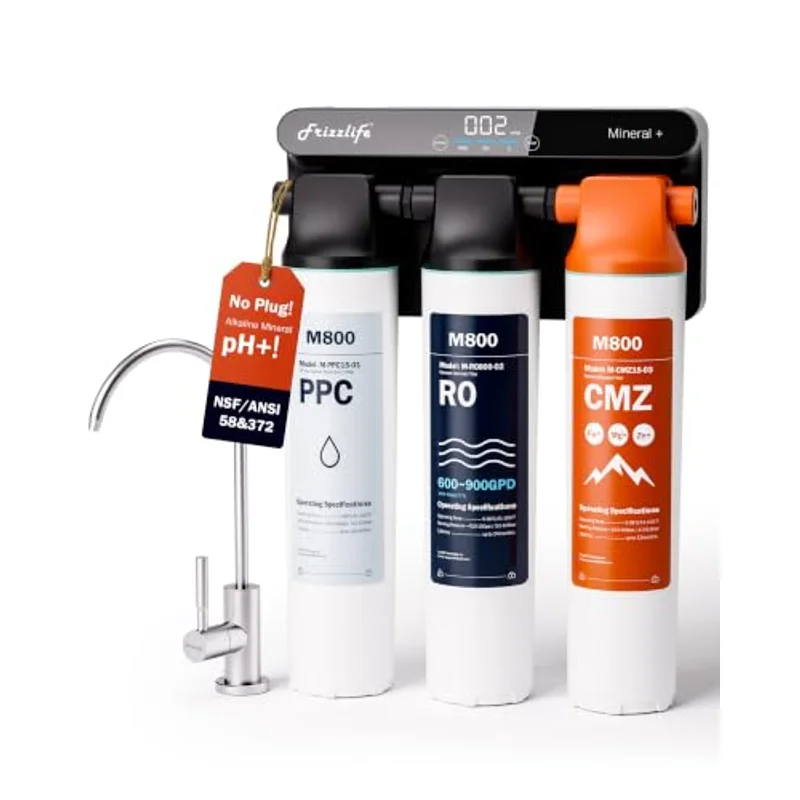
Frizzlife M800

Tankless behaviour without a plug
NSF/ANSI 58 & 372 · up to 900 GPD · 4:1 pure to drain · non-electric · 8 stages

If the cabinet has no outlet and you still want water on demand, this is the design that gets you there: no tank, no cord, no noise, running on line pressure alone. Certified against both the performance and materials standards, remineralized with calcium, magnesium and zinc, and its claimed 4:1 pure-to-drain is the inverse of older systems that send three or four gallons away per gallon made. Two things to settle first, and Frizzlife flags one itself: it measures 14.5 by 5.1 by 19.7 inches, so check the height under your basin — and check your incoming pressure, because without a pump that pressure is the whole engine.

The theme that repeats across owner reviews: no cord and no tank was exactly what was wanted, and the water-waste figure is what closed the decision.

Frizzlife M800 non-electric tankless reverse osmosis system with brushed nickel faucet
$300
Non-electricCheck price →
The answer

The verdict, by the situation you're actually in

There's no winner in the abstract, and a guide that names one is answering a question you didn't ask. Five situations cover almost everyone.

Small cabinet with an outlet in it. Tankless, almost automatically — you buy back most of the space and get steady flow with it. The G3P600 at $439.00 if you want the NSF/ANSI 58 performance certification; the G2P600 at $299.00 if municipal water and a materials-only certification are enough. Both 600 GPD at 2:1.

Big cabinet, tight budget. Tank, without much hesitation. The RCC7AK-BN is a whole-system NSF/ANSI 58 certification for $198.76 with a $69.24 yearly filter bill on universal cartridges — the lowest cost of ownership here by a comfortable margin, paid for in cabinet space and an afternoon.

No outlet under the sink. Either the M800 at $299.99, if the height fits and your pressure is healthy, or any tank system, none of which have ever needed power. That's genuinely the whole decision: on-demand flow versus a lower price and a tank.

Large household, or one that fills bottles constantly. Tankless, and this is where 600 GPD justifies itself. A 75 GPD tank keeps up with a couple; run it for a family of five and you'll meet the drained-tank refill rate regularly. Flow that doesn't sag is worth the premium here in a way it isn't in a two-person kitchen.

Low incoming pressure. A pumped tankless unit, or a tank system — but not a non-electric one. The pump manufactures the pressure the membrane needs; the tank doesn't care how long filling takes; only the non-electric design has nothing to compensate with. Check the gauge before committing either way.

One thing neither camp fixes: if you rent, can't drill a faucet hole, or expect to move within a year, both designs are the wrong shape for your life — that's a countertop versus under-sink question, and it has a good answer. If you're still weighing whether any RO system earns its place, the arithmetic sits in is reverse osmosis worth it. Either way, start from our comparison of the six systems and let the tape measure vote first.

We compared published specifications, certification listings and current prices to write this — we don't physically test these systems and we don't run a testing lab. Where a number is a manufacturer's claim, we've labelled it.
FAQ

Questions people ask before choosing

Is a tankless reverse osmosis system worth the extra money?

It depends which constraint is squeezing you. If cabinet space is tight and there's an outlet nearby, yes — you recover most of the space a pressure tank occupies and get flow that doesn't sag as you draw. If you have room and want the lowest lifetime cost, no: the iSpring RCC7AK-BN at $198.76 is an NSF/ANSI 58 certified system for less than any tankless unit here, running on universal cartridges that cost $69.24 a year rather than proprietary ones.

What happens to a tankless RO system during a power outage?

It stops. A tankless system uses a booster pump to push water through the membrane on demand, so with no power there's no pump and no water, and no reservoir holding anything in reserve. A tank system still gives you whatever was stored in its bladder tank, typically a few gallons, with no electricity involved. The exception is a non-electric tankless design such as the Frizzlife M800, which runs on line pressure and is unaffected by an outage.

Does water sitting in an RO storage tank go stale?

It sits, and in a household drawing only a few glasses a day it can sit a long time between refills. Reviewers consistently note a flatter or faintly plastic taste from tanks that turn over slowly. It's a freshness question rather than a safety one, and it largely disappears in a household that uses the faucet heavily, because the tank then turns over constantly. A tankless system avoids the question by making water only at the moment you ask for it.

Will a tankless system work if my water pressure is low?

A pumped tankless system is the most tolerant option, because the booster pump generates the pressure the membrane needs rather than relying on your supply. A non-electric tankless unit is the opposite: it has only your line pressure to work with, so low pressure directly reduces output. Tank systems sit in between — they fill slowly regardless, so a weak supply mostly means a longer refill. Check with an inexpensive hose-bib gauge before choosing; APEC, for instance, publishes a feed water pressure window of 40 to 85 psi for the ROES-PH75.

Keep reading

Next, in order of usefulness