Best RO Systems
Home › Guides › Countertop temperature settings
Honest take

Nine Temperature Settings on a Countertop RO Dispenser: What You're Actually Paying For

We're reader-supported: buying through our links may earn us a commission at no extra cost to you. We compare published specifications and prices — we don't run a testing lab.

Countertop reverse osmosis hot and cold dispenser with a touchscreen temperature menu next to a glass of water

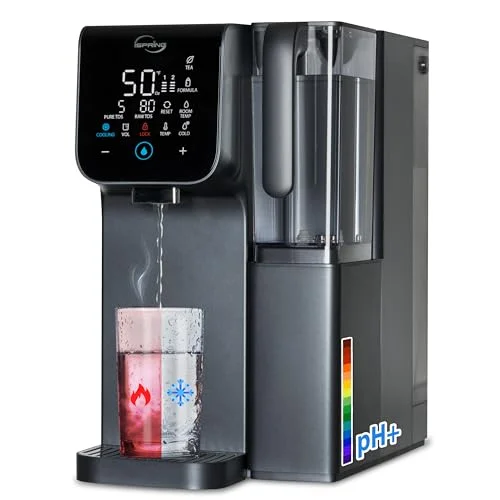
iSpring's RCD100HCG lists nine temperature settings and six dispensing volumes on its touchscreen, and the obvious misreading is to picture nine small reservoirs, each holding water at a different degree, waiting for a button press to pick one. That isn't how a hot-water dispenser works, countertop or otherwise. Inside a unit like this is one heating element — a compact instant-heat core plumbed downstream of the RO membrane — and the "nine temperatures" are nine programmed stop points a controller tells that single heater to reach before it cuts power and opens the dispense path. Select a lower setting and the controller runs the heater for less time; select a higher one and it runs longer. It's the same physical process repeated nine times at nine different stopping points, the way one oven can bake at 325°F or at 450°F without owning nine ovens.

The six dispensing volumes are a second, independent menu stacked on top of that, not a second heating variable. Choosing a smaller pour keeps the dispense valve open for less time; choosing a larger one keeps it open longer. Multiply nine temperature stops by six volumes and you get fifty-four possible combinations, which is a true number the same way a thermostat with a dial and a fan switch technically offers dozens of settings — accurate, and mostly beside the point, because almost nobody touches more than a handful of those combinations in an ordinary week. We ran into a similar gap between "listed combinations" and "combinations anyone actually uses" in our look at Waterdrop's G3P600 faucet-finish ladder, where three finishes and one LED feature produced a similarly inflated sense of choice without changing what the system actually does to the water.

None of this is a knock on the engineering. A single heating element that can hit nine repeatable setpoints on command, and report back accurately each time, is a harder and more expensive piece of electronics than a plain hot/cold toggle that runs the same heater to one fixed target and stops. The menu is real. What's worth separating out is the cost of building hardware that can hit nine setpoints from the question of whether any particular household will ever ask it to.

DREO's $144.49 case against the whole premium

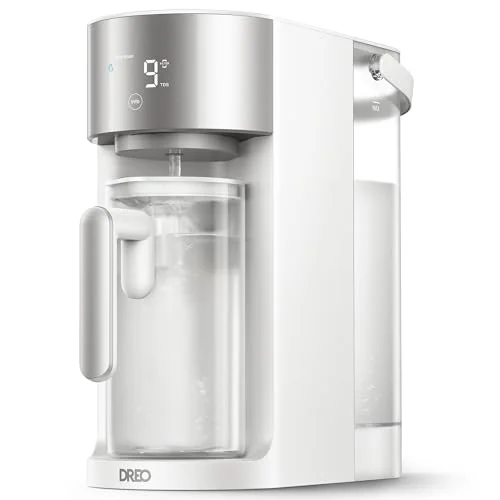
Set the KJ600 and the RCD100HCG next to DREO's countertop unit and the comparison stops being about temperature at all. DREO's Reverse Osmosis Water Filter Countertop system — a 3:1 pure-to-drain unit built around a 3L autofill pitcher — lists TDS monitoring, filter-life tracking, an installation-free setup and a self-cleaning cycle. That's most of the headline feature list on iSpring's own spec sheet, on a unit priced at $144.49: roughly $350 less than either hot-water system. What's absent from DREO's listing is any mention of a heating element, a temperature menu or a hot setting of any kind — this is a cold-filtration unit, full stop.

That absence is exactly what makes DREO the cleanest way to see what the heating hardware is actually worth on the two pricier units, because it isolates the one variable that changes. TDS monitoring, filter-life tracking, autofill, self-cleaning, no installation — DREO has effectively all of it, at under a third of the price, and the remaining gap to either $499 unit is the heating core and the menu layered on top of it. If what you actually wanted from a $500 countertop dispenser was the filtration and the monitoring, and hot water was never really the point, $144.49 buys the same underlying feature set without paying for an appliance you might use once a week for tea. We've seen this same shape before from the opposite direction, where ANGEL's ultra-slim tankless unit trades cabinet depth for a narrower footprint — a different spec moves, the price moves with it, and the rest of the feature list stays exactly where it was.

DREO's size also matters here in a way neither pricier listing gives us a comparable number for: neither the RCD100HCG nor the KJ600 publishes a reservoir or output capacity the way DREO's 3L pitcher figure does, so we can't tell you how a pitcher's refill cadence compares to a continuously plumbed or tankless supply. What we can say is that DREO is explicitly a pitcher-fed countertop unit, and that single detail should rule it out for anyone who wants RO water running continuously rather than refilled a batch at a time — a limitation the spec sheet states plainly, not one we're inferring from the price.

The cost of keeping water hot around the clock

Neither iSpring nor Waterdrop publishes a standby wattage figure for the RCD100HCG or the KJ600 — how many watts either unit draws just sitting ready, holding its heating element between pours — so we aren't going to assign either product a number it hasn't published. What we can talk about, as general information about the category rather than a claim about these two specific listings, is how instant-hot dispensers behave in general. A unit that heats water on demand from a standing-ready heating core, rather than storing a tank of already-hot water, typically loses some heat to the room between uses and spends a small amount of continuous power recovering it — the same reason a kettle left on its powered base, or an instant-hot tap at a kitchen sink, can draw a little electricity even during the hours nobody fills a cup. For instant-hot kitchen appliances generally, that idle draw is commonly in the tens of watts, which at typical US residential electricity rates works out to a few dollars a month. That is a category-level estimate, not a published figure for either the RCD100HCG or the KJ600, and we're flagging it as such rather than presenting it as either unit's number.

The reason that figure matters at all is that it's a cost DREO's owners simply never pay. A cold-only filtration unit with no heating element has nothing to keep warm between pours, so there's no standby draw to budget for in the first place — one more line item that only exists once you've decided you want hot water from the countertop, and one more reason the $144.49 unit and the roughly $499 units aren't really competing for the same buyer. If a household's actual hot-water habit is occasional — tea once or twice a day, rather than hot water running for most of the afternoon — that standby cost gets paid continuously in exchange for an on-demand convenience used only in short bursts. It's the countertop-dispenser version of a pattern we worked through in more plumbing-specific terms in our breakdown of bulk replacement filter packs: a recurring cost that's easy to overlook precisely because it never shows up as a single line item on a receipt.

How many of the nine you'll actually touch in a week

This is the part no spec sheet can answer, because it's a question about the household, not the hardware. Picture an ordinary week with the RCD100HCG on the counter: coffee wants water close to its hottest setting, tea generally wants something a notch or two below boiling so it doesn't scald delicate leaves, instant oatmeal or soup wants something in the middle, and anyone drinking plain water wants it cold. That's realistically three or four distinct temperature habits on repeat, not nine. The remaining five or six settings exist for the household that also prepares baby formula at a precise lower temperature, or for someone with a specific tea ritual that calls for one exact degree and nothing else — real use cases, just not most households' use cases in most weeks.

That pattern — a wide menu, a narrow slice of it in regular rotation — shows up constantly across multi-setting kitchen and home appliances in general, and it's worth naming as the broad tendency it is rather than treating it as unique to this dispenser: once someone finds the one or two settings that cover their actual routine, the rest of the menu tends to go untouched, not because it stopped working, but because habit is sticky and most people don't keep re-shopping a dial they've already set. We looked at a parallel version of this question from the opposite direction in our comparison of a 4-stage and a 10-stage tankless system rated at the same 800 GPD: more stages, like more temperature stops, is a real capability, and also not automatically one most owners end up exercising.

None of this means the touchscreen is wasted on everyone. A household that genuinely rotates through formula, tea, coffee and a couple of kinds of instant food on a given day is exactly the buyer the nine-setting menu was built for, and for that household the RCD100HCG's screen is doing real, continuous work rather than sitting on a single default. The honest framing is that "nine settings" describes the ceiling of what the hardware can do, not the floor of what any one household needs — and that gap between ceiling and floor is what you're paying the premium over the KJ600's toggle, and the premium over DREO's cold-only unit, to keep available, whether or not you end up using most of it.
At a glance

The three, side by side

Prices as recorded from each Amazon listing. Prices move — confirm the live price before buying.

ModelBest forTemperature menuPrice
DREO Countertop RONo hot water, lowest priceNone — cold filtration only$144.49Price
Waterdrop KJ600One hot settingHot/cold toggle$499.00Price
iSpring RCD100HCGWants all nine9 temperatures · 6 volumes · touchscreen$499.49Price
What we'd buy

Three coherent answers, not one winner

This isn't a roundup with a single best pick — it's three different answers to "how much temperature control do I actually want," priced close enough together that the honest move is to match the pick to the habit, not the spec sheet.

01One hot setting

Waterdrop KJ600

For a household that wants tea or coffee water and nothing more exotic
600 GPD · tankless · instant hot/cold toggle

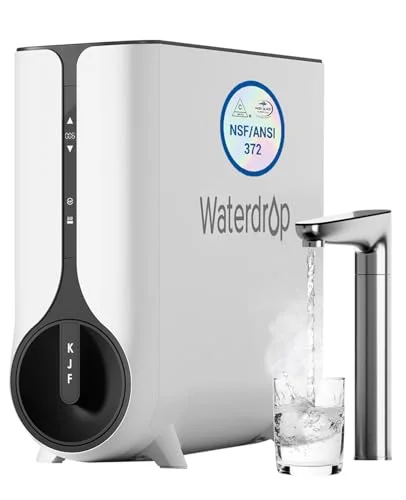
The KJ600 skips the stop-point ladder and gives you the toggle version of the same heating mechanism: hot water on demand, cold water on demand, no screen to navigate in between. At $499.00 — forty-nine cents less than the RCD100HCG — it's the pick for anyone who knows they'll use "hot" and "cold" and nothing in between, and would rather have a one-step toggle than learn a nine-setting menu they'll mostly ignore.

Waterdrop KJ600 instant hot tankless reverse osmosis system
$499
600 GPD · tanklessCheck price →
02Wants all nine

iSpring RCD100HCG

For a household that actually rotates through formula, tea, coffee and more
9 temperatures · 6 volumes · touchscreen · TDS & filter-lifespan monitor

If your routine genuinely uses more than one hot setting in a given week — a precise lower temperature for formula, a notch-below-boiling pour for tea, a full-heat pour for coffee, all from the same counter — the RCD100HCG's touchscreen is doing continuous work rather than sitting on a default. At $499.49 it's priced within fifty cents of the simpler toggle, so the nine-setting menu isn't actually costing you anything extra on these two listings — it's only "worth it" in the sense that you'll use it, not in the sense that skipping it saves money.

iSpring RCD100HCG touchscreen hot and cold reverse osmosis dispenser
$499
9 temps · 6 volumesCheck price →
03No heat, no standby cost

DREO Countertop RO

For a household that never actually wanted hot water from this unit
$144.49 · 3:1 pure-to-drain · 3L autofill pitcher · TDS & filter-life monitor · self-cleaning

Drop the heating hardware entirely and most of the rest of the feature list — TDS monitoring, filter-life tracking, an installation-free setup, self-cleaning — survives at under a third of the price. The trade-off is explicit, not hidden: no hot setting of any kind, and water comes from a 3L pitcher rather than a continuous line. For anyone whose actual want was filtered cold water with some monitoring, not a hot-water appliance, this is the pick that stops paying for a menu you'd never open.

DREO countertop reverse osmosis water filter with autofill pitcher
$144
Cold only · 3LCheck price →
FAQ

Questions people ask about countertop temperature menus

Does "nine temperatures" mean the dispenser has nine separate tanks of water?

No. A countertop hot/cold RO dispenser like the RCD100HCG uses one heating element plumbed after the RO membrane. The nine listed temperatures are nine programmed stop points a controller runs that single heater to — the same physical process repeated nine times at nine different stopping points, not nine reservoirs holding water at different degrees simultaneously.

Why do the RCD100HCG and the KJ600 cost almost the same amount?

On the prices we recorded, they do: $499.49 for iSpring's nine-setting touchscreen unit against $499.00 for Waterdrop's simpler hot/cold toggle, a forty-nine-cent gap. Neither listing publishes enough detail to say exactly why the extra setpoints and the screen don't carry a price premium over the toggle — only that, on these two listings, they don't.

Does keeping water hot all day cost a lot of electricity?

Neither manufacturer publishes a standby wattage figure for these two units, so we can't give you a number specific to the RCD100HCG or the KJ600. As general information about the category, instant-hot dispensers typically draw a small continuous amount of power to offset heat loss between uses, commonly in the tens of watts — a few dollars a month at typical US residential rates. A cold-only unit like DREO's has no heating element and therefore no equivalent standby draw.

Which one should I buy if I only ever drink cold water?

DREO's countertop unit, at $144.49. It carries TDS monitoring, filter-life tracking, an installation-free setup and a self-cleaning cycle — most of the same monitoring features as the pricier hot-water units — without the heating hardware, the temperature menu, or the standby power draw that comes with keeping water hot around the clock.

Keep reading

Next, if you're still comparing countertop units