Best RO Systems
Home › Guides › VIOMI app-control ladder
Honest take

VIOMI's $760 Touchscreen RO System: What App Control Actually Adds Over Its Own $180 Base Model

We're reader-supported: buying through our links may earn us a commission at no extra cost to you. We compare published listing titles, specifications and prices — we don't run a testing lab, and nothing below is a star rating or a paraphrased review.

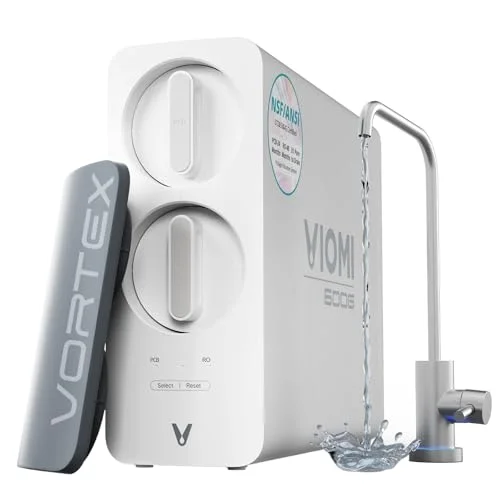
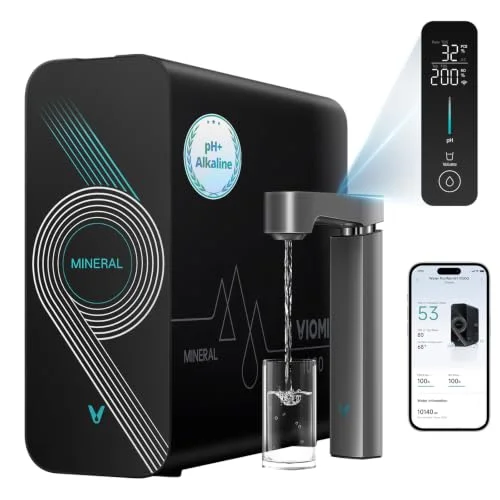
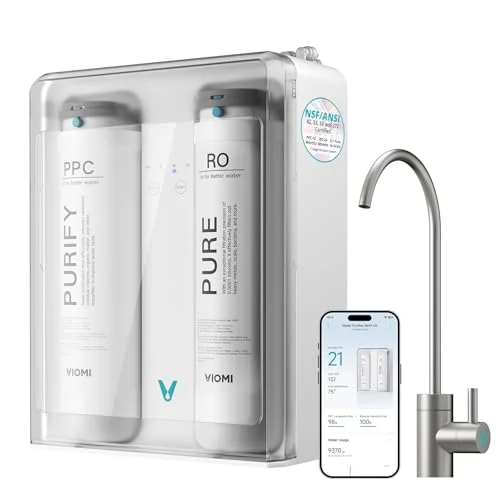
Three VIOMI under-sink reverse osmosis systems lined up to compare the touchscreen flagship against its plainer app-controlled siblings

VIOMI doesn't sell one reverse osmosis system — it sells three, under three different model names, at three prices that don't move in neat steps. The VIOMI Pure B6W lists at $139.99 (recorded November 23, 2026). The VIOMI V6 sits above it at $189.99 (recorded November 20, 2026). The VIOMI Master M1 — the one with the touchscreen faucet, the alkaline remineralization stage and a listing title that reads more like a spec sheet than a product name — tops the range at $659.99 (recorded November 19, 2026). Run the plainest against the flagship and the gap is $520.00 at the prices we actually recorded, not a round number, and worth checking against the live listing before you buy, since all three move independently on Amazon.

That gap is worth working through because VIOMI is one brand making the same promise — tankless, under-sink, reverse osmosis — at three price points, which holds the manufacturer and the category constant in a way most "which RO system" comparisons can't. We've made this kind of same-brand ladder comparison before on Waterdrop's G3P600 faucet-finish ladder, but that one turned out to be almost entirely cosmetic — three listings, one spec sheet, a $20.00 finish charge. VIOMI's ladder is not that: the specs actually move between these three systems, and not all in the direction the price would suggest.

Here's the shape of it, each summarized from what its own Amazon listing states. The B6W: 600 GPD, 7-stage filtration, NSF/ANSI 42, 53, 58 and 372 stated, a 2:1 pure-to-drain ratio, and — the detail that makes this comparison worth running — app control for monitoring filter life and water quality, at $139.99. The V6: the same 600 GPD rating, a deeper 9-stage system, NSF/ANSI 53, 42 and 372 stated (not 58), a less efficient 3:1 drain ratio, and no app-control feature mentioned anywhere in its listing, at $189.99. The M1: a higher 1,000 GPD rating, 9-stage filtration with what VIOMI's own product name calls a "4-Year RO Water Filter," NSF/ANSI 42, 58 and 372 stated (not 53), a touchscreen faucet, app control, and an alkaline remineralization stage that adds minerals back after the membrane — at $659.99.

Lay those three side by side and "pay more, get a smarter system" only holds up at the very top. In the middle, something stranger happens: the $189.99 V6 is pricier than the $139.99 B6W and has more filtration stages, but drops both the stated app-control feature and the better of the two drain ratios. The rest of this page works through whether the $520.00 jump to the M1 — or the smaller $50.00 jump to the V6 — buys what it sounds like it should.
The feature nobody expects at the bottom

What the app actually connects to, and the one listing that skips it

Start with what's genuinely counterintuitive here: app control on this ladder is not exclusively a flagship feature. VIOMI's own listing for the $139.99 B6W states it plainly: "Monitor filter life, water quality, and consumption patterns conveniently through the Viomi app, giving you complete control and timely filter replacement reminders." That's the cheapest of the three systems, explicitly marketed on app connectivity — the same category of feature the $659.99 M1 leads with on its touchscreen faucet.

What the B6W's listing does not state is the connection method — no mention of Wi-Fi versus Bluetooth, no stated range, nothing about whether the app works without an internet connection in the house. The listing we sourced doesn't answer that, and we're not going to guess at a protocol VIOMI didn't publish. The same gap exists for the M1: "Touchscreen Faucet & App Control" is in the product name, but the connectivity standard behind it isn't spelled out in the text we have.

What the stated feature set does tell you is what it's measuring: filter life, water quality and consumption patterns, with a reminder pushed to your phone when a cartridge is due. Compare that with the alternative every RO system without an app has used for decades — a sticker with a "replace by" date written in marker. A sticker is static: accurate on install day, with no idea whether your household of five is running the system twice as hard as the two-person household the manufacturer's testing assumed. A consumption reading, by contrast, is live, measuring your actual draw rather than a calendar guess made at the factory. That's the real value of app control on a filter system, regardless of which VIOMI model states it.

Then there's the V6, priced in between at $189.99, whose listing — covering installation, certification, stage count, drain ratio and footprint — never mentions app control or any software feature. That's not the same claim as "the V6 has no app"; a feature a listing doesn't advertise isn't confirmed absent, and VIOMI may simply not have led with it in this listing's copy. But strictly on what each seller put in writing, the $139.99 system is the one explicitly selling a phone-based monitoring feature, and the $189.99 system in between it and the flagship is silent on the question. If a live filter-life readout on your phone matters to you, confirm it on the V6's current listing before assuming "it's VIOMI, so it probably has the app too."

What else moves on this ladder

GPD, stage count and certification don't climb together

Software is only one axis. The hardware specs that usually anchor an RO buying decision — rated output, stage count, certification, drain ratio — also change across these three listings, and not in lockstep with price or with each other, the same way three unrelated tankless systems rated near 800 GPD disagree sharply on how many stages it takes to get there. A bigger number in one column doesn't guarantee a bigger number in every other column.

On rated output, the B6W and V6 are identical: both state 600 GPD. The jump only happens at the top, where the M1 states 1,000 GPD — a larger membrane and pump assembly, consistent with a system also feeding a remineralization stage and a touchscreen faucet without losing flow. The $50.00 step from B6W to V6 buys nothing on this axis; the real output jump is the $470.00 step from V6 to M1.

On stage count, the pattern inverts. The $139.99 B6W states 7 stages; the pricier $189.99 V6 states 9 — a genuine upgrade, using (per its listing) a 0.0001-micron membrane and quoting up to 94.75% TDS reduction with PFOS and PFOA reduction above 99.88% and 99.6%. The $659.99 M1 also states 9 stages — the same count as the V6, not a higher one. Its extra cost buys the higher 1,000 GPD rating, the remineralization stage, the touchscreen and the stated "4-Year" filter life in its own product name, meaningfully longer than the two- to three-year membrane life typical of this category if VIOMI's rating holds.

On certification, none of the three listings states the identical set of NSF/ANSI numbers — easy to miss if you assume a flagship inherits everything its cheaper siblings claim. The B6W states 42, 53, 58 and 372 — all four standards that show up anywhere on this ladder. The V6 states 53, 42 and 372, leaving out 58, the standard certifying TDS reduction performance specifically. The M1 states 42, 58 and 372, leaving out 53, which covers chlorine, taste and odor. To be precise: a standard missing from a listing's text isn't the same as a system failing it — plenty of certified systems don't list every number in every piece of copy. But strictly on documentation, the $139.99 base model is the only one stating all four at once, and choosing the flagship specifically for certification breadth assumes something the M1's own listing doesn't spell out.

And on pure-to-drain ratio, the B6W states 2:1 and the V6 states 3:1 — the cheaper system is the more water-efficient one as stated, not the pricier one. VIOMI's V6 listing frames 3:1 as an improvement over "traditional tanked systems," true as far as it goes, but that's a comparison to an older category, not to its own cheaper tankless sibling. The M1's listing doesn't state a drain ratio at all — an absence worth noting rather than filling in with an assumed number.

Correcting an assumption before making it

Touchscreen faucet versus no faucet display at all

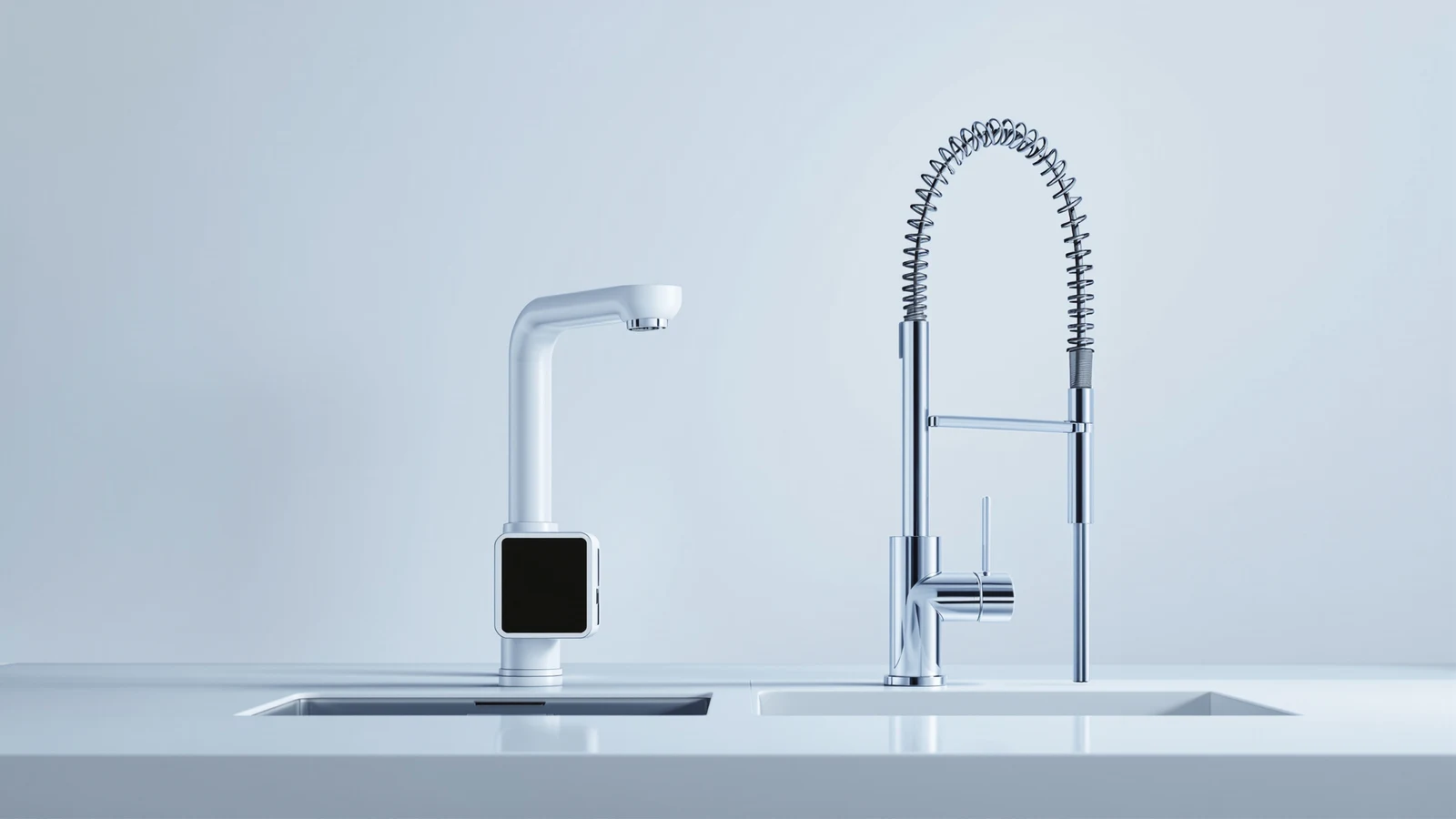
It's worth being precise rather than assuming the two cheaper VIOMI systems simply ship a plainer screen. Going strictly by the listing text, neither the B6W nor the V6 states any onboard display, LED or otherwise, on their faucets — their monitoring feature, where stated at all, lives entirely in the phone app. The M1 is the only one whose listing states a physical display: "Touchscreen Faucet & App Control," built into the product name rather than a bullet point.

That reframes the real comparison. It isn't touchscreen-versus-basic-LED-screen, because the cheaper systems don't document having a screen of any kind — it's a built-in touchscreen at the sink versus a phone app with no onboard display at all. For a lot of households that's a wash: you're checking your phone anyway. For a kitchen where several people use the filtered-water tap and not everyone has the app installed, a screen at the point of use is a real, if modest, usability advantage the M1 alone claims.

On what fails first and what a repair costs, we have to be honest about the limits of what's published. Neither VIOMI's listings nor any source we could verify states a failure rate, a warranty term for the touchscreen specifically, or a replacement-part price for a cracked display. We're not going to manufacture a repair-cost figure for a part VIOMI hasn't priced separately — that gap is itself the finding, the same way a plumbing brand's first reverse osmosis listing left its warranty term and certification number unstated, and the honest response was to say so rather than fill in a plausible-sounding number. As general category information rather than a VIOMI-specific claim: any electronic display adds failure points a plain mechanical faucet doesn't have — a touch sensor, a small circuit board, a seal keeping water away from both — while a system with no onboard screen has less at the tap that can break, even though its phone-side software depends on your phone and home network staying functional instead. Before buying specifically for the touchscreen, check VIOMI's current warranty terms and, if you can reach support, what a standalone display replacement costs.

The question underneath all of this

Does app control change filter life, or just how you're told about it?

The honest answer is that app control, as both the B6W and M1 listings describe it, is a monitoring and notification feature — not a filtration feature. Nothing in either listing claims the app extends a cartridge's physical life or changes how much water passes through a membrane before it needs replacing. What it claims to do is tell you, continuously, where a cartridge sits in its lifespan, instead of leaving you to track that against a date written down at install time.

That distinction matters because it's easy to conflate "smart" with "better-performing" when a product name leads with "App Control." A sediment or carbon stage degrades at a rate set by your water's actual sediment and chlorine load and your household's actual usage — physical facts a phone notification can't alter. What a monitoring feature changes is purely informational: whether you learn a cartridge is nearly spent through a push notification, through water that starts tasting slightly off, or through a sticker that was only ever a generic estimate. Stretching the filter life itself in actual months is a different, harder problem about cartridge design and usage, not phone connectivity; reverse osmosis systems built specifically to stretch the standard six-month cycle cover that ground directly.

There's a related, practical upside worth naming: a reminder you actually see is a reminder that works. A cartridge run well past its intended life is how a cheap pre-filter ends up loading contaminants onto a membrane that costs far more to replace — the same mechanism this site has flagged when pricing out running an RO system on standard versus bulk replacement-cartridge schedules. An app notification is a better delivery mechanism than a sticker you stopped reading months ago — but it's a better messenger, not a longer-lasting cartridge.

Side by side

The three VIOMI systems, lined up

What each listing states for itself, at the prices we recorded. Confirm the live price and current listing text before buying — Amazon listings for all three move independently.

SystemPriceGPDStagesNSF/ANSI statedDrain ratioApp controlFaucet screen
VIOMI Pure B6W$139.99600742, 53, 58, 3722:1Yes (app)Not statedView
VIOMI V6$189.99600953, 42, 3723:1Not statedNot statedView
VIOMI Master M1$659.991,000942, 58, 372Not statedYes (app)Yes (touchscreen)View

Read the "Not stated" cells as gaps in each listing's own documentation, not as confirmed absences. The pattern worth remembering: the cheapest system is the only one stating all four NSF/ANSI numbers that appear anywhere on this ladder, and it shares the app-control feature with the most expensive one — it's the $189.99 middle tier that's the outlier, with more filtration stages but a less efficient drain ratio and no stated software feature at all.

Two honest answers

The pick for the reader who wants the data, and the pick for the reader who just wants clean water

01Wants the data

VIOMI Master M1

Touchscreen, app, remineralization and the only 1,000 GPD rating on this ladder
$659.99 · 1,000 GPD · 9-stage · NSF/ANSI 42, 58 & 372 stated · touchscreen faucet & app control

If you want a live readout at the sink as well as on your phone, the higher rated output, and water that comes back out with minerals reintroduced rather than stripped flat — relevant if you're drinking it black or running it through coffee or espresso equipment that wants a mineral floor — this is the only system on the ladder that states all three. You're also paying for a "4-Year RO Water Filter" per its own product name, longer than the two-to-three-year membrane life typical of this category, if VIOMI's rating holds up over time. The certification set it states (42, 58, 372) leaves out 53 — worth a glance at the current listing if chlorine/taste/odor certification specifically matters to you.

VIOMI Master M1 touchscreen reverse osmosis system with app control
$659.99
Touchscreen · 1,000 GPDCheck price →
02Just wants clean water

VIOMI Pure B6W

The cheapest of the three, and the only one stating all four certifications
$139.99 · 600 GPD · 7-stage · NSF/ANSI 42, 53, 58 & 372 stated · 2:1 drain ratio · app control included

If the goal is filtered water at the tap without paying for a faucet display, this is the system whose own listing states the broadest certification set on this ladder — all four NSF/ANSI numbers that show up anywhere across the three — plus the tighter 2:1 drain ratio and the same phone-app filter-life monitoring the $659.99 flagship advertises. It has fewer filtration stages than its two pricier siblings and a lower rated output, which matters if your household runs the tap hard; for most single- or two-person kitchens, 600 GPD with 7 stages and a working reminder system is the complete job.

VIOMI Pure B6W under-sink tankless reverse osmosis system
$139.99
600 GPD · App controlCheck price →
03Confirm before you choose it

VIOMI V6

More stages than the base model, but priced above it while stating less
$189.99 · 600 GPD · 9-stage · NSF/ANSI 53, 42 & 372 stated · 3:1 drain ratio · app control not stated

The V6's own listing is explicit that it works only with its included faucet — it can't be connected to another faucet, a refrigerator or an ice maker, unlike the B6W's more flexible plumbing. It also costs $50.00 more than the B6W while its listing states a worse drain ratio and no app feature at all. The two extra filtration stages and the finer 0.0001-micron membrane are real and worth something — just confirm the current listing and photos for app support and certification 58 before paying a premium over the base model for a system that documents less on both fronts.

VIOMI V6 under-sink tankless reverse osmosis system
$189.99
9-stageCheck price →
FAQ

Questions people ask about this ladder

Does the cheapest VIOMI system really have app control?

Yes, as stated on its own listing. The $139.99 VIOMI Pure B6W's listing states: "Monitor filter life, water quality, and consumption patterns conveniently through the Viomi app, giving you complete control and timely filter replacement reminders." App control on this ladder is not exclusive to the $659.99 touchscreen flagship — it's the $189.99 VIOMI V6, priced in between, whose own listing doesn't mention an app feature at all.

What's the real price gap between VIOMI's cheapest and most expensive reverse osmosis system?

$520.00 at the prices we recorded — $139.99 for the B6W (November 23, 2026) against $659.99 for the Master M1 (November 19, 2026). Both prices move independently on Amazon, so confirm the current listing price before treating that figure as current.

Does app control make a reverse osmosis filter last longer?

No evidence of that in either listing. App control, as VIOMI describes it on the B6W and M1, monitors filter life, water quality and consumption and sends replacement reminders — it's a notification feature, not a change to the physical cartridge. A sediment or carbon stage degrades at a rate set by your actual water quality and usage, not by whether a phone app is tracking the countdown.

Which VIOMI system states the most NSF/ANSI certifications?

The $139.99 B6W, whose listing states NSF/ANSI 42, 53, 58 and 372 — all four standards that appear anywhere across the three systems. The V6's listing states 53, 42 and 372 (not 58); the M1's listing states 42, 58 and 372 (not 53). A standard missing from a listing's stated text isn't confirmed proof a system fails it, but on documentation alone, the base model states the broadest set.

Keep reading

Next, if you're still comparing tiers