Buying a Replacement RO Membrane? The GPD Number on the Box Has to Match
We're reader-supported: buying through our links may earn us a commission at no extra cost to you. We compare published specifications, housing dimensions and prices — we don't run a testing lab.
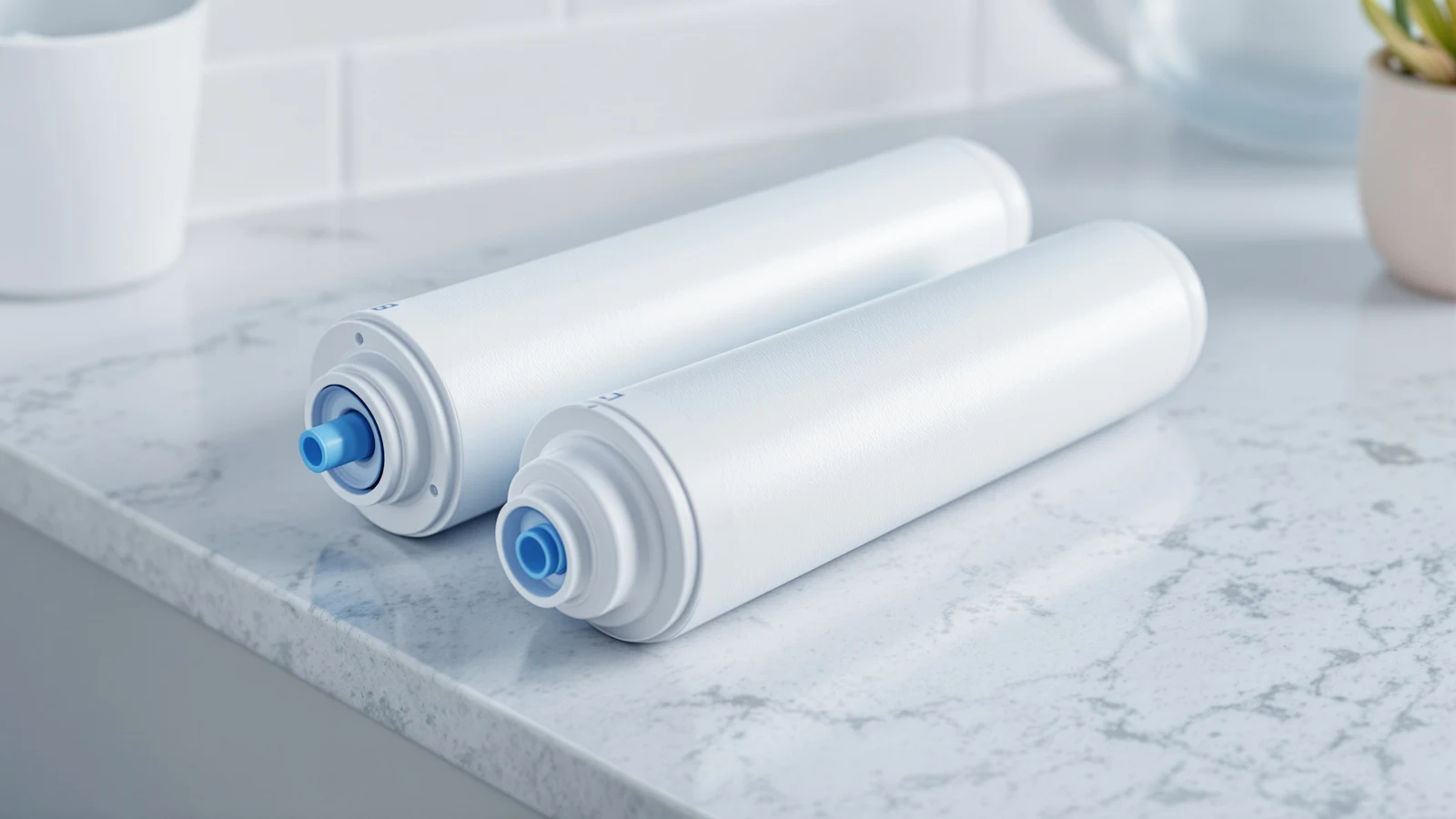
Order a replacement RO membrane and the listing will usually reassure you on exactly one point: it fits a standard 10-inch by 2.5-inch housing, the same size used across most under-sink systems since the category existed. That reassurance is true, and it is also not the question that matters. A 10"×2.5" housing will physically accept a 36 GPD membrane, a 50 GPD membrane, a 75 GPD membrane or a 100 GPD membrane — the tube is the same diameter and length regardless of which one is inside it. Fit and function are two separate questions, and a listing answering the first one convincingly tells you nothing about the second.
GPD stands for gallons per day: the membrane's rated permeate output, measured under a standard test condition — conventionally 77°F feed water at 60 psi, the same convention behind the 75 GPD and 97% TDS rejection figures published for the cartridges we've compared on lifespan claims elsewhere on this site. It is not a measure of filtration quality, contaminant removal, or how "strong" the membrane is. It is a production-rate spec, and your system was engineered around one specific number, not a range.
That number lives on the original membrane's sticker and in your system's manual, not on the housing. Two checks, done separately, before you order anything: does the replacement fit the housing (almost always yes, for standard sizes), and does its GPD rating match what your system shipped with (frequently no, if you shop by housing size alone). This page is about the second check — the one a "fits 10 inch housings" badge on a listing will never answer for you.
What a 75 GPD membrane produces that a 50 GPD membrane, in the same housing, doesn't
Strip away the branding and a 75 GPD and a 50 GPD membrane are solving the same problem — rejecting dissolved solids through a thin-film composite — at two different rated speeds. Under the manufacturer's test condition, the 75 GPD membrane is rated to produce permeate water roughly half again as fast as the 50 GPD one. In practice that shows up as a faster-refilling storage tank, a shorter wait after you've drawn a few glasses back to back, and — on a booster-pump or tankless system where the membrane feeds a faucet more directly — a faster sustained flow at the tap.
What it does not mean is cleaner water. GPD and rejection performance are reported as separate specs for a reason: a 50 GPD membrane rejecting dissolved solids at a given percentage and a 75 GPD membrane rejecting at the same percentage are producing water of comparable quality, just at different rates. Higher GPD is a throughput upgrade, not a purity upgrade — useful if your household empties the tank faster than it refills, irrelevant if the thing actually bothering you is taste or TDS creep.
The rated number also assumes everything downstream of the membrane — the flow restrictor on the drain line, the check valve, the auto shutoff valve wired to the storage tank — was sized to match it. That's the detail a housing-size comparison skips entirely, and it's the mechanism behind the mismatch problems covered further down this page.
Generic-fit replacement sets versus a set built for one named model
Search "RO membrane replacement" and the results split into two distinct kinds of listing, and the difference between them is exactly the one this page is about.
The first kind markets itself by housing compatibility: "fits standard 10-inch 5-stage reverse osmosis systems," with the brand's own name on the box but no claim to fit one specific manufacturer's model line. SimPure's 5-Stage Replacement Filter Set is written that way — a 75 GPD membrane plus four pre- and post-filter cartridges, sized and sold for the universal 10"×2.5" housing format rather than for a SimPure-branded system specifically. iSpring's F5-75 reads almost identically: five cartridges including a 75 GPD membrane, described as fitting 5-stage reverse osmosis systems generally, not restricted to iSpring hardware. Both are legitimate, both are genuinely interchangeable across brands that use the standard housing — and both put the burden of checking the GPD number entirely on you, the buyer, because the listing's own compatibility claim stops at the housing.
The second kind is named to a line. APEC's FILTER-MAX-ES50 carries APEC's own Essence part-numbering in its title and is rated at 50 GPD specifically — a set built around APEC's lower-output Essence systems rather than marketed as a universal drop-in for any 10"×2.5" housing. A model-specific listing like this one narrows the guesswork: the GPD rating is baked into the product name, which is harder to scroll past than a spec buried in bullet four of a generic listing.
Neither pattern is inherently the safer buy. A generic listing with the right GPD number is exactly as correct as a model-specific one; a model-specific listing bought for the wrong system is exactly as wrong as a generic one bought by housing size alone. What changes is how much the listing itself protects you from your own skim-reading — and with generic sets, the answer is: not at all.
| Replacement set | GPD rating | Fit claim | Price | |
|---|---|---|---|---|
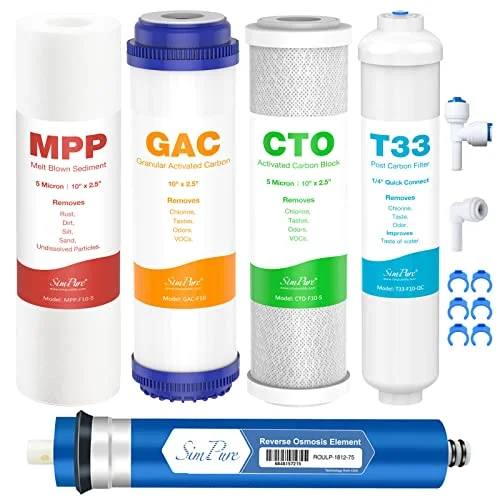 SimPure 5-Stage Replacement Set | 75 GPD | Generic — standard 10" 5-stage systems | $38.85 | Price |
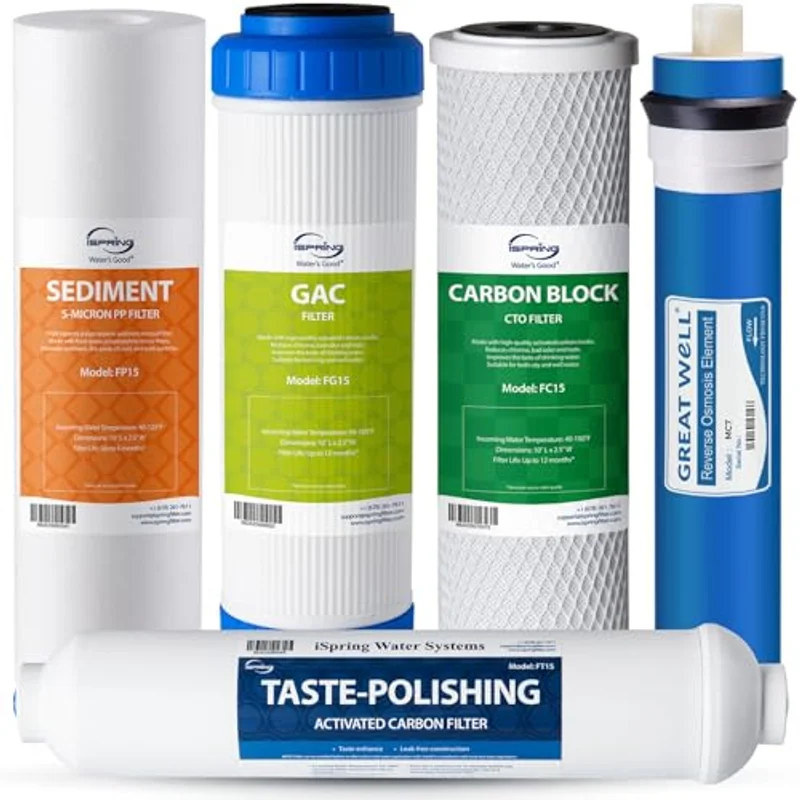 iSpring F5-75 | 75 GPD | Generic — 5-stage reverse osmosis systems | $46.49 | Price |
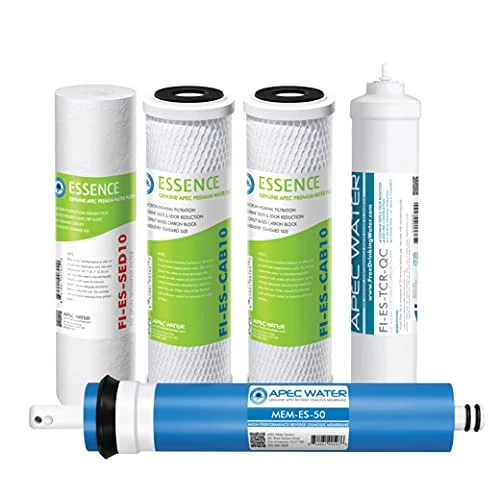 APEC FILTER-MAX-ES50 | 50 GPD | Named — APEC's own Essence (ES) line | $61.73 | Price |
Two 75 GPD sets, one 50 GPD set, all fitting the same standard housing size. Buying any of the three for a system rated at a different GPD is the mistake this page exists to prevent.
What happens mechanically when the replacement's rating doesn't match the original
A standard 5-stage RO system isn't just a membrane in a tube. Downstream of it sits a flow restrictor on the drain line, sized specifically to the membrane's rated GPD, whose job is to hold the ratio between permeate water (what you drink) and reject water (what goes down the drain) inside the range the system was designed around. That ratio isn't incidental — it's what keeps the membrane surface flushed of the dissolved solids being rejected, and it's what the auto shutoff valve and check valve on the storage tank are calibrated to work alongside. The flow restrictor is matched to the original membrane's output; it is not matched to the housing, and swapping the membrane without touching anything downstream leaves that restrictor doing math for a different number than the one now installed.
Install a 75 GPD membrane into a system built and plumbed around a 50 GPD membrane, restrictor included, and the membrane is producing permeate faster than the downstream components were sized to pass it along correctly. The practical result is a shift in the reject-water ratio away from what the system was tuned for and, because the water is moving through the membrane faster, less residence time against the membrane surface — the mechanism that typically shows up as a higher percentage of dissolved solids slipping through into the "clean" side than the membrane's own rejection spec would otherwise suggest, along with a drain flow that no longer matches what the plumbing downstream expects.
Go the other direction — a 50 GPD membrane into a system built around 75 GPD — and the shortfall shows up as underproduction: a storage tank that takes noticeably longer to refill, a tankless or booster-fed system that can't sustain the flow rate the faucet and downstream fittings were specified for, and a flow restrictor now passing reject water at a ratio sized for more permeate than the membrane is actually producing. Neither direction breaks the system outright in most cases. Both quietly change how it performs against the numbers printed on it, in a way that's invisible until you check — and the direction of the error is why "it fit in the housing" is such a poor substitute for "I checked the rating."
This is also where buying by brand name instead of by number causes the most damage, and it connects directly to the newer-brand question we cover in what to check before trusting a newer RO brand: a generic replacement set from any manufacturer, well-established or not, will say almost nothing on the front of the package about whether 75 GPD is the number your specific system needs. The brand on the box tells you who made the cartridge. It does not tell you whether it belongs in your housing.
Read the GPD number before you read the brand name
The order most people shop a replacement filter in is backwards. They look for a brand they recognize or a price that looks right, confirm the listing says "10 inch" or "5-stage" somewhere in the title, and add it to the cart. The GPD number — the one spec that actually determines whether the set belongs in their system — gets read last, if it gets read at all, because it's usually smaller text further down the listing than the brand name and the housing-size claim.
Reverse that order and the check takes about two minutes, against two sources you already own: the sticker on the membrane currently installed, and the specification page of your system's manual.
Find your current GPD rating
Check the sticker on the membrane you're replacing, or the spec sheet in your system's manual — look for a number followed by "GPD."
Confirm the housing size
Most under-sink systems use 10"×2.5" standard housings. Your manual will state the size if yours differs.
Match the GPD number first
On the replacement listing, find the GPD rating before you check the brand name. It should equal your original, not just be close.
Order only once both match
Housing size and GPD rating both confirmed against your manual — not just the housing size — is what makes a replacement correct.
If your manual has gone missing, the original membrane's sticker is usually the faster source — manufacturers print the GPD rating directly on the cartridge itself precisely because it's the number installers and buyers need most. When neither is available, the cautious move is to contact the system manufacturer with your model number rather than guess from the housing size alone; a two-minute email is cheaper than a mismatched membrane you've already installed.
What each one is actually built for
Same housing size, two different GPD ratings, two different shopping patterns. Check your manual against the number, not the name, before choosing between them.
SimPure 5-Stage Set
Five cartridges including a 75 GPD membrane, sold as a generic fit for standard 10" 5-stage systems rather than for one named model. Correct only if your original membrane was also rated 75 GPD — the listing's housing-size claim won't tell you that either way.
Check price →iSpring F5-75
Also a 75 GPD membrane plus four supporting cartridges, also sold as a generic fit for 5-stage systems rather than restricted to iSpring hardware. Same GPD number as the SimPure set above; the choice between the two comes down to price and cartridge-count preference, not compatibility.
Check price →APEC FILTER-MAX-ES50
A 1-year set rated 50 GPD and named to APEC's own Essence (ES) line rather than marketed as a universal drop-in. The model-specific naming narrows the guesswork, but it's still worth confirming 50 GPD is the number on your current membrane's sticker before ordering.
Check price →Questions people ask about matching a replacement membrane
Does a higher GPD membrane filter water more thoroughly than a lower one?
No. GPD is a rated production-rate spec — gallons per day under a standard test condition, conventionally 77°F feed water at 60 psi — not a measure of contaminant removal or water quality. A 50 GPD and a 75 GPD membrane with comparable rejection specs produce comparably clean water; the 75 GPD one simply produces it faster. Choosing by GPD is about throughput, not purity.
Will a 75 GPD membrane physically fit where a 50 GPD membrane was installed?
Usually yes, if both are standard 10"×2.5" cartridges — that housing size is shared across GPD ratings and across brands. Fitting is not the same question as belonging there: the flow restrictor and downstream plumbing were sized to the original membrane's rated output, and installing a different GPD rating shifts the permeate-to-drain ratio those components were calibrated around, even though the membrane slides into the housing without issue.
What's the difference between a generic-fit replacement set and a model-specific one?
A generic-fit set, like the SimPure and iSpring sets compared on this page, markets itself by housing compatibility — "fits standard 10-inch 5-stage systems" — without naming a specific manufacturer's model line, and puts the responsibility for checking the GPD rating entirely on the buyer. A model-specific set, like APEC's FILTER-MAX-ES50, is named to one brand's own product line and rating, which narrows the guesswork but doesn't eliminate the need to check your own system's rating against it.
Where do I find my system's correct GPD rating before ordering a replacement?
Two sources, both faster than guessing from housing size: the sticker printed directly on the membrane currently installed, which almost always states the GPD rating, and the specification page of your system's manual. If neither is available, contacting the system's manufacturer with your model number is the safer route rather than assuming the housing size alone confirms compatibility.