Waterdrop's 10UA has two upgrades: the reminder-equipped UL12A and the faucet-equipped 10UB
We're reader-supported: buying through our links may earn us a commission at no extra cost to you. We compare published listing titles, prices and specifications — we don't run a testing lab, and nothing below is a star rating or a paraphrased review.
Shop for Waterdrop's under-sink filter and the plain 10UA is rarely the only listing Amazon puts in front of you. Sitting next to it, or surfaced in the "related to this item" row, are two other model numbers that look like minor variations but are actually two separate upgrade paths — and they don't upgrade the same thing. Here are all three listings as their own titles state them, with the prices we recorded:
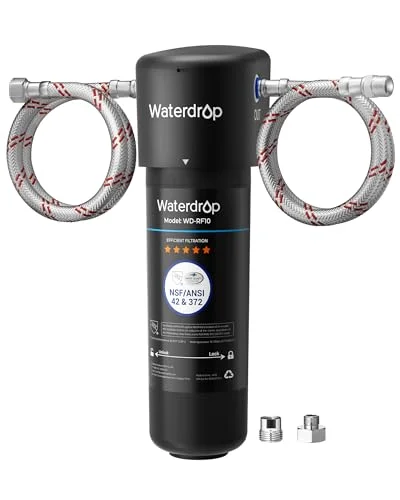
- Waterdrop 10UA Under Sink Water Filter System, NSF/ANSI 42 Certified 1 Year — $36.09, recorded November 2, 2026. Size/variant: 1 Year.
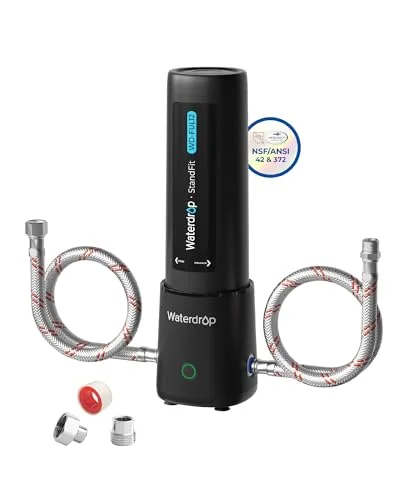
- Waterdrop UL12A Under Sink Water Filter, Upgraded for 10UA, Time Reminder — $42.99, recorded November 2, 2026. Size/variant: 1 Pack.
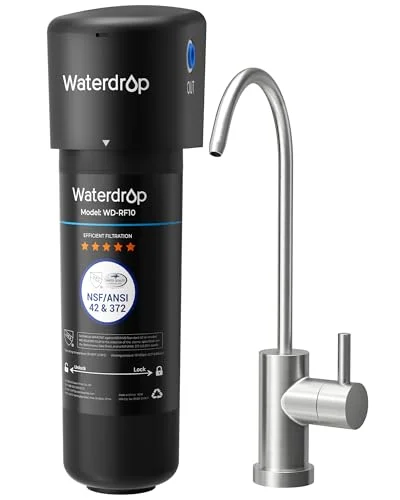
- Waterdrop 10UB Under Sink Water Filter System with Dedicated Faucet — $50.34, recorded November 3, 2026. Size/variant: Standard-1 Year.
Do the arithmetic on what we actually recorded, rather than rounding to a marketing-friendly number, and the UL12A costs $7.99 more than the plain 10UA, while the 10UB costs $15.00 more. Two upgrades, two different sizes of premium — and the mistake would be treating this as a single question of "is the cheaper or the pricier add-on worth it," because the two titles don't add the same kind of thing. The UL12A's own title names exactly one addition: Time Reminder. The 10UB's title names a different one entirely: a Dedicated Faucet. Neither title claims the other upgrade. Neither title claims a change to filtration. That last point matters enough that it gets its own section below, because it's the thing worth confirming before either upgrade's price tag starts to look justified.
The UL12A's title also carries a phrase worth sitting with for a second: "Upgraded for 10UA." That's Waterdrop's own language, not ours, and it tells you how the company itself frames this listing — not as an unrelated product, but as a direct successor aimed at someone who was already looking at the 10UA. The 10UB doesn't use that phrase, but its title's structure — "Under Sink Water Filter System," the same core phrase as the 10UA's title, plus "with Dedicated Faucet" tacked on — reads the same way: a 10UA with one specific thing bolted on. We're treating both upgraded listings as what their titles present them as, not as the same product.
What the UL12A's time reminder tracks, and what it structurally can't
The UL12A's title states "Time Reminder" and nothing more specific than that — it doesn't say whether the mechanism is an electronic display, a battery-powered indicator light, or a simple dial-and-sticker you set by hand at install. We don't have that confirmed anywhere in the data we're working from, so we're not going to guess a mechanism the title doesn't name; if the exact implementation decides your purchase, that's a question for the current listing photos and Q&A, not for us.
What we can say with confidence applies to every reminder of this category, regardless of how it's built: a time reminder tracks one thing — elapsed calendar time since the filter went in. That is a meaningfully different measurement from the two things that actually determine when a filter is spent. The first is cumulative water throughput: how many gallons have actually passed through the cartridge, which depends on how many people are drinking from the tap and how many appliances are plumbed to it, not on the calendar. The second is the sediment and contaminant load of your specific water supply, which a filter rated for a general household can burn through faster on well water or an older service line than on treated municipal supply. We've made this exact point before, in more depth, in our breakdown of whether printed filter lifespan claims are realistic: a "lasts 12 months" rating on a box is almost always a gallon number translated into a calendar figure for an assumed household, and your household is probably not that assumed household.
The 10UA's own title, notably, already carries a calendar-style claim of its own — "NSF/ANSI 42 Certified 1 Year" — before the UL12A ever enters the picture. What the $7.99 upgrade really buys is a way to stop losing track of that 1-year number, not a way to make the number itself more accurate to your actual usage. For someone who has genuinely forgotten the install date on a filter sitting in the back of an under-sink cabinet, that's real, non-trivial value — a missed change-out is how a saturated carbon stage stops doing its job quietly, with no sensor telling you so. For a household on well water, a large family running the tap constantly, or anyone who's already disciplined about writing the install date on a piece of masking tape, the reminder is solving a problem they may not actually have.
What the 10UB's dedicated faucet solves that a direct-connect install doesn't
Neither the 10UA's title nor the UL12A's title claims a dedicated faucet. That absence is informative on its own: the most common way a budget under-sink filter of this type gets water to your glass without its own spout is a direct-connect install — the filter housing ties into the cold-water supply line below the sink, and the filtered water is routed back out through the existing kitchen faucet, typically through a diverter valve that lets you switch between filtered and unfiltered, or sometimes with no switch at all if the whole cold line now runs through the filter. Either way, the kitchen faucet you already have is the one dispensing filtered water, and it's also the one dispensing everything else that faucet has always done.
A dedicated faucet changes that physically, not just cosmetically. The 10UB's title claims a separate faucet, which in practice means its own small spout, mounted through its own hole in the sink deck or countertop — often reusing a spare hole left for a sprayer or soap dispenser, or requiring a new one drilled if there isn't a spare. The filtered stream comes out of that spout and only that spout; your existing kitchen faucet is untouched, both physically and functionally. That buys three concrete things a direct-connect setup doesn't: the main faucet's handle, cartridge and warranty are never modified; filtered and unfiltered water are available from two different points at the same time, which matters if someone wants to fill a pot from the regular tap while filtered water is being drawn elsewhere; and there's no diverter valve for a housemate or a kid to accidentally leave in the wrong position, quietly defeating the filter without anyone noticing.
What it costs beyond the $15.00 on the price tag is the thing worth being upfront about: a dedicated faucet needs a hole, and not every sink has a spare one. If yours doesn't, you're looking at drilling stainless steel (manageable with a step bit) or a laminate countertop (also manageable) — or, on granite or quartz, a job that usually means calling someone with a diamond-tipped bit rather than doing it yourself on a Saturday afternoon. The 10UB's title doesn't address your specific sink, because it can't; that's a measurement you make before you buy, not a spec on the box.
Can you add a faucet to the 10UA or UL12A later, and what does that actually cost?
This matters most if you've already bought the plain 10UA or the reminder-equipped UL12A and only later decided you want the dedicated-faucet experience the 10UB ships with. We don't have a specific Waterdrop retrofit kit or accessory listing on record for either system, and we're not going to invent one to give you a tidy answer — if a matched aftermarket faucet exists for the 10UA platform, confirm it on the current Amazon listing rather than taking our word for a product we haven't verified.
What we can tell you honestly, without naming a product we can't source, is the shape of the cost rather than a dollar figure. Retrofitting a faucet after the fact means paying for two things separately that the 10UB bundles into a single $15.00 line-item over the plain 10UA: the faucet hardware itself, and — if your sink doesn't already have a spare hole — the drilling. A faucet matched and specified by the manufacturer to work with its own system removes the guesswork of whether a generic aftermarket spout fits the connection fittings, the mounting deck thickness and the tubing size your system actually uses. That's the real value in the $15.00 premium: not the faucet as a part, but the certainty it's the right part, accounted for in one box at one price you know ahead of time.
So the honest framing is this: adding a faucet later is possible in principle for most direct-connect under-sink filters, but it is not a confirmed, priced option for the 10UA or UL12A specifically, and the unknown cost of sourcing a compatible aftermarket spout is exactly the kind of expense we flag whenever a running cost or an add-on price can't be sourced in advance. If you already know you'll want a dedicated faucet, paying the $15.00 for the 10UB up front is the version of this decision with a number attached to it.
Confirming what's actually identical before you pay for a reminder or a faucet
Both upgrades are only worth paying for if the thing underneath them — the actual filtration — is the same thing you'd get from the plain 10UA. Here's exactly what we can and can't confirm from the three titles themselves. The 10UA's title states one specific certification: NSF/ANSI 42. That standard covers aesthetic effects — reduction of chlorine taste and odor, and in many certified products, particulate — and it is a different, narrower claim than NSF/ANSI 58, the standard that certifies total dissolved solids reduction and is the one used by the dedicated reverse osmosis systems we cover elsewhere on this site. Notably, none of the three titles in this comparison use the words "reverse osmosis," "membrane," or state a gallons-per-day output figure. Based on what's actually printed in front of us, these are under-sink carbon-type filters rather than RO membrane systems, and we're describing them that way rather than assuming an RO stage the titles never claim.
That matters for the question this section exists to answer. The UL12A's title states "Upgraded for 10UA," which is Waterdrop's own language tying the two together, and strongly implies the UL12A carries forward the same core filtration the 10UA uses. But the UL12A's title does not restate "NSF/ANSI 42" or any other certification number, and the 10UB's title doesn't either. We have that specific certification confirmed, in writing, on exactly one of the three listings. We're not asserting the other two lack it — "upgraded for 10UA" reads far more like a hardware and feature successor than a filtration downgrade — but we also aren't going to tell you it's confirmed when the title in front of us doesn't say so. If the NSF/ANSI 42 citation specifically matters to you — because you're matching a landlord's water-quality requirement, or your own records — verify it's still printed on the current UL12A or 10UB listing before you buy, the same caution we'd apply to any certification claim that isn't restated on every related listing in a product family.
This is a different kind of comparison than our look at matching a replacement RO membrane's GPD rating, where the whole risk is a wrong number on a spec sheet for an actual membrane. There's no membrane and no GPD figure to mismatch here. The risk in this comparison is narrower and cheaper to check: confirm the certification language before you pay extra for a reminder or a faucet, not because either upgrade is likely to be a downgrade, but because "likely" isn't the same as "stated," and the title is the only documentation we have for any of these three.
All three, lined up
What each listing's own title states, and the prices we recorded. Confirm the live price before buying — Amazon prices move.
Which upgrade is worth it for a renter, and which is worth it for a long-term owner
These two upgrades split cleanly along one line: does the premium touch your plumbing, or does it only touch your calendar. The UL12A's $7.99 reminder touches nothing physical — it's the same direct-connect install as the plain 10UA, with an added way to flag the 1-year mark. The 10UB's $15.00 faucet touches your sink itself, permanently, through a drilled hole.
That split maps almost exactly onto renter versus owner. If you're renting, drilling a new hole in a sink or countertop you don't own is the kind of change that needs a landlord's sign-off before it needs a screwdriver, and a dedicated faucet you have to leave behind — or explain at move-out — is a worse trade than it looks on the spec sheet. The UL12A's reminder, by contrast, is close to a free upgrade for a renter: no plumbing change, no landlord conversation, and a genuine answer to the easiest way a forgotten filter goes stale in a rental you might only occupy for a year or two anyway — coincidentally close to the certified 1-year window printed on the base system.
If you own the place and plan to keep the system for years, the calculation shifts. A dedicated faucet is a one-time plumbing decision that gets easier to justify the longer you'll live with it, and the $15.00 premium for a manufacturer-matched faucet is cheap insurance against the unpriced retrofit cost we walked through above. An owner who knows they'll eventually want the faucet is better off paying for it in the 10UB on day one than installing the plain 10UA now and shopping for a compatible spout later. The time reminder is worth adding regardless of tenancy — it's cheap, it's non-invasive, and the only caveat is the one we raised earlier: it's still measuring the calendar, not your water, so don't let a clean reminder light talk you out of checking the filter if your household uses noticeably more water than a typical one or two people.
Questions people ask about the 10UA, UL12A and 10UB
What's the actual difference between the Waterdrop 10UA, UL12A and 10UB?
Based on what each title states: the 10UA is the base listing at $36.09 with NSF/ANSI 42 certification and a 1-year rating. The UL12A, at $42.99, adds a time reminder and is described by Waterdrop as "Upgraded for 10UA." The 10UB, at $50.34, adds a dedicated faucet instead. Neither upgraded listing's title claims the other's feature, and neither claims a change to filtration.
What does the UL12A's time reminder actually track?
The title only states "Time Reminder," without naming the mechanism. Structurally, any reminder of this kind tracks elapsed calendar time since install — not the actual gallons of water that have passed through the cartridge and not the sediment or contaminant load specific to your water supply, both of which are the real drivers of when a filter is spent. It's a way to remember the 1-year mark printed on the base system, not a more accurate measurement of your own usage.
Can I add a dedicated faucet to a 10UA or UL12A after buying it?
We don't have a specific Waterdrop retrofit kit or price on record for either system, so we're not asserting one exists. If a matched aftermarket faucet is available, confirm it on the current listing. What's certain either way: retrofitting means separately sourcing faucet hardware and possibly drilling a new hole, where the 10UB bundles manufacturer-matched hardware into its $15.00 premium over the plain 10UA.
Is the filtration different between the 10UA, UL12A and 10UB?
Nothing in any of the three titles claims a filtration difference. Only the 10UA's title states its certification, NSF/ANSI 42 — a standard covering chlorine taste, odor and particulate reduction, not total dissolved solids. The UL12A's "Upgraded for 10UA" language implies it shares that core filtration, but its title doesn't restate the certification number, and neither does the 10UB's. Verify the certification is still listed on the specific listing you're buying if it matters to you.