Best RO Systems
Home › Guides › Philips RO formats compared
Comparison

One appliance brand, three RO formats: how Philips's countertop, under-sink and tankless systems compare

We're reader-supported: buying through our links may earn us a commission at no extra cost to you. We compare published listing specifications, certifications and prices — we don't run a testing lab, and nothing below is a star rating or a paraphrased review.

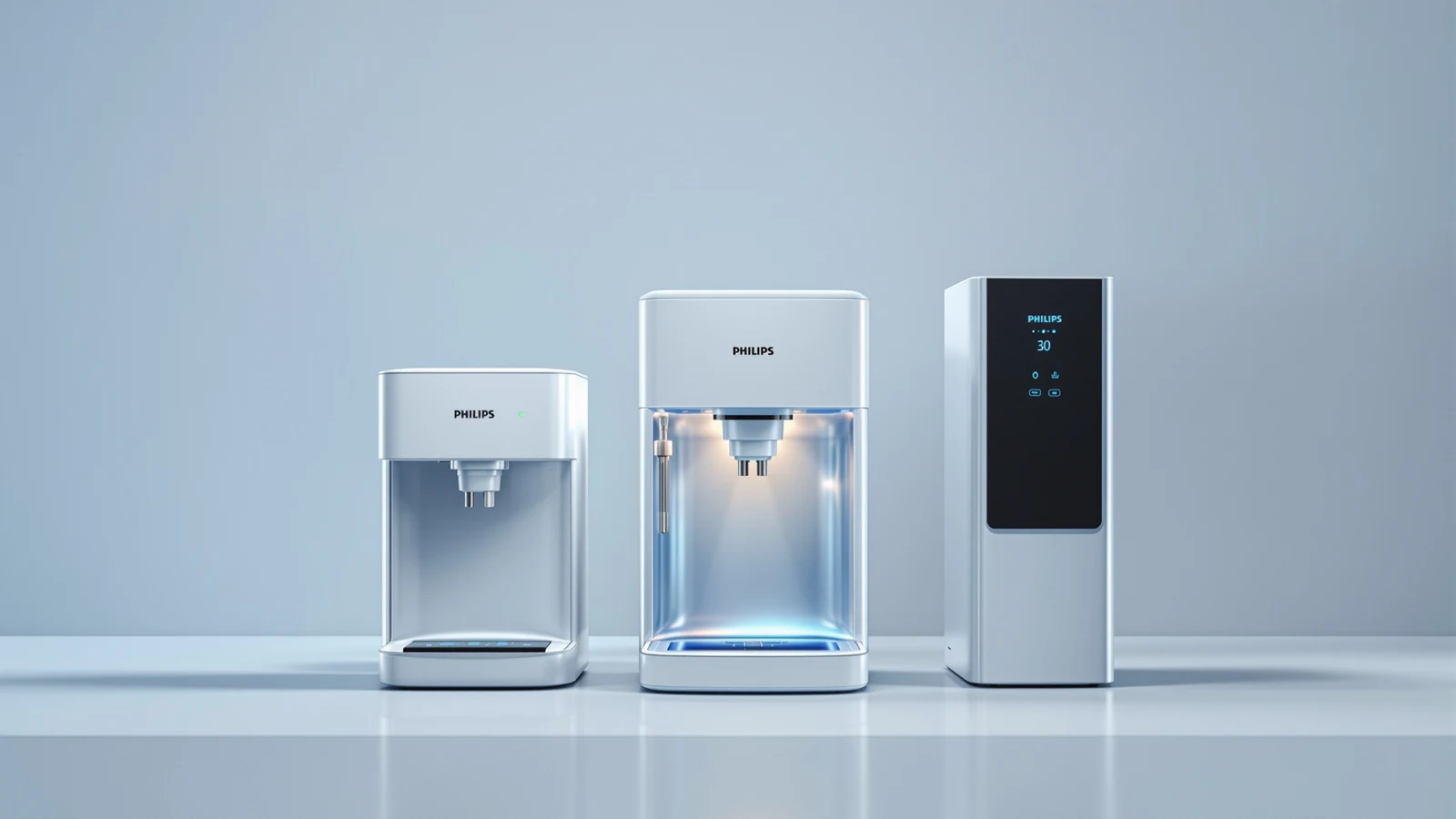
Three Philips reverse osmosis systems side by side — a countertop purifier, a 400G under-sink unit and a 600 GPD tankless system — on a kitchen counter

Philips is not a water-treatment specialist. It's an appliance brand people already associate with irons, air fryers and electric toothbrushes, and in 2026 it has three separate reverse osmosis listings live on Amazon at once. That's unusual by itself — most single-model brands we cover sell one platform and iterate on it, the way we broke down Waterdrop's T3 line. Philips instead shipped three genuinely different pieces of hardware: a plug-in countertop purifier, a 400G tankless under-sink system, and a separate 600 GPD tankless under-sink system pitched as the higher-output tier. None of the three is a re-skin of another. Whether a recognizable name outside water filtration is a reason for confidence or caution is its own question, one we work through in general terms in newer RO brands without a long track record — but for this piece we're staying inside Philips's own three listings and reading what each one actually states.

Here's the lineup, at the prices we recorded:

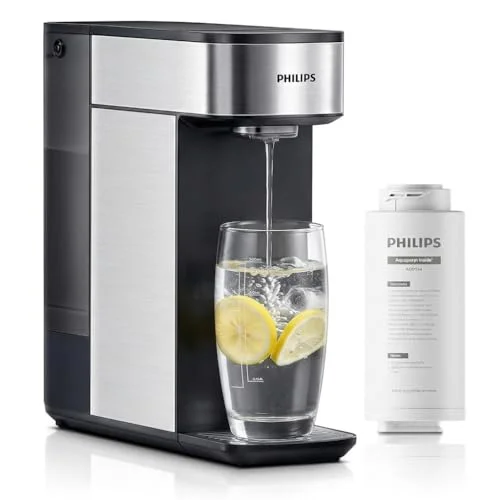
  • PHILIPS Countertop Reverse Osmosis Water Filter, Installation-Free — $199.99. No plumbing connection of any kind; sits on the counter and runs from its own reservoir.
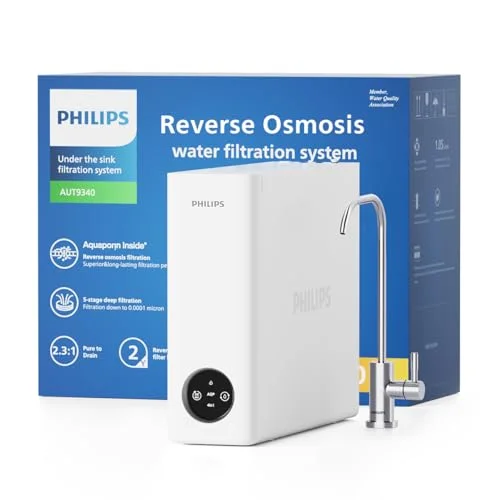
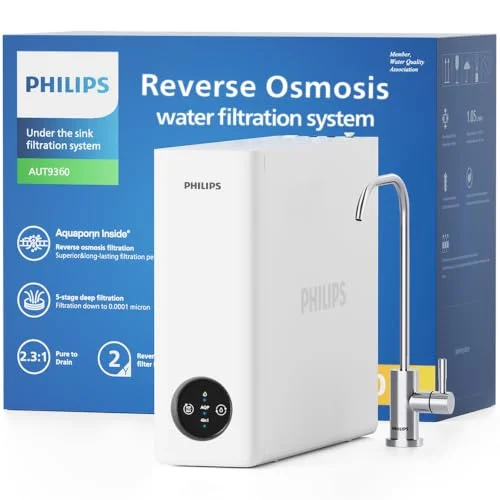
  • Philips Reverse Osmosis Water Filter System, 400G Under Sink Water Filter (sold as the Standard‑Flow Model) — $254.98. A tankless unit that installs permanently under the cabinet.
  • Philips Tankless Reverse Osmosis System, 600 GPD, Self-Cleaning RO System (sold as the High‑Flow Model) — $284.99. The same under-sink format as the 400G, at a higher stated output tier and close to a hundred dollars more.

Notice the price shape first: the countertop purifier and the 400G under-sink system sit within five dollars of each other, while the 600 GPD tankless system is roughly ninety to ninety-five dollars above both. That gap is the first clue that the 600 GPD unit isn't simply "the under-sink version of the countertop" — it's priced as the flagship of the three. Does that extra money buy the same core membrane technology Philips advertises elsewhere in its own lineup, or something else entirely? It depends which of the three listings you're reading, which is the whole subject of this comparison.

The headline claim

Aquaporin Inside: what the claim says, and who's actually making it

"Aquaporin Inside" is the branded name for a biomimetic membrane technology built around aquaporin proteins — the same water-channel proteins that occur naturally in living cell membranes, used here inside a reverse osmosis filter instead of a conventional thin-film composite membrane alone. The pitch: a protein that evolved specifically to pass water molecules while blocking almost everything else can move water through more efficiently, while still rejecting dissolved solids down to a very small particle size. Philips's own tankless 600 GPD listing states this directly: Aquaporin Inside uses "aquaporin proteins — nature's own water channels — in the RO membrane to create a biomimetic filtration process," supporting "deep 0.0001-micron RO filtration" and helping reduce TDS, chlorine, particulates, taste and odor, lead, chromium III, and calcium. That listing adds a detail none of the other two mention: the technology was "tested in collaboration with NASA and ESA" — whatever that's worth to a kitchen buyer, it at least tells you Aquaporin has a research history outside Philips's own marketing copy.

The countertop purifier makes the same underlying claim in shorter form: its first feature bullet describes a "5-stage reverse osmosis process, enhanced by Aquaporin Inside technology," "powered by Aquaporin proteins that mimic natural water filtration," removing chlorine, lead and calcium and reducing TDS down to the same 0.0001-micron figure. It doesn't repeat the NASA/ESA line, but it's unmistakably the same branded technology, stated as a feature of that specific unit.

That's two of the three listings. The 400G under-sink system's own feature bullets — all three of them — don't mention Aquaporin Inside, biomimetic membranes, aquaporin proteins, or a 0.0001-micron figure anywhere. That's not a minor omission to skim past, because it's the one claim this comparison exists to test: of the three Philips reverse osmosis systems available right now, only the countertop purifier and the 600 GPD tankless system state, in their own words, that they run on the Aquaporin membrane the brand is known for marketing. The 400G doesn't make that claim at all.
What the 400G doesn't say

The 400G's quieter spec sheet, and what the silence does and doesn't tell you

Read the 400G's three feature bullets in full and a pattern emerges: one covers fitting and included parts, one is an installation pre-check notice, and one covers certifications. There is no bullet dedicated to the membrane itself — no name for the filtration technology, no micron rating, no percentage figure for what it reduces. The countertop and 600 GPD listings each give the membrane its own headline bullet. The 400G simply doesn't have that bullet.

We want to be careful about what that silence actually proves. It does not prove the 400G uses an inferior or non-Aquaporin membrane — Philips could, in principle, use the same technology across all three and simply not market it on this page. It also doesn't prove the omission is purely cosmetic. What we can say honestly is only what the listing states: the 400G makes no claim about its membrane technology, while both siblings do, explicitly and by name. A listing's silence on a spec isn't a guarantee of anything either way — the same caution worth applying to any unstated detail on any product page.

One place to look for a harder signal is the replacement-filter part numbers, since those are specific enough to actually check against. The 400G names its replacement filters as AUT831 and AUT854R400; the 600 GPD system names AUT831 and AUT854R600 — a shared filter plus a model-specific second one differing only by the flow-tier suffix. That kind of part-number detail matters more than a marketing bullet when you're confirming what you're actually buying, the whole argument for matching the exact replacement filter to your RO model by part number instead of by brand, rather than assuming two listings share a cartridge just because they share a brand name.

The same quiet-spec pattern shows up on filter life. The countertop listing states plainly that "the integrated filter lasts up to 12 months." Neither the 400G nor the 600 GPD listing gives any stated lifespan for its own filters — no month figure, no gallon figure, anywhere in their feature bullets. That's a second spec one listing is loud about and the other two are silent on, the same printed-interval question we go through more generally in are lifespan claims on under-sink filters realistic. Until Philips states a number for the 400G and 600 GPD cartridges, treat "up to 12 months" as applying to the countertop unit alone, not the line as a whole.

Getting it into the kitchen

Installation: plug-and-play versus a dedicated outlet and a drilled hole

The countertop purifier earns its "Installation-Free" name literally. At a stated footprint of 5 x 13 x 14 inches, it sits on the counter, fills from its own reservoir with tap water, and dispenses roughly 9 oz (266 ml) a minute into the included 16.9 oz glass bottle — no cold-water line, no drain, no faucet hole, no outlet requirement beyond a standard wall socket. The listing's own maintenance instructions ask you to refill the source tank daily and run the built-in self-cleaning cycle monthly, which is the closest thing to "installation" this unit asks of you.

The 400G is the opposite kind of project, and Philips spells it out in an unusually direct bullet it labels an "Installation Pre-Check Notice": the system requires an electrical outlet under the sink to run its tankless, electric-powered delivery, and it needs a dedicated hole in the sink or countertop for its own RO faucet — drilling required if there isn't a spare hole already there. The included drain saddle is stated to work with standard drain pipes only. Both under-sink units fit standard 1/2" NPT/T-valve connections, with Philips offering a free adapter for 3/8" or other fitting sizes on request. None of that is unusual for an under-sink RO system as a category, but it is a meaningfully bigger project than filling a countertop reservoir, and the listing is honest that you should verify your kitchen setup before ordering.

The 600 GPD tankless system shares the same 1/2" NPT/T-valve fitting language as the 400G, which tells you it's built for the same under-sink installation category rather than being a countertop unit at a higher price. What its own three feature bullets don't do is repeat the 400G's explicit outlet-and-drilling notice. Given that it's also described as tankless and self-cleaning, it's a reasonable expectation that it needs power and a dedicated faucet connection much like the 400G does, but that's an inference from the format, not a claim the listing makes. We ran into the identical pattern comparing Waterdrop's T3-C, T3-M and T3-T listings, where only one of three titles stated a plug-in requirement outright even though the others were built the same way: confirm the power and faucet-hole requirements on the current 600 GPD listing yourself before buying, rather than assuming they carry over from a sibling just because the hardware format looks the same.

What's on every label

NSF/ANSI 372 and SGS testing are consistent. NSF/ANSI 58 is not.

Here's where the three listings actually agree, and agree clearly. All three state NSF/ANSI 372 certification, which covers lead-free materials — a statement about what the unit is built from, not how well it filters. All three also state some form of SGS testing: the countertop listing says its filter core is "additionally certified by SGS," while the 400G and 600 GPD listings both state SGS testing "for FDA food-contact material safety." The wording differs, but the underlying claim — an independent third party tested the materials that touch your drinking water — holds across the whole line. The 400G and 600 GPD listings go further and also state UL 979 / CSA C22.2 No.68 listing (the safety standard for powered water treatment appliances) and FCC certification, both expected for hardwired under-sink units and both absent from the countertop's own certification bullet.

Where the three genuinely diverge is NSF/ANSI 58. The countertop purifier's listing states certification to "NSF/ANSI/CAN 372 & NSF/ANSI 58" explicitly. The two standards aren't interchangeable: 372 certifies lead-free materials, while 58 actually tests and verifies contaminant and TDS reduction performance — the standard that speaks to how well a system filters, not just what it's made of. Neither the 400G's nor the 600 GPD's feature bullets state NSF/ANSI 58 anywhere. That doesn't necessarily mean either under-sink unit fails to perform to that standard; it means Philips isn't making that specific performance-certification claim on those two listings the way it does on the countertop one. If NSF/ANSI 58 matters to your decision — and for anyone buying on filtration performance rather than materials safety alone, it should — the countertop purifier is the only one of the three whose own listing states it.

Side by side

The three Philips systems, lined up

What each listing's own title, feature bullets and recorded price state — not an inference about internal components we haven't seen specs for.

SystemPriceFormatAquaporin statedNSF/ANSI 58 statedInstall requirement
Countertop, Installation-Free$199.99Countertop, plug-and-playStatedStatedNone — fill reservoirView
400G Under Sink (Standard-Flow)$254.98Tankless under-sinkNot statedNot statedOutlet + faucet hole + drain saddleView
Tankless 600 GPD (High-Flow)$284.99Tankless under-sinkStatedNot statedNPT/T-valve stated; outlet/hole not stated — confirm listingView

The highlighted row marks the 600 GPD system only in the sense that it's the one listing combining the under-sink installed format with the stated Aquaporin membrane claim — not an overall verdict, since it's also the most expensive of the three and the one whose install bullet points are the least spelled out. Every other cell reflects a difference the listing itself states, not something we inferred about hardware we haven't seen.

What we'd buy

Which format fits which kitchen

The three systems trade off on installation effort, output and one specific membrane claim — the right pick depends on which of those actually binds for you.

01No plumbing, period

PHILIPS Countertop RO Filter

The only format with zero installation and the full certification set
$199.99 · Aquaporin Inside stated · NSF/ANSI 372 & 58 stated · plug-and-play

If you're renting, don't want to drill a sink hole, or want the option to move the unit to a new kitchen without touching a pipe, this is the only one of the three that asks nothing of your plumbing. It's also the only listing stating both NSF/ANSI 372 and the performance-focused NSF/ANSI 58, on top of the Aquaporin claim — the fullest documented spec sheet in the lineup, for roughly the same price as the 400G.

PHILIPS Countertop Reverse Osmosis Water Filter, installation-free
$199.99
CountertopCheck price →
02Under-sink, lower cost

Philips 400G Under Sink (Standard-Flow)

The permanently installed format, without the Aquaporin claim
$254.98 · tankless, electric · NSF/ANSI 372 + SGS stated · outlet & faucet hole required

If what you actually want is a tankless system plumbed permanently under the cabinet, out of sight, at the lowest price in Philips's own lineup, the 400G gets you there for about five dollars less than the countertop unit. What you're not getting, based on its own listing, is the Aquaporin membrane claim or the NSF/ANSI 58 performance certification the countertop makes — you're paying for the installed format and the baseline NSF/ANSI 372 and SGS material-safety claims, nothing the listing states beyond that.

Philips Reverse Osmosis Water Filter System, 400G Under Sink Water Filter
$254.98
Under-sink · 400GCheck price →
03Installed, plus the membrane claim

Philips Tankless 600 GPD (High-Flow)

The under-sink format that does state Aquaporin Inside
$284.99 · Aquaporin Inside stated · tankless, self-cleaning · NPT/T-valve fit

If you want the permanently installed under-sink format and the Aquaporin biomimetic-membrane claim in the same unit, this is the only Philips listing that combines both — at roughly $90 to $95 more than either of its siblings. Confirm the electrical-outlet and faucet-hole requirements on the current listing before you buy, since unlike the 400G's page, this one doesn't spell them out in as many words, even though the hardware format strongly suggests they apply.

Philips Tankless Reverse Osmosis System, 600 GPD, self-cleaning
$284.99
Under-sink · 600 GPDCheck price →

Where does paying for the Aquaporin claim stop being justified? If the biomimetic membrane and NASA/ESA-tested language is what you're shopping for, only two of the three listings make that claim, and the countertop unit gets you there for the lowest price in the line — no need for the extra $90 on the 600 GPD system, unless the permanently plumbed, higher-output format is itself the point. If you just want an installed, tankless under-sink system wearing a brand you already trust, and the Aquaporin language isn't the deciding factor, the 400G gets you Philips's installed format for about $95 less, on the same baseline NSF/ANSI 372 and SGS claims the whole line shares, minus the membrane bullet the other two state. We don't have enough from any of the three listings to say the Aquaporin language produces measurably cleaner finished water than the plain certification claims on the 400G — only that it's a claim two listings make and one doesn't, and that distinction, not the brand on the box, is what should drive the purchase. The same "read what the listing states, not what the format implies" discipline applies to UV claims on countertop units generally, the subject of our look at whether UV on a countertop RO purifier actually matters.

FAQ

Questions people ask about Philips's RO lineup

Do all three Philips reverse osmosis systems use the Aquaporin Inside membrane?

No. Two of the three listings — the PHILIPS Countertop Reverse Osmosis Water Filter and the Philips Tankless 600 GPD system — state Aquaporin Inside biomimetic membrane technology in their own feature bullets. The Philips 400G Under Sink Water Filter's feature bullets don't mention Aquaporin, a membrane technology name, or a micron rating anywhere, so based on that listing alone, it's not making the same claim.

What's the actual difference between the Philips 400G and the 600 GPD tankless systems?

Both are tankless, electric-powered under-sink systems using the same 1/2" NPT/T-valve fitting and similarly named replacement filters (AUT831 paired with a model-specific second filter). The 400G, sold as the Standard-Flow Model at $254.98, doesn't state the Aquaporin membrane claim or NSF/ANSI 58 certification. The 600 GPD system, sold as the High-Flow Model at $284.99, does state the Aquaporin claim, at a higher output tier implied by its name and roughly $95 more.

Does the Philips countertop RO filter need to be installed or plumbed in?

No. It's plug-and-play with no complex installation, according to its own listing: fill the source tank with tap water, and it dispenses about 9 oz (266 ml) a minute into the included 16.9 oz glass bottle. At 5 x 13 x 14 inches it sits on a standard countertop, with a monthly self-cleaning cycle and no connection to a cold-water line, drain or dedicated faucet.

Are all three Philips systems certified the same way?

Not quite. All three state NSF/ANSI 372 certification (lead-free materials) and some form of SGS testing. Only the countertop purifier's listing additionally states NSF/ANSI 58, the certification that covers contaminant and TDS reduction performance rather than materials alone. Neither the 400G's nor the 600 GPD's feature bullets state NSF/ANSI 58, though both state UL 979 / CSA C22.2 No.68 and FCC certification for their electrical components, which the countertop listing doesn't spell out by name.

Keep reading

Next, if you're still deciding