Reverse osmosis systems with the longest filter change intervals
We're reader-supported: buying through our links may earn us a commission at no extra cost to you. We compare published specifications, certifications and prices — we don't physically test these systems and we don't run a testing lab.
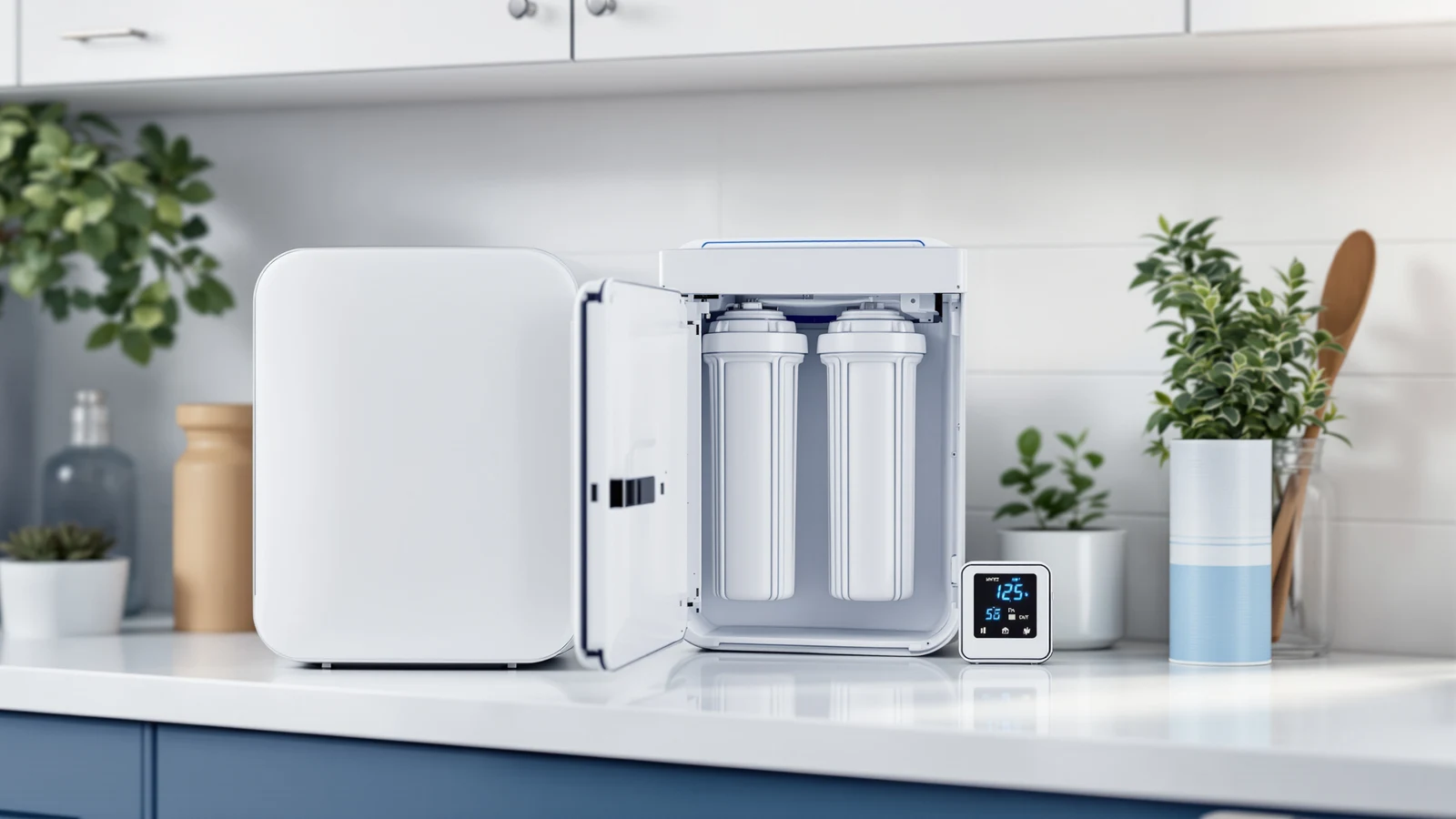
Open almost any reverse osmosis listing and the filter schedule reads the same way: six months for the cheap stages, maybe twelve if the brand is feeling generous, two to three years for the membrane buried behind them. That cadence isn't arbitrary — it's what happens when a sediment screen and a block of activated carbon are sized to handle an average American kitchen's water for roughly half a year before they're either full of trapped particulate or chemically exhausted. Four systems in our database try to beat that number by a meaningful margin, and each one does it a different way: a bigger single cartridge, a slower-fouling membrane, a smarter counter, or some combination of the three. None of them are using exotic chemistry. They're using the same four jobs every RO system performs — strip sediment, strip chlorine and taste, reject dissolved solids through a membrane, sometimes remineralize — and changing one variable in that chain to push the clock out further.
What actually changes a filter's real lifespan comes down to three levers, and they explain almost every "lasts longer" claim on Amazon. The first is raw capacity: a cartridge rated for 550 gallons will, all else equal, outlast one rated for 300, because it simply has more surface area or media volume to absorb before it saturates. The second is throughput: a single person filling a glass twice a day puts a fraction of the load on a filter that a family of five running an ice maker and a coffee machine off the same line does. The third is the thing no spec sheet can see — your water. Hard water scales a membrane faster than soft water. Sediment-heavy well water or an aging municipal line loads a pre-filter faster than clean treated supply. A manufacturer can engineer the first lever and estimate the second, but the third belongs entirely to the house the system is installed in, which is the honest caveat behind every month-count on a box, including the four in this guide.
Before buying into a long-interval claim, it's worth knowing which stage the clock is actually measuring. "The filter" on a label can mean a sediment screen, a carbon block, the RO membrane, or — on the systems below — a single combined cartridge doing two or three of those jobs at once. The number only means something once you know which part of the system it's attached to, which is the question we work through system by system below.
Waterdrop X8-WAN: a 24-month claim, attached to the membrane
The Waterdrop X8-WAN Alkaline Mineral Tankless Reverse Osmosis System ($559.00) is the longest-interval claim in this guide by a wide margin, and it's worth reading precisely because Waterdrop's own listing is specific about where the 24 months applies. The bullet point reads: "with a 24-month RO filter lifespan, it reduces replacement frequency." That's the membrane stage — the 0.0001 micron RO membrane at the center of the system's 10-stage filtration, built with 16 layers and backed by SGS testing and NSF/ANSI 42, 58 and 372 certification. A membrane naturally has the longest rated life of any stage in an RO system anyway, because it doesn't clog with particulate the way a sediment filter does — it slowly loses rejection efficiency over time. Doubling that typical two-to-three-year range isn't a new mechanism; it's a thicker, more durable membrane construction extending a number that was already the longest-lived part of the system.
What the listing does not state is a replacement schedule for the other nine stages. A 10-stage tankless system under a sink is doing pre-filtration and polishing work before and after that membrane, and nothing in the specifications we sourced tells you how often those earlier stages need swapping. That's not a knock on the product — it's a gap in the published data, and we're not going to fill it with a guessed number. If the 24-month figure is the reason you're buying the X8-WAN, confirm with the current listing or Waterdrop support exactly which cartridges that interval covers and what the pre-filter stages are rated for, because "24 months" describing one part of a 10-stage system is a very different ownership experience than "24 months" describing the whole thing.
The X8-WAN also runs an 800 GPD tankless design with a 2:1 pure-to-drain ratio and a stated 30-minute DIY install — specs that put it in a different category entirely from the three countertop units below. It's an under-sink system sized for a full household's demand, not a single-person countertop unit, and that scale is a meaningful part of what the $679 price buys alongside the longer membrane interval. Tankless systems generally trade a storage bladder for continuous flow, a trade-off we compare across brands in our look at the quietest reverse osmosis systems, where tankless design shows up again as the route several brands take to a slimmer, quieter under-sink footprint.
Bluevua: two price tiers, two different interval claims
Bluevua sells two countertop systems in our database that look similar at a glance and quote different filter-life numbers once you read past the headline. The Bluevua RO100ROPOT-Lite ($219.00) is a 7-stage countertop unit — a 5-in-1 combined filter plus UV and remineralization — that Bluevua's own listing describes as "requiring filter replacement just once a year, at only $0.22 per day." That's a calendar-based claim: one cartridge, swapped annually, with the company's running-cost figure built on the assumption that a year is the actual interval, not a ceiling. It's a 3:1 pure-to-drain system sized by Bluevua for one to two people, with a smart LED panel that monitors water quality in real time and surfaces filter alerts.
The Bluevua RO100ROPOT Countertop Reverse Osmosis Water Filter System ($317.00) — the UV-equipped, six-stage version one tier up — makes the wider claim: Bluevua's listing states the filters "last for a long time between 12-24 months to provide 1-2 years of clean drinking water before needing replacement," with a monitor display tracking both filter service life and water quality. That $90 gap between the two Bluevua tiers buys more than a longer interval on paper. The pricier unit also carries a different drain ratio — 2:1 pure-to-drain against the Lite's 3:1 — and the same UV disinfection stage and 0.0001 micron RO membrane that justify its place as the step-up model. If the filter-change count is what's driving the purchase, the 12-to-24-month range on the $409 unit is the one to hold Bluevua to, not the Lite's one-year figure; they are not the same claim wearing two price tags.
Both Bluevua units share a WQA certification against NSF/ANSI/CAN 372 — materials safety, confirming the parts are lead-free — rather than the NSF/ANSI 58 performance standard that certifies contaminant and TDS reduction. That distinction matters more here than usual, because a "lasts up to 24 months" claim is a maintenance promise, not a performance one; it says nothing about whether the water coming out in month 23 meets the same reduction standard as month one. Neither Bluevua listing publishes a gallon-throughput number the way DREO does below, so there's no way to check the calendar claim against a usage figure — you're taking the once-a-year or 12-to-24-month window on the manufacturer's word, sized for the one-to-two-person household Bluevua designed around.
Both Bluevua countertop units also use a glass carafe rather than plastic, a material choice we compare directly against the plastic reservoirs on DREO's and other countertop units in our glass-vs-plastic pitcher breakdown — worth reading if the filter interval isn't the only thing deciding between these two tiers.
DREO: a filter-life monitor, for under $170 — tracking, not extending
The DREO Reverse Osmosis Water Filter Countertop ($144.49) is the cheapest system in this guide and the one whose maintenance claim is easiest to verify, because DREO publishes an actual throughput number rather than a calendar word. The listing states the filter "lasts 265 gallons (1000L) of filtered water" and pairs that with "Real-Time TDS & Filter Life Monitoring" — checking raw and pure water TDS and surfacing a filter-change reminder on the display, rather than just counting elapsed days. That 265-gallon figure is the actual rating; the real-time monitor is the instrument that watches your usage against it.
Here's the distinction that matters, and the one the brief for this article asked us to be precise about: a usage counter and a longer-lasting filter are two different features, and DREO's listing bundles them together in the same bullet point without being clear about which one you're paying for. The monitor itself does not make the 7-in-1 filter cartridge last longer — it just tells you, more accurately than a date on a calendar, when you've burned through the 265 gallons the cartridge was rated for in the first place. If you're a one-person household filling a glass a few times a day, 265 gallons could stretch well past a year; run it through an autofill pitcher for a family of four and you'll hit that ceiling faster, and the real-time display is the thing that catches that difference instead of letting a generic "12 months" sticker lie to you either way. The genuine life-extension claim here is the 265-gallon capacity itself — DREO's SGS-tested 7-in-1 filter is simply sized to hold more before it saturates. The tracking is a maintenance convenience on top of that, not a second source of extra life.
DREO's system is built around a 3L reservoir and a 1.1L autofill pitcher, with a self-cleaning cycle that auto-flushes the internal tubing between fills and a 3:1 pure-to-drain ratio — specs that put it at the small end of the countertop category, sized by DREO for one to two people in a footprint of about 14.5 by 6.7 by 13.4 inches. At under $170, it's the lowest entry price of the four systems here, and the one place where "longer interval" and "tells you exactly when" are genuinely two separate, honestly labeled things rather than one marketing phrase doing double duty.
Usage-based wear vs. calendar-based ratings
Every number in this guide falls into one of two categories, and knowing which one you're looking at is the single most useful thing to take from this page. A usage-based rating is tied to a measurable quantity — gallons, liters, or a TDS ratio that drifts as the membrane fouls. DREO's 265-gallon figure is usage-based; so, implicitly, is a membrane's rejection-percentage spec, since rejection degrades with throughput and water chemistry, not with the date on the wall. A calendar-based rating is a courtesy conversion — a manufacturer assumed a household size and a usage pattern, divided a real capacity number by it, and printed a month count that's accurate for exactly one household profile and approximate for everyone else. Bluevua's "once a year" and "12-24 months" claims are calendar-based on their face; Waterdrop's 24-month membrane figure reads the same way, since no gallon number accompanies it in the specifications we sourced.
Neither format is dishonest, but only one of them adapts to your actual household. A single person living alone and a family of five running an ice maker off the same RO line are both "within spec" on a calendar-based filter, yet one of them will hit saturation in a fraction of the printed time. A gallon or TDS-based rating at least gives you a number you can watch against your own consumption; a pure calendar claim asks you to trust that your household matches the one the manufacturer assumed when they wrote the box copy.
And neither format — usage-based or calendar-based — accounts for the variable that swings the real-world number furthest: your water. Hard water accelerates scale buildup on an RO membrane regardless of what the label promises. Sediment-heavy supply — well water, an older municipal line, anywhere a utility has recently been digging — loads a pre-filter stage faster than clean treated water, shortening a 265-gallon or a 24-month figure alike. None of the four systems in this guide can see your water chemistry from the factory floor, which is why every interval claim here, even the longest one, is a ceiling worth testing against your own tap rather than a schedule to set and forget. A handheld TDS meter, run before and after the system, is the cheapest way to confirm whether your real interval is tracking the label or quietly running ahead of it.
Is a longer interval worth the higher upfront price?
The honest answer depends on a number we don't have for every system here: the price of the replacement cartridge itself.
Line the four systems up by price and the interval claims roughly track the sticker: DREO at $144.49 with a 265-gallon filter and no stated long-interval claim beyond that capacity, the Bluevua Lite at $219.00 with an annual filter, the Bluevua ROPOT at $317.00 stretching to 12-24 months, and the Waterdrop X8-WAN at $559.00 claiming 24 months on its membrane. That pattern is suggestive, but it isn't proof that the pricier systems are cheaper to own — because we have the price of each system, not the price of each replacement filter. None of the four listings we sourced for this guide publishes its own cartridge's replacement price, so there's no way to compute an honest annualized filter cost the way our bottled-water payback breakdown does for systems where that number exists. If you can't find the replacement-filter price before you buy, you can't do that division — and that unknowability is itself worth factoring into the decision, not something to wave away because the interval claim sounds good.
What a longer interval reliably buys, independent of any cost math, is fewer interruptions: fewer times you have to remember a cartridge exists, order the right one, and find twenty minutes to swap it. That's a real convenience, and for some households it's worth paying for on its own terms — the same logic that makes a twist-in filter change appealing even when it costs more than a universal cartridge, a trade-off we work through from the standard-housing side in our Express Water vs. APEC entry-level comparison. But it's worth separating that convenience value from a cost-savings claim the specifications here don't actually support. A $90 jump from the Bluevua Lite to the ROPOT buys a documented longer window, a different drain ratio and UV disinfection together — not a longer window in isolation. The $360 jump from DREO to the Waterdrop X8-WAN buys an entirely different class of system — whole-household tankless flow instead of a one-to-two-person countertop unit — with the 24-month figure attached to only one of its ten stages. Before paying a premium for interval length alone, confirm what else that premium is buying, and ask the brand directly for the cartridge's standalone price; a company confident in its running costs will have that number ready, and one that doesn't is telling you something too.
Warranty terms are the other piece of the ownership picture that a filter interval alone doesn't capture — a long filter life doesn't help much if the pump or display fails in year two with no coverage behind it. We compare what each brand's warranty actually promises in our warranty coverage guide, worth reading alongside the filter math above.
The four claims, side by side
Prices and specifications as we recorded them. Confirm the live price and current listing wording before buying — both move.
| System | Price | Interval claim | What it covers | Tracked how | |
|---|---|---|---|---|---|
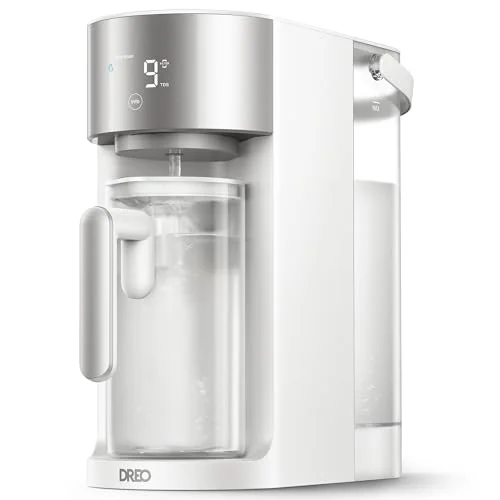 DREO Countertop RO | $144.49 | 265 gal / 1,000L | Single 7-in-1 combined filter | Real-time TDS & filter-life display | Price |
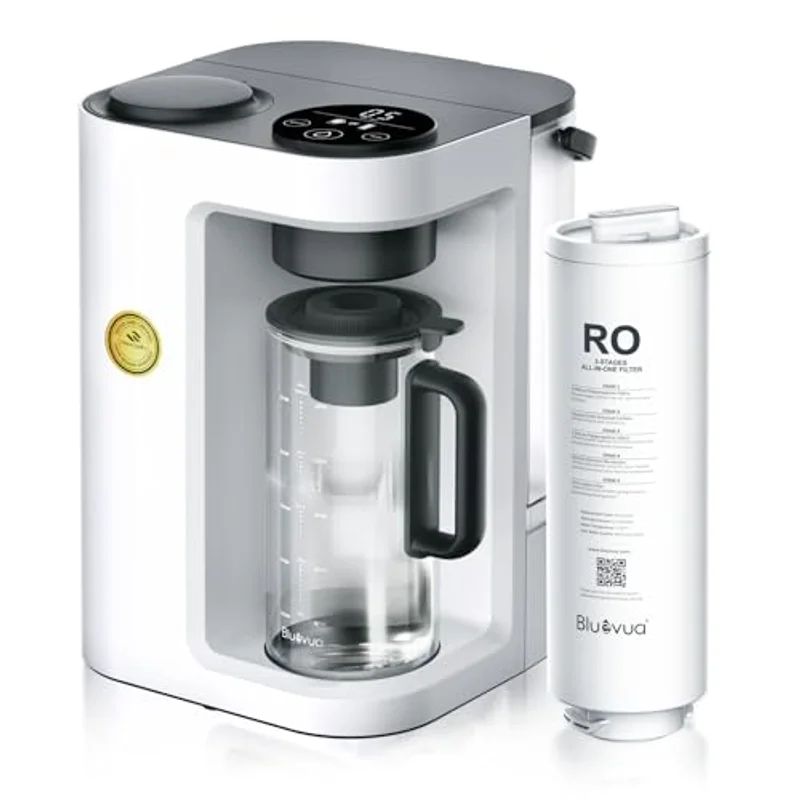 Bluevua RO100ROPOT-Lite | $219.00 | Once a year | Combined 5-in-1 filter (of 7 stages) | Calendar claim; smart display monitors quality | Price |
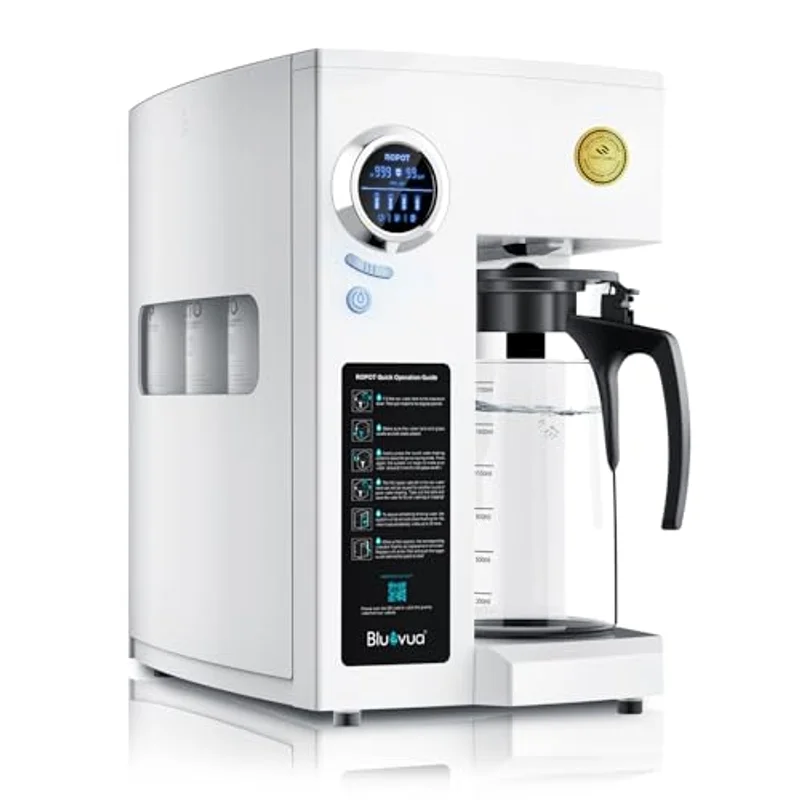 Bluevua RO100ROPOT (UV) | $317.00 | 12-24 months | Filter set, of 6 stages incl. UV | Monitor display: filter life + water quality | Price |
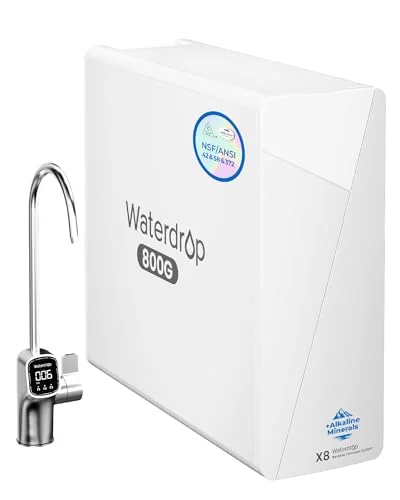 Waterdrop X8-WAN | $559.00 | 24 months | RO membrane only (1 of 10 stages) | Calendar claim; no gallon figure published | Price |
None of the four listings sourced here publish a standalone replacement-cartridge price, which is why the comparison table stops at the interval claim rather than an annual running cost — a gap we'd rather name than paper over with an estimate.
Questions people ask about filter change intervals
Why are most reverse osmosis filters rated for only 6 to 12 months?
Sediment and carbon stages are sized to catch particulate and absorb chlorine for an average household over roughly half a year before they clog or chemically exhaust. The rating is a manufacturer's estimate for a typical usage pattern, divided from a real capacity figure — usually gallons — into a calendar number. Two people drinking only RO water can stretch that interval well past the printed date; a family running an ice maker and a coffee machine off the same line can burn through it faster, both while using the filter exactly as intended.
Does Waterdrop's 24-month claim on the X8-WAN cover every filter in the system?
No. Waterdrop's own listing attaches the 24-month figure specifically to "the RO filter" — the membrane stage of its 10-stage system — not the earlier sediment and carbon pre-filter stages. The listing doesn't publish a replacement schedule for those other stages, so confirm the current listing or Waterdrop support for the full cartridge-by-cartridge schedule before assuming the whole system runs on a two-year clock.
Does a filter-life monitor make a cartridge last longer?
Not on its own. A monitor like DREO's real-time TDS and filter-life display tracks your actual usage against the cartridge's rated capacity — in DREO's case, 265 gallons — so it tells you more accurately when you've reached that limit than a date on a calendar would. The capacity itself, not the monitor, is what determines how long the filter lasts; the display is a maintenance convenience layered on top of that rating, not a second source of extra life.
Is it worth paying more for a system with a longer filter interval?
It depends on what else the premium buys, because none of the four systems compared here publish a standalone replacement-cartridge price, so a true annualized cost can't be calculated from the system price alone. A longer interval reliably buys fewer maintenance interruptions, which has real value on its own, but the step up from a $319 Bluevua Lite to a $409 Bluevua ROPOT also buys UV disinfection and a different drain ratio, and the jump to a $679 Waterdrop X8-WAN buys an entirely different, whole-household tankless system. Confirm the cartridge's own price and exactly which stage the interval claim covers before treating a longer window as a cost-saving feature.