Does reverse osmosis remove VOCs and pesticides? What the membrane does and what carbon does
We're reader-supported: buying through our links may earn us a commission at no extra cost to you. We compare published specifications, certifications and prices — we don't run a testing lab.
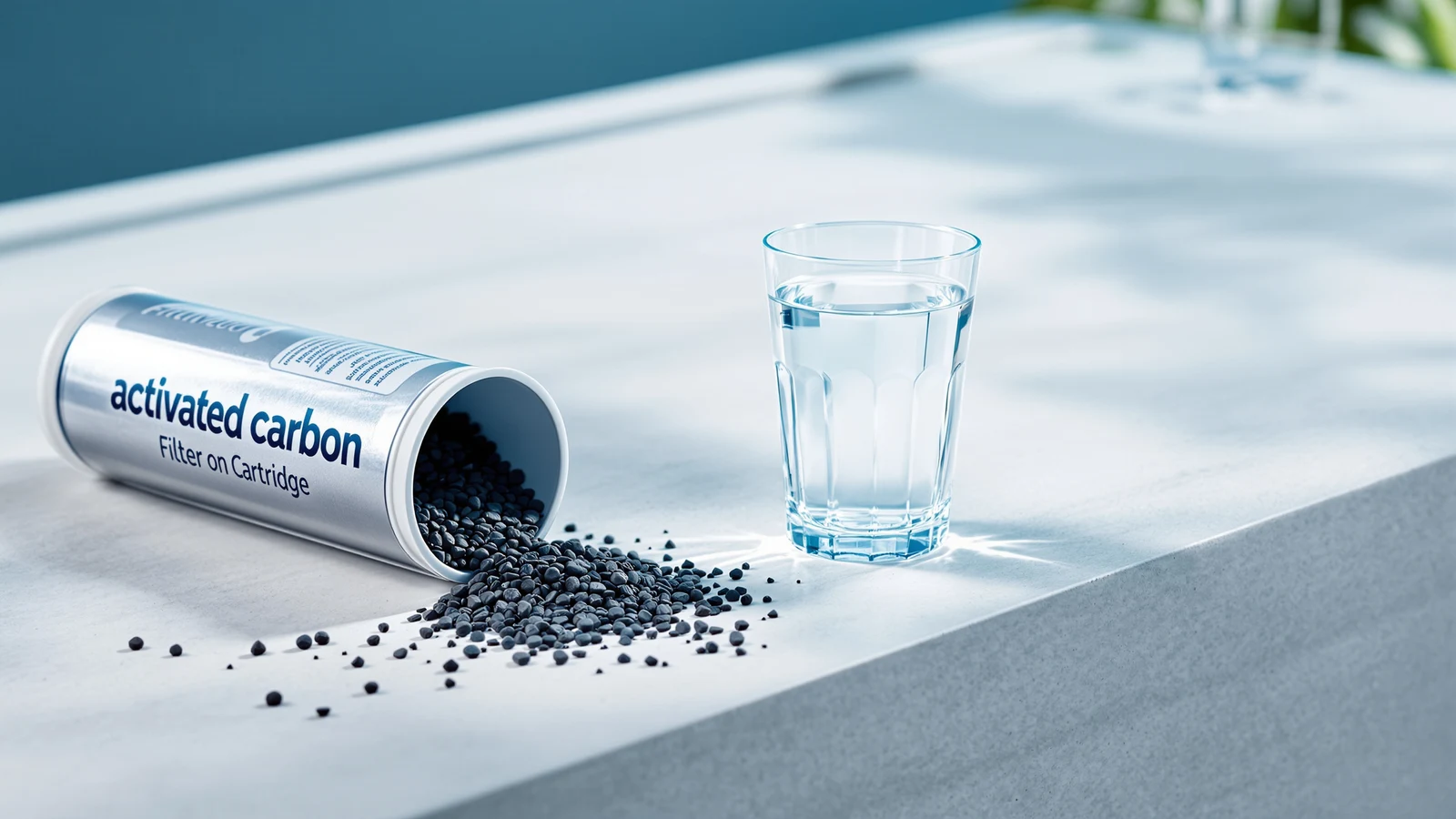
Most buying guides for reverse osmosis systems talk about volatile organic compounds and pesticide residues in the same sentence as lead, arsenic and dissolved solids, as if the membrane removes all of it by the same mechanism. It doesn't, and the gap between those two categories of contaminant is the part that actually decides whether a given system — or a much cheaper carbon filter — does the job you bought it for.
Volatile organic compounds are carbon-based chemicals that evaporate easily at room temperature: industrial solvents, fuel-related compounds such as benzene and toluene, dry-cleaning chemicals like trichloroethylene and tetrachloroethylene that migrate into groundwater near old industrial sites, and trihalomethanes, which form when a municipal utility's chlorine disinfectant reacts with natural organic matter already in the source water. Pesticide residues — atrazine and simazine are two of the most commonly tested for in US water surveys — are a related but distinct family: larger, more complex organic molecules used in agriculture that run off into surface water and can persist in groundwater for years. Both groups share one property that matters here: they are organic, mostly neutral in electrical charge, and often small enough to behave very differently from the contaminants an RO membrane was originally built to catch.
Dissolved solids — the calcium, magnesium, sodium and chloride ions that make water "hard" or salty, and the heavy metal ions like lead — are charged particles in solution. A reverse osmosis membrane is a dense, semi-permeable barrier that rejects them through a combination of size exclusion and electrostatic repulsion: a charged ion is pushed away from a membrane surface that carries a matching charge, on top of simply being too large to pass through the membrane's pores. That mechanism is well understood, consistent, and the reason NSF/ANSI 58 — the certification standard built specifically around TDS reduction — exists and means something concrete.
VOCs and pesticide residues don't play by that rulebook. They're organic, often uncharged, and their rejection by a bare membrane varies widely by molecular weight and chemistry rather than following one predictable curve the way ion rejection does. Some small, neutral organic molecules can diffuse across the thin-film composite material a membrane is made from, rather than being physically screened out at the surface. That's the reason a system's membrane spec — a pore size, a TDS rejection percentage, an NSF/ANSI 58 badge — tells you almost nothing about how well that same system handles the organic chemicals in your water. A different stage is doing that job, and it isn't the one most marketing copy points to.
Why carbon, not the membrane, does most of the VOC removal work
Granular activated carbon works on an entirely different principle from a semi-permeable membrane. It's a highly porous material with an enormous internal surface area — the kind of surface area that, gram for gram, is measured in the hundreds of square meters — and organic molecules stick to that surface through adsorption, a physical attraction between the carbon and nonpolar carbon-based compounds. VOCs and pesticide residues are exactly the class of molecule activated carbon is good at grabbing: organic, often nonpolar, and chemically similar enough to the carbon surface itself to bind to it as water passes through the bed.
This is also why a typical under-sink reverse osmosis system puts carbon stages on both sides of the membrane rather than relying on the membrane alone. A pre-filter carbon stage protects the membrane from free chlorine, which otherwise degrades the thin-film material over time, and does the heavy lifting on VOCs, pesticide residues, taste and odor before the water ever reaches the membrane. A post-carbon polish stage mops up anything left over and removes any taste the water picked up sitting in a storage tank. The membrane, in between, is doing a different and genuinely complementary job: stripping dissolved minerals, heavy metals and other charged contaminants down to a fraction of a micron.
There's a reason the certification landscape mirrors this division of labor instead of treating RO systems as one undifferentiated box. NSF/ANSI 58 is the standard for TDS reduction — the membrane's territory. NSF/ANSI 53 is a separate standard, built specifically around health-effect contaminant reduction that includes VOCs and certain pesticides, and it's a carbon-stage standard as much as anything else: a filter can be tested and certified against 53 without containing a reverse osmosis membrane at all, because the mechanism it's certifying is adsorption, not membrane rejection. Knowing which standard a product is actually certified against — and for which specific contaminants — tells you far more than knowing it "has a membrane."
Reading a "reduces VOCs" claim against what the system can actually test for
The Brio SIMPL is a tankless under-sink system built around a 0.0001-micron reverse-osmosis membrane, rated at 800 gallons a day across four stages, and its own listing title states that it reduces PFAS, VOCs and heavy metals. That's a real, specific product claim worth taking seriously — and also worth reading carefully, because a title line and a tested, certified claim are two different things, and we only have the title and the headline specs to go on here, not a published per-stage breakdown or a certification number for this particular listing.
Start with the 0.0001-micron figure. That number describes the RO membrane's pore size — a fact about how finely it can screen particles and larger dissolved species, which is directly relevant to heavy metals and dissolved solids. It is not, on its own, evidence about VOC reduction, because — as above — small neutral organic molecules aren't necessarily stopped by pore size the way an ion or a bacterium is. A tighter membrane spec is a meaningful upgrade for some contaminants and a largely separate question for others.
Then there's the stage count. "Four stages" tells you how many cartridges water passes through, not what each one is rated to remove or how much carbon mass is doing the adsorption work described above. A lean four-stage tankless design can still carry a genuinely capable carbon stage — or a thin one sized mainly to protect the membrane rather than to carry a VOC-reduction certification. We don't have a published, stage-by-stage specification for this listing beyond the headline count and the 800 GPD rating, so we aren't going to guess at what's inside stage two versus stage three. What we'd want to see before leaning on "reduces VOCs" for a specific compound you're worried about — say, a documented solvent plume near a private well — is the actual certification mark and test standard on the product listing or spec sheet, not the headline phrase alone. "Reduces" is doing real work in that sentence, and it's work a buyer should be able to verify, not infer from a stage count.
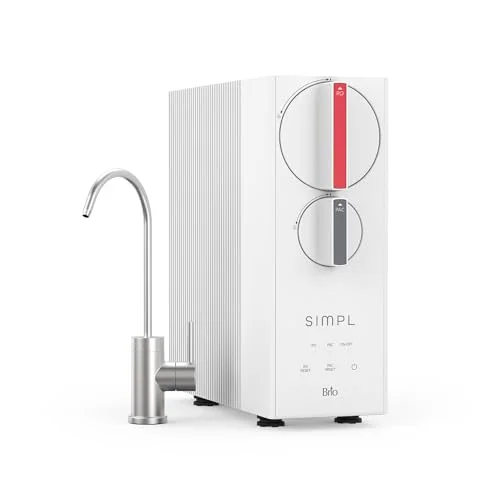
Brio SIMPL, 4-Stage, 800 GPD
Tankless under-sink system with a 0.0001-micron RO membrane; the listing states it reduces PFAS, VOCs and heavy metals. Check the current listing for the specific certification mark behind that claim before buying on it alone.
Check price →AquaTru's 84-contaminant list: where VOCs and pesticides actually sit on it
The AquaTru Glass Carafe is a countertop four-stage reverse osmosis unit, and its listing leads with a round number: removes 84 contaminants, including PFOA and PFOS, lead and microplastics. A list that broad is a useful marketing headline and, read correctly, also a genuinely informative one — but it's worth understanding what a number like 84 actually represents before deciding where your specific worry about VOCs or a particular pesticide lands on it.
Lists of this kind are typically built by running a system against the full roster of contaminants covered by one or more recognized test standards — NSF/ANSI 53 for VOCs and certain pesticides, NSF/ANSI 58 for TDS and general dissolved-solids performance, and NSF/ANSI 401 for a newer tier of "emerging" contaminants that includes some pharmaceuticals and additional pesticides. A headline count like 84 is an aggregate across categories like these, with PFOA, PFOS, lead and microplastics called out by name because they test well as attention-getting examples, not because they're the only items on the list. VOCs and pesticide residues, as categories, are very likely folded into that aggregate rather than being absent from it — but we don't have AquaTru's line-item performance data sheet in front of us, so we can't tell you the exact reduction percentage for, say, atrazine specifically, or confirm which individual VOC compounds are itemized in the 84.
That's the honest limit of what a round contaminant count can tell a buyer. It's a credible signal that the system was tested broadly rather than on a single spec, and four-stage countertop RO units generally do carry carbon stages capable of the adsorption work described above. If one particular compound is the actual reason you're shopping — a known agricultural pesticide in your local water utility's annual report, for instance — the number 84 isn't itself the answer. The manufacturer's published performance data sheet, which lists specific contaminants and their tested reduction percentages against a named standard, is the document that answers that question, and it's worth tracking down before buying on the strength of a headline count alone.
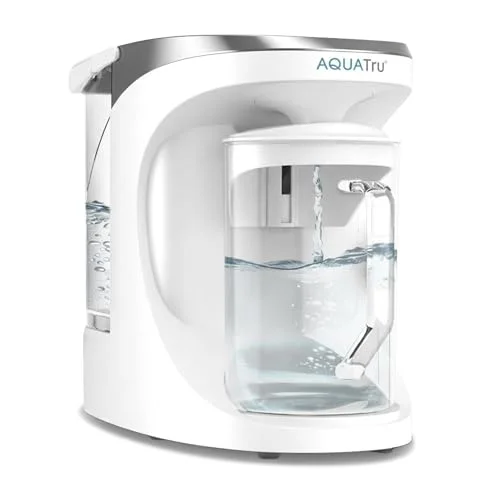
AquaTru Glass Carafe, 4-Stage
Countertop RO purifier whose listing claims removal of 84 contaminants, including PFOA, PFOS, lead and microplastics. Broad, credible as a headline — check the manufacturer's data sheet for the specific compound you care about.
Check price →GAC cartridge life, and why a spent carbon stage lets VOCs straight through
Carbon's adsorption capacity is finite. Every internal surface site on a bed of granular activated carbon can hold a certain amount of organic material before it's full, and once it's full, additional VOC or pesticide molecules passing through simply don't have anywhere left to stick — they come out the other side of the cartridge at close to whatever concentration they went in at. That's a different kind of failure from a sediment filter clogging, which announces itself as reduced flow. A spent GAC stage usually gives no mechanical signal at all: water still looks clear, flow rate is often unaffected, and the only clue is the thing the carbon was supposed to be removing — chlorine taste, odor, or an organic compound you can't taste — quietly reappearing or never having been reduced in the first place.
This is the practical argument for changing a carbon or GAC cartridge on the manufacturer's rated interval rather than waiting for a symptom, and it's a bigger deal for VOCs specifically than it is for taste alone. A chlorine taste coming back is at least a signal you can notice. A pesticide residue or a VOC with no detectable taste or odor at drinking-water concentrations gives you nothing to notice — the cartridge can be exhausted for that specific compound well before anything seems wrong. Systems with longer rated change intervals aren't automatically better here; they're making a bet on your household's actual usage and water quality matching the gallons-or-months rating printed on the box, and that bet is worse the heavier your VOC or pesticide exposure actually is.
The iSpring F7-GAC is a straightforward illustration of how this is priced and scheduled in practice: a seven-cartridge pack built for standard 5-stage RO housings, NSF certified, sold as a one-year replacement supply. Seven cartridges sized to rotate across a system's sediment and carbon stages over twelve months means the carbon doing the VOC and taste work gets refreshed on a defined schedule rather than being left in place until something seems off — which, per the point above, may be well after it has stopped doing its job for the compounds you can't taste.
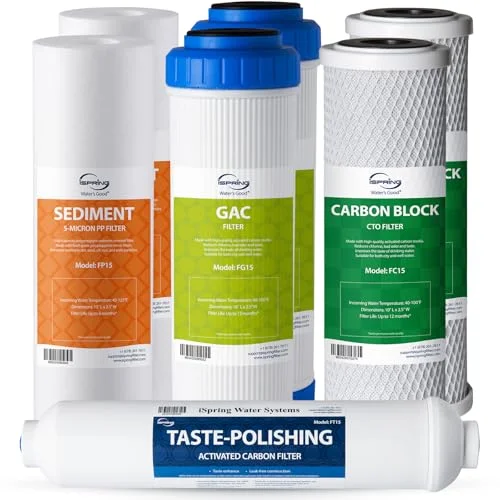
iSpring F7-GAC, 7-Count, 1-Year
NSF certified replacement cartridge pack for standard 5-stage RO housings, sized as a one-year supply. 7 Count (Pack of 1). The scheduled way to keep the carbon stages fresh rather than waiting for a symptom that VOCs may not give you.
Check price →When a carbon-only filter is enough, and when the fuller membrane stack matters
Once you separate the two jobs, the buying decision gets simpler. If VOCs and pesticide residues are genuinely your whole concern — a documented solvent issue, agricultural runoff, a chlorine taste you want gone — and your water isn't otherwise carrying elevated dissolved solids, lead or other inorganic contaminants, a well-sized carbon filter can plausibly do the job on its own, at a fraction of the cost, the installation complexity and the drain-water waste of a full RO system. A carbon-only setup also has no membrane to protect, no drain line to run, and faster flow, because it isn't restricted by a membrane's throughput.
The case for the fuller membrane stack shows up as soon as the contaminant list widens. Lead and other heavy metals, dissolved solids generally, PFAS compounds, and microplastics are the categories a carbon-only filter isn't built to remove reliably — that's the membrane's job, the one NSF/ANSI 58 and a tight pore-size spec actually certify. Well water with unknown contaminants, older plumbing with a lead-solder risk, or a household simply wanting broad coverage rather than a single-issue fix are the situations where paying for both stages — carbon for the organics, membrane for everything else — is buying something carbon alone structurally can't provide. Stocking carbon cartridges in bulk is worth doing either way, since the carbon stage needs replacing on a schedule regardless of which system it sits inside.
If the appeal of a full system is coverage without assembling the parts and schedule yourself, a bundled unit with a published stage list — whether that's one of the countertop or tankless systems discussed above, or a premium plumbed-in option like the Delta Clarifi — buys you that convenience at a price. The question worth asking before paying it is the one this page keeps returning to: what, specifically, is each stage certified or rated to remove, and does that list actually match the contaminant you're trying to get rid of. A membrane badge answers that question for dissolved solids and heavy metals. It doesn't answer it for VOCs and pesticides — the carbon does, and only for as long as that carbon still has room left to adsorb.
Questions people ask about VOCs, pesticides and RO systems
Does reverse osmosis remove VOCs and pesticides from tap water?
Mostly, but largely through the carbon stages that sit before and after the membrane, not the membrane itself. Activated carbon adsorbs organic compounds like VOCs and many pesticide residues; the membrane's strength is dissolved solids and heavy metals, which follow a different removal mechanism. A system's membrane spec alone doesn't tell you how it performs on VOCs — the carbon stage's size, freshness and certification do.
Is a carbon filter alone enough to remove VOCs and pesticides?
Often, yes, if that's genuinely your only concern. Carbon is the stage actually doing the adsorption work for organic compounds, and a well-sized carbon filter can handle VOCs and pesticide residues without a membrane, a drain line, or the water waste a full RO system involves. It won't touch dissolved solids, lead or other inorganic contaminants — those need the membrane stage.
How do I know when a GAC cartridge is exhausted and letting VOCs through?
Often you can't tell from taste alone — chlorine returning is a noticeable signal, but a VOC or pesticide residue with no taste or odor at drinking-water levels can pass through an exhausted carbon stage with no symptom at all. The reliable approach is replacing on the manufacturer's rated interval, in gallons or months, rather than waiting for something to seem wrong.
What does AquaTru's "84 contaminants" claim actually tell me about VOCs and pesticides?
It's an aggregate count, typically built from testing against the panel of contaminants covered by recognized standards like NSF/ANSI 53 and 58, with headline names like PFOA, PFOS, lead and microplastics called out for marketing. VOCs and pesticides are very likely included in that aggregate, but the number itself doesn't tell you the tested reduction percentage for one specific compound — the manufacturer's performance data sheet does.