Best RO Systems
Home › Guides › Cheapest under-sink filters
Budget picks

The cheapest under-sink filters in this catalogue aren't reverse osmosis at all

We're reader-supported: buying through our links may earn us a commission at no extra cost to you. We compare published specifications, certifications and prices — we don't run a testing lab.

Compact white under-sink carbon water filter cartridge installed on the cold-water line beneath a kitchen sink, next to an open cabinet door

Every roundup on this site eventually prices out a full reverse osmosis system — a membrane, a pressure tank, a dedicated faucet, somewhere between $180 and well over $1,000 depending on format and stage count. These three products are not that. Each is a single-cartridge carbon filter that bolts onto the cold line already feeding your kitchen faucet, certified for exactly one thing — chlorine, taste and odor — and priced at $32.48, $47.49 and $47.19. If your water report doesn't ask for more than that, one of these is the actual floor price of better-tasting tap water in this catalogue, not a corner-cutting workaround.

Why these three cost a third of the cheapest RO system here

The cheapest complete reverse osmosis system we've priced anywhere on this site is the Express Water RO5DX at $179.99 — five stages, a 50-gallon-per-day membrane, a pressure tank and its own dedicated faucet. Divide that by three and you land at exactly $60.00. Every filter in this piece comes in under that line, and the most expensive of the three, the PUREPLUS at $47.19, sits right at the threshold. At the other end of the RO price range, that same extra money buys a lot more plumbing and a lot more stages — see how four 500 GPD systems spend four very different budgets once you're past $600.

The gap isn't a discount; it's a different bill of materials. A reverse osmosis system has to reject water to work: a semi-permeable membrane in a pressure vessel, a storage tank to hold the slow trickle of purified water, a dedicated faucet with its own hole in the sink or counter, and a drain saddle clamped onto the waste pipe to carry the reject stream away. None of that exists in an Amazon Basics, ICEPURE or PUREPLUS listing. Each is one filter cartridge in a single twist-and-lock housing, plumbed straight into the same 3/8-inch or 1/2-inch cold line that already feeds your existing faucet. There's no reject stream to engineer, no tank to pressurize, no membrane to manufacture and warranty. Fewer parts accounts for most of the forty-to-two-hundred-dollar gap between these and the cheapest RO system on the site.

The simpler design also keeps the flow rate that RO gives up. ICEPURE and PUREPLUS both publish 2.5 gallons per minute at 60 PSI — close to what the faucet delivered before you installed anything, because the water isn't being forced through a membrane or held in a tank. A tank-based RO system fills at a fraction of that rate and makes you wait for the tank to recover after drawing more than a glass or two quickly; these three don't have that bottleneck because they aren't storing anything.
NSF/ANSI 42, and the gap between that and what's printed above it

NSF/ANSI 42 is a single, narrow certification. It tests whether a filter reduces chlorine, taste and odor — the things a municipal utility adds on purpose, and the reason tap water in some cities tastes like a swimming pool. That's the whole scope. It says nothing about total dissolved solids, nothing about lead, arsenic or nitrate, and nothing about PFAS. Those are different standards entirely: NSF/ANSI 53 covers specific health-effect contaminants, tested compound by compound for whatever a product actually claims to reduce, and NSF/ANSI 58 is the standard reverse osmosis systems carry for reducing dissolved solids. A filter holding NSF/ANSI 42 has told you nothing about whether it would pass either one.

All three filters here also carry NSF/ANSI 372 — worth reading carefully, because it is not a performance claim at all. It certifies that the plastic and components the filter is built from are lead-free. It says nothing about what the filter removes from your water; it's a statement about what the housing is made of, the same certification the index page of this site flags every time a product leans on it as if it meant more.

Where it's worth reading the listing past the headline: ICEPURE's and PUREPLUS's product titles both promise to remove heavy metals. Neither carries a certification that tests for that claim — NSF/ANSI 42 is a taste-and-odor standard, and heavy-metal reduction is evaluated under NSF/ANSI 53, which neither listing carries. PUREPLUS is actually candid about the related limit in its own feature text: it states outright that the filter retains minerals and does not change your water's TDS value, and it directs buyers who specifically want TDS removed to a separate reverse osmosis listing instead. Amazon Basics is the most conservative of the three on this point — its listing sticks to the plain NSF/ANSI 42 claim of chlorine, taste and odor reduction and makes no heavy-metals claim at all.

Direct-connect installation versus RO's faucet hole, drain saddle and tank

"Direct-connect" describes the whole mechanism. A twist-and-lock fitting ties the filter straight into the cold-supply line that already runs to your kitchen faucet, using push-to-connect tubing and, on the Amazon Basics unit, an included 3/8-to-1/2-inch converter fitting for faucets on the wider supply line. Water still comes out of the faucet you already have; it's just filtered on the way. Amazon Basics and ICEPURE both put the install at roughly three minutes and the cartridge swap at about three seconds, because there's nothing to align beyond the twist-lock housing itself. All three are explicit that this only works on a cold-water line — the same restriction a plumbed RO system carries, so it isn't a point of difference between the two categories.

A reverse osmosis install is a longer list by design: a feed valve tapped into the cold line, a drain saddle clamped onto the under-sink waste pipe to carry away the water the membrane rejects, a hole drilled in the sink or counter for a dedicated RO faucet (most sinks already have a spare one for a sprayer or soap dispenser; if not, that's a call to a plumber on granite or quartz), and on tank systems, a pressurized tank taking up most of the remaining cabinet. Budget two to three hours for a first RO install against the few minutes these three need, because the extra time is the drain saddle and the faucet hole, not the filter cartridge itself.

Not every product in this price band skips the faucet entirely. Waterdrop's 10UA ships in almost the same price range as these three, at $43.99, and the base unit has no dedicated faucet either — it's a direct-connect filter in the same structural class as the three here. Waterdrop sells it a $14 upgrade, the 10UB, that adds one, which is the single feature that starts to move that product toward an RO-style installation; its other add-on is just a filter-life reminder, not a faucet. See which of Waterdrop's two 10UA upgrades is worth paying for if you're weighing that same direct-connect-versus-faucet decision on a different brand.

11,000 versus 22,000 gallons, and what that means in months for one household

The headline number on all three listings is a gallon capacity, and each manufacturer has already done its own division to turn that into a calendar claim — which means you can check their math. Amazon Basics rates its filter at 11,000 gallons or one year, whichever comes first; divide 11,000 by 365 days and that one-year claim is built on an assumed throughput of just over 30 gallons a day. ICEPURE rates its 22,000-gallon filter at three years, which works out to roughly 20 gallons a day. PUREPLUS's own feature text describes the same 22,000-gallon capacity as a five-year filter, implying a much lighter assumed load of about 12 gallons a day. Same raw capacity as ICEPURE's filter, a different assumption about how fast you'll use it — not a different cartridge.

That assumption matters more here than it would on a reverse osmosis system, because a direct-connect filter like these three sees every gallon that leaves the faucet it's plumbed into — rinsing dishes, filling a pot, running the tap while it gets cold — not just the two or three gallons a day a household might actually drink or cook with. An RO system's dedicated low-flow tap only dispenses purified water on demand for drinking and cooking, so its tank and membrane see a far smaller, more predictable slice of total kitchen water use. A two-person household that mostly fills a kettle and a water bottle from this faucet might run 8 to 12 gallons a day through it, which would stretch Amazon Basics' 11,000-gallon filter past two years — well beyond its printed one-year ceiling. A family of four or five doing dishes by hand and filling a dog bowl from the same tap can plausibly double or triple that daily figure, and now the printed interval starts to look optimistic rather than conservative. There's no way to know which household you are from the box; the printed month count is the manufacturer's guess, stated as an assumption, exactly the way a reverse osmosis membrane's replacement interval is also an assumption until you know your own usage — the same principle our guide to matching a replacement RO membrane's GPD rating walks through on the other side of this purchase.

The practical read: at 22,000 gallons, ICEPURE and PUREPLUS cover roughly twice the throughput of the Amazon Basics filter for a manufacturer's printed cost of $14.40 and $19.40 more, respectively — cheaper, gallon for gallon, than buying the smaller filter twice. If your household is light on faucet use, the Amazon Basics filter at $32.48 may simply never reach its twelve-month ceiling before the cartridge should be changed anyway for sanitary reasons; if it's a busy kitchen tap, the 22,000-gallon filters buy real headroom against a printed calendar date that was never really about your household in the first place.

The picks

The three, and who each is actually for

01Lowest entry price

Amazon Basics Under Sink Water Filter System

The cheapest way into this category
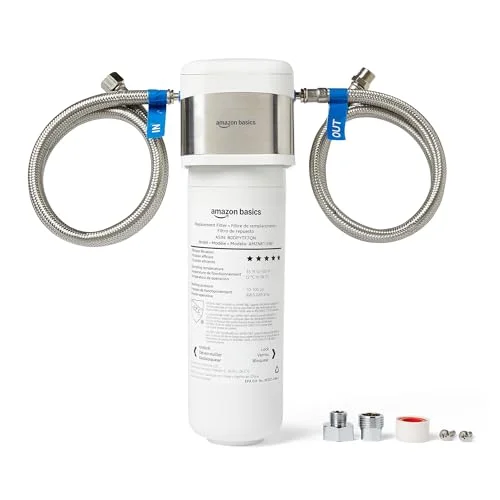
NSF/ANSI 42 & 372 · 11,000 gallons · 1-year service life · twist-and-lock

At $32.48 this is the floor price of the entire reverse-osmosis-systems catalogue, not just this article. It connects to the cold line with a twist-and-lock housing and push-to-connect fittings, ships with a 3/8-to-1/2-inch converter for wider supply lines, and the listing claims a three-minute install and a three-second cartridge swap. It's also the most conservative of the three on claims: the title promises only what NSF/ANSI 42 tests for — reduced chlorine, taste and odor — with no heavy-metals language to square against a certification that doesn't cover it.

Amazon Basics under-sink water filter system with white twist-and-lock housing
$32.48
11,000 gal · 1 yrCheck price →
02Best capacity per dollar

ICEPURE Under Sink Water Filter System

Twice the gallons for $14.40 more
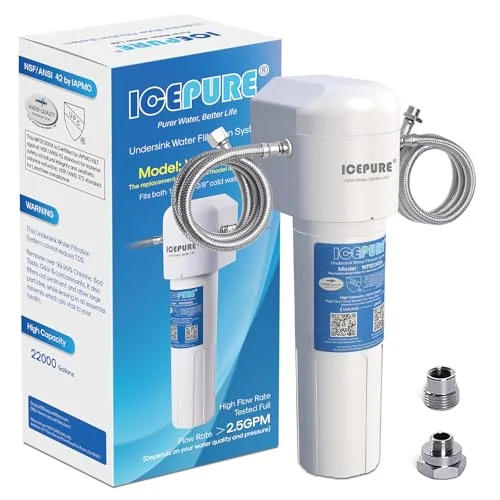
NSF/ANSI 42 & 372 · 22,000 gallons · 3-year rating · 2.5 GPM at 60 PSI

Double the rated capacity of the Amazon Basics filter for a $14.40 premium — the better buy on a pure gallons-per-dollar basis if your household will actually use it that long. ICEPURE builds the cartridge from coconut-shell carbon with a 0.5-micron outer layer and publishes a full-flow rate of 2.5 GPM at 60 PSI, so the faucet doesn't feel throttled. The title's "removes heavy metals" line is the one thing to read skeptically here: the certifications on the listing are NSF/ANSI 42 and 372, neither of which tests for heavy-metal reduction.

ICEPURE under-sink water filter system rated for 22,000 gallons
$47.49
22,000 gal · 3 yrCheck price →
03Most candid listing

PUREPLUS Under Sink Water Filter System

The same 22,000 gallons, with the limits spelled out in writing
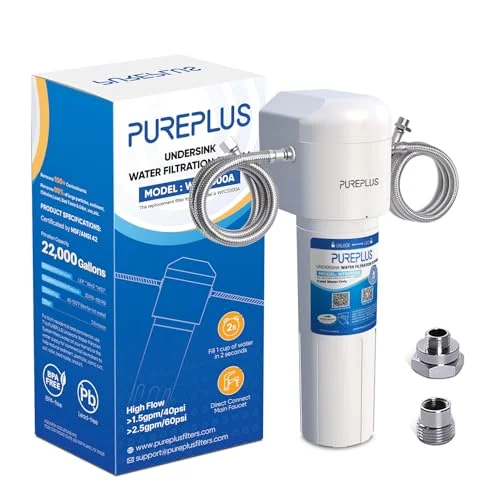
NSF/ANSI 42 · 22,000 gallons · 6-in-1 composite filter · 2.5 GPM at 60 PSI

The same 22,000-gallon capacity as the ICEPURE unit, $5 more, and functionally the same pitch — a 6-in-1 composite cartridge at 0.5 microns, 2.5 GPM at 60 PSI, cold-water-only direct connect. What sets it apart isn't the hardware; it's that PUREPLUS's own feature text states plainly that the filter retains minerals and does not change your water's TDS value, and tells buyers who want TDS removed to look at a separate reverse osmosis listing instead. That's a manufacturer admitting the exact boundary this whole article is about, in its own product description.

PUREPLUS under-sink water filter system rated for 22,000 gallons
$47.19
22,000 galCheck price →
FilterCertifiedCapacityFlow ratePrice
Amazon BasicsNSF/ANSI 42 & 37211,000 gal / 1 yrNot stated$32.48Price
ICEPURENSF/ANSI 42 & 37222,000 gal / 3 yr2.5 GPM @ 60 PSI$47.49Price
PUREPLUSNSF/ANSI 4222,000 gal / 5 yr (mfr. est.)2.5 GPM @ 60 PSI$47.19Price

What a water report would need to show before one of these is actually enough

Every municipal utility in the US publishes an annual water quality report — a Consumer Confidence Report, usually available on the utility's own website — listing what was detected and at what level. If you're on a private well, the equivalent is a lab test, not a utility document, and it's worth running one before buying anything in this category. Either way, the report is the thing that tells you whether an NSF/ANSI 42 filter is actually sufficient, because that certification only covers one slice of what a water report can flag.

If the only things your report shows are chlorine, chloramine, or a faint taste-and-odor note with no violations elsewhere, one of these three filters is doing exactly the job it's certified for. If the report shows elevated lead, arsenic, nitrate above the EPA limit, excessive total dissolved solids or hardness you want reduced, or PFAS, none of the three filters here will touch it — not because they're poorly made, but because that's outside the standard they're certified to. NSF/ANSI 372 doesn't help with any of that either; it's about the filter's own plastic, not about contaminants already in your water or in the pipes between the street and your faucet. That combination — a specific contaminant named on a water report, above its listed limit — is the actual trigger for moving up to a system carrying NSF/ANSI 53 for that specific contaminant, or NSF/ANSI 58 for a reverse osmosis system that reduces dissolved solids generally.

That's also the point where the rest of this site becomes relevant again. Once a water report justifies reverse osmosis specifically, format is the next decision — countertop, under-sink tank, or tankless all solve the certification problem the same way but trade off cabinet space, install time and price very differently, and our breakdown of one brand's countertop, under-sink and tankless RO systems walks through that trade-off on a single product line. On the budget end of that upgrade, APEC's first tankless RO system is a useful reference point for what a stripped-down, lower-stage tankless entry actually costs against the category leaders — the same kind of "cheapest in its class" question this article asks about taste filters, asked one tier up.

FAQ

Questions people ask about these filters

Can an NSF/ANSI 42 filter remove lead or other heavy metals?

Not by certification. NSF/ANSI 42 tests for reduced chlorine, taste and odor only. Heavy-metal reduction is evaluated under a different standard, NSF/ANSI 53, which none of the three filters in this piece carry — even though two of their product titles use the phrase "removes heavy metals." NSF/ANSI 372, which all three also carry, only certifies that the filter's own components are lead-free; it says nothing about what the filter takes out of your water.

What's the real difference between a direct-connect filter and a reverse osmosis system?

A direct-connect filter ties into the cold line feeding your existing kitchen faucet and filters everything that comes out of it — no new hole in the sink, no drain line, no tank, typically a few minutes to install. A reverse osmosis system adds a dedicated faucet (its own hole in the sink or counter), a drain saddle to carry away the water the membrane rejects, and on tank systems, a pressurized storage tank in the cabinet. Budget two to three hours for a first RO install against a few minutes for one of these.

How many months will an 11,000-gallon or 22,000-gallon filter actually last?

It depends on how much water passes through the specific faucet the filter is plumbed into, which varies far more than the printed rating suggests. Amazon Basics' 11,000-gallon, one-year rating assumes about 30 gallons a day; ICEPURE's 22,000-gallon, three-year rating assumes about 20 gallons a day; PUREPLUS describes the same 22,000-gallon capacity as a five-year filter, implying about 12 gallons a day. A light-use household can run well past the printed date; a busy kitchen tap can use the filter up well before it.

When should I upgrade from one of these to a reverse osmosis system?

When your municipal water quality report or a private well test shows something NSF/ANSI 42 doesn't cover — elevated lead, arsenic, nitrate above the EPA limit, high total dissolved solids or hardness you want reduced, or PFAS. At that point you need a system certified to NSF/ANSI 53 for that specific contaminant or NSF/ANSI 58 for general TDS reduction, which is what a reverse osmosis system provides and none of the three filters here are certified to do.

Keep reading

Next, if a taste filter isn't the full answer