iSpring's RCC7AK family compared: BN vs BLK vs the AKF3 value pack
We're reader-supported: buying through our links may earn us a commission at no extra cost to you. We compare published listing specifications, certification wording and prices — we don't run a testing lab, and nothing below is a star rating or a paraphrased review.
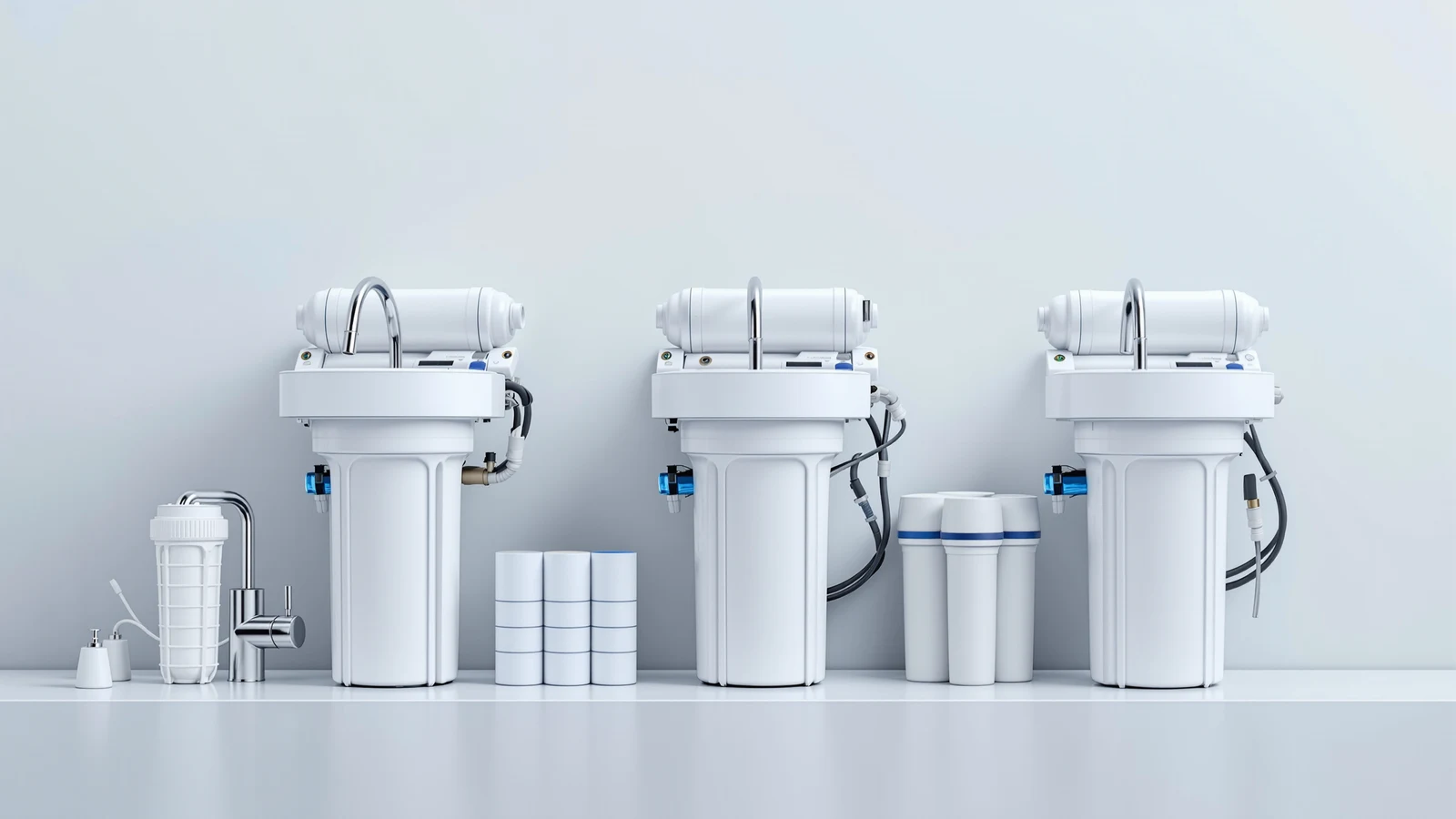
Search "iSpring RCC7AK" on Amazon and you don't get one result, you get a small cluster of them: the RCC7AK-BN, the RCC7AK-BLK, and the RCC7AKF3 Value Pack. Three different ASINs, three different prices, three separate pages each with its own photos, its own bullet points, and its own buy box. Nothing on the page tells you outright that you're looking at variations on one underlying system rather than three systems that happen to share a model prefix.
This is not an iSpring quirk. It's how Amazon's catalog works for almost every mid-size appliance brand: a faucet finish, a color, or a bundled accessory is enough to justify a separate listing rather than a size/color selector on one page, especially for sellers who came to the platform before "variation listings" were the norm or who want each SKU to carry its own reviews and search ranking independently. The result is that the same core hardware ends up priced, described and photographed three separate times, and the buyer is left to do the reconciliation themselves.
Here's what that reconciliation looks like for this family, at the prices we recorded:
- iSpring RCC7AKF3 Value Pack — $149.99. Alkaline 6-stage under-sink system, patented Easy-Mount faucet, with three additional pre-filters included in the box.
- iSpring RCC7AK-BN — $189.99 (recorded October 15, 2026). NSF Certified, 75 GPD, alkaline 6-stage system with pH+ remineralization and a patented top-mounted faucet.
- iSpring RCC7AK-BLK — $202.49 (recorded October 15, 2026). NSF/ANSI 58 Certified, alkaline 6-stage system with pH+ remineralization and a stylish black RO faucet.
That's a $74.68 spread between the cheapest and most expensive listing of what is, on the specs each page actually states, the same filtration core. Before deciding which one makes sense for your kitchen, it's worth separating what genuinely differs across these three pages from what's just different marketing copy describing identical hardware — a distinction we also lean on in our explainer on reverse osmosis stage counts, since stage count is one of the easiest specs to compare apples-to-apples once you know what to look for.
What's actually identical across all three listings
The specs each page states for itself, lined up next to each other.
Stage count. All three listing titles say the same thing: "Alkaline 6-Stage." That's the core filtration sequence — sediment, two carbon stages, the reverse osmosis membrane, a post-carbon polish, and an alkaline remineralization stage that adds minerals back after the membrane strips them out. None of the three pages describes a different stage architecture. If a seller wanted to sell a genuinely cut-down version of this system, the honest way to do it is to change that number, and none of them did.
The membrane and the filtration job it does. The RCC7AK-BN listing states the system is NSF Certified and rated at 75 GPD (gallons per day), which is the standard iSpring membrane output for this family. The RCC7AK-BLK listing doesn't repeat the GPD figure in its title, and the AKF3 Value Pack listing doesn't state a GPD number either — which means we won't claim the exact same 75 GPD figure for those two beyond what their own pages say. What we can say is that all three are sold under the "RCC7AK" naming and described as the same alkaline 6-stage class of system, which is the basis for treating them as one family rather than three unrelated products. If the GPD rating matters to your decision, confirm it on the specific listing page before you buy — that number occasionally gets revised between a model's original listing and a later variant.
The alkaline remineralization stage. "Alkaline" appears in all three titles, and "pH+ Remineralization" is spelled out explicitly on the BN and BLK pages. The AKF3 page doesn't use the "pH+" branding term, but it does say "Alkaline 6-Stage," which is the same functional claim in plainer words. This is the stage that puts calcium and magnesium back into the water after the membrane removes them — a point worth understanding on its own terms if you're weighing whether that matters to you.
Certification — stated differently, which is itself worth noticing. The BLK listing names a specific standard: "NSF/ANSI 58 Certified." That's the standard that actually governs contaminant and TDS-reduction performance for point-of-use RO systems. The BN listing says only "NSF Certified" without naming which NSF standard — in practice this is very likely the same certification, since NSF/ANSI 58 is the standard that applies to this class of system, but the listing copy itself doesn't spell it out, and we're not going to fill that gap with an assumption. The AKF3 listing doesn't mention NSF certification in its title at all. That doesn't mean the value pack isn't certified — plenty of accurate listings simply don't repeat every certification in the title — but it does mean you should check the current listing's full description and images for the certification mark before assuming it matches the other two. For more on what NSF/ANSI 58 actually tests versus what some RO marketing implies it tests, see our breakdown of which RO testing claims have real evidence behind them.
Faucet finish and color: the real functional difference
Once you set aside the filtration core, the genuine distinguishing feature between the BN and BLK listings is sitting right in their model suffixes. iSpring uses "-BN" and "-BLK" as shorthand across its RO lineup for brushed nickel and black faucet finishes respectively — the RCC7AK-BLK listing confirms this directly, describing a "Stylish Black RO Faucet," while the RCC7AK-BN listing's "-BN" suffix is iSpring's standard brushed-nickel designation, paired with a patented top-mounted faucet design.
That's genuinely the one functional, visible difference between those two listings: the faucet you'll see and touch at your sink every day is a different finish and color, mounted the same way (top-mounted) on both. Everything upstream of the faucet — the housings, the membrane, the stage count, the alkaline cartridge — is the same system doing the same job. If your kitchen hardware is brushed nickel, the BN faucet will look like it belongs; if it's matte black or you simply prefer the look, the BLK faucet is built for that, and iSpring's own description leans into it as a design choice rather than a performance one.
The AKF3 Value Pack is the outlier here, and in a way worth noting rather than glossing over: its faucet is described as a "Patented Easy-Mount Faucet for Effortless Installation," which is a different mounting design from the BN's "top-mounted" language, not just a different finish. Easy-Mount designs are typically built to simplify the install step — fewer under-sink connections to route — rather than to change the water path. The AKF3 listing doesn't state a faucet color or finish at all, so if finish matters to you, check the current listing photos rather than assuming it matches either the BN or BLK faucet. That's a straightforward case of a spec the page simply doesn't give you, and the honest answer is to go look rather than guess.
What the AKF3's extra pre-filters are actually worth
The RCC7AKF3's defining feature, per its own title, is "Additional 3 Pre-Filters Included" — on top of whatever set ships with a standard 6-stage system. Pre-filters are the sediment and carbon stages that sit ahead of the membrane, and they're also the cheapest, fastest-wearing parts of any RO system: sediment and carbon cartridges are typically the first things you replace, often well before the membrane itself needs attention. Having three spares in the box means the first replacement cycle is already paid for and sitting in a drawer rather than something you have to shop for and order separately once the system has been running a few months.
Whether that's worth more or less than the price gap to the BN or BLK listings is a real question, and we'd rather give you the honest framework than a made-up number. We don't have a current standalone price for iSpring's RCC7AK pre-filter replacement packs in front of us, so we're not going to invent one — but the logic holds regardless of the exact figure: three bundled pre-filters save you one future purchase and one future "which filter pack do I even need" search, at a point when you'd otherwise be starting from zero. If you search the current iSpring replacement-filter listings and find that a 3-pack of sediment-and-carbon pre-filters costs noticeably less than the roughly $62–$75 price gap between the AKF3 and the BN/BLK listings, the bundle is the better deal even before you account for the convenience. If it costs more than that gap, the bundle is arguably still convenient but not necessarily the cheapest route to the same filters.
What the bundle doesn't change is the membrane replacement cycle, which runs on a much longer timeline than pre-filters regardless of which of these three listings you buy. Three extra pre-filters are a head start on year-one maintenance, not a reason to stop budgeting for the system's actual long-term running cost.
Reading the fine print that reveals shared hardware
iSpring's RCC7AK cluster is a clean, visible example of a pattern that shows up constantly in appliance categories on Amazon, and it's worth having a short checklist for it rather than relearning the pattern every time you shop a new brand:
- Compare the stage count or core spec number first. It's usually stated plainly in the title — "6-Stage," in this case — and it's the single hardest number for a seller to misstate without it being an obvious, checkable lie. If that number matches across listings, you're very likely looking at the same core system.
- Check the model number suffix. Letters after the base model code — "-BN," "-BLK," "-F3" here — are almost always a finish, color or bundle flag, not a different generation of hardware. Manufacturers reuse this convention across entire product lines because it's genuinely how they track SKU variants internally.
- Notice when certification wording differs between near-identical listings. One page naming a specific standard (NSF/ANSI 58) while a near-identical sibling page just says "NSF Certified" is common and usually harmless, but it's exactly the kind of inconsistency worth clicking through and confirming on the page you're actually about to buy from — especially for anything certification-adjacent, where the specific standard determines what was actually tested. We go deeper on which RO certification and testing claims hold up in our look at PFAS and RO testing claims.
- Treat price divergence between near-identical listings as a question, not a red flag by itself. Older listings accumulate reviews and search ranking that newer, functionally identical listings don't have yet, and Amazon's own promotional cycles move independently per ASIN — which is a big part of why the "same" system can be $75 apart depending on which specific page you land on, the same way a renewed listing of the same model can undercut a new one without the hardware underneath actually changing.
- If you're buying secondhand or a listing that reads as unusually cheap, verify before you assume it's this same kind of harmless variation. Our checklist for buying a used reverse osmosis system covers how to confirm you're actually getting what the listing claims, which matters more once a system has left its original retail packaging.
None of this requires special tools or inside knowledge — it's reading the same page everyone else is scrolling past, slightly more carefully.
The three listings, lined up
What we could confirm from each listing's own stated specs, as recorded.
| Listing | Price | Faucet | Certification as stated | Extra pre-filters | |
|---|---|---|---|---|---|
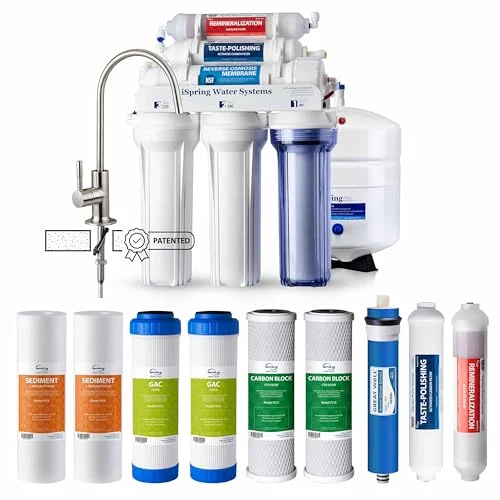 RCC7AKF3 Value Pack | $149.99 | Easy-Mount, color not stated | Not stated in title — check listing | 3 included | View |
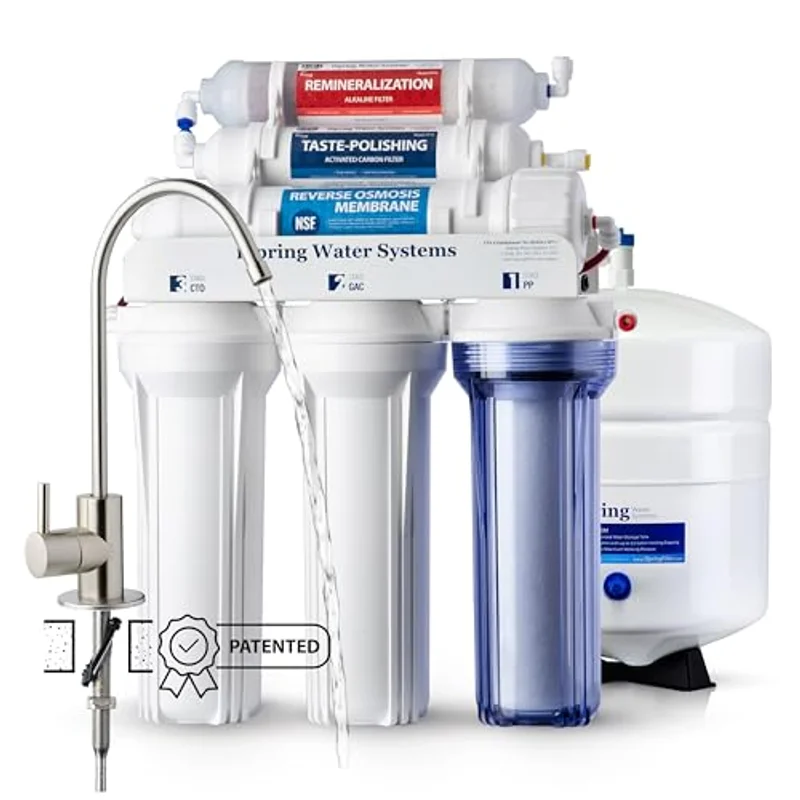 RCC7AK-BN | $189.99 | Top-mounted, brushed nickel ("-BN") | NSF Certified (standard not named) | None stated | View |
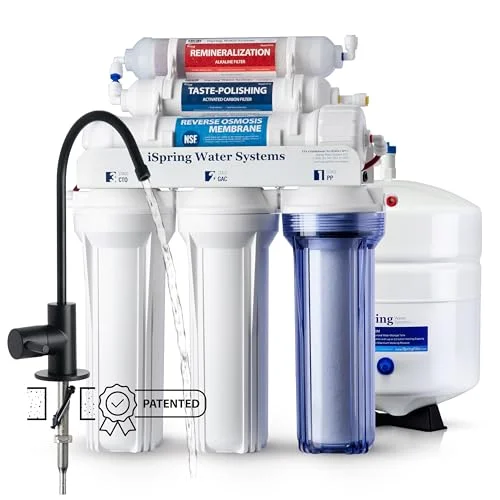 RCC7AK-BLK | $202.49 | Stylish black RO faucet | NSF/ANSI 58 Certified | None stated | View |
All three rows share the "Alkaline 6-Stage" claim stated on their own pages — that's the line we're treating as the backbone of this being one family rather than three unrelated systems. Everything else in the table is a difference the listing itself states, not something we inferred.
Which one to buy, since the filtration doesn't change
Once you accept that the filtration core — stage count, membrane class, alkaline remineralization — is the same across all three pages, the decision stops being about performance and becomes a straightforward value question: what are you actually paying the extra $61.50 to $74.68 for?
For the BN versus BLK choice, that's entirely a finish preference. Pick whichever faucet color and finish will look right at your sink — there's no filtration reason to pay the BLK listing's premium over the BN listing, or vice versa, since the only stated difference between them is the faucet itself. If you have no preference either way, buy whichever of the two is cheaper at the moment you're looking, since that gap moves with Amazon's independent per-listing pricing and isn't fixed.
For the AKF3 Value Pack, the calculation is different because you're not just choosing a faucet, you're choosing whether the Easy-Mount faucet design and three bundled pre-filters suit you better than a top-mounted or black faucet would. At $149.99, it undercuts the BN listing by $61.50 and the BLK listing by $74.68 — a gap that's larger than what three pre-filters alone would likely cost new, which suggests the AKF3 listing may simply be priced more competitively as a newer or less-established ASIN, independent of what's in the box. If you don't have a strong faucet-finish preference and you're comfortable with the Easy-Mount installation style, the value pack is the harder listing to argue against on price. If faucet finish matters enough to you that you'd pick BN or BLK on looks alone, that preference is worth the price gap, because it's the one thing in this comparison that's genuinely yours to decide and not a hidden performance difference.
What we wouldn't do is pay the BLK listing's premium while rating the BN listing's certification wording against it, or assume the AKF3's missing certification line means anything is actually missing — in all three cases, check the live listing for the specifics that matter to you before checkout, because a $75 spread across identical hardware is exactly the kind of thing that changes with Amazon's pricing engine from one week to the next.
Questions people ask about this family of listings
Are the iSpring RCC7AK-BN, RCC7AK-BLK and RCC7AKF3 the same reverse osmosis system?
They're the same core system: all three listing titles state "Alkaline 6-Stage," which is the filtration architecture — sediment, two carbon stages, the RO membrane, post-carbon polish, and an alkaline remineralization stage. The differences stated on their pages are the faucet finish and mounting style (BN's top-mounted brushed nickel versus BLK's black faucet versus the AKF3's Easy-Mount design), the bundled pre-filters on the AKF3, and how each listing words its NSF certification claim.
What's the actual difference between the BN and BLK iSpring listings?
Based on what each listing states, it's the faucet: brushed nickel and top-mounted on the RCC7AK-BN, versus a stylish black faucet on the RCC7AK-BLK. The BLK listing also names its certification specifically as NSF/ANSI 58, where the BN listing says "NSF Certified" without naming the standard — likely the same certification, but worth confirming on the current listing rather than assuming.
Is the AKF3 value pack worth it just because it's cheaper?
At $149.99 against $189.99 for the BN and $202.49 for the BLK, the AKF3 undercuts both by a meaningful margin and bundles three extra pre-filters on top. If you don't have a strong preference for the BN's or BLK's specific faucet finish, the value pack is the harder listing to beat on price for what appears to be the same filtration core. Confirm the faucet finish and certification wording on the current listing before buying, since the AKF3 page doesn't state either in its title.
Why would the same core system be priced so differently across listings?
Separate ASINs on Amazon carry independent pricing, review counts and search ranking even when the underlying hardware is nearly identical — a pattern that shows up across many appliance categories, not just this one. A newer or less-established listing, like the AKF3 Value Pack appears to be relative to the BN and BLK, can be priced lower to build momentum, regardless of what's actually in the box. The way to protect yourself is to compare the stated specs line by line rather than assuming price reflects a performance difference.