Instant Hot Reverse Osmosis Systems: Is the Boiling Tap Worth It
We're reader-supported: buying through our links may earn us a commission at no extra cost to you. We compare published specifications, certifications and prices — we don't run a testing lab.
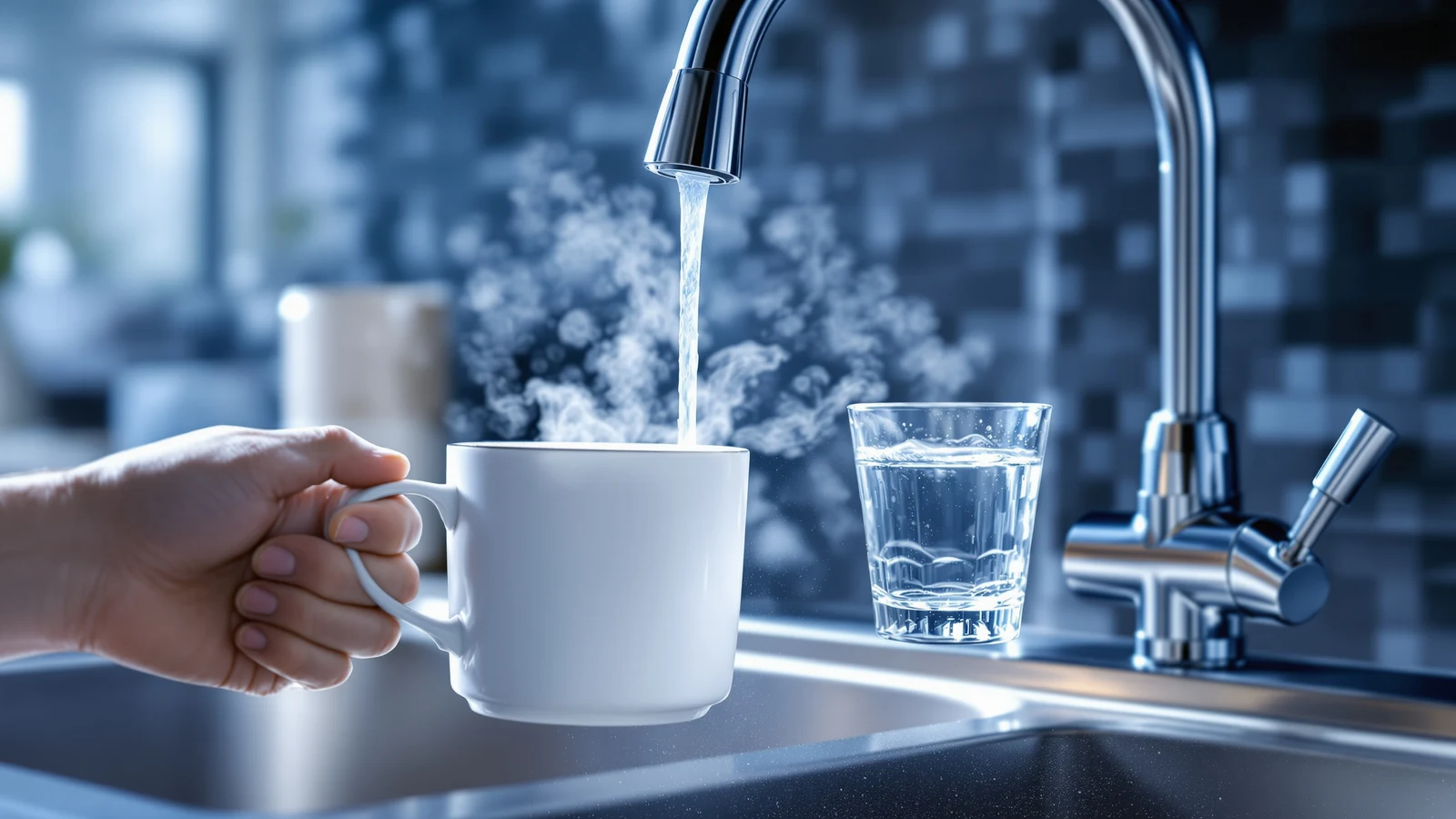
Every reverse osmosis listing on Amazon has, somewhere in its bullet points, a feature that has nothing to do with filtration: a faucet that also dispenses water hot enough to make tea or cook instant noodles, on demand, with no kettle. It reads like a filtration upgrade. It is not. It is a second appliance — a small electric water heater — plumbed onto the outlet side of a perfectly normal RO system, and it is the single biggest reason two otherwise similar systems can be $160 to $260 apart in price.
This page is about that feature specifically: what "instant hot" actually means mechanically, what it costs against filtration alone, where the extra hardware lives under your sink, what keeping it hot around the clock actually costs in electricity, who ends up using it daily versus who paid for a feature that sits idle, and the safety checks worth doing before you put a near-boiling tap within reach of a toddler.
A heating tank, not a kettle
The word "instant" is doing marketing work here, not describing the mechanism. A kettle brings a batch of water to a boil in a few minutes, on demand, then stops. An instant-hot RO faucet does the opposite: a small insulated tank — usually mounted under the sink next to the RO storage tank — holds a reserve of already-filtered water at a near-boiling temperature continuously, so that opening the hot side of the faucet delivers hot water immediately because the heating already happened, minutes or hours ago, and never actually stopped.
That is the entire trick, and it is also the entire trade-off. "Instant" at the tap means "always-on" under the cabinet. The Waterdrop M6CG Hot & Cold Reverse Osmosis System Countertop and the Waterdrop KJ600 Instant Hot Reverse Osmosis System both work this way: an RO membrane stage does the filtration exactly as it would on any other system, and a separate heating tank sits downstream of the clean-water storage, maintaining temperature so the tap never has to wait. Neither product page claims the water boils in the pot-on-a-stove sense — "near-boiling, dispensed on demand" is the honest description, and it is the one we're using throughout this page.
Compare that with a standard tankless RO system like the Philips Tankless Reverse Osmosis System, 600 GPD. It filters the same category of input water, delivers it on demand through its own storage or flow path, and stops there. Cold, filtered water, full stop. If you want tea, you still fill a kettle. The instant-hot feature is not a better filter; it is an added appliance riding on top of the same filtration job.
The price gap: $459–$599 for hot dispense versus $300 for filtration alone
Three systems, one filtration job, two very different price tags once a heating tank is added.
| System | What it does | Hot dispense | Price | |
|---|---|---|---|---|
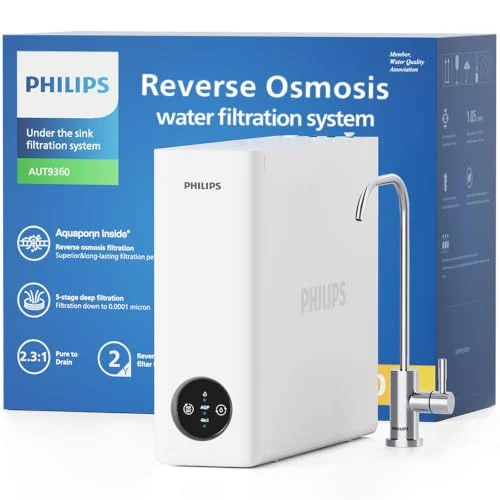 Philips Tankless RO, 600 GPD Philips Tankless RO, 600 GPD | Filtration only | No | $299.99 | Price |
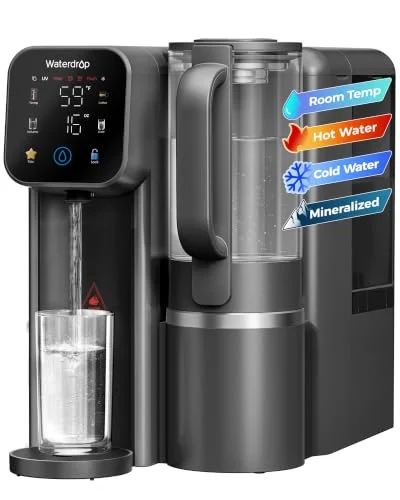 Waterdrop M6CG Hot & Cold Countertop Waterdrop M6CG Hot & Cold Countertop | Filtration + heating tank | Yes | $459.00 | Price |
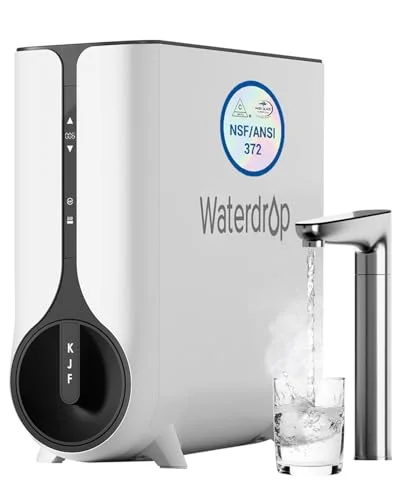 Waterdrop KJ600 Instant Hot, 600 GPD Waterdrop KJ600 Instant Hot, 600 GPD | Filtration + heating tank | Yes | $599.00 | Price |
Line the three up and the pattern is plain. The Philips unit, filtration only, is $299.99. The Waterdrop M6CG, which adds the heating tank on a countertop form factor, is $459.00 — a $159.01 premium over the Philips for the hot-water capability. The Waterdrop KJ600, an under-sink 600 GPD system with the same instant-hot feature, is $599.00, a $299.01 gap against the Philips at the same 600 GPD rating. That is the honest range promised in this article's framing: $459–$599 for hot dispense versus $300 for filtration alone, and the two Waterdrop prices bracket it depending on form factor rather than on anything about the filtration itself.
It's worth being precise about what that premium buys, because it is not "better water." The 600 GPD Philips and the 600 GPD Waterdrop KJ600 are solving the same filtration problem at the same rated output. The $299.01 difference between them is the heating tank, its insulation, its thermostat, its internal plumbing, and — as the next section covers — the standing electrical cost of keeping that tank hot. None of it changes what comes out of the cold side of either faucet.
This is also why we are not naming a single "winner" on this page the way a roundup would. The right system depends entirely on whether you will use the hot tap, which is a household-habits question, not a specs question. It's one of several on-faucet add-ons that work the same way, price-wise — see our look at RO systems with smart displays for another feature worth pricing against the plain version before assuming it's essential.
Where the extra plumbing and wiring goes under the sink
A standard tankless RO install, like the Philips, needs a cold-water feed line tapped from the supply, a drain saddle on the waste pipe for reject water, and a dedicated faucet hole at the sink — the install most people picture when they think "under-sink filter." Adding instant hot does not replace any of that. It adds to it.
The heating tank itself is a separate sealed unit, typically mounted on the cabinet wall or floor next to the RO system rather than inline with it, because it needs its own anchoring and its own clearance for the power cord. Where a filtration-only system has one water path from feed valve to faucet, a hot-and-cold system has two parallel paths from the same filtered-water source: one running straight to the cold side of the faucet, and a second branching off to the heating tank before reaching the hot side. That means an extra T-fitting, an extra few feet of tubing, and — critically — an electrical outlet under the sink that a cold-only system never needed. Most kitchen cabinets under the sink do not have a GFCI outlet already in place; budget for an electrician or a qualified plug-in if yours doesn't.
The faucet changes too. A cold-only RO faucet is a single lever over a single supply line. A hot-and-cold faucet, like the one bundled with the M6CG and KJ600, is a dual-handle or dual-position unit with two independent water paths built into one spout body, plus — on most of these designs — a child-lock mechanism on the hot side specifically, which the next section covers. That faucet needs the same single hole in your sink or countertop that a standard RO faucet needs, so no extra drilling there, but the fitting itself is a different part with two hose connections instead of one, and it is not interchangeable with a cold-only RO faucet if yours ever needs replacing. If you want to know exactly what hardware ships in the box before install day — fittings, feed valve, drain saddle, faucet — our breakdown of what's actually in RO install kits compares that across several systems.
The M6CG specifically is a countertop unit rather than an under-sink install, which sidesteps the drain-saddle and feed-valve work entirely — it sits on the counter and plugs in — but it still needs that same dedicated outlet for the heating tank, and its onboard storage is necessarily smaller than a tank plumbed permanently under a cabinet. If tank size and refill frequency matter to your decision, see our countertop reverse osmosis tank sizes compared guide for how that trade-off plays out across several countertop models.
Net result: more components, one more utility requirement (power), and a second plumbing branch that a filtration-only system simply does not have. None of it is exotic — it is the same category of work as installing any small under-sink appliance — but it is real additional work, and it is the physical reason the price gap in the previous section exists.
Energy cost of keeping a tank hot 24/7
Neither product page in this comparison publishes a wattage or a daily kWh figure for the heating tank, so the only honest way to talk about this cost is to state the assumptions plainly and show the arithmetic — not to print a number as if it came from the manufacturer.
A small instant-hot water heater is, electrically, the same kind of appliance as an under-counter beverage water heater or an instant-hot kitchen tap sold on its own — a resistive heating element plus a thermostat holding a reservoir at a set temperature, insulated to minimize standby loss. Published wattage for that general category of small hot-water-dispenser tanks commonly falls in the 500–750 watt range while actively heating, cycling on and off to hold temperature rather than running continuously. We do not have a manufacturer-stated wattage for either the M6CG or the KJ600, so take the figures below as a worked illustration of the mechanism, not a specification for these two products.
The assumption-driven math: if a unit's heating element draws roughly 500–750 watts and the thermostat keeps it cycling on for a combined total of around 2–4 hours of actual heating per day to offset standby heat loss — a household drawing hot water a few times a day, in a tank that is reasonably well insulated — that works out to roughly 1–3 kWh per day. At a U.S. average residential electricity price of roughly $0.17/kWh (2026), that is approximately $0.17 to $0.51 per day, or very roughly $5 to $16 a month, to keep the tank hot around the clock. A poorly insulated tank, a colder incoming water supply in winter, or a household that draws hot water more often would push toward the top of that range or past it; a well-insulated tank in a warm kitchen with light use would sit near the bottom.
Compare that to the alternative it's replacing: an electric kettle boiling, say, one liter of water draws roughly 1,500–2,000 watts for two to three minutes per use. Boil water for tea four times a day and you are looking at well under 0.5 kWh daily — likely cheaper in raw electricity than keeping a tank hot continuously, especially outside of heavy-use households. The instant-hot tap is not obviously cheaper to run than a kettle; its value proposition is convenience and immediacy, not energy savings, and nothing in either product listing claims otherwise.
The honest summary: the hot tap carries a standing electricity cost a filtration-only system doesn't have, running whether or not anyone uses the tap that day — and absent a published wattage from Waterdrop, the range above is a reasoned estimate, not a verified figure. If minimizing your utility bill matters, weigh that standing cost against the $159–$299 purchase premium from the price-gap section above.
Who actually uses the hot tap daily — and who paid for a feature that sits idle
The honest case for an instant-hot RO faucet is a household with a genuine daily pattern of hot-water-adjacent tasks at the kitchen sink: someone who makes pour-over coffee or tea multiple times a day, a household that regularly prepares instant noodles, oatmeal, or baby formula (see our separate guide on reverse osmosis water for baby formula for the formula-specific considerations) and wants filtered water at temperature without a kettle in rotation, or a home office setup where the kitchen sink doubles as the break-room counter. For those patterns, having filtered near-boiling water on demand genuinely removes a repeated small task — fill kettle, wait, pour — multiple times a day, every day.
The less honest case, and the more common one based on how these systems get bought, is the hot tap as a showroom feature: it sounds impressive next to a cold-only competitor, it photographs well, and it gets checked off a feature list during a remodel without anyone in the household actually having a daily hot-water habit at the sink. In that scenario, the $159 to $299 premium and the standing few-dollars-a-month electricity cost are paid indefinitely for a feature used rarely, if at all.
A useful gut check: count how many times in the last week your household boiled water in a kettle or microwave specifically to pour it over something near the kitchen sink. Zero to a couple of times a week, and the plain filtration system — the Philips at $299.99, or any comparable tankless unit — delivers the same water quality for less money and no standing electrical draw. Several times a day, and the premium is buying back real time, every day. Household size shifts that math too — a larger household hits the daily-use threshold sooner than one or two people; our guide to the best reverse osmosis systems for large families covers the throughput side of that same scaling question.
Safety: child locks, scald risk, and what to check before installing near kids
Child-lock mechanism
Dual hot-and-cold RO faucets, including the type bundled with the M6CG and KJ600, commonly use a two-step actuation on the hot side — a button press combined with a turn, or a separate lock lever — specifically so a toddler's hand resting on the faucet can't trigger hot dispense by accident. Check the specific listing for your faucet to confirm it has this, and test it yourself before kids use the kitchen unsupervised.
Scald risk is real
Near-boiling water causes serious scalds in a fraction of a second of contact, and a dispenser that delivers it "instantly" removes the warning period a kettle gives you — there's no watching it heat, no whistle, no visual cue. Treat the hot side of this faucet with the same caution as a stovetop, not as a regular tap.
Placement and reach
Before installing, consider whether the faucet's hot-side handle or button is reachable by a child standing on a step stool or climbing onto the counter — sink-side faucets are exactly the fixtures kids climb toward. If reach is a concern, some households choose to keep the hot tank's hot-water function disabled via its own isolation valve until kids are older, and use the system for filtered cold water only in the meantime.
Read the listing, not assumptions
Neither product's listing in this comparison publishes a dispensed-water temperature spec in the details we have access to. Don't assume a specific number — check the current listing and manual for the actual rated output temperature and any child-safety certifications before you buy, and don't install near young children without confirming the lock mechanism works as described.
Questions people ask about instant-hot RO systems
Does an instant-hot RO faucet actually boil water?
Not in the pot-on-a-stove sense. It holds filtered water in a small insulated tank at a near-boiling temperature continuously, so the tap delivers hot water immediately on demand — the heating already happened before you turned the handle, rather than happening while you wait. Check the specific listing for the exact rated dispense temperature; we don't have a published figure to quote here.
How much more does hot dispense cost over a standard filtration-only system?
On the three systems we compared, $159.01 to $299.01 more upfront — the Philips Tankless RO at $299.99 (filtration only) versus the Waterdrop M6CG at $459.00 and the Waterdrop KJ600 at $599.00 (both filtration plus a heating tank). On top of that is a standing electricity cost to keep the tank hot around the clock, which neither manufacturer publishes a figure for but which reasoned estimates from comparable small-appliance wattages put at roughly $5 to $16 a month.
Do I need an electrician to install one?
You need a GFCI electrical outlet under the sink, which a cold-only RO install doesn't require. If your cabinet already has one near the water line, no electrician is needed beyond a standard plug-in; if it doesn't, budget for an electrician to add one before installation day, since running a new circuit is not a job to improvise under a sink.
Is the hot tap safe around kids?
It can be, with the right precautions: confirm the faucet has a child-lock mechanism on the hot side specifically, test that it works before kids use the kitchen unsupervised, and consider the faucet's reach from a step stool or climbed-onto counter. Near-boiling water on demand removes the warning period a kettle gives you, so treat it with real caution rather than as a regular tap — see the safety section above for the specific checks worth doing before installing near young children.