Best RO Systems
Home › Guides › Best reverse osmosis systems for large families
Buying guide

The Best Reverse Osmosis Systems for Large Families

We're reader-supported: buying through our links may earn us a commission at no extra cost to you. We compare published specifications, certifications and prices — we don't run a testing lab.

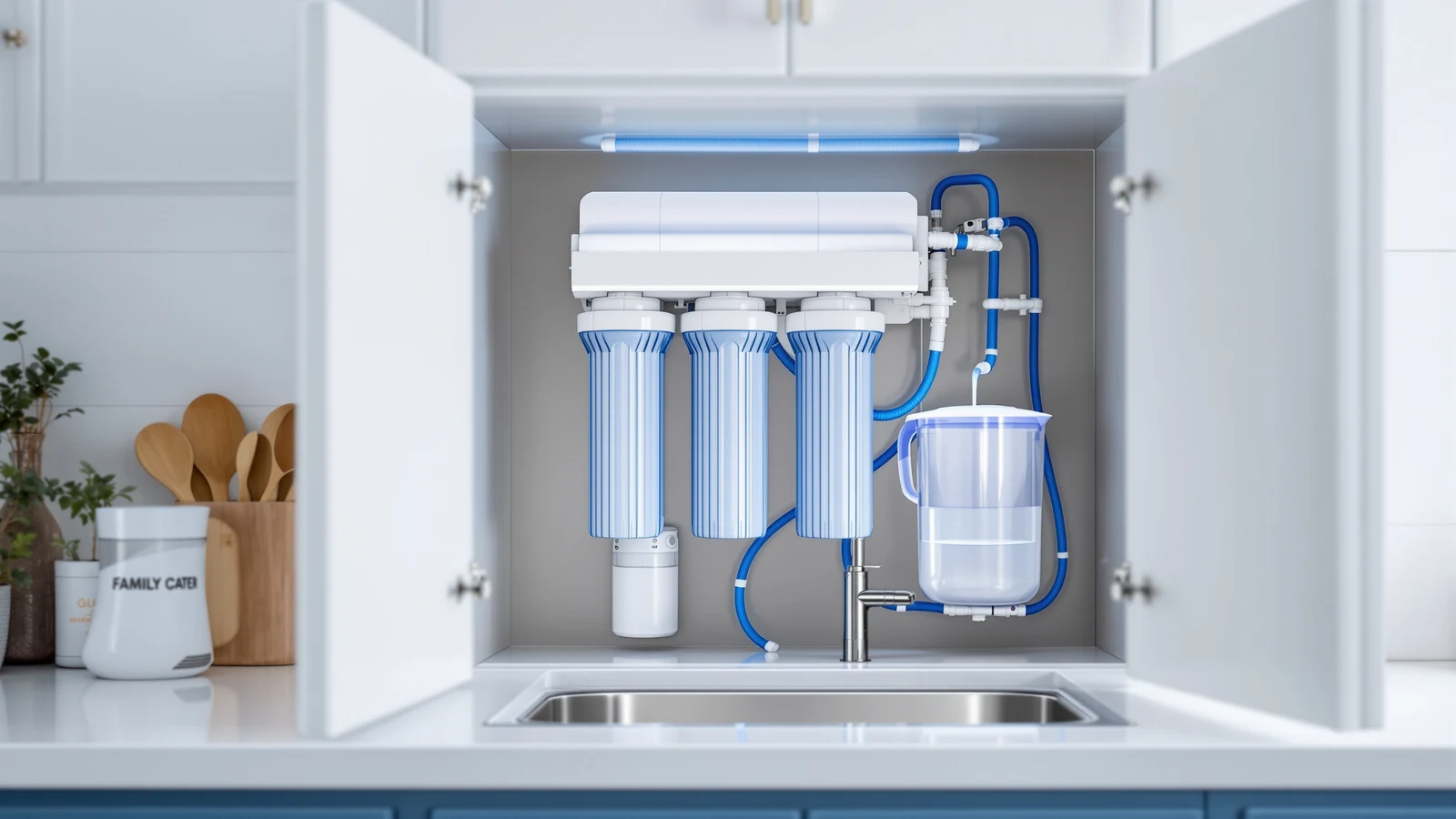
Under-sink tankless reverse osmosis system installed in a busy family kitchen with a large stockpot being filled at the sink

Most reverse osmosis buying guides size a system by counting bedrooms. That's the wrong unit. What determines whether a system keeps up in a busy kitchen is gallons per day — GPD — measured against how many people draw from it, how many separate taps and appliances are plumbed to the same line, and how much of that water gets used in short, heavy bursts rather than sipped a glass at a time.

"Large family" as a shopping category usually means five or more people under one roof, and the honest sizing question isn't "how many of us are there" so much as "how many of us might want water from this system at the same moment." A single person filling a glass twice a day never stresses a system's rated output. Five people making breakfast, one running the coffee maker, one filling a kettle, one rinsing a pot, inside the same fifteen-minute window, is a completely different load — even if the two households use a similar total number of gallons by day's end. That's the gap a 400 GPD residential unit, sized for a couple's average daily use rather than concurrent, back-to-back draws, starts to show.

Cooking water is the part most buying guides skip. A household that only drinks and makes coffee from its RO tap draws in small, spread-out increments. One that also fills stockpots for pasta, rinses rice, or tops off a slow cooker is asking the system to sustain a continuous draw for a minute or two at a time, several times a day — a much closer test of real throughput than the GPD number on the box was ever meant to describe alone. We work through what that number actually measures in our plain-language explainer on GPD ratings — read it first if "gallons per day" still sounds like a spec rather than a lab average.

None of this means every household of five needs the biggest system on the shelf. The sizing conversation should start with taps, appliances and cooking habits, not head count — we come back to exactly when the bigger tier isn't worth paying for near the end of this guide.
The 600-800 GPD tier: what's actually different from a 400 GPD residential unit

GPD is a manufacturer's lab figure — the volume of filtered water a membrane can produce over a continuous 24-hour period under a specific set of test conditions the manufacturer chooses. It is a useful yardstick for comparing systems tested under similar conditions, and a rough proxy for the tier a unit belongs to, but it is not a number you draw in one sitting. Do the arithmetic and the difference between tiers gets concrete fast: a 400 GPD unit averages out to roughly 0.28 gallons a minute over a full day; 600 GPD works out to about 0.42 gallons a minute; 700 GPD to about 0.49; and 800 GPD to about 0.56 — essentially double the 400 GPD baseline. That doubling is the entire pitch of this tier, and it's why "more than a 400 GPD residential unit" is the right way to frame the upgrade rather than simply "a bigger number."

What buys that extra daily throughput, mechanically, is a general story rather than a spec sheet: manufacturers typically get there with a stronger booster pump, a membrane rated for higher sustained flow, or in some designs a second membrane element working in parallel with the first. None of the four systems in this guide publish a membrane count, pump wattage or internal architecture we could verify, so we won't assign a specific mechanism to a specific box — a direct question to the listing or the manufacturer if that detail matters to you.

The four systems we cover here span exactly this tier: the VIOMI V6 at 600 GPD, the Waterdrop G5P700A at 700 GPD, and the Waterdrop X8-WAN and Waterdrop G3P800 both at 800 GPD. That 200 GPD spread across the group is roughly the same size as the whole gap between a 400 GPD residential unit and this tier's own entry point — worth remembering before assuming "they're all basically the same, just pick the cheapest."

Recovery time and drain ratio at high draw: why a fast tankless unit doesn't run dry

A classic reverse osmosis system stores its output in a small pressurized bladder tank ahead of the faucet, because the membrane itself produces water too slowly to satisfy a normal tap flow directly. Draw the tank down and you're waiting on "recovery time": the minutes or hours it takes the membrane to refill the tank before the next full-pressure draw is available. Our tankless versus tank comparison walks through that mechanism if you're choosing between the two formats rather than just this tier.

All four systems in this guide are tankless, which changes the question. There's no bladder to draw down and no recovery window to wait out, because the unit produces water on demand rather than releasing what it stockpiled earlier. The constraint moves from "how much did we store in advance" to "can the unit sustain output for as long as the tap is open" — exactly what the higher GPD ceiling in this tier is built to answer. A family filling cup after cup, or running the tap through a full stockpot fill, is testing sustained output, not stored capacity, and that's the scenario a 400 GPD residential unit is least equipped to handle gracefully.

Drain ratio is the other half of high-draw performance. Every RO membrane rejects a portion of the incoming water to the drain, and manufacturers publish that split as a ratio — the lower the "waste" side, the less water goes down the drain per gallon produced. None of the four listings here publishes a drain ratio we could verify, so we're not assigning one to any of these four systems. In general, a higher-GPD tankless unit sustaining a long, continuous draw for a family dinner also sends proportionally more total water down the drain over that stretch than a smaller system would for the same job — which is exactly why the ratio is worth confirming on the specific listing, not treated as a footnote. Our waste-water ratio explainer covers how to read that spec and what a "bad" number costs on a metered water bill.

Dispensing speed under back-to-back use

The GPD rating is a 24-hour average, not the rate water leaves the faucet while you're standing there holding a stockpot under it — the single most common misreading of this spec, and we walked through the arithmetic above for exactly that reason. What determines how a system feels at the tap during a real dinner-prep rush is closer to two things: how the booster pump behaves under a sustained draw, and how big the tubing and faucet valve are — neither disclosed on any of the four listings in this guide, so we won't print an invented gallons-per-minute figure for any of them.

What we can say from general first principles is where tankless systems have a structural advantage here. A tank-fed system's flow rate is tied to the tank's own air charge, which drops as the stored volume empties, so a big pour late in the draw runs noticeably slower than the first cup. A tankless unit's pump works for the entire time the tap is open, so flow doesn't taper the same way. That's the practical benefit of this tier for a large family: filling four cups back to back, or running the tap continuously for a stockpot, is closer to what these systems were built for than a 400 GPD unit, let alone a tank-fed system sized for a couple.

The caveat: "closer to what it was built for" is not a guaranteed number of seconds per cup. Feed pressure, water temperature and how many other fixtures share the line all move the real result up or down. If flow rate decides your purchase, that's a question for the listing or the manufacturer, not a number this guide will estimate.

The picks

Four systems built for the 600-800 GPD tier

All four are tankless, under-sink systems in the tier this guide covers. Ranked here by rated output, then price. Confirm the live price before buying.

ModelTypeRated outputPrice
VIOMI V6Tankless · under-sink600 GPD$219.98Price
Waterdrop G5P700ATankless · alkaline · under-sink700 GPD$289.99Price
Waterdrop X8-WANTankless · alkaline · undersink800 GPD$599.00Price
Waterdrop G3P800Tankless · under-sink800 GPD$759.00Price
01Entry to the tier

VIOMI V6

The cheapest way past 400 GPD
600 GPD · Tankless · under-sink

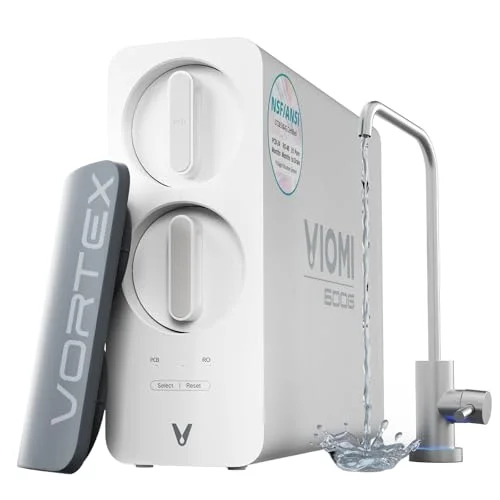
At $219.98 this is the lowest-priced route into this tier — a genuine step up from a 400 GPD residential unit without paying for the 800 GPD ceiling most large families won't consistently use. Start here if your household has one busy kitchen tap and no second RO outlet planned; if a fridge or dishwasher line is on the horizon, read the sizing math for a second outlet below first.

VIOMI V6 600GPD under sink tankless reverse osmosis water filtration system
$220
Tankless · 600 GPDCheck price →
02Alkaline step-up

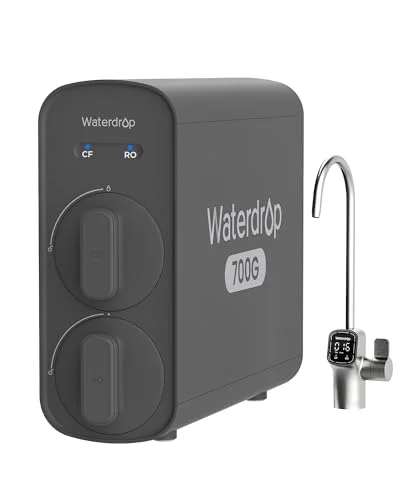
Waterdrop G5P700A

100 more GPD than the V6, and minerals added back
700 GPD · Alkaline mineral · Tankless

At $289.99, the G5P700A sits between the V6 and the two 800 GPD systems on price and output, and adds an alkaline mineral stage the V6 lacks — putting calcium and magnesium back after the membrane strips them out. That mix of moderate price, a real throughput step up, and remineralization makes it a reasonable middle path for a family that wants headroom over 600 GPD without the premium the 800 GPD picks carry. Our guide to remineralization filters covers what that stage does and doesn't change.

Waterdrop G5P700A alkaline mineral reverse osmosis water filter, 700 GPD
$290
Alkaline · 700 GPDCheck price →
03Best for a second outlet

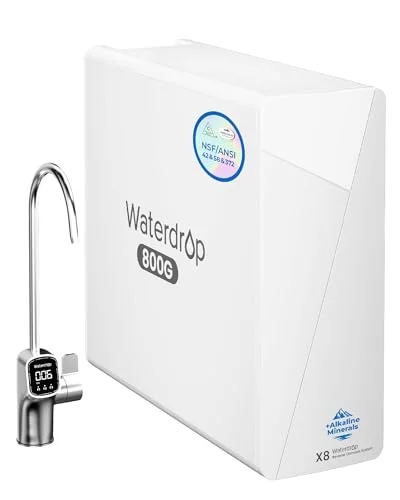
Waterdrop X8-WAN

800 GPD with the alkaline stage built in
800 GPD · Alkaline mineral · Tankless · undersink

The X8-WAN pairs the top of this tier's output — 800 GPD, tied with the G3P800 below — with the same alkaline mineral stage as the G5P700A, at $599.00. That mix of headroom and remineralization is the profile to reach for first if a second outlet, to a fridge or dishwasher, is part of the plan: splitting draw across two fixtures eats into the ceiling a single-tap household never touches. We size that trade-off out in the second-outlet section just below.

Waterdrop X8-WAN alkaline mineral tankless reverse osmosis system undersink, 800 GPD
$599
Alkaline · 800 GPDCheck price →
04Top of the tier

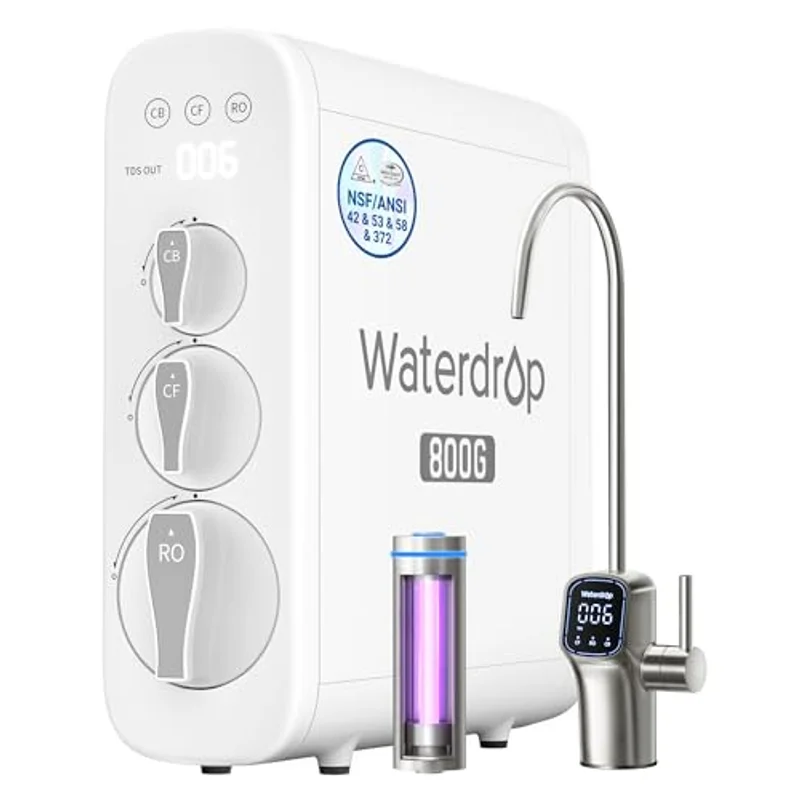
Waterdrop G3P800

The most expensive pick, without the alkaline stage
800 GPD · Tankless · under-sink

At $759.00 the G3P800 matches the X8-WAN's 800 GPD ceiling but skips the alkaline mineral stage, priced $160 above it as a result — worth resolving directly against the X8-WAN before paying it, since on the specs available here the difference between these two 800 GPD picks comes down to minerals added back after the membrane, not how much water either can produce in a day. If remineralization isn't something you want, or you already have a standalone cartridge for it, this reaches the same 800 GPD ceiling without paying for a stage you won't use.

Waterdrop G3P800 reverse osmosis water filter, 800 GPD, tankless RO system
$759
Tankless · 800 GPDCheck price →

Where a second outlet for a fridge or dishwasher fits the sizing math

A large family is also the household most likely to eventually want a second point plumbed to the same RO system — a fridge door dispenser and ice maker, a dishwasher's rinse-aid-free fill, or a dedicated coffee maker line. Every one of those is a second draw point competing for the same daily GPD ceiling as the main kitchen faucet, not a separate budget on top of it. Our guide to plumbing RO to a fridge and ice maker and our piece on running RO to a dishwasher or coffee maker cover the plumbing side; the sizing side is simpler to state here.

If a second outlet is anywhere in your plans, size up rather than sizing to today's single-tap usage. A 600 GPD system splitting its ceiling between a kitchen faucet and a fridge line has materially less headroom left over during a simultaneous draw than an 800 GPD system doing the same split, even though neither listing publishes a number showing exactly how the two draw points share load in practice. That's the reasoning behind treating the two 800 GPD picks here, the X8-WAN and the G3P800, as the safer buy for a household that already knows a second outlet is coming, and the 600 GPD VIOMI V6 as the better fit for a family certain it will stay single-tap.

Filter and membrane replacement cost scaling with higher throughput

A bigger sticker price is the visible half of buying into this tier. The less visible half is the replacement cartridge schedule, and none of the four listings in this guide publishes a replacement cartridge price or part number we could verify, so we won't invent one and present it as sourced data. What we can walk through is the general mechanism, because it matters directly to a large family's math.

Sediment and carbon cartridges are typically rated on whichever comes first of a time window or a gallon count — "six months or 550 gallons" is the shape of a typical rating in this category. Our filter replacement cost guide makes the point plainly: that printed interval is a gallon number wearing a calendar costume, calculated against an assumed household's usage, not yours. A family of five running more total daily gallons through a 700 or 800 GPD system — especially one also feeding a second outlet — will push toward the gallon side of that rating faster than a couple would on a smaller unit, even where the printed time window looks identical. Expect to hit the cartridge-change point on the calendar-early side of whatever interval the manufacturer prints, not the late side.

The two alkaline picks here, the G5P700A and the X8-WAN, also carry a remineralization stage the V6 and the G3P800 lack, typically replaced on its own separate, longer cycle from the sediment and carbon cartridges — a genuine added line item, though we don't have a sourced price for it on either system. Whichever you land on, it's worth knowing before you buy whether its cartridges are a standard universal size or a proprietary part only the manufacturer sells — a decision that affects every year you own the system. Our quick-change versus universal filters guide breaks down what that lock-in costs over time.

When a smaller, cheaper system is still the better buy for five people

Everything above argues for headroom, so the counter-case deserves equal weight: more people in the house is not, by itself, a reason to buy the biggest GPD number on the shelf. GPD is a continuous 24-hour lab ceiling, and no household draws water non-stop all day. A family of five that shares one kitchen tap, has no fridge or dishwasher line planned, and rarely fills a stockpot straight from the RO faucet may never stress even a 400 GPD residential unit, let alone need the 700-800 GPD tier.

This tier earns its higher price specifically when the load is concurrent or sustained: several people wanting water at once, a second outlet on the same line, or regular stockpot-scale fills. Strip those scenarios out and the extra throughput sits unused, while the smaller system is both cheaper to buy and — per the section above — generally easier on the replacement-cartridge schedule. If that's your household, our roundup of reverse osmosis systems under $250 is a better starting point, and our GPD explainer is the fastest way to work out which category actually describes your kitchen.

How we picked

Four listings that share the tier that matters

We looked for tankless, under-sink systems rated between 600 and 800 GPD — the tier a household outgrows a 400 GPD residential unit into — and kept the four with a clear published output figure and a current Amazon listing. We didn't require a full spec sheet beyond output, form factor and, where stated, an alkaline mineral stage; several publish little beyond that, and we say so rather than filling gaps with an inferred number.

How we compared

Research, not a lab

We're honest about this: we don't physically test these systems and we don't run a testing lab. We compare published specifications, listed features and live pricing, and we're explicit wherever a listing doesn't publish a spec we'd want to compare — drain ratio and cartridge pricing chief among them here. Amazon no longer exposes star ratings through its product API, so you won't find invented ratings or review counts on this page.

FAQ

Common questions

What GPD size should a family of five or more buy?

It depends on how many taps and appliances draw from the system and whether draws overlap, not just on how many people live in the house. A household with one busy kitchen tap and occasional stockpot fills is usually well served by the 600 GPD entry point in this tier. A household planning a second outlet — a fridge, an ice maker, a dishwasher — or one that regularly has several people wanting water within the same few minutes should size toward the 700-800 GPD end of the range, since that headroom is what a 400 GPD residential unit lacks.

Does a higher GPD rating mean water comes out of the faucet faster?

Not directly. GPD is a manufacturer's lab figure for continuous production averaged over 24 hours, not a measurement of instantaneous flow at your tap. Run the arithmetic and 800 GPD works out to roughly 0.56 gallons a minute averaged across a full day, against about 0.28 for a 400 GPD unit — a real difference in sustained capacity, but not a guarantee of exactly how fast a single cup fills, which depends on your home's feed pressure and the system's own pump and tubing.

Do I need a bigger system if I'm adding a line to the fridge or dishwasher?

Generally yes. A second outlet is a second draw point competing for the same rated GPD ceiling as your main kitchen faucet, not a separate allowance on top of it. If a fridge, ice maker or dishwasher line is part of your plan, sizing toward the 800 GPD end of this tier — rather than the 600 GPD entry point — leaves more headroom for both fixtures to draw at once.

Are the filters more expensive on a 700-800 GPD system than a smaller one?

We don't have sourced cartridge prices for the four systems in this guide, so we won't put a number on it here. What we can say generally is that a higher-throughput household pushes more total gallons through the same cartridges, which tends to hit gallon-based replacement thresholds sooner than the printed time window suggests — meaning more frequent changes in practice, even where the sticker interval reads the same as a smaller system's.

Keep reading

Next, if you're still choosing