Reverse osmosis water for baby formula: what to know before you mix a bottle
We're reader-supported: buying through our links may earn us a commission at no extra cost to you. This article compares published specifications and general public-health guidance — it is not medical advice, and it is not a substitute for your pediatrician.
The question arrives at roughly the same moment as the diaper bag and the swaddle blankets: is the water coming out of the tap good enough to mix into a bottle, or should it go through something first? For most households the honest answer is that ordinary tap water is fine for formula, and a pediatrician can confirm that for your specific water supply in about thirty seconds. But the question keeps coming up for a reason — reverse osmosis changes water in ways that matter differently once the person drinking it is eight pounds and drinking nothing else. This is a walk through what actually changes, what the general guidance says about fluoride, why some parents make the switch anyway, and the one part of the routine — sanitizing — that deserves more attention with formula water than it usually gets with everyday drinking water.
Start with the mechanism, because most of what follows depends on it. A reverse osmosis membrane forces water through a semi-permeable film under pressure, and the pores are small enough that dissolved solids — not just visible particles — get left behind on the reject side while purified water passes through. That is a fundamentally different job from a carbon pitcher filter, which mostly adsorbs chlorine, taste and odor compounds and leaves dissolved minerals alone. RO membranes are built to reject the large majority of what is dissolved in the feed water: calcium, magnesium, sodium, nitrates, fluoride, and — depending on the system's stage count and certification — a wide range of other contaminants. We go through that list contaminant by contaminant, and where RO's limits actually are, in what reverse osmosis actually removes — and what it misses; the short version for this article is that RO produces water with a near-total mineral content, not a partially-reduced one.
That distinction is what makes formula water a different conversation from drinking water. An adult's mineral intake comes overwhelmingly from food, so whether their glass of water carries municipal-average calcium and magnesium or almost none of either is a rounding error next to dinner. An infant on formula is, for months, getting effectively all of their nutrition — including whatever the reconstituting water contributes or fails to contribute — from a fairly small, repeated set of ingredients. That is not a reason to panic about RO water and formula; commercial infant formula is engineered specifically to be complete when mixed with water that adds little of its own, which is a large part of why RO comes up as an option at all. It is a reason the water source is worth understanding rather than assuming is interchangeable with whatever came out of the tap the week before.
The other change worth naming plainly: RO water also strips out fluoride, along with everything else it removes. In most U.S. municipalities, fluoride is intentionally added to the public water supply at a target concentration for the specific purpose of reducing childhood tooth decay. An RO membrane does not distinguish between the fluoride the utility added on purpose and the minerals it did not — it rejects both. That single fact is the hinge the rest of this article turns on, and it deserves its own section rather than a passing mention.
Fluoride and formula: the general guidance, stated plainly
Here is what is well established and not particularly controversial, stated as plainly as we can manage without turning it into medical advice. Community water fluoridation exists because fluoride, at low concentrations, measurably reduces cavities across a population. Separately, dental researchers have long documented that infants who are fed formula reconstituted exclusively with fluoridated tap water, over an extended period during the specific window when permanent teeth are forming under the gums, have a somewhat higher chance of developing mild dental fluorosis — faint white flecking or lines on the teeth once they come in. It is described as a cosmetic effect on the enamel's appearance, not a disease, and it is dose- and duration-dependent rather than an all-or-nothing outcome.
That is the entire finding, and it is narrower than it often gets repeated. It is not a statement that fluoridated tap water is unsafe for infants, that formula-fed babies need special water, or that reverse osmosis is required or even preferable. It is a statement about one specific, low-probability, cosmetic outcome tied to one specific feeding pattern — exclusive, long-duration mixing with fluoridated water — and general dental guidance in that narrower space has, at times, suggested that parents who want to reduce that specific exposure can use low-fluoride water (which includes RO-treated water, distilled water, or water explicitly labeled low-fluoride) for some or all bottle preparation, particularly during infancy.
What none of that tells you, and what only your pediatrician or a family dentist can, is: what your community water supply's actual fluoride level is, whether your baby is getting fluoride from anywhere else, whether your family's dental history makes the cosmetic outcome something you'd rather avoid, and whether your formula is a powder that needs reconstituting at all or a ready-to-feed liquid that needs no added water in the first place. Those four facts change the calculation completely, and we do not have any of them about your household. If fluoride is the reason you're weighing an RO system, that conversation belongs with a pediatrician before it belongs with a filter comparison — this article can tell you what changes about the water; it cannot tell you what is right for your baby.
Why some parents choose RO for formula water — and what they're actually solving for
Set the fluoride question aside for a moment, because it is only one of several reasons this comes up, and often not the main one. Talk to parents who have already made the switch and a handful of recurring motivations show up, none of which require a medical claim to explain.
Consistency, batch to batch. Municipal water quality is not a fixed number — it shifts with the season, with upstream construction, with a boil-water notice two towns over, with whatever the utility is flushing through the mains that month. A parent mixing eight bottles a day for months does not want the water's mineral load, taste or clarity to be a variable. RO water, by design, starts from close to zero total dissolved solids every time, which makes the input the one constant in an otherwise chaotic newborn routine.
Old plumbing and lead. Homes built before the late 1980s, and some public supply lines even in cities with modern treatment, can still have lead solder or lead service lines somewhere between the treatment plant and the kitchen faucet. Lead exposure is a genuine concern in infancy specifically because a developing nervous system is more sensitive to it than an adult one — this is well-established public health information, not a claim about any product on this page — and an RO membrane is one of the more effective consumer-grade ways to remove lead that has leached into water after it left the treatment plant. For a parent who does not know their service line's age or material, that uncertainty alone is often enough to justify filtering the water going into every bottle.
Not wanting to run a plumbing project during maternity leave. Under-sink systems need a drain saddle, a feed valve and usually a dedicated faucet hole, which is a reasonable ask when you have time and not a reasonable ask two weeks postpartum. This is exactly where a countertop unit earns its keep: no drilling, no cut into the supply line, plug it in and fill the reservoir. We cover the trade-offs of that format — what you give up in flow rate against what you gain in zero-install convenience — in the best reverse osmosis systems for renters, which is written for tenants but applies just as directly to anyone who wants purified water on the counter without a home-improvement project attached.
Two countertop carafe systems illustrate the actual product category well, and the difference between them matters for exactly the question this article is about — which is the subject of the next section.
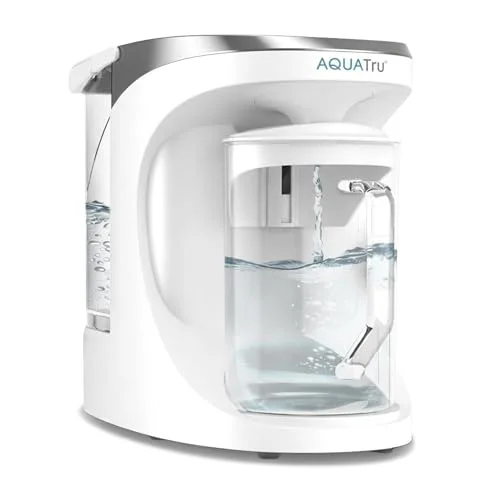
AquaTru Glass Carafe
A 4-stage countertop RO unit, plug-and-fill, no installation. Per its own listing it is built to remove 84 contaminants including PFOA and PFOS, lead and microplastics. No remineralization stage — the water it produces is not alkalized or mineral-added.
Check price →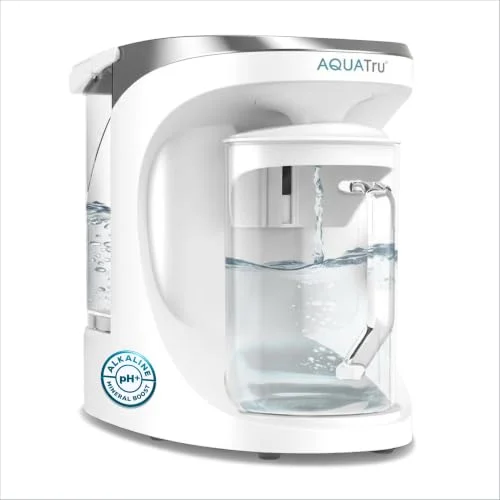
AquaTru Glass Carafe Alkaline
The same 4-stage countertop format and the same contaminant list, plus a stage that adds alkaline minerals back into the water after the membrane — a real, listed difference between the two, not a marketing color variant.
Check price →Remineralization filters: what they put back before you mix a bottle
Reverse osmosis, unmodified, produces water that is close to mineral-free. A lot of adults find that water tastes flat, so a large share of the RO market — both countertop carafes and under-sink systems — offers a version with an added remineralization or alkaline stage: a cartridge, placed after the membrane, that reintroduces calcium, magnesium and sometimes raises the water's pH before it reaches the faucet or spout. The AquaTru pair above is the cleanest illustration in this category, because the two units are otherwise the same machine: one leaves the post-membrane water alone, the other runs it through an added mineral stage. Under-sink systems make the same distinction at the cartridge level rather than the model level — a replacement filter set like the iSpring F6K75, listed as NSF certified and including an alkaline mineral filter for 6-stage systems, is built around the same idea as the alkaline AquaTru: the mineral stage is a distinct, identifiable, swappable part, not an inherent property of "reverse osmosis" as a category.
For everyday drinking water, which stage you pick is mostly a taste and pH preference with no strong right answer. For formula water, the calculation changes, and it changes in a direction that surprises some parents: adding minerals back is not obviously the better choice. Infant formula, whether cow's-milk-based or otherwise, is formulated by its manufacturer on the assumption that the water used to reconstitute it is not itself contributing a meaningful, variable mineral load — the nutrition is supposed to come from the formula, in the ratios the formula was designed around, not from whatever the local water happens to add on top. An alkaline or remineralized RO water product introduces exactly the variable — an added, non-standardized dose of calcium, magnesium and elevated pH — that plain RO water was chosen specifically to eliminate. Whether that variable is trivial or worth avoiding for a given baby is, again, a pediatric question and not one this article can answer for you; the useful thing we can do here is make sure you know the choice exists, because the marketing language for alkaline and remineralized water — "healthier," "more balanced," "closer to spring water" — is written for adults choosing a drinking water, not for parents choosing what to reconstitute formula with, and it does not flag the distinction on its own.
The practical takeaway: if a system or filter set in your kitchen has an alkaline or remineralization stage, know that it's there before you assume "reverse osmosis water" is a single, uniform thing. Read the cartridge list on the box or the listing, not just the marquee name on the front of the unit — a system built around quick-change proprietary cartridges and one built around universal 10-inch housings can both be sold as "6-stage" while one includes an added mineral cartridge and the other doesn't. If you're not sure which stages your system runs, the model number and stage list on the housing, or a replacement filter set like the iSpring F5-75 — a plain 5-stage set with a 75 GPD membrane and no added mineral cartridge — will tell you plainly what is and isn't in the water path, which is the actual information you need rather than a brand name.
Sanitizing and stagnation matter more with formula water than with drinking water
This is the part of the routine that gets the least attention relative to how much it matters, and it has nothing to do with fluoride, minerals or contaminant lists — it is about what happens inside the system between uses. Every RO system, tank or tankless, countertop or under-sink, has internal surfaces — a storage bladder, lengths of tubing, a faucet or dispensing spout — where water sits rather than flows. For an adult drawing a glass here and there through the day, a small amount of biofilm building up on those surfaces over weeks is a low-stakes proposition; adult digestive systems handle incidental low-level bacterial exposure routinely, and a lapse in the cleaning schedule rarely has a noticeable consequence.
That calculation is different for formula. An infant's immune system is still developing, formula itself is a nutrient-dense medium that supports bacterial growth readily if it sits at room temperature after mixing, and the water going into the bottle in the first place is the one ingredient a parent has full control over before anything else happens. None of that means an RO system is dangerous — properly maintained, it is not — but it does mean the manufacturer's sanitizing schedule, the one printed in the manual that adult households routinely stretch or skip, is worth actually following once that water is going into a newborn's bottle rather than an adult's water glass. Sanitizing typically means running a food-grade sanitizing solution through the empty housings and tank at a filter change, per the specific system's instructions, rather than merely swapping the cartridge and reassembling.
Two everyday signals are worth knowing, because they show up before anything is visibly wrong. First: a change in taste or smell from a system that has been sitting mostly unused — which happens often in a household where routines just got upended by a newborn — is usually stagnant water in the tubing or tank, not a contamination event, but it is the system telling you it wants a flush and, if enough time has passed, a proper sanitizing cycle before you trust it for a bottle again; we go through what's normal and what isn't in what's normal and what isn't when RO water tastes off, and the same signal applies to a system that has gone stale from disuse as to one that's brand new. Second: cartridges and membranes have a rated service life for a reason beyond throughput — a spent carbon block or an aging membrane is also a surface with more time and more organic material on it, and letting a filter run well past its interval is a maintenance lapse that compounds with everything else on this list. We cover realistic replacement windows, part by part, in how long a reverse osmosis system lasts, and for formula-water households, treating that schedule as a floor rather than a suggestion is the one piece of advice on this page that isn't really a judgment call.
None of this is a reason to avoid RO water for formula. It is a reason to treat the cleaning schedule as part of the deal, the same way sterilizing bottles is part of the deal, rather than an optional extra step that only matters if something already smells wrong.
What this article is not
This is a comparison of published specifications, filtration mechanisms and general public-health guidance — the same kind of research-based comparison we do for every product on this site. We do not run a testing lab, we have not tested any of these systems on infants, and nothing here is a recommendation for or against reverse osmosis water for your specific baby. Fluoride exposure, mineral intake and infection risk in infancy are pediatric questions with answers that depend on your water supply, your baby's health history and your formula type — three things we have no visibility into from a blog post. If you take one thing from this article, take the questions to ask your pediatrician, not a conclusion to act on without them.
Questions parents ask about RO water and formula
Is reverse osmosis water safe for mixing baby formula?
For most households, yes, in the sense that RO water is purified water with minerals and fluoride reduced or removed, and using it to reconstitute formula is common practice. Whether it's the right choice for your baby specifically — versus your regular tap water — depends on your water supply, your fluoride exposure and your pediatrician's guidance. This is general information, not a medical recommendation for your household.
Does reverse osmosis remove fluoride from water?
Yes. An RO membrane rejects dissolved fluoride along with the majority of other dissolved minerals and many contaminants, which is why RO water is considered a low-fluoride water source. Whether reducing fluoride exposure during formula feeding is advisable for your baby is a question for your pediatrician or dentist, not something a filtration guide can answer generically.
Should I use alkaline or remineralized RO water for formula?
Not necessarily by default. Alkaline and remineralization stages add calcium, magnesium and higher pH back into RO water, which is a taste and preference feature for adult drinking water. Infant formula is formulated assuming the reconstituting water isn't itself adding a variable mineral load, so plain, non-remineralized RO water is arguably the closer match to that assumption — but this is a question worth raising with a pediatrician rather than deciding from a product label.
How often should an RO system be sanitized if I'm using it for formula water?
Follow the manufacturer's stated sanitizing schedule, typically performed at each filter change, rather than skipping it as households sometimes do for everyday drinking water. Formula is a nutrient-rich medium and infants have less mature immune systems, so stagnant water sitting in tubing, a storage tank or a dispensing spout between uses is worth taking more seriously than it would be for an adult's water glass.