Best RO Systems
Home › Guides › Countertop tank sizes
Buying guide

Countertop Reverse Osmosis Tank Sizes Compared: How Much Water Before a Refill

We're reader-supported: buying through our links may earn us a commission at no extra cost to you. Every capacity and spec below comes from the manufacturer's own Amazon listing — we compare published numbers, we don't run a testing lab.

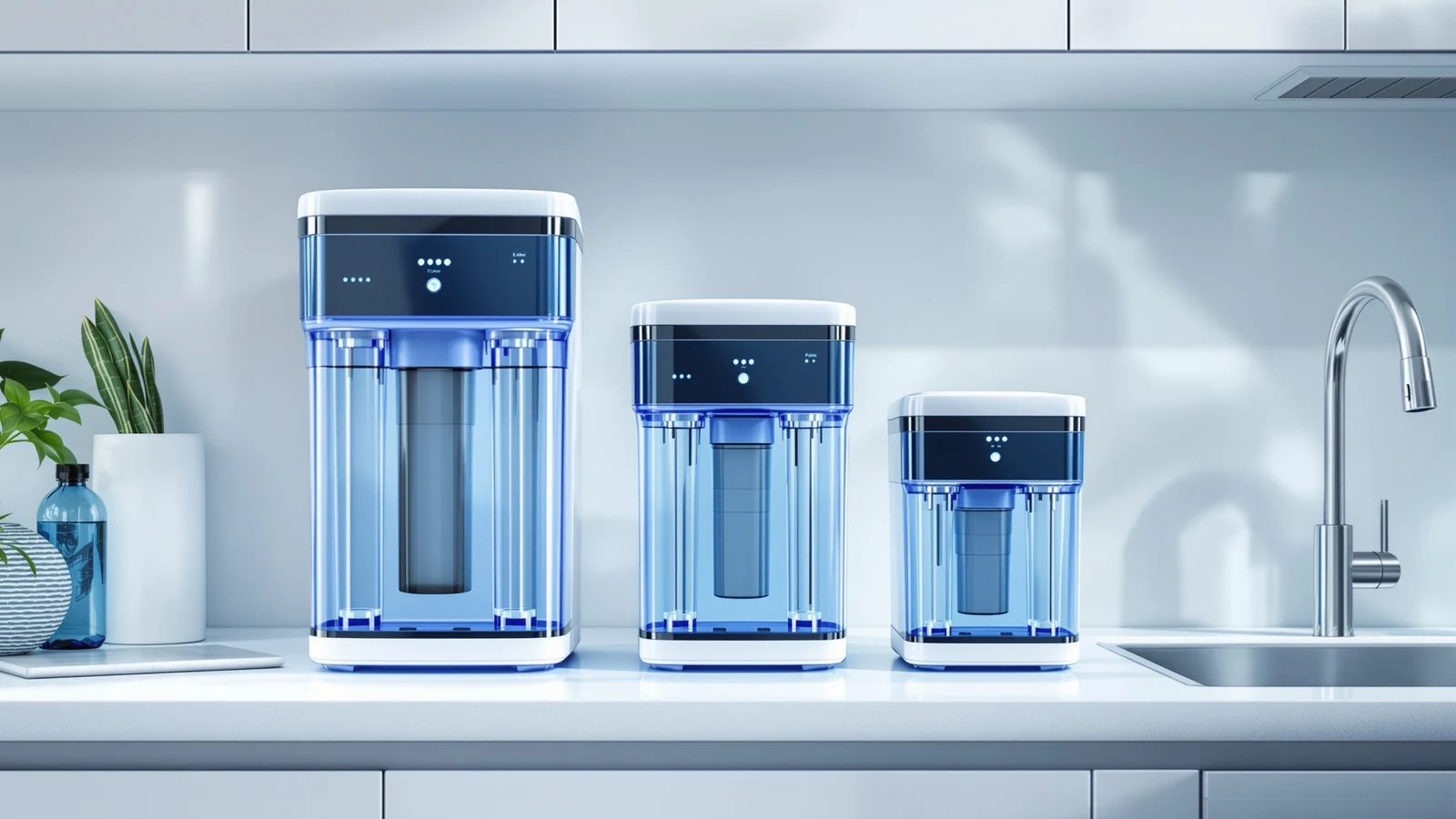
Three countertop reverse osmosis systems on a kitchen counter with their feed water tanks and purified water reservoirs visible side by side

The number on the box isn't the number that matters

Every countertop reverse osmosis system on Amazon leads with a number: 5 liters, 3.6 liters, a tank you can picture standing in your kitchen. It's the spec shoppers scan for first, and also the least useful one for predicting how the system behaves next Tuesday morning when you want a glass before the tank has caught up.

That's because the headline figure is almost always the capacity of the tank you fill with tap water — the feed tank — not the tank that hands you something to drink. The Aigerri Countertop Reverse Osmosis Water Filter with UV (ASIN B0H9MJH7CX) is the clearest example here: its listing leads with a 5-liter feed water tank, and only further down discloses a separate, smaller 2-liter purified water tank. Fill the 5-liter tank completely and you still only have 2 liters ready to pour at any one moment — the rest is raw tap water waiting its turn through the membrane, or water already down the drain as reject.

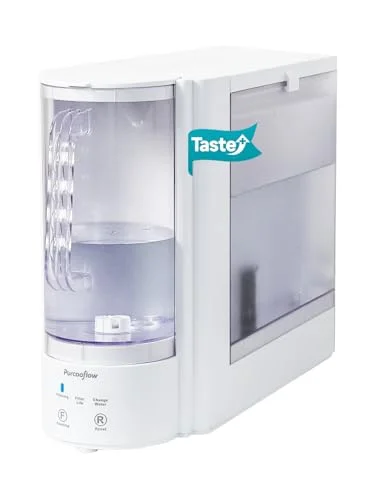
The Purcooflow Countertop Dual Carbon Reverse Osmosis Water Filtration System (ASIN B0GL53HKCZ) runs the same two-tank design at a smaller scale: a 3.6-liter feed tank paired with a 1.4-liter pitcher the system fills automatically, then stops. The PHILIPS Countertop Reverse Osmosis Water Filter, Installation-Free (ASIN B0GQLWS5Z8) skips the published tank number entirely and advertises a flow rate instead — a genuinely different answer, not a smaller version of the same one. Three products, three ways of telling you how much water you'll actually have, and none of them is the number printed largest on the box.

Feed tank versus purified-water tank: the two capacities every listing hides

Two very different jobs happen inside a countertop RO unit, and each has its own capacity that the marketing copy treats unevenly. The feed tank holds ordinary tap water waiting to be pushed through the membrane; its size decides how long the system can run before someone has to walk over and pour more water in. The purified-water tank — a pitcher, a reservoir, whatever the manufacturer calls it — holds the finished product, ready to drink without waiting on the machine; its size decides how much water is available the instant you want a glass.

Aigerri publishes both numbers: 5 liters feed, 2 liters purified. That's the most transparent of the three listings on this point, and also the one that makes the gap most visible — the purified tank holds only 40% of what the feed tank's headline number promises. Aigerri also rates its two cartridges (one PPC filter, one RO filter) for up to 529 gallons of purified water before replacement — a number that, like the tank size, tells you little until you attach a household to it.

Purcooflow publishes both figures too, at a smaller scale: a 3.6-liter feed tank and a 1.4-liter pitcher, with the system designed to auto-dispense into the pitcher from the base and stop once it senses full — no gauge to watch. The ratio here, about 39%, is nearly identical to Aigerri's, worth knowing if you assumed a bigger box meant a proportionally bigger drink-ready reserve. It mostly doesn't; it mostly means a bigger raw-water buffer between refills.

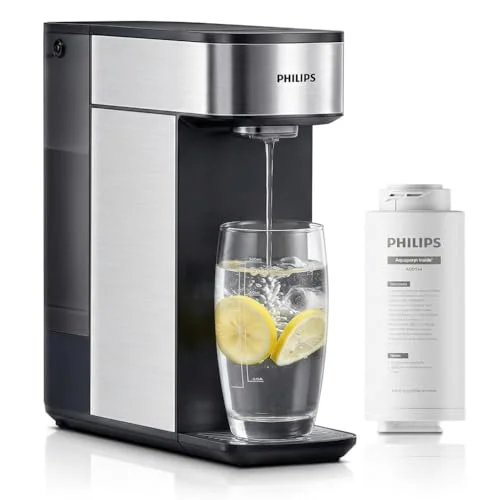
Philips is the outlier, and an instructive one. Its listing states a unit footprint (5 x 13 x 14 inches) and a flow rate (9 oz per minute), but never states a feed tank or purified-water tank volume. The only container capacity anywhere in the listing is the 16.9 oz glass bottle that ships with the unit — a portable bottle you fill and carry, not a stated internal reservoir spec. That's a real difference in design, not a gap in our research. If the two-tank capacity is the number you're shopping on, Philips's page won't give it to you. It's also worth knowing a freshly filled system can taste slightly off for the first few fills while a new cartridge settles in — what's normal and what isn't is a separate question from tank size.
Refill frequency for one person versus a family of four

Tank size only means something once you attach a household to it. As a rough planning assumption — not medical guidance, just a common rule of thumb for drinking and light cooking use — figure about half a gallon, roughly 1.9 liters, per person per day. Multiply by household size and compare the result against the purified-water capacities above.

One person at 1.9 liters a day: Aigerri's 2-liter purified tank just barely covers a full day if nothing else draws from it, though anyone who also fills a kettle or a pet bowl from the same tap will be back sooner. Purcooflow's 1.4-liter pitcher covers a bit under three-quarters of that daily figure, which in practice means refilling the feed tank roughly once a day, sometimes twice.

A family of four at the same 1.9-liter-per-person estimate needs about 7.6 liters a day. Against a 2-liter purified tank, that's on the order of four refill-and-reprocess cycles; against Purcooflow's 1.4-liter pitcher, closer to five or six. Run the same household size against Aigerri's 529-gallon combined filter-life rating, and cartridges that might last a single person the better part of three years get used up in under nine months — the same "big number, smaller everyday reality" pattern as the tank size itself. Neither pace is unreasonable for a countertop unit — nobody buys one to replace a 400-gallon-a-day under-sink system — but it's a different daily chore than "fill it in the morning and forget it." A household topping up four or more times a day is usually better served by a plumbed system sized for a family of four instead.

Philips complicates this math usefully. With no stated storage reservoir, it doesn't run "empty" the way a tank-based system does — it produces water on demand at its published 9 oz-per-minute rate for as long as the feed side has water to draw from. The limiting factor becomes how often you refill whatever holds the incoming tap water, and Philips doesn't publish that number, so it can't go on the same chart as the other two. For bursty daily draws that can be an advantage over a fixed-size purified tank, or an annoyance if the unpublished feed reservoir is small. There's also a case where the daily-liters estimate understates things: mixing baby formula calls for a specific, repeatable volume measured out several times a day, and a small tank needing frequent refills is a different routine than a large pitcher kept ready in the fridge.

Footprint versus capacity: the trade-off a small kitchen actually feels

Bigger tanks don't come free — they take up counter or cabinet space, and a countertop RO unit is worse at hiding that than an under-sink system tucked behind a cabinet door.

Philips is the most explicit about its footprint: 5 x 13 x 14 inches, a size the listing compares to roughly the space a coffee maker takes up — the smallest stated footprint of the three, though the trade for it is an unmeasured runtime, since there's no published tank size behind it.

Aigerri's footprint is stated in a way worth reading carefully: 16.1 inches when closed, but the listing also calls out roughly 22 inches of vertical clearance needed when open. That reads like a design that folds or telescopes upward to access the tanks, so the number that matters for fitting it under a cabinet isn't the closed measurement — it's whether you have 22 inches of clear space above the counter when you need to open it. A unit that looks compact closed can still be a poor fit under a low shelf.

Purcooflow's listing doesn't publish exterior dimensions at all — only a description of it as having a "compact footprint," an unquantified claim we can't verify from the spec sheet. If counter space is tight, that's a question for the current listing or its product photos, not one we can answer here.

All three also need an outlet, since all three are plug-in units — a real difference from the non-electric under-sink systems built to skip that requirement, and one more thing worth confirming about the spot you have in mind. None of the three needs a drain saddle, a feed valve or a dedicated faucet hole either — the entire installation kit that under-sink buyers have to think through in what actually comes in the box simply doesn't apply to a countertop unit.

Counting the fill-to-drink wait most listings don't mention

Tank size tells you how much water is available; it says nothing about how long you'll stand at the counter waiting for more once the tank runs dry. Only one of these three listings gives us a published number to do that math with.

Philips states a flow rate of 9 oz (266 ml) per minute — a spec we can turn directly into a wait time rather than a marketing phrase. An 8 oz glass takes about 53 seconds at that rate; the 16.9 oz glass bottle Philips ships with the unit takes just under two minutes from empty. The listing frames the rate honestly, noting it's slower than a kitchen tap but calling it strong for a countertop RO system specifically, and the arithmetic backs that up — it's a real, checkable number, not an adjective.

Purcooflow and Aigerri don't give us that option. Purcooflow's listing describes the system filling its 1.4-liter pitcher automatically and stopping when full, with no stated flow rate or fill-time figure. Aigerri leans on phrasing instead of a spec, promising purified water "in minutes" without a number — which could mean two minutes or fifteen. We're not going to convert that phrase into a number just to complete a table; the honest answer is that the wait time isn't published for either one, and it's worth asking in the listing's own Q&A before assuming it matches Philips's rate.

The picks

The picks, ranked by stated tank size

Biggest published capacity to least — with the caveat that "biggest number" and "best fit for your kitchen" are two different questions, as the sections above should make clear.

01Largest published tanks

Aigerri Countertop Reverse Osmosis Water Filter with UV

For the household that wants the numbers up front
5L feed · 2L purified · 5:1 drain ratio · 5-stage + UV

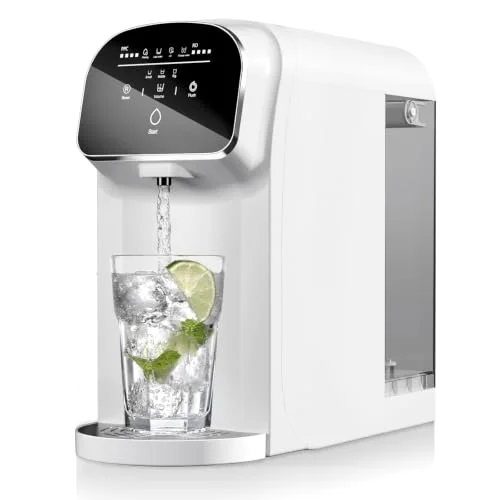
Aigerri publishes the most complete capacity picture of the three: a 5-liter feed tank and a separate 2-liter purified-water tank, plus a 5:1 pure-to-drain ratio the listing calls its most water-efficient spec. Five filtration stages including a UV step, with the PPC and RO cartridges rated for up to 529 gallons combined before replacement — a number that, like the tank sizes above it, means something very different for one person than for a family of four running through it in well under a year at the estimate in this guide. The trade for the bigger numbers is the footprint: 16.1 inches closed but roughly 22 inches of vertical clearance to open it, so measure the space above the counter before assuming compact-closed means compact everywhere.

Aigerri countertop reverse osmosis water filter with UV, 5-liter feed tank and 2-liter purified water tank
$259.99
5L / 2LCheck price →
02The mid-size, auto-stop pitcher

Purcooflow Countertop Dual Carbon Reverse Osmosis Water Filtration System

For a smaller household that wants to set it and forget it
3.6L feed · 1.4L pitcher · 3.5:1 drain ratio · SGS-verified to NSF/ANSI 58

Purcooflow pairs a 3.6-liter feed tank with a 1.4-liter pitcher and automates the handoff between them: fill the raw-water tank, set it on the base, and the two-filter, four-stage system fills the pitcher and stops on its own rather than needing you to watch a gauge. At a 3.5:1 pure-to-drain ratio it sits between the other two systems here, and the listing cites SGS-verified testing against NSF/ANSI 58 for its filtration claims. What it doesn't publish is an exterior footprint in inches — call it the one open question left on an otherwise fully specified listing.

Purcooflow countertop dual carbon reverse osmosis water filtration system with 3.6-liter feed tank and 1.4-liter pitcher
$195.99
3.6L / 1.4LCheck price →
03No published tank, a different design

PHILIPS Countertop Reverse Osmosis Water Filter, Installation-Free

For anyone who'd rather have a flow rate than a reservoir
Flow-fed design · 9 oz/min · 5-stage + Aquaporin Inside · NSF/ANSI 58 & 372

Philips is the pick that breaks the ranking, because it doesn't publish a feed or purified tank capacity to rank in the first place. What it does publish is a flow rate — 9 oz per minute — a 5 x 13 x 14 inch footprint, and 5-stage filtration built around Aquaporin Inside membrane technology, certified to NSF/ANSI 58 and NSF/ANSI/CAN 372, with the filter core separately SGS-certified. The integrated filter is rated for up to 12 months, and like most countertop units — unlike the swappable universal cartridges we cover in quick-change versus universal housings — it's a proprietary part built into this specific model, not something you'll find a generic substitute for. If a stated tank number is what you're comparing systems on, Philips's listing won't give you one to put in the spreadsheet; you're buying a different kind of spec sheet, not a smaller version of the other two.

PHILIPS countertop reverse osmosis water filter, installation-free, with 9 ounce per minute flow rate
$229.98
Flow-fedCheck price →
At a glance

The three tank profiles, side by side

Every figure here is the manufacturer's own published spec. A dash means the listing does not state a number for that column.

ModelFeed tankPurified tank / flowDrain ratioPrice
Aigerri RO + UV5L2L5:1$259.99Price
Purcooflow Dual Carbon3.6L1.4L3.5:1$195.99Price
PHILIPS Installation-Free—9 oz/min—$229.98Price
How we picked

Three countertop systems, one specific question

We looked at three countertop reverse osmosis systems currently listed on Amazon and pulled every capacity-related figure their own listings publish: feed tank volume, purified-water tank volume, flow rate, drain ratio and stated footprint. Where a listing doesn't publish a number — as Philips doesn't for tank volume, and Purcooflow doesn't for footprint — we say so explicitly rather than estimating from a similar model.

How we compared

Research, not a lab

We're upfront about the limits here: we don't own these three systems and we don't run a testing lab, so every number in this guide is one the manufacturer chose to publish, not one we measured ourselves. The fill-to-drink figures are arithmetic performed on Philips's own stated flow rate. Amazon's product data does not surface star ratings or review counts for any of these three items, which is one more reason this comparison runs on published specifications rather than owner sentiment we don't have data for. Prices move on Amazon — confirm the current price and specs before buying.

FAQ

Questions people ask about countertop tank sizes

How big is the water tank on a countertop reverse osmosis system?

It depends which tank you mean, and that's the whole point of this guide. The Aigerri Countertop RO with UV publishes a 5-liter feed tank and a separate 2-liter purified-water tank. The Purcooflow Dual Carbon system publishes a 3.6-liter feed tank and a 1.4-liter pitcher. The PHILIPS Installation-Free system doesn't publish a tank volume at all — it states a 9 oz-per-minute flow rate and ships with a 16.9 oz portable bottle instead. Always check both the feed and purified figures separately; the bigger number on the box is almost always the feed tank, not the water you can actually pour right now.

Is a countertop RO tank big enough for a family of four?

Using a common planning estimate of about 1.9 liters per person per day for drinking and light cooking — not medical guidance, just a rule of thumb — a family of four needs roughly 7.6 liters a day. Against a 2-liter purified tank that's on the order of four refill cycles a day; against a 1.4-liter pitcher, closer to five or six. That's workable but it's a real daily chore, not a fill-it-once-and-forget-it system. A household refilling that often is usually better matched to a plumbed under-sink system sized for higher daily output than to a countertop unit.

Why doesn't every listing state a tank capacity?

Because not every countertop system is built around a stored reservoir. The PHILIPS Installation-Free unit is designed around a continuous flow rate — 9 oz per minute — rather than filling a tank and dispensing from it, so there's no purified-water tank volume to publish. Its feed side isn't sized in the listing either. That's a design difference, not a missing spec we could look up elsewhere, and it's worth confirming directly on the current listing before assuming any countertop system works like the two-tank designs.

How long does it take to fill a glass from a countertop RO system?

Only one of the three systems in this comparison publishes a flow rate to calculate that from. PHILIPS states 9 oz (266 ml) per minute, which works out to about 53 seconds for an 8 oz glass and just under two minutes for its own 16.9 oz bottle. Purcooflow and Aigerri don't publish a flow rate or fill time — Aigerri's listing only promises purified water "in minutes" without a number — so there's no equivalent figure to compare for those two.

Keep reading

Next, if you're still choosing