NSF 58 vs NSF 372 vs WQA: What RO Certifications Actually Mean
We're reader-supported: buying through our links may earn us a commission at no extra cost to you. We compare published specifications, certifications and prices — we don't run a testing lab.

Almost every reverse osmosis listing on Amazon carries a badge that says some version of "NSF Certified." It is one of the most effective three words in the category, and it is doing far less work than it looks like it's doing. There isn't one NSF certification for reverse osmosis systems — there are dozens of numbered standards, and a system can be legitimately certified to one of them while telling you nothing at all about the thing you actually care about, which is whether it removes what's in your water.
Three names show up constantly in RO listings, and they answer three different questions:
- NSF/ANSI 58 — does the system actually reduce the contaminants it claims to reduce, compared under a specified protocol at a specified pressure?
- NSF/ANSI 372 — is the plastic and metal the water touches free of meaningful lead content? It says nothing about filtration performance.
- WQA — not a standard at all, but a second organization, the Water Quality Association, that certifies products against the same ANSI-approved standards NSF uses. A WQA Gold Seal on 58 and an NSF mark on 58 are evidence of the same thing, from two different accredited labs.
The confusion is not an accident of consumer ignorance. A listing that says "NSF certified" without a standard number is technically true and functionally uninformative — it could mean the system reduces arsenic, or it could mean nothing more than that the faucet handle won't leach lead into your coffee. Below is what each mark actually tests, the sentence manufacturers use to blur the two, and a two-minute way to check any specific claim yourself before you buy — using the five certification statuses we could verify across the systems on this site as worked examples, not as a ranking.
NSF/ANSI 58: performance, against named contaminants, at a specified pressure
NSF/ANSI 58 is the standard written specifically for point-of-use reverse osmosis systems. To be certified against it, a manufacturer submits a complete system — not just a membrane — to an accredited lab, which runs it against a challenge water spiked with specific contaminants at concentrations set by the standard, at a fixed influent pressure (the protocol specifies 50 psi ± 5 psi as the standard test condition), and measures what comes out the other side.
Two things matter about how narrow that certification is. First, it is contaminant-specific. A system certified to 58 for total dissolved solids (TDS) reduction has been proven to reduce TDS under test conditions — it has not automatically been proven to reduce arsenic, PFOA, or hexavalent chromium unless those specific claims were also compared and listed on the certification. Reading "NSF/ANSI 58 certified" and assuming it covers everything a membrane could theoretically remove is the single most common misreading of the mark. Second, it is pressure-specific. The percentage reduction a membrane achieves is not a fixed property of the cartridge; it changes with feed pressure, and the certified figure is the one measured at the standard's test pressure — which is why low incoming water pressure at your own sink can leave you with worse real-world rejection than the certified number implies, even with a certified system installed correctly.
On this site, the iSpring RCC7AK-BN ($234.99) is certified to NSF/ANSI 58 as an entire assembled system, not as a membrane sold in isolation — the distinction that matters most, covered below. The Frizzlife M800 ($279.99) and the Waterdrop G3P600 ($429.00) both carry NSF/ANSI 58 alongside 372, meaning their listings claim both a performance certification and a materials certification — worth reading as two separate facts, not one combined stamp of approval.
NSF/ANSI 372: lead-free materials, and nothing about what the system removes
NSF/ANSI 372 exists for an entirely different reason. It's a materials standard, not a performance standard, and it governs how much lead can leach out of the wetted surfaces of a plumbing product — the housings, fittings, faucet body and any metal the water actually contacts as it passes through. A product certified to 372 has a weighted average lead content below the federal "lead-free" threshold set by the Safe Drinking Water Act's 2011 amendment (0.25% weighted average, calculated across the wetted surface area). That's a real, useful thing to certify. It has nothing to do with what the system filters out of your water.
A reverse osmosis system with no filtration performance certification at all can still be legitimately NSF/ANSI 372 certified — the system's plastic doesn't add lead to the water, but nobody has independently verified it reduces the contaminants already in your water before it reaches your glass. The Waterdrop G2P600 ($289.00) is the clean example here: its certification is NSF/ANSI 372 only. That is not a defect — lead-free materials is a genuinely good thing for a system that touches your drinking water to have — but it is a different claim from the one its 58-certified sibling, the G3P600, can make, and the two products sit one rung apart on the same comparison table specifically because of that gap.
The failure mode to watch for is a listing photo showing an NSF checkmark logo with no standard number printed anywhere nearby, next to marketing copy that talks about contaminant removal. The logo may be entirely real and still be certifying the plastic, not the performance being advertised next to it.
WQA: a second certifying body, testing to the same standards
The Water Quality Association is not a competing or lesser standard — it's a separate accredited certification body, alongside NSF International and IAPMO, all of which are authorized to test and certify products against the same set of ANSI-approved standards, including NSF/ANSI 58 and NSF/ANSI 372. A product carrying the WQA Gold Seal for 58 has been through comparable third-party testing to one carrying the NSF mark for 58; the organization doing the certifying changed, not the bar the product had to clear.
The APEC ROES-PH75 ($189.99) on this site is the WQA example: its listing states WQA certification rather than an NSF mark. Practically, that means you check WQA's own product listing to confirm which standard and which claims the certification covers — the same due-diligence step you'd take with an NSF mark, just filed under a different organization's database. What you should not do is treat "WQA certified" as a vaguer or lesser claim than "NSF certified" by default. Ask the same question of both: certified to which standard, for which claim, on which specific model number.
Where this gets genuinely confusing is those rare listings that name a certifying body without naming a standard at all — "WQA compared" or "NSF listed" with no 58, 42, 53, or 372 attached. That phrasing is a flag to look closer, covered in the next section, because it's structurally identical to the sentence manufacturers use to imply more than they've actually proven.
"Compared to NSF standards" vs "certified" — the sentence that does the deceiving
This is the single most valuable distinction in the whole category, and it lives in one preposition. "Certified to NSF/ANSI 58" means an accredited third-party laboratory ran the product through the standard's protocol, verified the results, and the manufacturer's facility is subject to ongoing surveillance audits to keep the certification current. "Compared to NSF/ANSI 58 standards" — or "compared in accordance with," or "meets NSF/ANSI 58 criteria" — can mean the manufacturer, or a lab the manufacturer hired directly, ran a test using the standard's methodology and is now reporting its own result. No independent body verified the claim, no ongoing audit exists, and there is no listing you can go check on a certifier's public database, because there is no certification — only a test the company chose to describe using certification-adjacent language.
Both sentences can be entirely honest. A company can genuinely have run the NSF/ANSI 58 protocol in a competent lab and gotten a real result. The problem is that "compared to standard" and "certified to standard" are marketed identically — same badge shapes, same confident font, often the same paragraph — while carrying completely different evidentiary weight. Certification means you can verify the claim independently, on a database the manufacturer doesn't control. Self-reported testing means you're trusting the seller's word about the seller's own product, dressed in the vocabulary of a standard that has an actual verification process the seller chose not to use.
The practical rule: any time a listing uses "compared to," "compared in accordance with," "meets the criteria of," or "designed to meet" in front of an NSF or WQA standard number, read it as an unverified claim until you've checked the certifier's own database — the two-minute process below. When a listing instead says "certified to NSF/ANSI 58" or shows a specific certification number, that's the sentence built to be checked.
Component certification vs whole-system certification
One more layer sits underneath all of this, and it's the one that trips up people who've already learned to check for a standard number. Certification can apply to a single component — most often the membrane — or to the assembled system as sold, including its housings, tubing, fittings and faucet. Those are not interchangeable claims, and a listing that shows a certified-membrane badge is not the same as a listing for a certified system.
Why it matters: a membrane certified in isolation was compared in a controlled test rig built by the certifying process, not in the plastic housing and fitting configuration the manufacturer actually ships. A whole-system certification means the exact assembly in the box — the one whose fittings could leach, whose housings could crack a seal, whose faucet is the last thing the water touches — was the thing compared and audited. iSpring's language for the RCC7AK-BN is explicit on this point: the system is certified to NSF/ANSI 58 as an entire assembly, and that phrasing is doing real work, because it rules out the weaker claim of a certified membrane bolted into an otherwise unverified housing.
This is also where swapping in an off-brand replacement cartridge quietly changes what you own. Whole-system certification describes a specific assembly of specific parts. Put an uncertified third-party membrane into a system that was certified as a complete unit, and the certification no longer accurately describes what's under your sink — the system may perform identically, or it may not, but the third-party paperwork that used to answer that question no longer applies to the parts actually installed.
Here's what each of the five systems on this site actually claims, as a reference for reading any other listing the same way:
| System | Certification claimed | What that mark actually covers | Price |
|---|---|---|---|
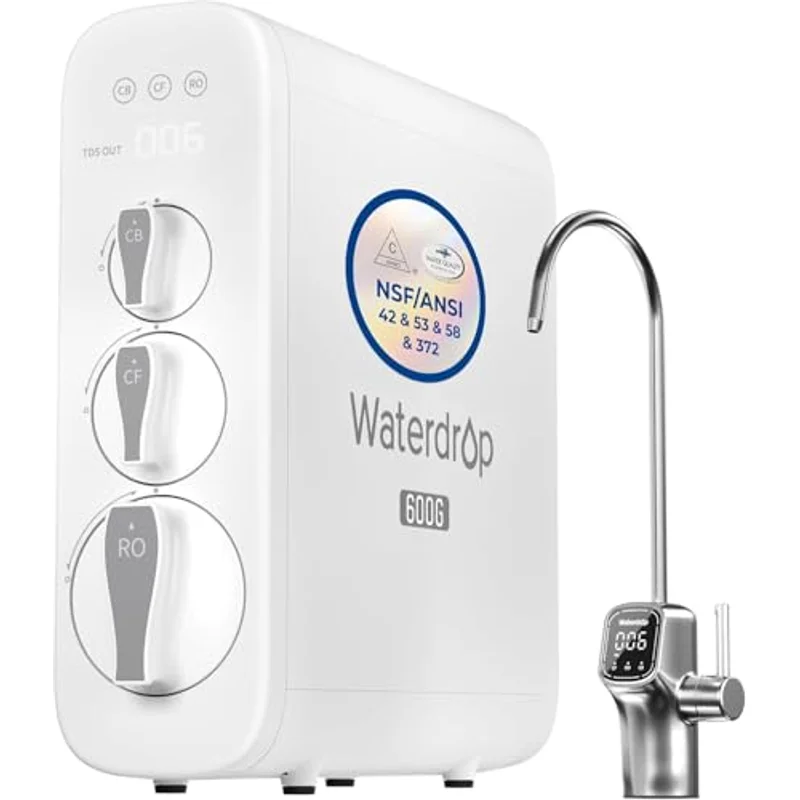 Waterdrop G3P600 Waterdrop G3P600 | NSF/ANSI 58 & 372 | Performance (TDS reduction) plus lead-free materials — both claims, separately certified | $429.00 |
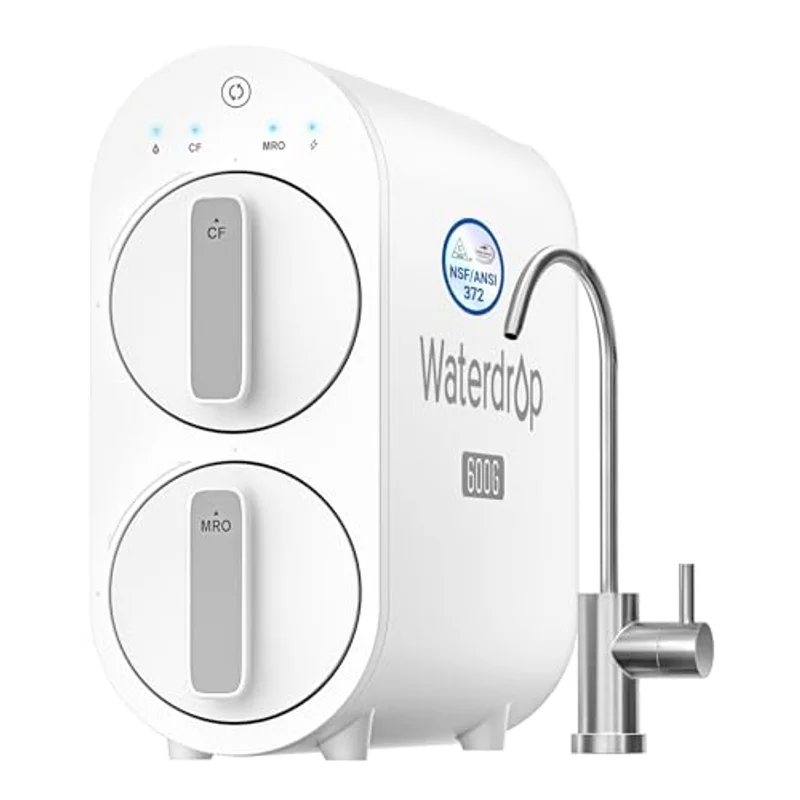 Waterdrop G2P600 Waterdrop G2P600 | NSF/ANSI 372 | Lead-free materials only — no filtration-performance certification on this model | $289.00 |
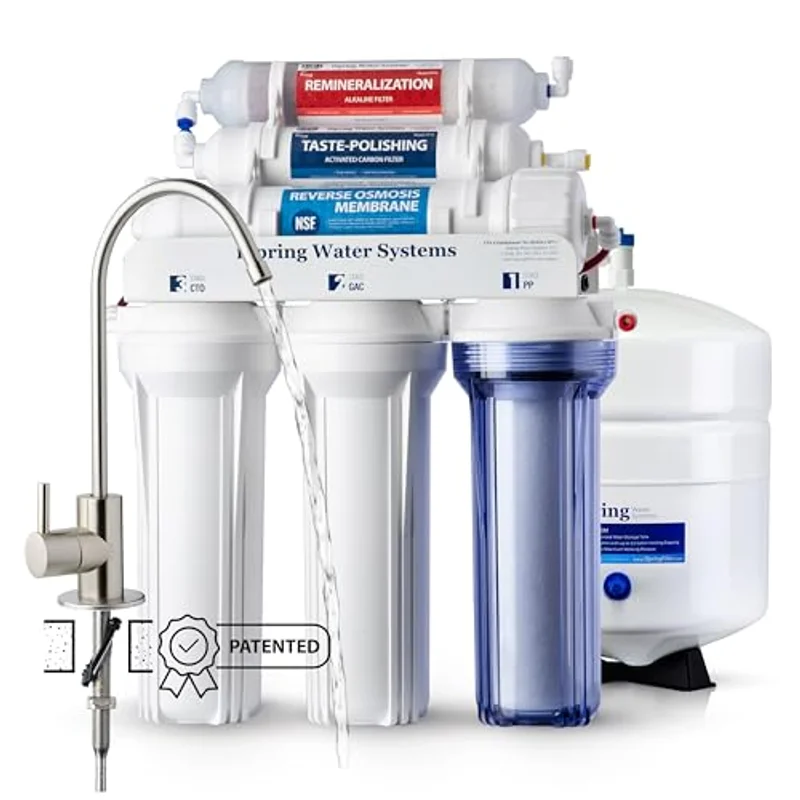 iSpring RCC7AK-BN iSpring RCC7AK-BN | NSF/ANSI 58 | Performance, certified as an entire assembled system rather than a component | $234.99 |
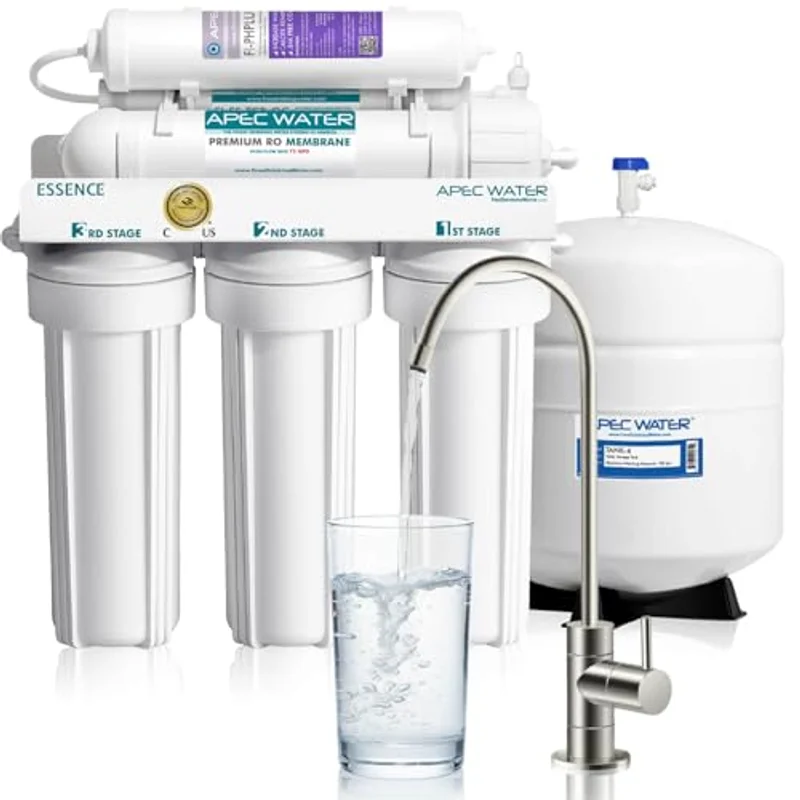 APEC Water ROES-PH75 APEC Water ROES-PH75 | WQA certified | Third-party certification from a different accredited body — check WQA's listing for the specific standard | $189.99 |
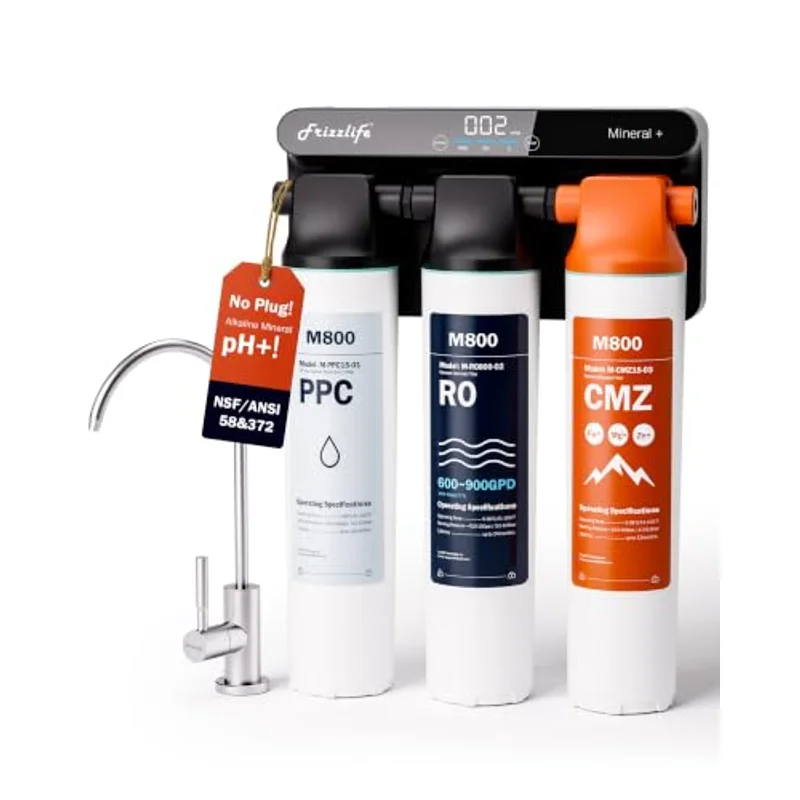 Frizzlife M800 Frizzlife M800 | NSF/ANSI 58 & 372 | Performance plus lead-free materials, per the manufacturer's own product title | $279.99 |
Certification claims as stated on each manufacturer's Amazon listing at the time of writing. We have not independently pulled each certifier's database entry for every model — do that check yourself using the steps below before you rely on a specific claim.
How to check a claim yourself in two minutes
You don't have to take a listing's word for any of this, and you shouldn't, because Amazon's product pages are written by the seller with no verification step in between. Both major certifiers publish free, searchable databases of everything they've actually certified:
- NSF's public listings let you search by brand name, product name, or standard number. A genuine NSF/ANSI 58 certification for a specific model will show up with the exact standard, the contaminants it's certified to reduce, and the certification status.
- WQA's Gold Seal product database works the same way — searchable by company or product, showing the specific standard and claim behind the seal.
The process: take the exact model name and manufacturer from the listing, search it on the relevant database rather than trusting the badge image on the product page, and confirm three things — that the model appears at all, which standard number it's listed against, and which specific contaminants or claims are covered. If a system claims "NSF/ANSI 58 certified for arsenic reduction" but the database entry only shows a TDS claim, that's a real discrepancy worth emailing the seller about before you buy, not after. This takes less time than reading the next paragraph, and it's the single highest-leverage two minutes you can spend on an RO purchase.
When a system has no certification mark at all. Plenty of inexpensive systems carry no NSF or WQA mark of any kind — not a lead-free claim, not a performance claim. That isn't automatically disqualifying, but it does shift the burden of proof onto you. A few honest options: treat the manufacturer's percentage-reduction claims (if published) as unverified marketing, not evidence; check whether the specific membrane inside is separately certified even if the assembled system isn't (some sellers list a membrane's own certification deeper in the spec sheet); confirm your own water quality with a TDS meter before and after installation so you have your own before-and-after evidence rather than relying on anyone's paperwork; and weigh the price against a certified alternative in the same class — the gap between an uncertified budget system and one of the certified options under $250 is often smaller than it looks once you account for what you're actually buying evidence of. What you shouldn't do is read "NSF" anywhere on the box and stop asking questions — the two minutes above tells you whether that word is attached to a standard that matters to you, or to one that doesn't.
Common questions
Is NSF/ANSI 372 a bad certification to have?
No — it's a genuinely useful one, just a narrow one. It confirms the parts touching your water don't add meaningful lead to it, which matters. The mistake is reading it as proof the system also removes contaminants from the water already there, which it does not certify at all. A system can carry 372 with no performance certification whatsoever, and several inexpensive RO systems do exactly that.
Does a WQA Gold Seal mean less than an NSF mark?
No. WQA and NSF International are both accredited third-party certifying bodies testing against the same ANSI-approved standards, including NSF/ANSI 58 and 372. A WQA Gold Seal for a given standard is comparable evidence to an NSF mark for the same standard. What matters is which standard number is attached to the seal, not which of the two organizations issued it.
What's the real difference between "compared to" and "certified to" an NSF standard?
"Certified to" means an accredited third-party lab verified the claim and the manufacturer is subject to ongoing audits, and you can look the specific model up on the certifier's own public database. "Compared to" or "meets the criteria of" usually means the manufacturer, or a lab it hired directly, ran the standard's test protocol and is reporting its own result — with no independent verification and nothing to check on a public database. Both can be honestly stated; only one is independently checkable.
If I swap in a third-party replacement membrane, does the certification still apply?
Not necessarily. Whole-system certifications — like iSpring's NSF/ANSI 58 certification for the RCC7AK-BN, stated as covering the entire assembly — describe a specific combination of parts as compared and audited. Replace the membrane with an uncertified third-party part and the system may still perform well, but the third-party certification no longer accurately describes what's actually installed under your sink.