Best RO Systems
HomeGuidesCarbon filter vs reverse osmosis
Comparison

Under-sink carbon filter vs reverse osmosis: which do you need?

We're reader-supported: buying through our links may earn us a commission at no extra cost to you. We compare published specifications, certifications and prices — we don't run a testing lab.

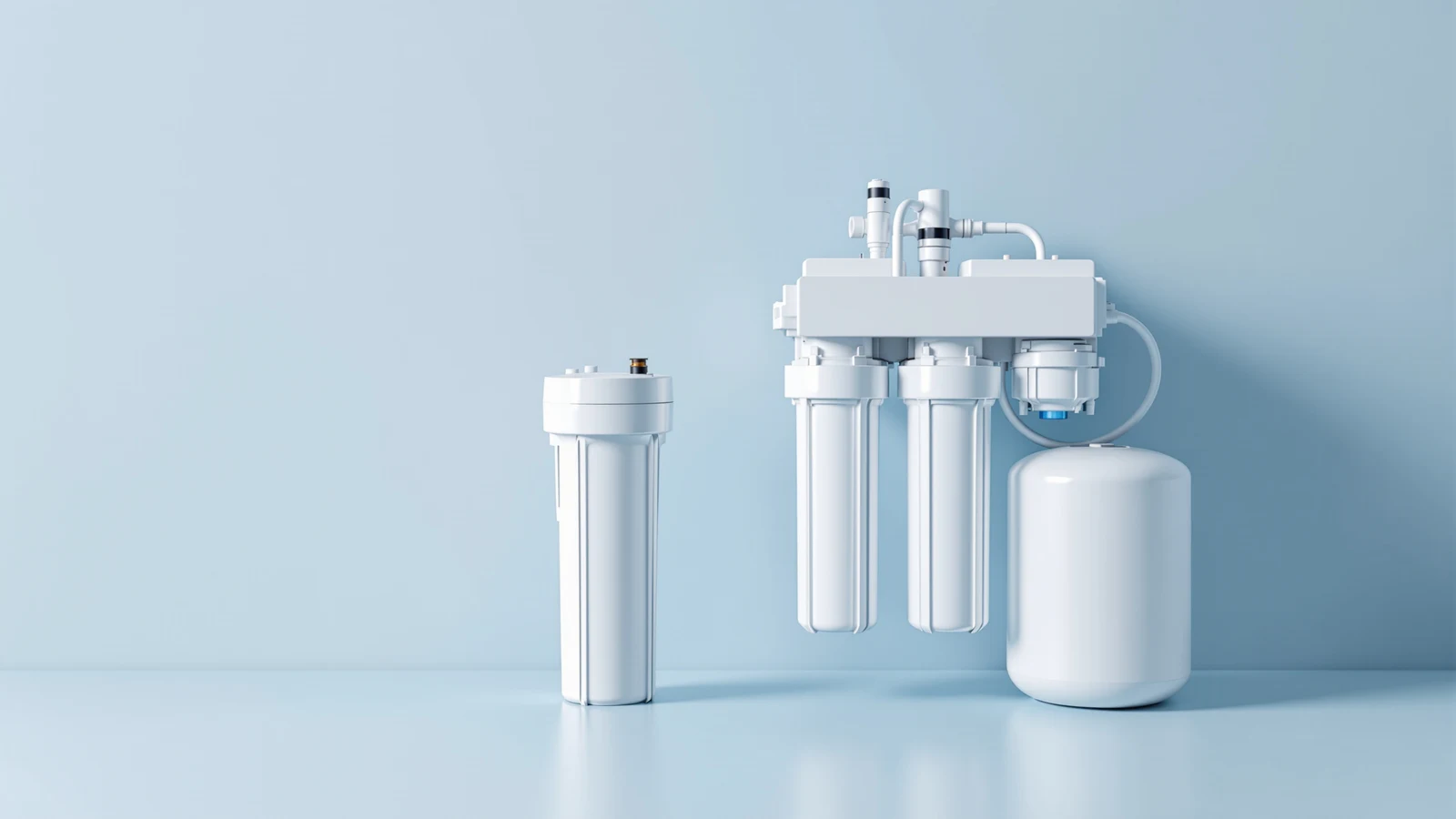
Under-sink carbon water filter cartridges next to a reverse osmosis membrane housing on a kitchen counter

Most people shopping for "an under-sink filter" are actually choosing between three different technologies marketed as one decision. A carbon block strips almost nothing dissolved in the water — it works by adsorption, trapping chlorine, organic compounds and odor molecules on activated carbon's internal surface area. A reverse osmosis membrane does something structurally different: it pushes water through a semi-permeable barrier fine enough to reject dissolved ions, the salts and minerals a TDS meter measures. Ultrafiltration sits in between, using a physical pore size small enough to block particles, bacteria and cysts without touching anything actually dissolved. Confusing the three is the single most common reason someone spends $300 on a system engineered to solve a problem their water report never mentioned — or spends $95 on a carbon block and never learns it was never going to touch the one contaminant they actually needed removed.

What a carbon block actually removes

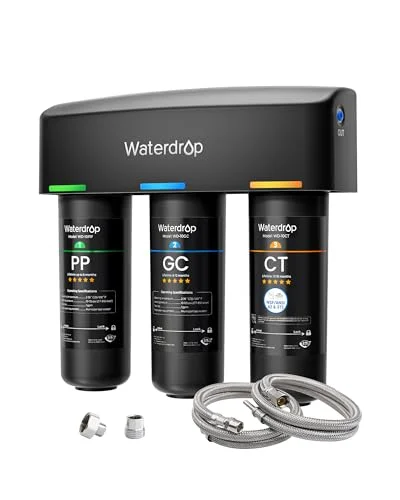
The Waterdrop TSA 8 Layer Under Sink Water Filter is a useful baseline because its certification tells you exactly what class of problem it's built for: NSF/ANSI 42. That standard covers aesthetic effects — chlorine taste and odor, particulate — not the health-effects contaminants that NSF/ANSI 53 or 58 address. A three-stage carbon system built around that certification does what it claims: sediment out first, then granular and block carbon stripping chlorine and the taste compounds that ride along with it. What it does not claim to do is reduce the dissolved mineral load of your water at all. Run a TDS meter on the inlet and outlet of a pure carbon system and the two numbers stay close to identical, because carbon adsorption and total dissolved solids are almost entirely unrelated mechanisms.

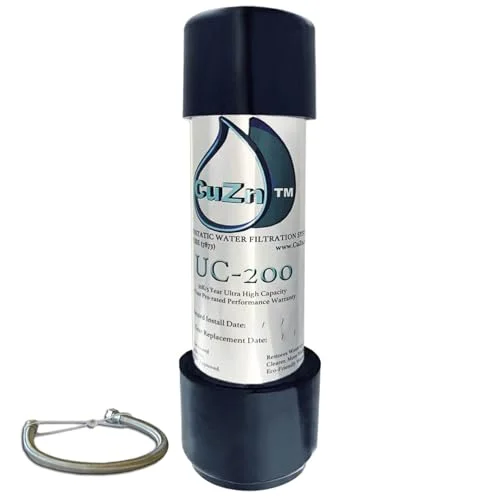
The CuZn UC-200 Under Sink Water Filter makes the same basic promise on a longer clock. It carries both NSF/ANSI 42 and 372 — the second standard certifies lead-free construction materials, not contaminant removal performance, and it's worth knowing the difference since marketing copy leans on it more than its actual scope justifies. What sets the UC-200 apart is its filter life: rated for five years, a single cartridge outlasting most systems' annual replacement cycle several times over — a carbon-media engineering choice that changes the cost math more than any certification, covered in the five-year comparison below.

What ultrafiltration adds

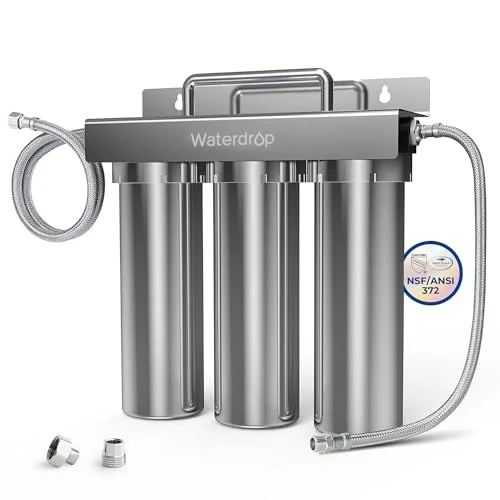
The Waterdrop TST-UF Ultra-Filtration Under Sink Water Filter is built around a 0.01 micron hollow-fiber membrane, and that number is the whole story. Ultrafiltration is a physical sieve, not a chemical or ionic process: a pore that small blocks bacteria, cysts like giardia and cryptosporidium, sediment, rust and microplastics almost completely, because those particles are enormously larger than 0.01 microns. What it cannot do is stop a dissolved ion. Sodium, fluoride, arsenic, nitrate and lead in dissolved form are all smaller — often by several orders of magnitude — than the smallest pore in a UF membrane, so they pass through with the water rather than the water passing through them. A UF filter typically pairs with a carbon stage ahead of the membrane, giving a combination that handles biological and particulate risk plus aesthetics, while leaving the dissolved-solids question exactly where it started.

What only a membrane removes: dissolved solids, and the contaminants that matter

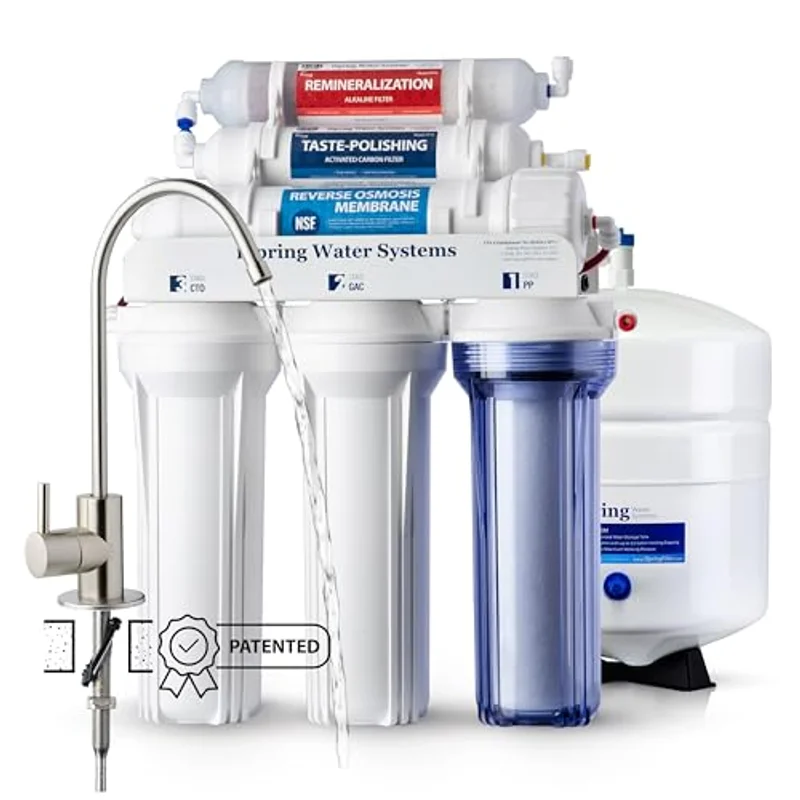
Reverse osmosis is the only technology of the three built to reduce dissolved solids, and the mechanism explains why. An RO membrane's effective pore structure operates at roughly 0.0001 micron — a hundred times finer than the ultrafiltration membrane above — fine enough to reject hydrated ions themselves, not just particles suspended around them. That matters for a specific, short list of contaminants neither carbon nor UF meaningfully touch: fluoride, arsenic, nitrate, sulfate, hexavalent chromium, and the portion of lead and PFAS that exists in dissolved rather than particulate form. Systems like the iSpring RCC7AK-BN, a 75 GPD six-stage alkaline RO system, and the Waterdrop G2P600, a 600 GPD tankless RO system, both put a carbon pre-filter and sediment stage ahead of the membrane — the same aesthetic work the carbon and UF systems do alone — then add the membrane stage that's the actual reason to choose RO over either cheaper technology. If your water report shows elevated dissolved solids at a level that concerns you, no amount of carbon or UF capacity substitutes for that membrane. Our guide to reading a TDS number covers how to tell a cosmetic reading from one that actually signals a problem.
No drain line, no waste water, no tank

This is the part of the comparison that has nothing to do with contaminant removal and everything to do with what installing the thing actually involves — and it's where the carbon block wins outright, structurally, regardless of what your water needs. A carbon or ultrafiltration system is a single in-line cartridge or housing set plumbed onto your cold-water supply line, with filtered water routed to a dedicated faucet. That's the entire plumbing job: one tee, one faucet hole. There's no drain saddle to clamp onto your waste pipe, because there's no reject stream to send anywhere — every gallon entering the housing exits as filtered water, at essentially the same rate it went in. Both the Waterdrop TSA and the CuZn UC-200 are built this way, and so is the Waterdrop TST-UF: ultrafiltration produces no concentrate stream either, since it's a straight-through physical filter rather than a rejection process.

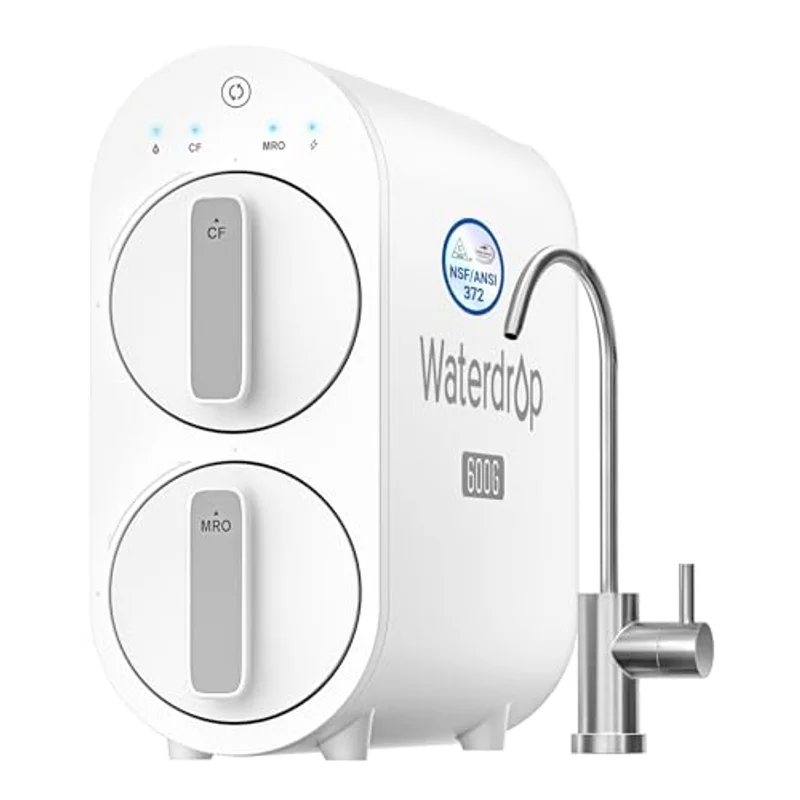
Reverse osmosis works by rejection, and rejection has a byproduct: for every gallon of RO-filtered water produced, the membrane sends a second stream of concentrated reject water down the drain, which is what a drain saddle and drain line exist to carry away. That's inherent to how a semi-permeable membrane operates under pressure — every RO system on the market needs a drain connection because of it. A tank system also needs somewhere to store output ahead of demand, which is why classic RO installs eat most of a cabinet: three or four filter housings plus a pressure tank, against the carbon block's single slim housing. Tankless designs like the G2P600 remove the storage tank by producing water fast enough on demand, but they don't remove the drain requirement — that's a function of the membrane, not the tank. If your cabinet has no spare hole for a second faucet, no accessible drain pipe, or simply not the depth for extra housings, that's a constraint a carbon or UF system never runs into.

Flow rate: a filter keeps up with a tap, RO does not

A carbon block or ultrafiltration housing filters at essentially line pressure and line flow — water passes through the media once, at close to the rate your cold-water line delivers it, so filling a pot or running the faucet steadily doesn't outpace the system. There's no rated daily capacity printed on the box because there's no bottleneck to rate; the constraint is the housing's flow coefficient, not a production rate.

Reverse osmosis is rated in gallons per day for a reason: producing filtered water through a membrane is inherently slower than water moving through a carbon bed, because the membrane has to reject most of what hits it rather than simply let it pass. The iSpring RCC7AK-BN's 75 GPD rating works out to roughly 3 gallons an hour under ideal lab conditions — which is why classic tank-based RO systems store output in a pressure tank ahead of demand rather than trying to produce it live at the faucet. The Waterdrop G2P600's 600 GPD rating is dramatically higher because it's a tankless design built around a booster pump that pushes far more feed water through the membrane per minute, closing most of the gap with a running tap without a storage tank. Even so, GPD figures are lab numbers measured under controlled conditions; incoming pressure below the roughly 40–85 psi window most RO systems are designed around, or cold winter feed water, both reduce real-world output below the rated number, sometimes substantially — our guide to RO pressure and flow covers what actually determines the flow at your faucet. The practical takeaway: a carbon filter never notices a pot, a coffee maker and a faucet running in quick succession; an RO system, tank or tankless, is working against a rated ceiling the whole time.

The arithmetic

Cost over five years, both routes

System price from the product listing plus a typical replacement-cartridge range for that class of filter — the honest way to compare a $99.99 sticker against a $289.00 one.

SystemTypeSystem priceTypical filters/yr~5-year totalDrain required
CuZn UC-200Carbon block, 5-yr filter$121.43$0 (rated 5-year filter life)≈$121.43No
Waterdrop TSA 8 LayerCarbon block, 3-stage$99.99≈$20–$40≈$200–$300No
Waterdrop TST-UFUltrafiltration, 0.01μm$149.99≈$25–$45≈$275–$375No
iSpring RCC7AK-BNRO, tank, 75 GPD$234.99≈$25–$70≈$360–$585Yes
Waterdrop G2P600RO, tankless, 600 GPD$289.00≈$60≈$589Yes

The assumptions, stated plainly rather than buried in a footnote. The carbon and UF filter-cost ranges above are typical figures for their class of cartridge — standard replaceable carbon and UF media generally run $20 to $45 a set, changed every six to twelve months — not a price sourced for these exact SKUs, and we're flagging that distinction rather than presenting it as a looked-up number. The one row that isn't an estimate is the CuZn: a five-year filter life, stated on the listing itself, means no scheduled cartridge purchase across the comparison window, which is why it's the cheapest system in this table despite not being the cheapest sticker price. The RO figures reflect the running-cost pattern we've documented elsewhere on this site for standard-housing and proprietary twist-in cartridges respectively — roughly $25 to $70 a year for systems using universal 10-inch housings like the RCC7AK-BN, and around $60 a year for the proprietary front filter on a tankless design like the G2P600, before the membrane and rear carbon block on a longer cycle. Both RO totals are a floor, not a ceiling.

The shape holds regardless of the exact dollar figures: every route on the carbon and UF side lands under $400 over five years with no drain, no wasted water and no tank eating cabinet space, while both RO routes land higher and require the drain connection this section explains. That gap isn't RO being a worse product — it's two technologies solving different problems at different physical cost. For the fuller five-year math on RO cartridge economics, see are reverse osmosis systems worth it.

The decision rule: start from your water report, not the marketing

Every product page in this comparison is honest about what it's certified for, and none of that certification language answers the only question that actually decides your purchase: what's in your water. The correct starting point is not a buying guide — it's your water utility's annual Consumer Confidence Report, which every municipal supplier is required to publish and which lists the actual measured levels of regulated contaminants in your specific supply, not a national average. If your report shows chlorine taste and odor as the only flagged issue, a carbon block resolves the entire problem for under $100 and neither ultrafiltration nor an RO membrane adds anything you'd notice. If it shows elevated nitrate, fluoride above your comfort level, arsenic, or PFAS in dissolved form, no carbon system and no UF membrane will move those numbers — only reverse osmosis will, and at that point the drain line and the waste water stop being a design inconvenience and become the cost of the only technology that solves the problem you have.

Private well water changes the starting point, because there's no utility report to read — you're the utility, and the report has to come from an independent lab test. Well water frequently carries sediment, iron, hardness and sometimes bacteria at levels municipal systems rarely see, all of which can matter more to your filtration choice than the carbon-versus-RO question this article is built around. Our guide to reverse osmosis for well water covers the pre-filtration order that keeps a membrane alive on a private supply, worth reading before buying anything if a lab test is where you're starting. Either way, the rule is the same: buy the water report first, buy the filter second. A $289 tankless RO system solves nothing a $95 carbon block wasn't already going to solve, if the report never flags a dissolved-solids problem — and a carbon block solves nothing at all if the report does.

Ultrafiltration as the middle ground, and where it disappoints

Ultrafiltration is genuinely useful as a category, and it's easy to see why it gets marketed as "reverse osmosis without the downsides" — the Waterdrop TST-UF shares RO's no-tank, on-demand delivery and adds meaningful protection against bacteria and cysts that a plain carbon block doesn't touch, all without a drain line. For a household on municipal water whose only concerns are chlorine, taste, sediment and biological safety margin, that combination is a real upgrade over carbon alone, and at $149.99 it sits priced between the cheapest carbon block and the RO systems here — which is exactly where it belongs functionally as well as on the price list.

Where it disappoints is anyone who bought it believing "ultra" implies RO-level performance on dissolved contaminants, because a 0.01 micron pore, however impressively small it sounds, is still enormously larger than a dissolved ion. A UF system will not move a TDS reading, reduce fluoride, touch dissolved arsenic or nitrate, or reliably strip dissolved PFAS — the same list of contaminants only a membrane reaches, discussed above, is exactly the list UF cannot reach either. The confusion is understandable: both technologies use the word "membrane," both are sold as under-sink cartridge systems, and marketing copy for UF products leans hard on proximity to reverse osmosis without always being precise about the gap between a physical sieve and an ionic-rejection membrane. If your report is clean on dissolved solids and you want the extra biological margin, ultrafiltration is a reasonable, honestly-priced choice. If it flags a dissolved contaminant, ultrafiltration is the wrong middle ground to compromise toward.

The five in this comparison

Where each one actually fits

01Chlorine & taste

Waterdrop TSA 8 Layer

The cheapest complete answer to a chlorine problem
NSF/ANSI 42 · 3 stage · under-sink

If your water report shows nothing beyond chlorine taste and odor, this is the whole solution: one supply-line tee, one faucet hole, no drain, no tank, no waste water. It is not certified for and does not claim to reduce dissolved solids — pair it with a TDS meter check before assuming it's doing more than it is.

Waterdrop TSA 8 Layer under-sink water filter system
$99.99
3 stage · carbonCheck price →
02Lowest 5-yr cost

CuZn UC-200

One cartridge, five years, no rebuying
NSF/ANSI 42 & 372 · 5-year filter life · under-sink

The filter-economics winner in this whole comparison, RO included: a single cartridge rated for five years means the $121.43 sticker is close to the entire five-year cost of ownership. Same structural advantages as any carbon system — no drain, no waste, no tank — with none of the recurring cartridge purchases.

CuZn UC-200 under sink water filter with 5-year filter life
$121.43
5-Year filterCheck price →
03Biological margin

Waterdrop TST-UF

Carbon's convenience plus cyst and bacteria protection
0.01μm ultrafiltration · 1 count · under-sink

Adds a physical pore-size barrier against bacteria, cysts and microplastics on top of carbon-level taste and chlorine reduction — still no drain line, still no waste stream. Does not reduce dissolved solids; treat "ultra" as a description of the pore, not a substitute for a membrane.

Waterdrop TST-UF 0.01 micron ultrafiltration under sink water filter
$149.99
UltrafiltrationCheck price →
04Dissolved solids, tank

iSpring RCC7AK-BN

When the water report actually calls for a membrane
NSF certified · 75 GPD · 6-stage alkaline · tank

The system to reach for once the report flags something a carbon filter can't touch — fluoride, arsenic, nitrate, dissolved lead. Needs a drain saddle and cabinet space for three housings plus a tank; in exchange it's the only product in this comparison that actually reduces dissolved solids. See our full roundup of the best reverse osmosis systems under $250 for how it stacks up against other RO picks.

iSpring RCC7AK-BN 6-stage alkaline reverse osmosis system
$234.99
Tank · 75 GPDCheck price →
05Dissolved solids, no tank

Waterdrop G2P600

RO performance without giving up the whole cabinet
600 GPD · tankless · under-sink

Same membrane-level contaminant reduction as the iSpring, in a slim tankless box that trades the pressure tank for a booster pump and far higher rated output. Still needs the drain line and an outlet — the tank goes away, the fundamental RO trade-off in this article doesn't.

Waterdrop G2P600 tankless under-sink reverse osmosis system
$289.00
Tankless · 600 GPDCheck price →
FAQ

Questions people ask before choosing

Will a carbon filter remove lead or PFAS from my water?

Not reliably. A standard carbon block certified to NSF/ANSI 42 addresses aesthetic effects — chlorine taste, odor and some particulate — not the health-effects contaminants covered by standards like NSF/ANSI 53 or 58. Dissolved lead and dissolved PFAS pass through activated carbon media at meaningful rates unless the system carries a specific certification for those contaminants, which none of the carbon products in this comparison do. If your water report flags either one, reverse osmosis is the technology built to actually reduce it.

Do I need a drain line for an under-sink carbon or ultrafiltration filter?

No. Both technologies filter water in a single pass with no reject stream, so there's nothing to send down a drain. That's a structural difference from reverse osmosis, which produces a second, concentrated waste stream as an inherent part of how the membrane rejects dissolved solids — every RO system, tank or tankless, needs a drain saddle because of it.

Why is a reverse osmosis system so much slower than a plain filter?

Because it's doing fundamentally more work per gallon. A carbon or ultrafiltration housing lets water pass through media once at close to line flow rate. An RO membrane has to reject most of what hits it, which is why systems are rated in gallons per day rather than gallons per minute — the iSpring RCC7AK-BN's 75 GPD rating is roughly 3 gallons an hour under lab conditions, which is why tank-based systems store output ahead of demand. Tankless designs like the Waterdrop G2P600 close much of that gap with a higher-throughput membrane and a booster pump, but the underlying rate limit is inherent to the membrane, not the tank.

How do I actually know if I need reverse osmosis instead of a carbon filter?

Read your water utility's Consumer Confidence Report (or an independent lab test, for well water) before reading any buying guide. If the only issue flagged is chlorine taste or odor, a carbon block resolves it completely for well under $150. If the report shows elevated fluoride, arsenic, nitrate or dissolved lead, no carbon filter or ultrafiltration membrane will move those numbers — only a reverse osmosis membrane reduces dissolved solids, and that's the point at which the drain line and higher running cost become the price of solving the actual problem rather than an unnecessary upgrade.

Keep reading

Next, if you're still deciding