GPD math: what a water change actually needs
GPD — gallons per day — is the standard output rating on every RO system's box, and like most specs in this category it's measured under favorable conditions: higher incoming pressure and warmer feed water than a lot of real houses deliver. Treat the printed number as a ceiling you're working toward, not a guarantee of what you'll get the first week.
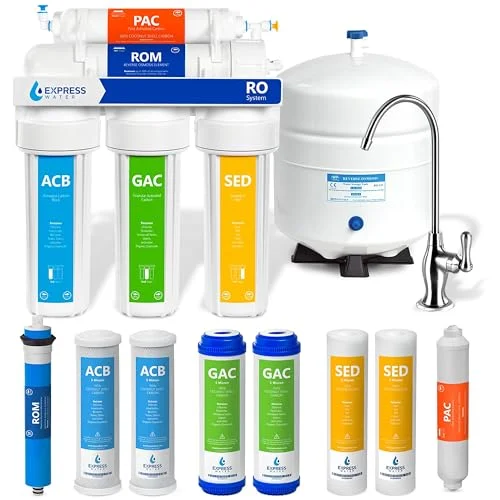
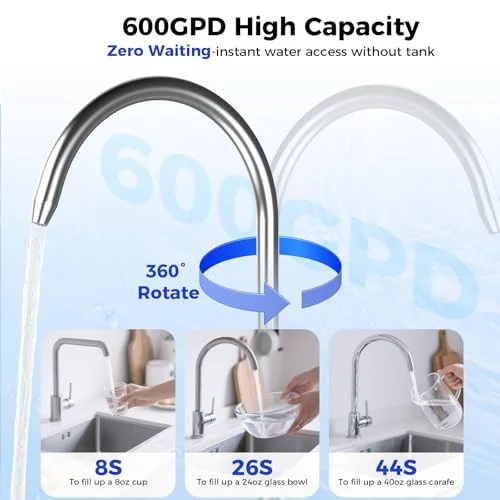
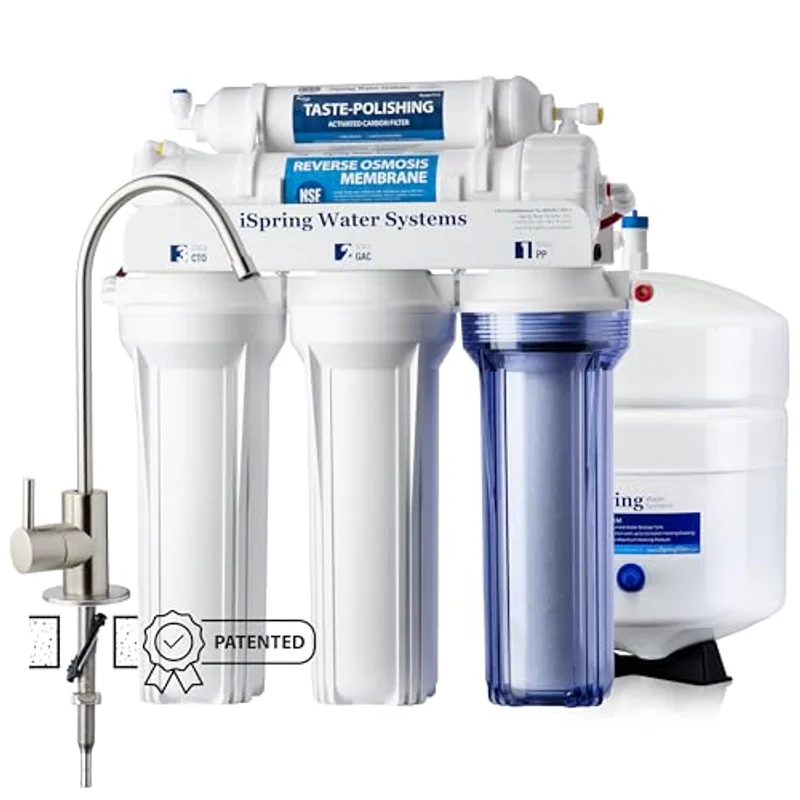
Of the three systems here, the Express Water RO5DX is rated at 50 GPD, the iSpring RCC7-BN at 75 GPD, and the VonWater 600GPD at up to 600 GPD. The VonWater's listing also publishes an instantaneous flow rate — 0.42 GPM, about 25 gallons an hour — which is how a tankless design reaches a number that high: there's no storage tank to refill slowly over the day, the unit produces at that flow rate on demand, straight into whatever you're filling.
Translate that into an actual water change. A commonly cited hobbyist guideline for a mixed reef is a 10–15% weekly volume change — call it 4 to 6 gallons on a 40-gallon tank, or 12 to 18 gallons on a 120-gallon tank. At 50 GPD the smaller change is roughly two to three hours of continuous production; the larger one eats most of a day. At 75 GPD the 120-gallon change drops to an hour and a half to just over two hours. On the VonWater's quoted 0.42 GPM, that same 12 to 18 gallons fills in well under 45 minutes, because the water comes out at a fixed flow rate rather than trickling into a pressure tank between draws.
Planted-tank keepers often run deeper, more frequent changes — 20–50% weekly is common on a heavily fertilized, CO2-injected tank — so a 40% change on a 29-gallon tank is about 11.6 gallons, comfortably inside an hour on any of the three at their rated output. Daily auto top-off for evaporation on a reef is a smaller number, commonly 1 to 3 gallons a day on a small-to-medium tank, well inside even the slowest system's daily capacity. GPD mostly matters for the periodic big change, not the daily top-off.
The non-electric design is worth flagging on its own. The Express Water RO5DX runs on line pressure with no pump, which also means no pump noise and nothing to fail electrically — relevant if the system is going in a stand next to a display tank rather than a basement sump; we compare non-electric and tankless designs on exactly that tradeoff in quietest reverse osmosis systems. Its listing also includes a built-in leak detector as part of the box, worth knowing before you plumb anything in next to a sump stand you can't afford to flood — see our roundup of systems built around leak detection if that's the deciding feature for your setup. The VonWater needs a dedicated outlet and two drilled holes (one for the faucet, one for the drain line under the sink), and its 600 GPD number comes from a 7-stage tankless design — for how stage count scales, or doesn't, with output on other tankless systems, see 4 stages vs. 10 at 800 GPD.