Buying advice
The RO Waste Water Ratio, Explained
By Ilane TallUpdated September 4, 2026Research-based.11 min read
We're reader-supported: buying through our links may earn us a commission at no extra cost to you. We compare published specifications, certifications and prices — we don't run a testing lab.
Every reverse osmosis system makes two streams of water from one supply line: a small, purified stream called permeate that reaches your glass, and a larger, mineral-heavy stream called concentrate or reject that goes down the drain. The ratio between them is the single spec that tells you how much of your tap water actually becomes drinking water — and it is also the spec buyers most often read backwards.
For decades, manufacturers wrote it as waste : pure. A system rated "4:1" discarded four gallons for every one it delivered — a 20% recovery rate, meaning only a fifth of the water entering the membrane came out the faucet. That is the number the meta description on this page is talking about, and it is still the convention used across most tank-style, line-pressure systems sold today.
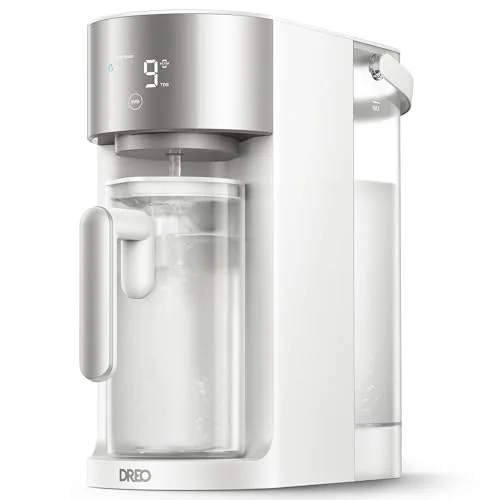
Newer listings, especially for countertop and tankless units, have started printing the fraction the other way around: pure : drain. When a listing for a countertop system reads "3:1 Pure to Drain," it means three gallons of purified water for every one gallon sent to waste — a 75% recovery rate. Flipped into the old convention, that is roughly a 1:3 waste-to-pure ratio: the inverse of an old 3:1 system, not the same thing wearing a different label. Read the words next to the numbers before you compare two listings, because "3:1" on one page and "3:1" on another can describe opposite performance.
Why 4:1 was the default for so long
The ratio is not an accident of cheap engineering; it comes from a real constraint. A reverse osmosis membrane needs a minimum continuous flow scrubbing across its surface, or the rejected minerals concentrate right at the membrane face, scale it, and shorten its life — a phenomenon water-treatment engineers call concentration polarization. Every system has to guarantee that scrubbing flow no matter how fast or slow it is actually producing permeate.
On a basic tank system with no pump, the only pressure available is whatever your municipal line delivers — commonly 40 to 80 psi. A fixed flow restrictor (sometimes just a capillary tube) sets the reject flow at a constant rate regardless of conditions. At that pressure, a standard residential membrane produces permeate slowly, so the fixed reject flow ends up being three or four times larger than the trickle of purified water it is protecting. The ratio balloons not because the system is wasteful by design, but because low pressure caps how much permeate the membrane can make while the required flush stays constant.
This is also why the ratio quoted on a spec sheet is a lab number, not a promise. Certification testing for systems and membranes typically runs at a specified pressure and water hardness; your home's actual line pressure, water temperature and total dissolved solids all shift the real-world ratio away from the printed one, usually toward more waste when pressure is lower than the test condition.
How modern pumps changed the number
The fix is not a better membrane — it is more pressure. Raising feed pressure lets the membrane push out permeate faster without needing a proportionally larger reject flow, which is what pulls the ratio down. Two pump designs did most of that work over the past decade.
Non-electric permeate pumps use the pressure already stored in the reject stream itself, through a small diaphragm shuttle valve, to give the incoming feed water an extra push — no outlet, no motor, and a meaningful drop in waste on tank systems that would otherwise run on line pressure alone.
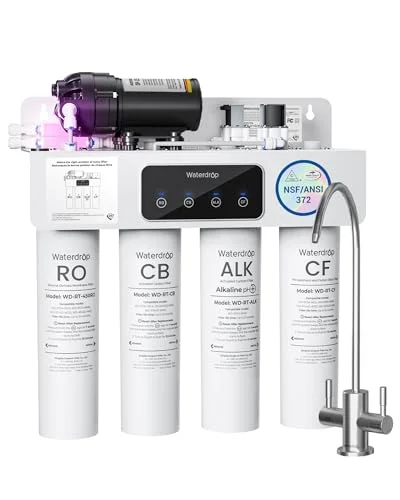
Electric booster pumps go further, raising feed pressure to 80–100+ psi ahead of the membrane. That is the technology behind most tankless under-sink systems, which need to produce water on demand rather than filling a bladder tank slowly in the background — see our roundup of the best tankless reverse osmosis systems for how that category is built. Higher sustained pressure is also what allows a "dual flow" design, like the pair of parallel membrane passes in the Waterdrop T4-A (ASIN B0F5V9G355, $259.99 on Amazon), to hit a rated output of 450 gallons per day — several times what a basic tank system can sustain — because more permeate is being produced per unit of the flush flow the membrane still needs.
We should be precise about what we can and cannot confirm here: a higher rated GPD is not the same claim as a favorable drain ratio, and the T4-A's listing does not publish a pure-to-drain figure the way the countertop units below do. A booster pump makes a good ratio possible; it does not guarantee the manufacturer put that number on the box.
What's actually in the waste line — and whether you can reuse it
The concentrate going down the drain is not contaminated by the reverse osmosis process. It is the same minerals, salts and dissolved solids that were already in your tap water, simply concentrated because the membrane separated them rather than destroyed them. If your supply water is safe to drink, the reject stream is not toxic — it is just harder, saltier water than what came out of your faucet before filtration.
That makes limited reuse reasonable: flushing a toilet, pre-rinsing laundry, mopping a floor, or watering established outdoor plants that tolerate mineral-heavy water. It is a poor choice for salt-sensitive potted houseplants, since the concentrated minerals build up in the soil over repeated watering with nowhere to leach out. It should not be treated as drinking water — that defeats the reason you bought the system — and if your supply carries anything you were specifically trying to remove, such as elevated nitrates or hardness, the reject stream carries more of it, not less.
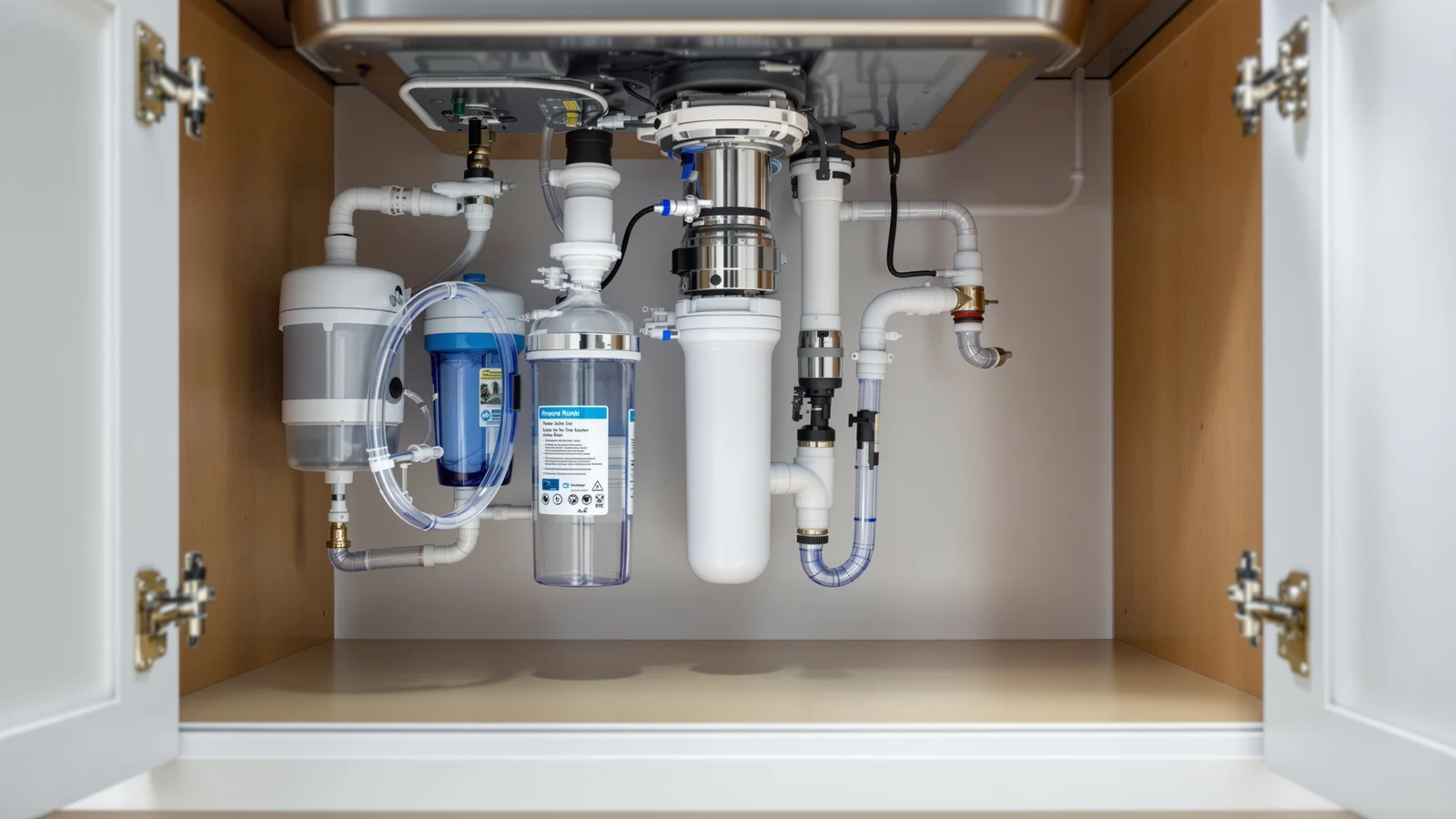
On the plumbing side, the reject line is meant to run to an approved drain connection — usually a saddle valve clamped onto the drain pipe under the sink, sometimes routed through an air gap fitting depending on local code. If that line starts gurgling, dripping at the saddle, or running when the faucet is off, that is a plumbing symptom rather than a ratio problem; our RO troubleshooting guide walks through the usual causes in the order to check them.
The arithmetic
The water bill, in real gallons per year
A rated GPD ceiling is not what your household actually draws. The math below uses one stated assumption — two gallons of purified water drawn per day, a reasonable estimate for drinking and cooking in a small household — so you can rerun it with your own number.
| Ratio (waste : pure) | Example | Waste per day* | Waste per year* |
|---|
| 4:1 | Older line-pressure tank systems | 8.0 gal | 2,920 gal |
| 2:1 | Common booster-pump tankless systems | 4.0 gal | 1,460 gal |
| 1:3 (3:1 pure-to-drain) | DREO countertop, as published | 0.67 gal | ~245 gal |
*Assuming 2 gallons of purified water drawn per day. Scale linearly for your own household: double the daily draw and you double every number in the waste columns.
The gap compounds because the ratio applies to every gallon you draw, every day, for as long as you own the system — it is not a one-time cost like the hardware. At a often-cited rough US average combined water-and-sewer rate of roughly $8–$10 per 1,000 gallons, the difference between the old 4:1 convention and the DREO's published 3:1 pure-to-drain figure works out to somewhere around $23–$29 a year in old-style waste versus roughly $2 a year on the better ratio — small money on a single metered bill, and worth checking your own utility's actual combined rate before you take that figure further, since rates vary widely by city and by whether sewer is billed separately from water.
Two caveats worth keeping in front of the math. First, a countertop pitcher unit like the DREO produces water far more slowly than a 450 GPD tankless system, so its excellent ratio is being applied to a much smaller daily volume in absolute terms — a good ratio on a small system and a good ratio on a large one are not the same number of gallons saved. Second, this is a maintenance and utility-cost signal, not a claim about water quality: a 4:1 system and a 3:1 pure-to-drain system can produce equally safe permeate, since the ratio governs efficiency, not filtration performance. If certification is what you actually want to compare, our NSF 58 vs NSF 372 vs WQA guide covers that separately.