Best RO Systems
Home › Guides › 1,000+ GPD systems
Buying guide

1000+ GPD Reverse Osmosis Systems: When a Residential Kitchen Actually Needs One

We're reader-supported: buying through our links may earn us a commission at no extra cost to you. We compare published specifications, certifications and prices — we don't run a testing lab.

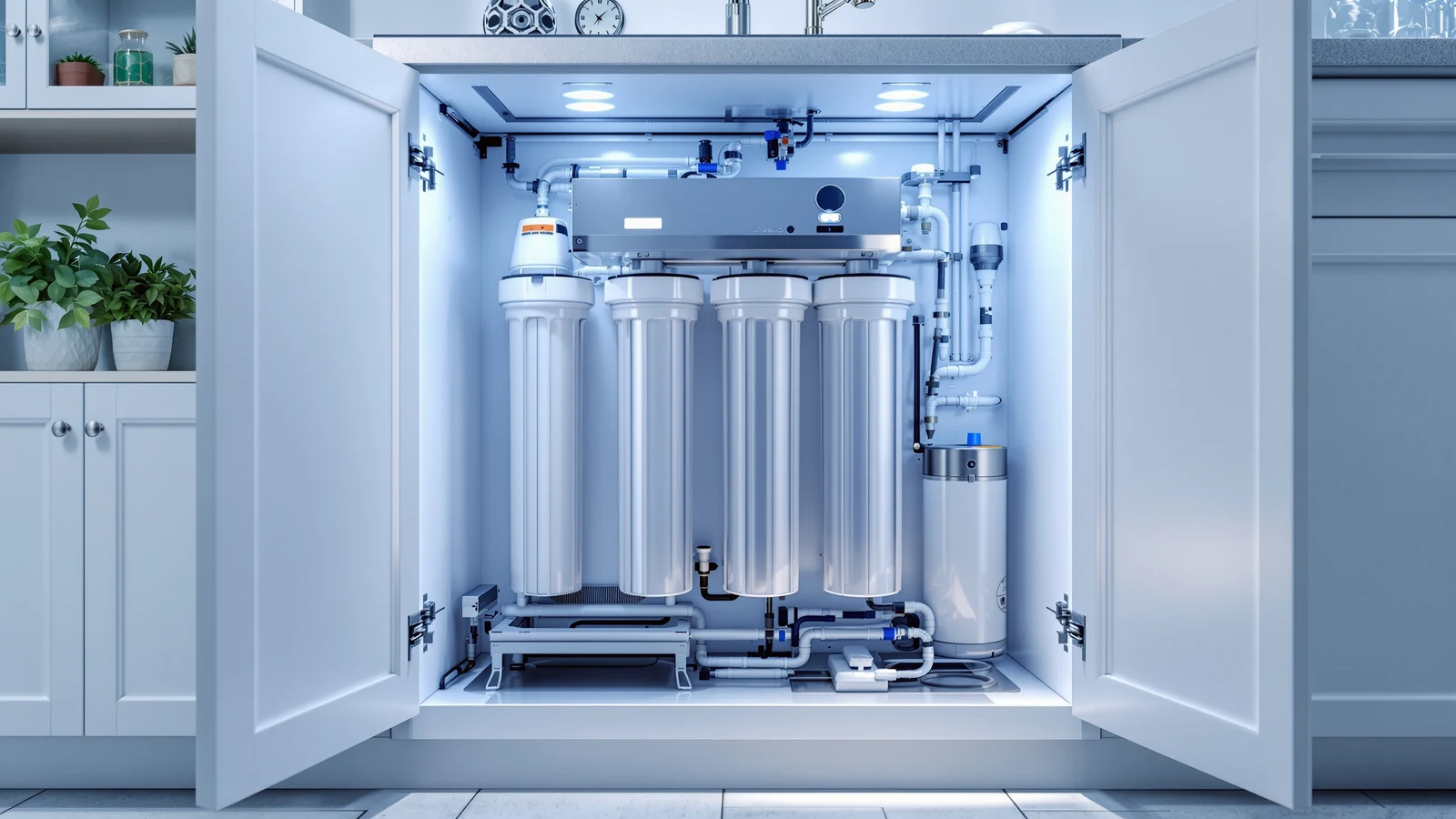
Large-capacity under-sink reverse osmosis system with multiple filter housings and a tankless membrane unit, sized for whole-building water production

The "GPD" printed on a reverse osmosis box is a production ceiling, not a bill for what a household actually uses. It is measured under the conditions set out in the NSF/ANSI 58 test protocol — a 77°F feed at 60 psi of inlet pressure — and it describes how many gallons the membrane can produce across a full day under those specific, favorable conditions. It is not a measurement of how many gallons any kitchen drains from the faucet.

Measured against real draw, a single-family kitchen's actual pull on an RO line is small. Filling a pitcher, a kettle, a few cooking pots, a coffee maker reservoir, an ice maker line and an instant-hot tap adds up to a handful of gallons a day — even for a busy household of six. A tankless residential unit rated in the 400 to 600 GPD class, commonly priced well under $450, already carries enormous headroom over that kind of draw. Stepping up to 800, 1,000, 1,200 or 1,600 GPD does nothing for a single kitchen that a smaller, cheaper system was not already doing.

Where that headroom actually gets used up is when one filtration point is feeding more than one kitchen, or feeding a kitchen plus a continuous commercial process. Picture a converted fourplex: four separate units, four sets of adults, each independently filling a kettle, running a coffee maker and feeding an ice maker line on their own schedule. Even a conservative 12 to 15 gallons of real drinking-and-cooking draw per unit per day adds up to 48 to 60 gallons of aggregate daily draw before anyone has touched a dishwasher pre-rinse or a whole-apartment RO loop. That is still a fraction of an 800 GPD rating, and the gap is the point, not a flaw in the math: real-world output on these systems commonly runs below the rated ceiling once feed water is colder than 77°F or house pressure sits under 60 psi, so sizing with that kind of margin above the arithmetic — rather than right at it — is the correct read of a spec sheet, not evidence of overbuying.

The same logic extends to a home office or a small business running RO water as an input across an entire workday rather than as an occasional glass. A single kitchen almost never needs this tier. A shared point of supply serving several kitchens, or a process that draws on RO water continuously for hours at a stretch, is what the 800 to 1,600 GPD range exists for.

What it costs to go bigger

The price jump from a 600 GPD kitchen unit to this tier

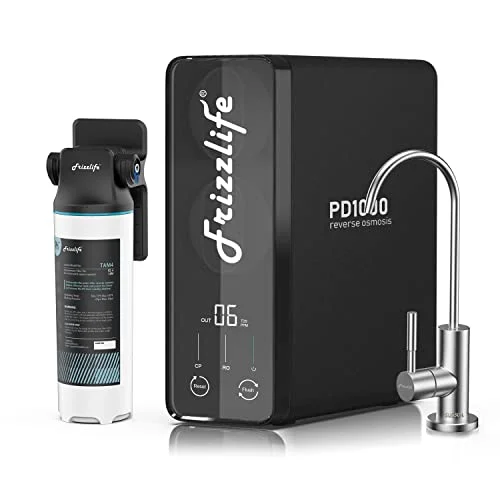
A single-kitchen tankless system in the 400 to 600 GPD class commonly lists for well under $450. Step over the line into the next tier of this catalogue and the floor moves immediately: the Frizzlife PD800-TAM4, rated at 800 GPD, lists at $509.99 — past $500 before you have gained any capacity a single kitchen will ever actually touch.

From there the next step is proportional. The Frizzlife PD1000-TAM4, rated at 1,000 GPD, lists at $599.99 — ninety dollars more for 200 additional gallons a day of rated capacity, inside the same product family, with the same 9-stage alkaline mineral design, the same NSF/ASNI 58, 53, 42 & 372 standard, and the same 2:1 pure-to-drain ratio published on both listings. That is a smooth, incremental upgrade.

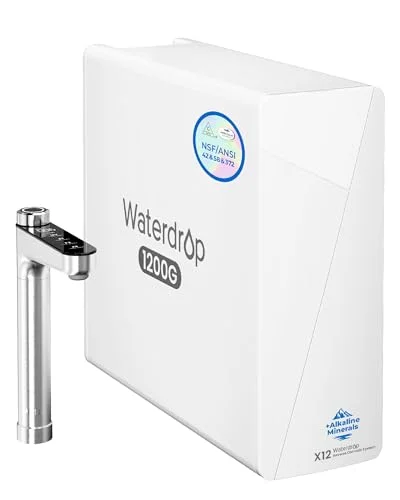
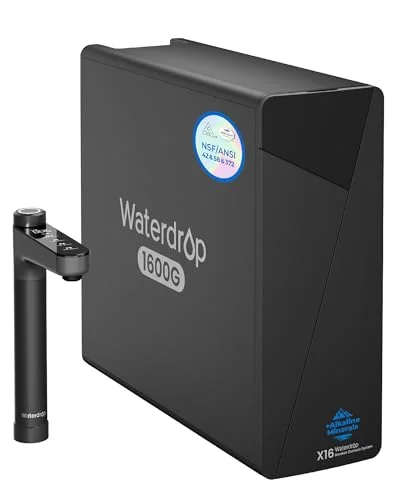
The step after that is not. The Waterdrop X12, rated at 1,200 GPD, lists at $1,099.00 — nearly double the 1,000 GPD Frizzlife's price for 200 more gallons a day of rated capacity. The Waterdrop X16, rated at 1,600 GPD, tops the range at $1,599.00. Pushing a membrane-based system's rated output past the 1,000 GPD mark generally means adding membrane area, pumping capacity, or both, to hit a higher ceiling under the same test conditions — a structural change in the hardware, not just a bigger number printed on the same box, and the price reflects that.

One caveat worth flagging before you buy on spec alone: neither Waterdrop listing in our data publishes a stage count, a named certification, or a drain ratio the way both Frizzlife listings do. Confirm all three on the current listing before ordering an X12 or X16 — the drain ratio especially, since it matters more at this throughput than it does on a residential system (more on that in the installation section below).
Who's actually buying this

Multi-unit households, home offices and small businesses

Multi-unit households. A finished basement apartment, an in-law suite, or a duplex, triplex or fourplex sharing one main water line is the clearest case for this tier: one filtration point serving several separate kitchens instead of installing and separately maintaining a residential system in each unit. For a single large family under one roof, however many people, our guide to the best reverse osmosis systems for large families covers systems rated in a lower band — this 800 to 1,600 GPD tier is usually more than one household needs, no matter its size, and exists specifically for the case where the plumbing serves more than one kitchen.

Home offices. A shared break room serving fifteen to forty people is a different draw pattern than a kitchen: water bottles filled and a coffee or tea station run through a concentrated morning and lunch window rather than spread evenly across the day. An office setting is also where a touch-panel TDS display earns its premium, since nobody wants to guess filter life on a system that many people rely on — we compare which touch panels and TDS readouts actually earn their price separately, for anyone weighing that add-on at this budget.

Small businesses. A café service bar, a small restaurant prep sink, a nail salon's rinse water or a laundromat's spot-free rinse all use RO water as a continuous process input across a shift, not an occasional glass. Setups like these also usually plumb RO output to more than the drinking faucet — a coffee machine, a dishwasher pre-rinse, an ice maker — and running several fixtures off one line is exactly the scenario where the drain ratio and sustained flow rate matter more than the headline GPD number on the box. We work through the plumbing side of feeding multiple fixtures from one system in plumbing RO water to a dishwasher or coffee maker.

What changes under the sink

Installation differences at this capacity

01

Power

Alkaline mineral tankless systems at this scale commonly run a booster pump, and a pump needs a dedicated outlet nearby. None of the four listings in our data specify voltage or amperage, so confirm the power requirement on the current listing before you commit a cabinet location, rather than assuming the outlet you have is adequate.

02

Drain sizing

Both Frizzlife units publish a 2:1 pure-to-drain ratio — two gallons produced for every one sent to waste. At 800 to 1,000 GPD of rated throughput, that ratio decides whether your drain line and P-trap can carry the waste stream during simultaneous draws from more than one fixture. The Waterdrop X12 and X16 listings in our data don't publish a drain ratio, so that's the first spec to pull up before ordering either.

03

Space

All four systems here are sold as under-sink units, but at this throughput a cabinet typically needs to hold more housings or a larger membrane assembly, and sometimes a dedicated pump. Measure actual depth behind the P-trap and confirm an outlet location before ordering — "under-sink" at this capacity can still need more room than the single cabinet a residential system shares comfortably with trash cans and cleaning supplies.

04

What ships in the box

What actually arrives with the unit — fittings, a drain saddle, a feed valve, tubing — tends to scale with system size and isn't always complete for a multi-fixture install. See our breakdown of what's actually in the box on RO installation kits for what to expect to source yourself before the day you install.

The lineup

The picks across the 800 to 1,600 GPD range

Ordered by rated capacity, low to high. Prices move on Amazon — confirm the live price before buying.

ModelBest forRated outputCertified / drain ratioPrice
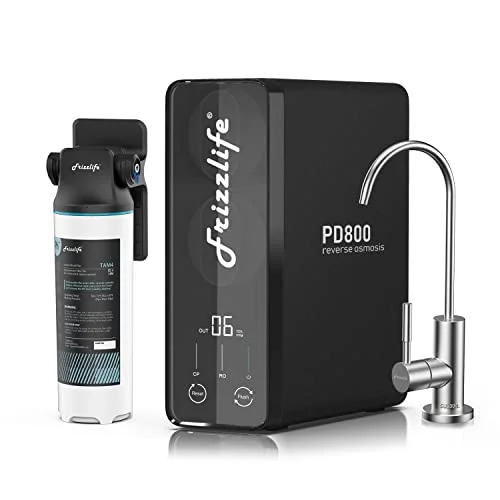
Frizzlife PD800-TAM4Entry point to this tier800 GPDNSF/ANSI 58, 53, 42 & 372 · 2:1 drain$509.99Price
Frizzlife PD1000-TAM4More margin, same family1000 GPDNSF/ANSI 58, 53, 42 & 372 · 2:1 drain$599.99Price
Waterdrop X12Triplex or small office1200 GPDNot published — confirm on listing$1,099.00Price
Waterdrop X16Fourplex or small business1600 GPDNot published — confirm on listing$1,599.00Price
01Entry to this tier

Frizzlife PD800-TAM4

The smallest step past a residential system
800 GPD · NSF/ANSI 58, 53, 42 & 372 · 9-stage · alkaline mineral pH+ · 2:1 drain · tankless

At $509.99, this is the cheapest way into the 800+ GPD range and the only one of the four that publishes a full certification string — NSF/ANSI 58, 53, 42 and 372 — alongside a 2:1 pure-to-drain ratio and a 9-stage alkaline design. It fits a duplex, a two-unit conversion, or a small office with a single shared break room, where the aggregate draw from several independent users starts to approach what a 600 GPD residential unit was built for. It is not the right buy for one kitchen on its own; a smaller, cheaper system covers that case with room to spare.

Frizzlife PD800-TAM4 800 GPD alkaline mineral reverse osmosis system
$510
800 GPD · 2:1 drainCheck price →
02More margin

Frizzlife PD1000-TAM4

The same certified design, with headroom to spare
1000 GPD · NSF/ANSI 58, 53, 42 & 372 · 9-stage · alkaline mineral pH+ · 2:1 drain · tankless

Ninety dollars more than the PD800-TAM4 for 200 additional gallons a day of rated capacity, and nothing else about the spec sheet changes — same 9-stage alkaline mineral filtration, same certification string, same 2:1 drain ratio. That makes it the easy upgrade inside this family: if a three-unit building or a busier office pushes past what 800 GPD comfortably covers, this is where the extra margin is cheapest to buy, before the price jumps into Waterdrop's X-series.

Frizzlife PD1000-TAM4 1000 GPD alkaline mineral reverse osmosis system
$600
1000 GPD · 2:1 drainCheck price →
03Triplex / small office

Waterdrop X12

Where the price structurally jumps
1200 GPD · alkaline mineral · under-sink

At $1,099.00, the X12 is nearly double the price of the 1,000 GPD Frizzlife for 200 more gallons a day of rated capacity — the point in this range where production capacity stops scaling smoothly with price, likely reflecting added membrane or pump capacity to reach that ceiling. It belongs in a triplex, a larger shared office, or a small business running RO water through more than the drinking faucet. The listing in our data does not publish a stage count, certification, or drain ratio, so confirm all three — especially the drain ratio — before you plan plumbing around it.

Waterdrop X12 1200 GPD alkaline mineral under-sink reverse osmosis system
$1,099
1200 GPDCheck price →
04Top of the range

Waterdrop X16

The most capacity in this catalogue
1600 GPD · alkaline mineral · under-sink

At $1,599.00, the X16 is the most expensive and highest-capacity system we carry, built for a fourplex, a multi-tenant building, or a small business whose process draw on RO water runs for hours at a stretch. It is the clearest example of the rule this whole guide is built around: buy it because the aggregate demand across multiple units or a continuous process actually adds up to this number, not because a bigger figure on the box feels like a safer purchase. As with the X12, the listing in our data does not publish a stage count, certification, or drain ratio — confirm them before you order.

Waterdrop X16 1600 GPD alkaline mineral under-sink reverse osmosis system
$1,599
1600 GPDCheck price →
The expensive mistake

Why oversizing a single kitchen wastes money on filters you'll rarely need

The hardware premium is only half the cost of buying more capacity than you need. The other half shows up every time the filters come due. A 9-stage system built to sustain 800 or 1,000 GPD of throughput carries more cartridges, in more stages, than a basic residential unit — and those cartridges age out on the same mechanics regardless of how much water actually passes through them.

Sediment and carbon stages foul with elapsed time and bacterial exposure, not purely with gallons processed; a cartridge sitting in a system that only ever sees a single kitchen's few gallons a day still needs changing on roughly the same calendar as one working much harder, because the clock, not the meter, is often the binding constraint at low utilization. Running a 1,600 GPD system to serve one kitchen does not defer a single filter change — it just means the filters being changed on that same calendar cost more, because there are more of them, sized for a throughput you never approach. Generic and OEM cartridge pricing for a given housing size is its own comparison worth doing before you commit to a system at all; see generic vs. OEM reverse osmosis filters for what third-party cartridges actually cost against the manufacturer's own.

The corrective is simple: size to the aggregate real-world demand worked out in the first section of this guide, with margin for colder feed water and lower house pressure, not to the largest number in the catalogue. A fourplex pulling an estimated 48 to 60 gallons a day of real draw is well served by an 800 or 1,000 GPD system with margin to spare; jumping straight to 1,600 GPD on the logic that bigger is safer buys a structurally more expensive machine and a structurally more expensive filter schedule, for capacity that building will likely never touch.

FAQ

Common questions about this capacity range

What size reverse osmosis system does a duplex or triplex actually need?

Start from real draw, not the biggest number available. A conservative estimate of 12 to 15 gallons of drinking-and-cooking draw per unit per day means a duplex lands around 24 to 30 gallons a day and a triplex around 36 to 45, before accounting for a dishwasher or ice maker line. Both fit comfortably inside the Frizzlife PD800-TAM4's 800 GPD rating or the PD1000-TAM4's 1,000 GPD rating with margin to spare; reserve the Waterdrop X12 or X16 for four or more units, or a unit count combined with a small business drawing on the same line.

Why does the price jump so much above 1,000 GPD?

Inside one product family, capacity scales smoothly with price — the Frizzlife PD800-TAM4 to PD1000-TAM4 step is $90 for 200 more rated gallons a day. Crossing into the Waterdrop X12 and X16 nearly doubles, then triples, that per-gallon cost, which generally reflects added membrane area or pumping capacity needed to reach a higher ceiling under the same NSF/ANSI 58 test conditions — a structural change in the hardware, not just a larger number printed on the box.

Does a higher GPD rating mean faster water at the faucet?

Not directly. GPD measures a cumulative production ceiling over a full day under specific lab test conditions — a 77°F feed at 60 psi — not the instantaneous flow rate at a tap. A higher-rated system can sustain output for longer during a heavy, continuous draw across multiple fixtures, which is the scenario this tier is built for, but the GPD figure itself is not a faucet flow-rate specification.

Will an 800 to 1,600 GPD system waste money in a single kitchen?

Generally, yes. A single kitchen's real draw is a handful of gallons a day, well inside what a 400 to 600 GPD residential system already covers for well under $450. Buying into this tier for one kitchen means paying a structurally higher hardware price and a structurally larger filter schedule for throughput that household will never approach — the premium exists to serve multiple kitchens or a continuous commercial draw, not one.

Keep reading

Next, if you're still sizing a system