Best RO Systems
Home › Guides › Plumbing RO to a dishwasher or coffee maker
How-to

Plumbing RO Water to a Dishwasher or Coffee Maker (Not Just the Fridge)

We're reader-supported: buying through our links may earn us a commission at no extra cost to you. We compare published specifications, plumbing fundamentals and manufacturer documentation — we don't run a testing lab.

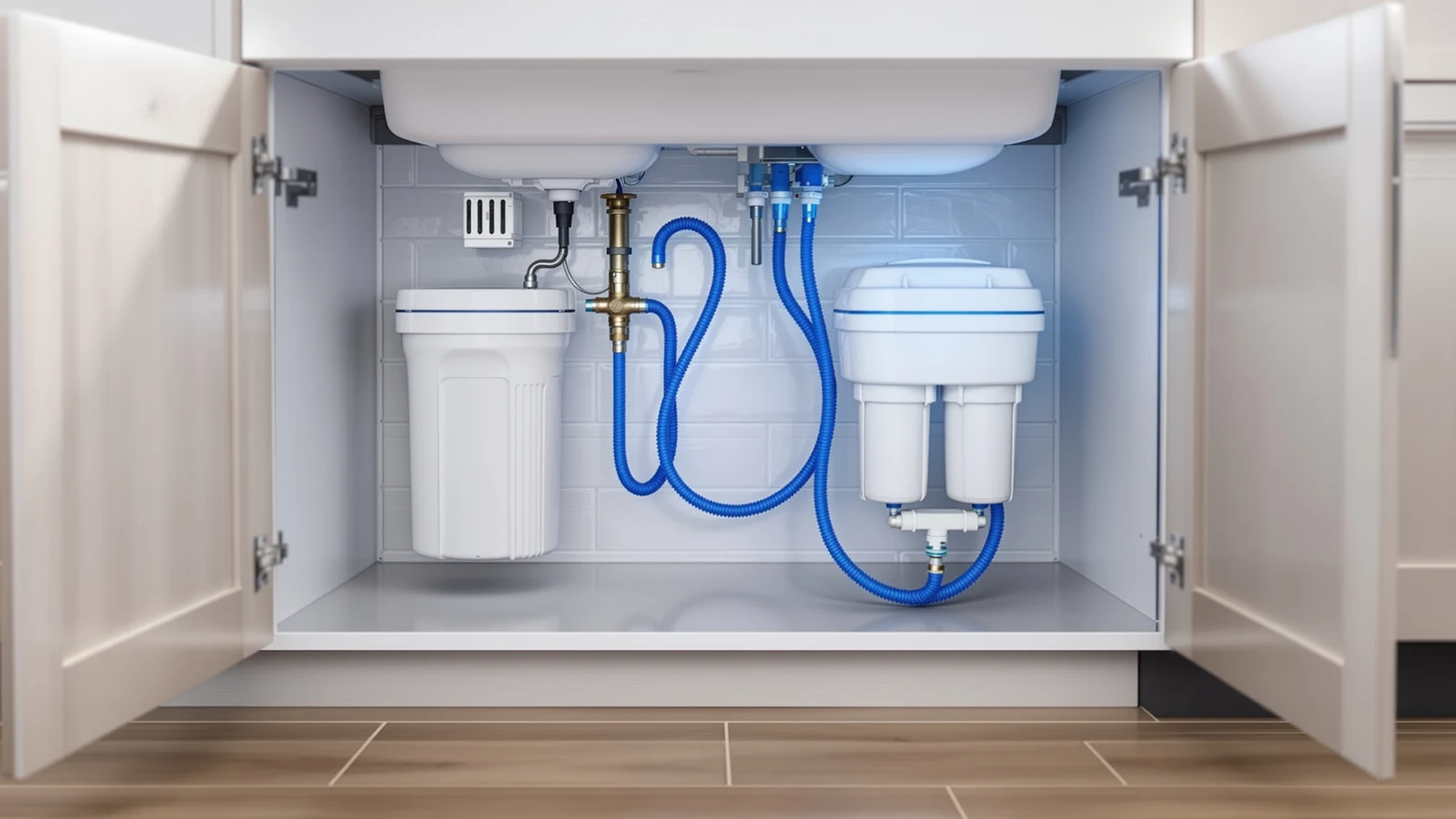
Reverse osmosis supply line tee'd off under a kitchen sink to feed a dishwasher and a coffee maker in addition to the main faucet

Every reverse osmosis listing on Amazon leads with the same photo: a glass of clear water next to a refrigerator ice maker. It's the easiest sell in the category, because a fridge line is genuinely the simple case — a quarter-inch push-to-connect tube, a low and steady trickle of demand a few times a day, and an appliance built from the factory to accept a filtered feed at ordinary household pressure.

A dishwasher or a coffee maker is a different plumbing problem, and most buying guides never get past the fridge. This one does. We'll cover what actually changes when the second appliance isn't a slow-sipping ice maker, which systems in our lineup are built with a dedicated second outlet instead of asking you to improvise one, how to tee a single-outlet system safely if that's what you own, why some coffee machine manufacturers explicitly warn against a direct RO feed, what a dishwasher gains and risks from RO water, and the arithmetic that tells you whether your system can actually keep up with a second appliance without starving the faucet.

None of this requires re-plumbing the house. It requires understanding what a "second line" is actually asking of your system, and buying — or retrofitting — accordingly. If you haven't run a dedicated faucet line yet, our guide to adding an RO faucet with no spare hole covers the first line; this one picks up from there.

Why a dishwasher or coffee maker isn't the fridge conversation

A refrigerator's water valve is a small solenoid that opens for a few seconds several times a day to fill an ice mold or top off a door dispenser — call it a cup or two per cycle, spread out, with long idle stretches in between. Almost any RO system, tank or tankless, can absorb that kind of demand without the rest of the kitchen noticing.

A dishwasher's inlet valve does something structurally different: it opens once per cycle and pulls a real volume of water in a short burst, on a schedule set by the appliance's own control board, not by a person standing at a faucet who'll wait if the flow is slow. A coffee maker or espresso machine is a smaller draw in volume, but it introduces a second concern a fridge never does — the water is about to be heated inside a boiler or thermoblock, which is exactly the kind of internal plumbing that scale, sediment or aggressive water chemistry damages fastest.

Both appliances also expect to be plumbed like they would be to a municipal cold line: a fitting they can pull from on demand, not a request that has to be relayed through a storage tank that might be partway through refilling itself. That's the practical reason a second appliance isn't just "another fridge line" — it changes how much your system needs to have ready to give, and how it needs to be able to give it.

Dual-outlet systems: a second line built in, not improvised

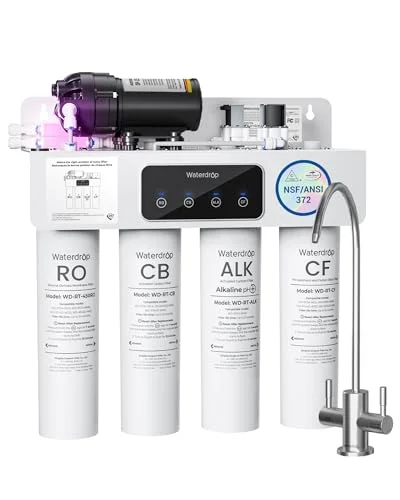
The straightforward way to feed a second appliance is to buy a system that was designed for it. The Waterdrop T4-A Alkaline Mineral Tankless Reverse Osmosis System is built as a dual-flow unit — its own listing describes two separate output lines rather than the single faucet port most under-sink systems ship with, which is the feature that matters here: a second, independent tap point off the same membrane and post-filtration stages, instead of a fitting you have to add yourself downstream of a single outlet.

That distinction is worth being precise about. You are not buying "twice the output" — the unit's rated production is 450 GPD, a single number describing what the membrane and pump can produce across however many outlets draw from it, not a doubled capacity per line. What you are buying is two independent connection points off that shared capacity, which means no tee fitting to install and no third-party check valve to source. The plumbing that a retrofit forces you to build yourself, this system ships with.

It's also a tankless unit, so both outlets draw directly from active production rather than from a bladder tank that has to refill between draws — relevant if you're running a dishwasher and a coffee maker close together. Tankless systems need power at the install point; if a nearby outlet is the obstacle, our guide to electric versus non-electric RO systems works through what a non-electric setup gives up in exchange for not needing one.

Beyond the T4-A, dedicated dual-outlet plumbing is still the exception in this category — most systems, including the other two in this guide, ship with one outlet, which means the second appliance is a retrofit job, covered next.

Retrofitting a single-line system: the tee, the check valve, and the pressure math

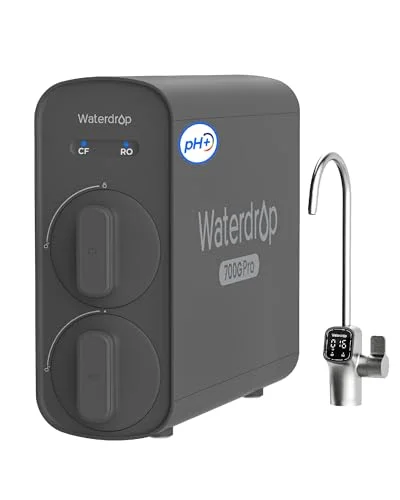
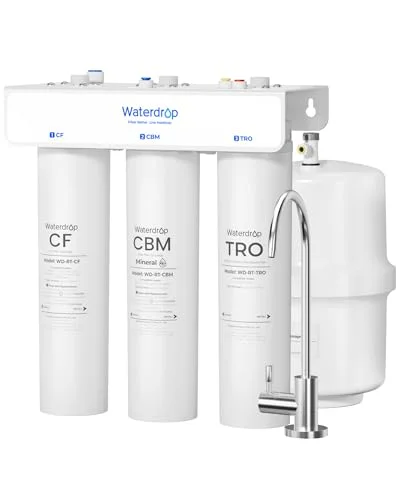
If your system has one outlet — the case for both the Waterdrop T3-T and the Waterdrop G5P700A-PRO in our lineup, neither of which lists a second output line — adding a dishwasher or coffee maker tap means building the second line yourself, downstream of the storage tank or the tankless unit's output port and ahead of the faucet. Three components decide whether that retrofit is safe and reliable.

The tee fitting. A quarter-inch push-to-connect or compression tee splits the RO product-water line into two branches — one continuing to the faucet, one running to the new appliance. Standard practice in this category, the same fitting used for years to add a fridge line off an under-sink system; the only difference here is what's on the far end of the branch.

The check valve. This is the part a fridge-line retrofit often skips and a dishwasher or coffee maker retrofit shouldn't. A check valve installed on the branch line prevents water — and, more importantly, whatever is on the appliance side of that line — from being pushed backward into the RO system's clean-water side under pressure fluctuation. Dishwashers cycle their own internal valves and pumps; without a check valve, that activity can transmit pressure pulses back up the branch line toward the tee. It's a small, inexpensive fitting, and skipping it is a false economy on exactly the two appliances this guide is about.

The pressure math. This is where a retrofit succeeds or quietly disappoints. A tank-based RO system delivers water from a bladder tank pressurized to roughly 40 to 45 psi at the factory setting, dropping as the tank empties between refills — and refill itself is throttled by the system's own production rate. Split that single output between a faucet and a dishwasher inlet valve, and both draws now share a tank sized assuming one point of use. The practical result on an undersized tank is a faucet that runs noticeably slower while the dishwasher fills. A tankless system sidesteps the tank-recovery half of the problem — it produces on demand rather than storing — but the branch still adds a second simultaneous draw against the same rated GPD ceiling, which is the arithmetic in the gallons-per-cycle section below.

None of this is exotic plumbing. It's the same tee-and-check-valve pattern already used to add ice-maker lines, done with a bit more respect for the volumes involved once the appliance on the other end is a dishwasher instead of a fridge.
Coffee makers specifically: why some manufacturers say no

A coffee maker or espresso machine is the appliance most likely to have an explicit line in its own manual about filtered or reverse-osmosis water, and it's worth reading that line before running a tap to one. The concern manufacturers raise isn't cleanliness — RO water is about as free of dissolved minerals as tap water gets — it's the opposite: some machines, particularly boiler-based espresso machines and a number of drip makers, rely on a baseline level of dissolved minerals for two things a coffee maker actually needs: electrical conductivity for certain water-level sensors to function, and enough hardness that internal gaskets and seals don't dry out or degrade the way they can with extremely low-mineral water over months of use. Water that's too pure, not too dirty, is the warning in the fine print.

This is also a warranty question, not just a mechanical one. Several manufacturers' documentation specifies a minimum total dissolved solids range for water fed into the machine, and running water below that range can affect warranty coverage on the internal boiler or heating element. Because RO product water commonly tests in the 5 to 50 ppm TDS range, it can sit well under some machines' stated minimums.

None of this rules out RO water for coffee — it's routine in commercial cafés, which often run RO through a dedicated remineralization cartridge for exactly this reason, adding back a controlled, small amount of hardness rather than none at all. If you want that on a home system, a standalone inline remineralization filter is the fix, and our guide to alkaline RO systems covers the built-in version. The step that actually matters before running any line to a coffee maker: open the machine's manual and check its stated minimum TDS or hardness before you tee off the RO line.

Dishwashers: descaling benefits versus the warranty fine print

A dishwasher's relationship with RO water runs the opposite direction from a coffee maker's, and it's a more straightforward win — with one caveat worth reading before you commit. Hard water is the single biggest reason dishwashers develop the white scale film on glassware and heating elements that shortens their working life and dulls a machine's cleaning performance over time; running low-mineral RO water through the fill line removes the mineral load that causes that scaling in the first place, which is why spot-free rinse systems in some higher-end dishwashers already do a version of this internally with their own small filtration cartridge.

The caveat is the same one that shows up with coffee makers, just in a different form: a small number of dishwasher manufacturers specify a minimum inlet water hardness or note that extremely soft or de-mineralized water can affect how well their detergent formulations perform, since many dishwasher detergents are formulated assuming a baseline mineral content to help lift and rinse residue. This is a performance note more often than a strict warranty exclusion, but it's the reason to check your specific model's manual for a water-hardness section before assuming RO water is a strict upgrade with no downside.

Practically, the dishwasher side of this retrofit is also the more forgiving one on plumbing: dishwashers connect to a standard 3/8-inch compression fitting at the shutoff valve, and an RO branch line reduced to that fitting is a routine adapter, not a specialty part.

Running the numbers on gallons per cycle before you commit

The number on the box — 220 GPD, 450 GPD, 700 GPD — is a rated daily production figure, not an instantaneous flow rate, and the difference is exactly what decides whether a second appliance is a good idea on a given system. Our full breakdown of what that number actually promises is in RO systems and GPD: what the number really tells you; the short version for this decision is that GPD describes total output if the system ran continuously for 24 hours at its rated test pressure, which no household draw pattern resembles, and it says nothing about how fast water arrives at a given moment.

What you can reason about with the GPD figure is relative headroom between products. A modern ENERGY STAR-certified dishwasher typically uses somewhere in the neighborhood of 3 to 4 gallons of water per full cycle — a small draw in absolute terms, but one that arrives compressed into a single fill window. A drip coffee maker's reservoir commonly holds under a gallon per brew. None of these are large numbers next to a system's daily rating, but a fill event on a dishwasher is a concentrated draw competing, for a few minutes, with whatever else is being asked of the same membrane and, on tank systems, the same storage tank.

SystemRated outputOutletsPrice
Waterdrop T3-T220 GPDSingle$169.99Price
Waterdrop T4-A450 GPDDual flow$249.99Price
Waterdrop G5P700A-PRO700 GPDSingle$359.99Price

The practical takeaway isn't a formula so much as a filter for the decision: if you're feeding a second appliance from a system rated well above what a single faucet and an occasional dishwasher or coffee maker cycle would ever ask for in a compressed window — the case for the 700 GPD G5P700A-PRO — headroom is on your side even on a single-outlet, retrofit-tee setup. On a lower-output single-outlet system like the 220 GPD T3-T, a second appliance sharing that one line and one storage tank is a much tighter fit, and the T4-A's dedicated second outlet at 450 GPD is the more deliberate middle path: built-in separation rather than a shared branch, at a higher ceiling than the entry-level unit. Whichever system you have, run the appliance's fill cycle once with nothing else drawing from the faucet, and you'll know within a few minutes whether the shared line is actually a bottleneck or a non-issue in practice.

The picks

Three systems for a second line, and who each is for

Prices move on Amazon — confirm the live price before buying.

01Built-in second outlet

Waterdrop T4-A

For a dishwasher or coffee maker without a DIY tee
Dual flow · 450 GPD · Alkaline mineral · Tankless

The only system here built with a second output line from the factory rather than a single outlet you'd have to split yourself. That means no tee fitting, no aftermarket check valve to source, and no third connection point to troubleshoot later if something leaks — the second line is part of the unit's own design. It's tankless, so both outlets draw from active production rather than a shared tank, and it adds alkaline minerals back after the membrane. It needs power at the install point, same as any tankless system.

Waterdrop T4-A dual-flow tankless alkaline reverse osmosis system
$249.99
450 GPD · Dual flowCheck price →
02Most headroom

Waterdrop G5P700A-PRO

The highest ceiling for a shared single-line retrofit
700 GPD · Alkaline mineral pH+ · Single outlet

Ships with one outlet, so a second appliance still means tee-ing off the product-water line with your own check valve. What it brings is the largest rated capacity of the three, which is the number that matters when a dishwasher fill and a faucet draw happen to overlap: more headroom on the membrane before either draw feels the other one. The pH+ alkaline stage adds minerals back after filtration, worth knowing if you're also running a line to a coffee maker with a published minimum-hardness requirement.

Waterdrop G5P700A-PRO 700 GPD alkaline mineral pH+ reverse osmosis system
$359.99
700 GPDCheck price →
03Budget single-outlet

Waterdrop T3-T

Fine for a fridge line; think twice before a second appliance
220 GPD · Remineralization · Faster flow · Single outlet

The lowest-rated output and a single outlet of the three, which makes it a reasonable choice if the plan is still just a faucet and maybe a fridge line — but the tightest fit in this guide for a dishwasher or coffee maker retrofit. If you're buying new specifically to add a second appliance, the case for stepping up to the T4-A or the G5P700A-PRO instead of adding a branch to this one is straightforward: more capacity, or capacity plus a dedicated outlet, for a moderate difference in price.

Waterdrop T3-T remineralization reverse osmosis system, faster flow
$169.99
220 GPDCheck price →

Two mistakes worth avoiding

Skipping the check valve because the fridge-line retrofit never needed one. A slow, steady ice-maker draw rarely pushes anything backward up a branch line. A dishwasher's inlet valve and internal pump activity are a different kind of load, and the small cost of a check valve on that branch is the difference between a retrofit that's finished and one that needs revisiting after the first time the dishwasher's fill cycle coincides with someone using the faucet.

Assuming "RO water is pure, so more is always better." It's the wrong lens for a coffee maker with a published minimum-TDS requirement, and it can be the wrong lens for a dishwasher tuned to detergent that expects some hardness. Read the appliance's own manual for a water-quality section before running a line to it — the manufacturer has already done the research on what their machine wants, and it isn't automatically "as pure as your RO system can make it."

FAQ

Common questions

Can I run RO water to my dishwasher?

Yes, and it's a straightforward win for most households — RO water lacks the dissolved minerals that cause scale buildup on glassware and heating elements. The one thing worth checking first is your specific dishwasher's manual for a minimum water-hardness note, since some detergent formulations are tuned assuming a baseline mineral content, and connection is a standard 3/8-inch compression fitting either way.

Why do some coffee maker manufacturers warn against reverse osmosis water?

Not because the water is unclean — because some machines, especially boiler-based espresso machines, rely on a baseline level of dissolved minerals for water-level sensor conductivity and to keep internal seals from drying out over time. Several manufacturers publish a minimum TDS or hardness figure in their documentation, and RO product water can test well under it. Check the machine's manual before running a direct RO line, or add a remineralization cartridge if it specifies a minimum.

Do I need a special reverse osmosis system to add a dishwasher or coffee maker line?

Not necessarily. A single-outlet system can be retrofitted with a tee fitting and a check valve on the branch line, the same basic pattern long used for ice-maker lines. A dual-outlet system like the Waterdrop T4-A skips that retrofit by shipping with a second output built in, which is worth the difference in price if you'd rather not source and install the branch fittings yourself.

Will adding a second appliance slow down my RO faucet?

It can, depending on the system's rated output and whether it uses a storage tank. A tank-based system splitting one outlet between a faucet and a dishwasher fill cycle can leave the faucet running slower while the tank is recovering; a higher-GPD or tankless system has more headroom to absorb a second simultaneous draw. Test the appliance's fill cycle with nothing else drawing from the faucet to see how much headroom your specific setup actually has.

Keep reading

Next, once the second line is in