Best RO Systems
Home › Guides › Ultrafiltration vs. reverse osmosis
Comparison

Ultrafiltration under-sink systems vs. reverse osmosis: no waste water, but what you give up

We're reader-supported: buying through our links may earn us a commission at no extra cost to you. We compare published listing specifications, prices and the general mechanics of each filtration class — we don't run a testing lab, and nothing below is a star rating or a paraphrased review.

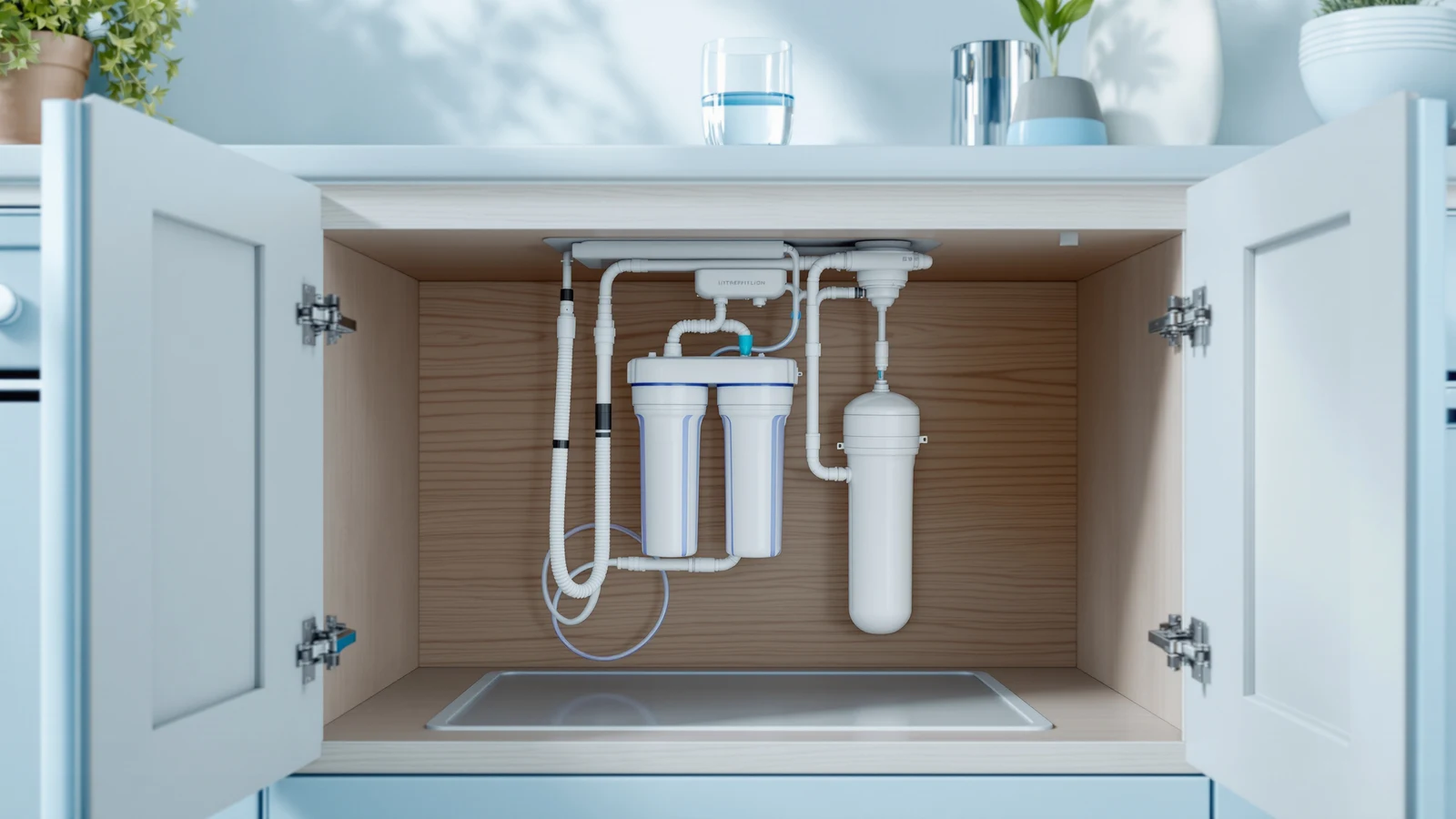
Ultrafiltration under-sink water filter system next to a reverse osmosis storage tank in a kitchen cabinet

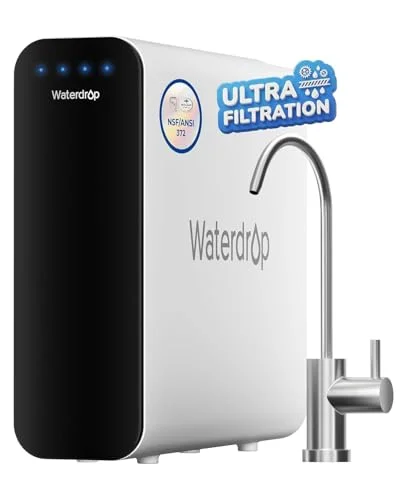
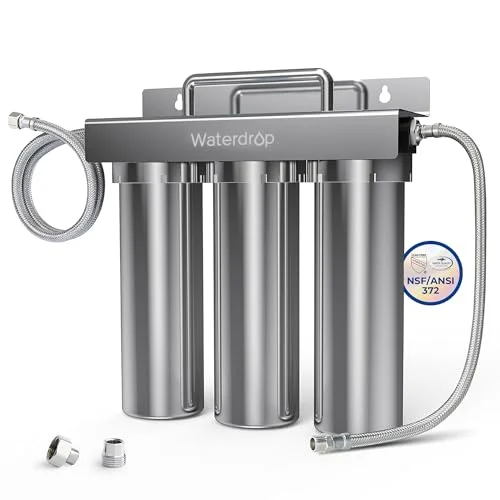
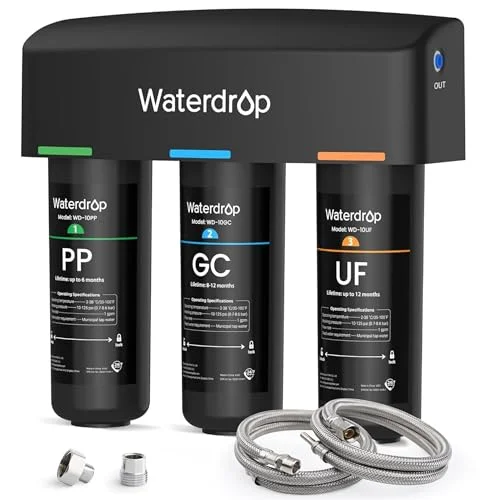
Three Waterdrop listings sit a few clicks from the under-sink reverse osmosis systems on this site, each stating the same core number: a 0.01 micron ultrafiltration membrane. The WD-TSA-UF runs $99.99, the TSU is $129.99, and the TST-UF tops the trio at $141.99 — all three under-sink, all three ultrafiltration rather than reverse osmosis, and all three a noticeably smaller purchase than most of the RO systems we cover elsewhere on this site.

That price gap is not an accident of brand positioning. Ultrafiltration and reverse osmosis both push water through a membrane under pressure and both sit under a kitchen sink, which is enough to confuse a first-time buyer on a results page — but they are not the same purchase, and conflating them is the single most common mistake we see in this category. This piece reads the real difference correctly: what a 0.01-micron membrane can and cannot remove, the sentence every honest UF listing has to carry because of that limit, what you get back by giving up a drain line and a tank, and the question that should actually decide which technology belongs under your sink.

The pore size

What a 0.01-micron membrane actually blocks

The number in all three Waterdrop titles — 0.01 micron on the WD-TSA-UF, "0.01 Micron" on the TSU, "0.01μm" on the TST-UF — is not marketing flourish. It is the one hard spec every ultrafiltration listing is required to make, because it is the entire mechanism: a bundle of hollow fibers with pores small enough to physically stop anything larger than 0.01 micrometers from passing through, while letting water molecules and dissolved minerals through unimpeded.

Put that number next to what it's actually straining out. Bacteria run roughly 0.2 to 2 microns — twenty to two hundred times larger than the pore. Protozoan cysts such as Giardia and Cryptosporidium run 1 to 15 microns. Sediment, rust particles and the turbidity that clouds a glass of poorly filtered tap water are larger again. A 0.01-micron pore is well inside the size class that stops all of it, which is why ultrafiltration earned a place in water treatment: it clarifies water and removes microorganisms and particulate using nothing but pressure and a membrane, no electricity and no chemical dosing.

What it is not doing, by the same physics, is touching anything smaller than that pore — and dissolved solids are smaller by a wide margin. Dissolved salts, metals and minerals exist in water as ions and small molecules, on the order of nanometers rather than micrometers; next to a 0.01-micron opening they are effectively invisible. That fact is the hinge the rest of this comparison turns on: a UF membrane is a size filter, and dissolved solids are too small to be caught by size alone.

The line every listing needs

The sentence every UF listing includes, and most buyers skip

Because of that pore-size math, there is a sentence that belongs on every honest ultrafiltration listing, whether or not a given buyer stops to read it: ultrafiltration does not reduce total dissolved solids. It is not a limitation specific to the WD-TSA-UF, the TSU or the TST-UF — it is a property of the technology itself, true of every 0.01-micron UF system regardless of brand, and it is the one line that most separates this category from the reverse osmosis systems sold a few rows down the same search results page.

This trips up buyers shopping by price and by the word "filter" rather than by what each filter class actually certifies. Someone comparing a $129.99 UF system against a $289 tankless RO system on sticker price alone is, without realizing it, comparing two answers to two different questions. The RO system is being asked, among other things, to pull dissolved lead, fluoride, nitrates, arsenic and the salts behind a high TDS reading out of the water. The UF system was never built to answer that question — the 0.01-micron figure in its own title is the tell, if you know what it's telling you.

None of that makes UF a worse product. It solves a narrower problem — biological and particulate contamination — extremely well, at a fraction of the price of a system built to also strip dissolved solids. The mistake isn't buying ultrafiltration; it's buying it while believing it does what reverse osmosis does. If a water report or your own TDS meter shows a dissolved-solids number you're trying to bring down, a UF spec sheet's silence on the subject is telling you it isn't the tool for that job.

What you give up, what you get back

No drain line, no wastewater, no tank — the other half of the trade

Reverse osmosis earns its dissolved-solids performance by running water hard enough against a much tighter membrane that a portion of the feed has to be rinsed away carrying the rejected material with it — that's the drain line every RO install needs, and the reason a reverse osmosis system's spec sheet always lists a drain ratio alongside its output figure. A storage tank sits downstream of that membrane because RO produces water slowly enough that most households need a reserve built up between draws, which is also why a typical tank system eats most of a cabinet.

Ultrafiltration doesn't need any of that, for the same pore-size reason covered above. A UF membrane doesn't have to reject dissolved solids, so it doesn't need the pressure differential that produces reject water in the first place — essentially all of the water entering a UF system leaves it as filtered water. No drain saddle, no permeate-to-drain ratio against your water bill, and no tank competing for cabinet space. The WD-TSA-UF, TSU and TST-UF are each a single under-sink unit rather than a multi-housing stack, consistent with that no-tank design across the whole UF category.

What you get back for giving up the drain line and the tank is less filtration power at the dissolved-solids level, discussed above, and — tied to the same tankless design — immediate, continuous output instead of a reserve you draw down and wait to refill. Whether that trade reads as a win or a loss depends entirely on what's actually in your water, which is the question the rest of this piece keeps coming back to.

At the faucet

Flow rate: why UF keeps up with a running tap and RO doesn't

The no-tank design has a second consequence beyond cabinet space, and it's the one that shows up the moment you turn the handle. A UF membrane's pores are, by design, far larger than an RO membrane's — wide enough to pass dissolved minerals, which is the whole reason it can't reduce TDS. Larger pores also mean dramatically less resistance to flow, so a UF system can typically deliver water close to your home's existing line pressure and volume, on demand, the same way an ordinary faucet does. That's a structural property of the membrane type, true across the UF category generally, rather than a published flow figure specific to any one of the three Waterdrop listings here — none of their titles state a gallons-per-minute number, and we're not going to assign one we can't source.

A reverse osmosis membrane works the opposite way almost by definition: the tight pore structure that rejects dissolved solids also resists flow heavily, which is why RO systems need either a storage tank or a booster pump to push harder, and why even tankless RO systems still publish output in gallons per day rather than per minute — a production-capacity rating, not a tap flow rate. Fill a pot quickly or have two people draw water back to back, and a UF system's faucet-pressure delivery has an advantage an RO system's membrane-limited output structurally can't match without a tank behind it.

The practical upshot: if what you want is RO-grade dissolved-solids reduction, you are also signing up for RO-grade flow limits, tank or no tank — the two are the same trade-off wearing different clothes. If your water doesn't carry a dissolved-solids problem in the first place, a UF system gives you that faucet-speed flow with nothing given up to get it.

Reading the marketing correctly

"Retains essential minerals" is a side effect, not a feature

Ultrafiltration listings frequently lean on language about retaining minerals, and it's worth being precise about what that phrase actually describes, because it is easy to misread as an added capability rather than what it really is: the direct, unavoidable consequence of the same pore size that keeps a UF system from reducing TDS.

A UF membrane isn't choosing to let calcium, magnesium and other dissolved minerals through as a deliberate design feature the way an alkaline RO system's remineralization cartridge adds minerals back after stripping them out. Those minerals were simply never large enough to be caught by a 0.01-micron pore — nothing was removed, so nothing needs restoring. Reading "retains essential minerals" as a point in UF's favor over RO is reading one side of a trade-off as a free win; it's the same fact already covered above — UF does not reduce TDS — described in language that sounds like a benefit instead of a limitation.

That doesn't make the framing dishonest. Minerals passing through untouched is a true, accurate statement about these systems, and for someone who specifically doesn't want tap minerals stripped out, it's a real point in UF's favor. It's worth being clear-eyed that it's the identical property from the TDS section above with different spin applied, not a second, independent advantage layered on top.

Side by side

Ultrafiltration and reverse osmosis, by what each actually does

General category comparison, not a spec sheet for one named product on either side — confirm the current listing for anything model-specific.

PropertyUltrafiltration (0.01 micron)Reverse osmosis
Bacteria, cysts, sedimentRemoved — larger than the poreRemoved — tighter membrane again
Dissolved solids (TDS)Not reducedReduced — the core job of the membrane
Drain line / wastewaterNone neededRequired — a published drain ratio
Storage tankNot neededCommon on tank systems; some tankless models exist
Flow at the faucetClose to line pressure, on demandMembrane-limited; rated in GPD, not GPM
Minerals in the output waterPass through untouchedRemoved, unless a remineralization stage adds them back

Now the three real listings this piece is actually about, lined up on what we could confirm — price and the shared 0.01-micron spec stated in each title. None of the three titles states a differentiating stage count, certification or flow figure beyond the model code itself, which is itself worth knowing before you pick one over the others on price alone.

ListingPriceMembrane ratingCount
WD-TSA-UF$99.990.01 μmNot stated — check listingView
TSU$129.990.01 micron1 Count (Pack of 1)View
TST-UF$141.990.01 μm1 Count (Pack of 1)View
The three listings

WD-TSA-UF, TSU and TST-UF, and what separates them

01Lowest price

Waterdrop WD-TSA-UF

The cheapest route into Waterdrop's UF lineup
0.01 μm · ultrafiltration · under-sink

At $99.99 this is the least expensive of the three, and its title states exactly one spec beyond the model name and the under-sink form factor: the 0.01-micron membrane rating that defines the entire UF category covered above. We don't have a published size or variant line for this listing, which means we can't tell you anything about cartridge count or bundled parts beyond what's shown on the current Amazon page — confirm those details there before buying rather than assuming parity with its two pricier siblings.

Waterdrop WD-TSA-UF 0.01 micron ultrafiltration under sink water filter system
$99.99
0.01 μm UFCheck price →
02Middle of the three

Waterdrop TSU

Thirty dollars over the WD-TSA-UF, same core rating
0.01 micron · ultrafiltration · under-sink · 1 Count (Pack of 1)

The TSU sits at $129.99 and carries the identical 0.01-micron ultrafiltration rating as its cheaper sibling — the title doesn't claim an additional stage, a faster flow figure or a certification the WD-TSA-UF's doesn't. The listing does confirm it ships as a single unit, one count, one pack. Beyond that, the honest comparison between this and the WD-TSA-UF is simply the $30 gap; we'd want to see what's actually different in the box before recommending paying it, and the current listing page — not the title — is where that answer lives.

Waterdrop TSU 0.01 micron ultra filtration under sink water filter system
$129.99
0.01 μm UFCheck price →
03Top of the lineup

Waterdrop TST-UF

The most expensive of the three, same stated membrane rating
0.01μm · ultra-filtration · under-sink · 1 Count (Pack of 1)

At $141.99 the TST-UF is forty-two dollars above the WD-TSA-UF and twelve above the TSU, and its title makes the same single hard claim the other two make: 0.01-micron ultrafiltration, under-sink, sold as one unit. Nothing in the name points to a reason for that premium over the TSU specifically. If the price gap matters to your decision — and at this size of purchase it reasonably should — that's a question for the current listing's full spec section and images, not for the three words in the title.

Waterdrop TST-UF 0.01 micron ultra-filtration under sink water filter system
$141.99
0.01 μm UFCheck price →

Unlike Waterdrop's own T3 reverse osmosis line, where each title states a differentiating GPD figure, a remineralization claim or a power requirement, these three UF titles state the same membrane rating and differ mainly on price and model code. That's not a flaw in any one listing — it may simply mean the hardware really is closer to identical and the gap reflects packaging, bundled fittings or timing rather than filtration performance — but it is a reason to read past the title on all three before choosing by price alone, the same discipline worth applying any time a brand's own naming doesn't tell the full story, as with matching an exact replacement filter to your model rather than assuming a family name is enough.

The actual decision

When ultrafiltration is the right call, and when it isn't

Everything above points at one practical test, and it has nothing to do with price or brand: what does your water need removed? Ultrafiltration is the right call when the concern is biological or particulate — municipal water with an occasional boil-water advisory, a well or rural supply where bacteria or turbidity are the worry, or simply wanting a clarifying, no-waste polish on water that already tests fine on dissolved solids. In those cases, a 0.01-micron UF system gives you faucet-speed flow, no drain line, no tank, and a lower price than a comparable RO setup, with nothing meaningful given up for your actual problem.

Reverse osmosis is the right call the moment dissolved solids are the concern — lead, fluoride, nitrates, arsenic, a high TDS reading from a water report, or water that tastes heavy with minerals you want gone rather than passed through untouched. No UF membrane, at 0.01 micron or any finer rating, closes that gap; the pore is the wrong tool for a problem measured in nanometers, not microns. If cabinet space or a missing drain line is the real obstacle, that's worth solving on its own terms — see our look at whether "compact" RO systems really mean a smaller footprint — rather than substituting a UF system never built to answer the dissolved-solids question.

And the two aren't always a choice between one or the other. Because ultrafiltration is cheap, tankless and waste-free, some households run a UF stage ahead of an RO membrane to protect it from sediment and microbial load, or run a standalone UF unit at a second tap while reserving RO for drinking water specifically. A $100 to $140 UF system and a $200-plus RO system are answering genuinely different questions, and the only honest way to choose is knowing which question your water is actually asking.
FAQ

Questions people ask about ultrafiltration vs. RO

Does an ultrafiltration system remove as much as reverse osmosis?

Not for dissolved solids. A 0.01-micron UF membrane is highly effective against bacteria, cysts, sediment and turbidity — particles far larger than its pore size — but it does not reduce total dissolved solids, because dissolved salts and minerals are small enough to pass through a pore that size untouched. Reverse osmosis uses a much tighter membrane specifically to catch what UF cannot.

Why doesn't an ultrafiltration system need a drain line?

Because it doesn't need to reject dissolved solids, a UF membrane doesn't require the high pressure differential that produces reject water in an RO system. Essentially all the water entering a UF unit leaves as filtered water, which is why the WD-TSA-UF, TSU and TST-UF — like UF systems generally — install without a drain saddle or a storage tank.

Does "retains essential minerals" mean a UF system is healthier than RO?

It means a UF system doesn't remove minerals in the first place, since they're too small for its pore size to catch — the identical physical fact behind its lack of TDS reduction, described from the other direction. It's a real point in UF's favor if you specifically don't want minerals stripped from your water, but it isn't an added capability layered on top of anything else.

Should I buy the cheapest of the three Waterdrop UF listings?

On stated specs alone, there isn't a clear reason not to: the WD-TSA-UF, TSU and TST-UF titles all claim the same 0.01-micron rating, and none states an extra stage, certification or flow figure that would justify its higher siblings' price on paper. Check the current listing page for each before buying, since packaging, bundled fittings or other details not in the title could still differ.

Keep reading

Next, if you're still deciding