Best RO Systems
Home › Guides › Compact reverse osmosis systems
Buying guide

Compact reverse osmosis systems: does "compact" actually mean a smaller footprint?

We're reader-supported: buying through our links may earn us a commission at no extra cost to you. We compare published specifications, certifications and prices — we don't run a testing lab.

Slim tankless reverse osmosis system installed inside a narrow under-sink cabinet next to a drain pipe and shutoff valve

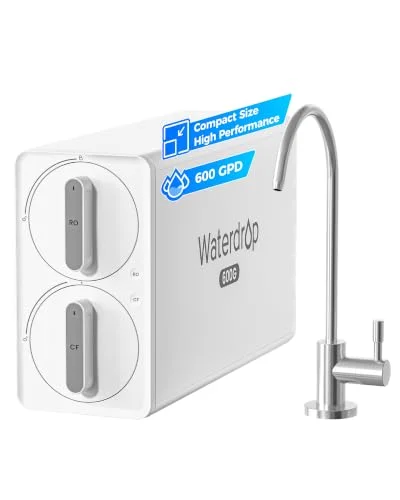
One listing in this comparison puts the word directly in its name: the Waterdrop G6A6 Compact Alkaline Mineral Reverse Osmosis System. Nothing about the other two says "compact" anywhere in the title, yet one of them is cheaper and rated at the same output, and the other is rated for a third more water a day. That is the actual question this page answers — not which of the three filters best, but whether the one that spends a whole word of its title on size is measurably smaller than the two that don't bother to claim it.

"Compact" is not a regulated term. Nobody certifies it the way a lab certifies a contaminant-reduction claim or a materials-safety standard. It is an adjective a manufacturer is free to put on a listing whether the case is four inches narrower than a competitor's or exactly the same width with better photography. That doesn't make it meaningless — several of the tankless systems we've covered on this site genuinely are a fraction of the size of the tank-and-canister systems they replaced — but it does mean the word itself proves nothing. The only thing that proves anything is a number you can hold a tape measure to, and that's where this gets interesting, because two of the three listings here don't give you one.

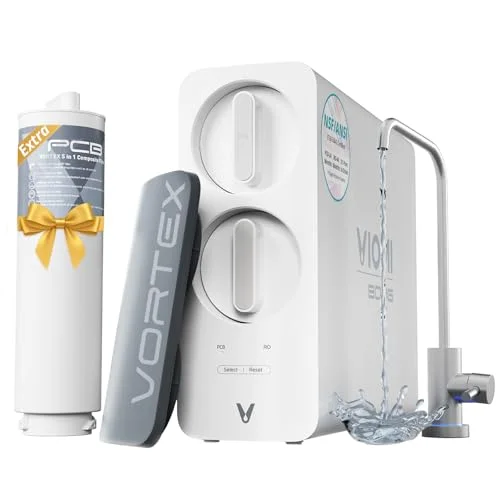
The three systems: the VonWater 600GPD Under Sink RO Water Filtration tankless system, a 7-stage unit at $175.99; the Waterdrop G6A6, an 8-stage alkaline tankless unit at $189.99 and the only one of the three labeled compact; and the VIOMI V8, a 9-stage tankless system rated at 800 GPD — a third higher output than the other two — at $219.99. All three are tankless, all three need a dedicated electrical outlet and two drilled holes (one for the countertop faucet, one for the drain line), and none of the three publishes a star rating or review count we could responsibly repeat here, so every claim below is anchored to the manufacturer's own specification text, not to secondhand sentiment.

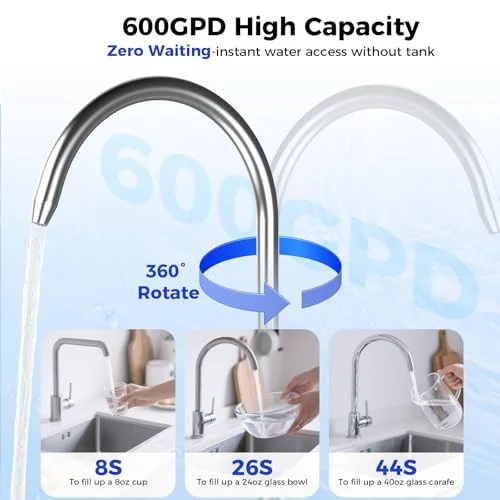
Gallons-per-day is the number every listing leads with, and it is also the number least connected to case size. GPD measures how much water the membrane and pump can push through in a day under the manufacturer's test pressure — a function of membrane area and pump capacity, not of how much plastic is wrapped around them. The VIOMI V8 is rated for 800 GPD, a third more than the VonWater or the Waterdrop, and nothing in its own listing claims that output costs it extra cabinet width. A higher GPD rating can come from a more efficient pump pushing the same membrane harder just as easily as it can come from a physically larger unit. Treat the gallon number as a statement about throughput, not about the box.

01

GPD ≠ footprint

Output is a pump-and-membrane spec. The VIOMI V8 outranks the other two by a third on GPD without claiming a larger case for it.

02

Stage count ≠ footprint

The compact-labeled Waterdrop packs more stages (8) than the VonWater (7), and the highest-output VIOMI packs the most (9) of all three.

03

Clearance is fixed

Fittings, drain saddle and tubing need the same few inches behind the case regardless of how slim the front panel is.

04

Tankless is the real lever

Dropping the pressure tank — not shaving width off a tankless case — is what actually frees most of a cabinet.

What's actually stated — and what isn't

Here is the honest finding, and it's the reason this page exists instead of a simple side-by-side ruler comparison: of the three listings, only one states a width, a depth and a height a shopper can compare against their own cabinet before buying. It is not the one with "compact" in its name.

The VonWater listing gives the full figure in its own bullet copy: 13.9" × 4.9" × 16.2" for the V2-600N model, described there as an "ultra-slim tankless design" that the manufacturer says saves roughly 70% of under-sink space versus a traditional tank system. That is a real, checkable number. Measure your cabinet's clear depth and height behind the P-trap, compare it to 4.9" deep and 16.2" tall, and you have your answer before you spend anything.

The Waterdrop G6A6 — the system actually named Compact — takes a different approach in its listing text. It calls itself "the smallest Waterdrop Reverse Osmosis Water Filter" and states that its "ultra-compact tankless design saves up to 81.8% more under-sink space than traditional RO systems." That 81.8% figure is specific-sounding and entirely unanchored: the listing doesn't say what baseline "traditional RO systems" means, doesn't publish the G6A6's own width, depth or height, and doesn't publish the dimensions of whatever it's being compared against. A percentage without two end-points to divide is a marketing number, not a measurement. "Smallest Waterdrop" is also a claim about Waterdrop's own lineup, not about this comparison — it tells you nothing about how the G6A6 sits next to a VonWater or a VIOMI case.

The VIOMI V8 doesn't publish a width, depth or height either, but its listing is candid about why it matters: the installation notes tell the buyer directly to "measure under-sink space for proper fit" before buying, and separately specify a rear clearance of 2.0" to 3.9" for tubing behind the unit. That's not a case dimension, but it is a real, stated number you can use — and notably it's the only one of the three listings that volunteers a clearance figure at all, rather than leaving the buyer to guess at it from product photos.

So the actual scorecard on "stated size," independent of which system is physically smallest: VonWater states a full case size. Waterdrop states a percentage with no stated baseline and no case size. VIOMI states a clearance requirement but no case size. If a listing doesn't give you inches, we are not going to estimate them from a photo and present a guess as a specification — that's exactly the kind of invented number this comparison is trying to replace. Check the listing's own technical-details table and customer Q&A section before you buy, and if neither has a number, assume the case is the width of whatever's in the hero photo and nothing more.
Where the size savings actually come from, mechanically

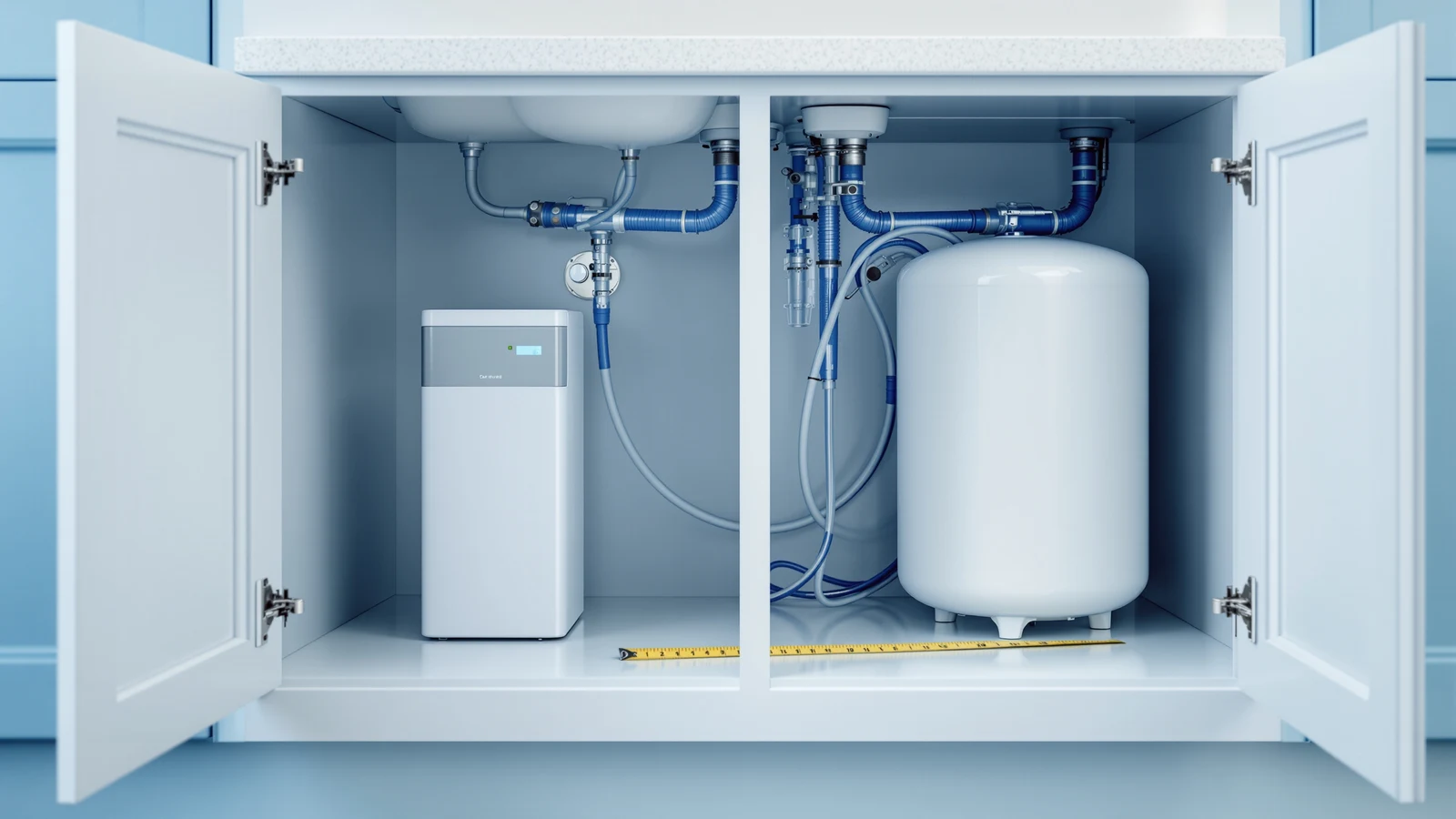
Before comparing three similar-looking tankless boxes, it's worth being clear about the one change that actually frees most of a cabinet: dropping the pressure tank. A classic under-sink system is three or four vertical housings plus a football-sized storage tank sitting on the cabinet floor — stage count aside, the tank alone is usually the single largest object in there. All three systems on this page are already tankless, so that lever has already been pulled for every one of them. What's left to compete over is the shape and size of the box that remains, and that's a much smaller margin than the tank-versus-tankless jump.

Within that smaller margin, stage count is a tempting but unreliable predictor. Intuitively, fewer filter stages should mean a smaller case — fewer cartridges, less plastic. The numbers here say otherwise: the VonWater runs 7 stages, the Waterdrop G6A6 (the one marketed as compact) runs 8, and the VIOMI V8 runs 9. The system with the most stages of the three is also the one rated for the highest output, and the system explicitly marketed on size carries more stages than the one that makes no size claim at all. That's consistent with how slim tankless cases are actually built: manufacturers combine sediment and carbon media into a single multi-function cartridge rather than giving every stage its own full-length housing, so a case can add filtration steps without adding a proportional amount of plastic. The stage count on the box describes filtration steps, not the number of physical canisters you'd count if you opened the case.

The other genuine levers are the pump housing and the case wall itself. A tankless system needs a booster pump to push water through the membrane fast enough to feel instant at the faucet — a separate factor from the filtration stages entirely — and a smaller, more efficient pump assembly takes up less internal volume than an older, bulkier one. Thinner-wall plastic and a narrower internal manifold shave real inches off a case without changing anything about what's inside it. None of the three listings here publishes an engineering breakdown of pump size or wall thickness, so we can't attribute a specific inch of savings to a specific mechanism for any of them — but it's useful to know that "compact" in this category is earned by case engineering and cartridge consolidation, not by rationing filtration stages, since the data above shows the opposite correlation.

Why a compact case still needs the same clearance behind it

This is the part a front-on product photo hides completely. A slim case buys you width on the shelf, but every one of these three systems still needs the same basic plumbing behind it: a feed line tapped off the cold-water supply, a drain saddle clamped onto the waste pipe, and the tubing and fittings connecting both to the unit. None of that shrinks because the case got narrower.

The VIOMI V8's own installation notes put a number on it directly, telling installers to allow 2.0" to 3.9" of rear clearance for tubing behind the unit — on top of whatever the case itself measures. Both the VonWater and the VIOMI listings also specify that installation requires two drilled holes (one for the dedicated RO faucet, one for the drain line through the waste pipe) and a standard electrical outlet for the booster pump, and the VonWater listing notes it ships with both 1/2" and 3/8" compression adapters to fit standard household plumbing — hardware that has to physically connect to the back of the unit regardless of how slim the front of the case is.

The practical consequence: a system's "footprint," in the sense that actually matters for fitting it into your cabinet, is its stated case dimensions plus a fixed clearance margin for fittings and tubing — and that margin doesn't meaningfully shrink from one tankless system to the next, because elbow fittings and compression adapters come in roughly the same handful of sizes industry-wide. A percentage-savings claim that only addresses the case and ignores the clearance behind it is describing less of the installation than it sounds like it is. When you're down to inches — which is exactly the situation a small-cabinet buyer is in — that clearance margin is often the thing that decides whether the system fits, not the width of the case itself.

Measure the cabinet, not the cabinet door

Before any of the numbers above matter, they need a real cabinet measurement to be checked against — and the number most people measure first is the wrong one. The width of the cabinet door, or even the open cabinet box itself, is not the same as the clear space you actually have for a filtration unit. A standard US base cabinet is commonly built around a 24-inch-wide box, but once you subtract the face frame, the hinges, the P-trap and drain arm, a garbage disposal if you have one, and whatever cleaning supplies currently live in there, the clear, unobstructed width for a new appliance is routinely well under that — often closer to 14 to 18 inches on an average kitchen sink base, and narrower still under a bathroom vanity.

Measure at the narrowest point behind the plumbing, not at the cabinet opening, and measure depth and height the same way — many P-traps and garbage disposal bodies hang lower than people expect, which eats into the vertical space a tall, slim tankless case needs more than a short, squat tank system would. The one real-world number this comparison has to check against is the VonWater's stated 13.9" × 4.9" × 16.2": a cabinet with roughly 5 inches of clear depth and 16-plus inches of clear height behind the plumbing is a reasonable fit for it, on the manufacturer's own figure. For the Waterdrop or the VIOMI, you don't have an equivalent published number to check against — which means the measuring tape has to do double duty, confirming both that your cabinet has room and, separately, emailing or messaging the seller to get an actual case dimension before you commit to either one.

Side by side

The three systems, what's published and what isn't

Prices as recorded. Where a dimension isn't published on the listing, the row says so rather than estimating one.

SystemStated case sizeGPDStagesCertificationPrice
VonWater 600GPD13.9" × 4.9" × 16.2" (published)600 GPD7-stageNSF/ANSI 372$175.99Price
Waterdrop G6A6 "Compact"Not published — "81.8% space saving" claim, no baseline given600 GPD8-stageNSF/ANSI/CAN 372$189.99Price
VIOMI V8Not published — 2.0"–3.9" rear clearance stated instead800 GPD9-stageNSF/ANSI 53, 42 & 372$219.99Price

None of the three carries NSF/ANSI 58, the certification that specifically covers TDS-reduction performance — a distinction we work through in full in our look at which contaminant claims have actual testing behind them.

When a slightly bigger footprint is worth it

None of this is an argument that smaller is always better. A few extra inches of case width is a reasonable trade in at least one common situation: filter access. An ultra-slim, single-column case has to stack or line up its cartridges in a tight run, which can mean pulling a cartridge straight out needs clear space in front of the whole unit rather than just at the cartridge itself. A case with a little more width can mount cartridges side by side with enough room to twist and remove one without disturbing its neighbors — a real convenience the twist-and-pull designs on this site's own top picks are built around.

That trade-off matters more as stage count climbs, simply because there are more cartridges to service over the system's life. The VIOMI V8's 9 stages and the Waterdrop G6A6's 8 both mean more individual service points than the VonWater's 7, inside cases whose dimensions none of us can currently check. If your cabinet has a spare inch or two to give, and you'd rather service a multi-stage system without wrestling the whole unit forward on its tubing, that spare inch is buying real day-to-day convenience — not just comfort. Conversely, if your cabinet is genuinely tight and you're choosing on footprint alone, the VonWater is the only one of the three you can actually confirm will fit before it arrives, because it's the only one that tells you its size.

Measured against what we actually know

The three systems, read against their own listings

01Verifiable size

VonWater 600GPD Under Sink RO Water Filtration

The only one of the three that tells you its size
13.9" × 4.9" × 16.2" · 600 GPD · 7-stage · 2:1 pure-to-drain · NSF/ANSI 372

The VonWater isn't the system marketed on size, but it's the one you can actually plan around: a full width, depth and height published in its own listing copy, alongside a 2:1 pure-to-drain ratio and a 0.42 GPM flow rate the listing claims fills an 8 oz cup in seconds. It ships with both 1/2" and 3/8" adapters for standard plumbing, and at $175.99 it's the least expensive of the three. Its certification is NSF/ANSI 372 — lead-free materials — not the 58 standard that covers contaminant-reduction performance, a distinction worth keeping straight rather than reading "certified" as one undifferentiated stamp of approval.

The number that matters most for a small cabinet isn't on this page — it's on your tape measure. VonWater is the one listing here that gives you something to check it against.

VonWater 600GPD tankless under-sink reverse osmosis system
$175.99
Tankless · 600 GPDCheck price →
02The compact one

Waterdrop G6A6 Compact Alkaline Mineral RO System

Lives up to its name in marketing copy, unverifiable in inches
600 GPD · 8-stage alkaline · "81.8% space saving" claim · IAPMO-certified NSF/ANSI/CAN 372

Waterdrop calls this "the smallest Waterdrop Reverse Osmosis Water Filter" and claims its case design saves up to 81.8% more under-sink space than a traditional RO system — plausible for a tankless unit replacing a tank-and-housings setup, but the listing doesn't publish a width, depth or height, and the 81.8% figure has no stated baseline attached to it. It adds an 8-stage alkaline mineral process and a 24-month filter life on its own G6RO-600 cartridge, and its SGS-tested contaminant reduction claim is a private lab test result, not an NSF/ANSI 58 performance certification. At $189.99 it's the middle price of the three and the one where you have the least to measure against before buying.

A percentage with no stated baseline is a claim about Waterdrop's own catalogue, not a number you can compare against the other two systems on this page.

Waterdrop G6A6 compact alkaline mineral tankless reverse osmosis system
$189.99
Tankless · 600 GPDCheck price →
03Higher output

VIOMI V8 Reverse Osmosis Water Filtration System

A third more output, the most stages, the same unstated case size
800 GPD · 9-stage · 2.0"–3.9" rear clearance stated · NSF/ANSI 53, 42 & 372

The VIOMI V8 is rated for 800 GPD against 600 for the other two, runs the most filtration stages of the three at 9, and carries the broadest certification set — NSF/ANSI 53 for health-effect contaminants, 42 for taste and odor, and 372 for lead-free materials, with claimed TDS reduction up to 90.35% and PFOS/PFOA reduction above 99.6%. Like the Waterdrop, its listing does not publish a case width, depth or height — but unlike the Waterdrop, it doesn't try to paper over that gap with an unanchored percentage. It states the one number that actually helps an installer: 2.0" to 3.9" of rear clearance needed for tubing, plus the same two-hole, dedicated-outlet installation requirement as the other two. At $219.99 it's the most expensive of the three, and the higher output is the thing you're paying for, not a confirmed smaller case.

A clearance figure is a more useful honesty signal than a percentage claim — it's a number an installer can actually use, not a number designed to sound bigger than the gap it's measuring.

VIOMI V8 tankless 800 GPD reverse osmosis water filtration system
$219.99
Tankless · 800 GPDCheck price →
How we compared

Listing text, not a tape measure on our end

We read each manufacturer's own published specifications, bullet copy and installation notes for the VonWater, the Waterdrop G6A6 and the VIOMI V8, and checked which of the three states checkable case dimensions. We cross-referenced GPD rating, stage count, certification body and price directly from each listing rather than from a third-party summary, because the gap between a published spec and a marketing adjective is exactly what this comparison is about.

A note on the numbers we won't publish

If a listing doesn't say, we don't guess

We don't physically own these three systems, and we don't run a testing lab or measure cabinets ourselves. Where a width, depth or height isn't published in a listing's own specification text, we say so rather than estimating one from a product photo and presenting it as a fact. That gap in the data is itself part of the finding: a listing that won't give you a case size is asking you to trust an adjective instead of a number.

FAQ

Questions people ask about compact RO systems

Does a higher GPD rating mean a reverse osmosis system needs more cabinet space?

Not necessarily. GPD measures how much water the pump and membrane can produce in a day under test pressure, which is a function of pump capacity and membrane area, not case size. The VIOMI V8 here is rated at 800 GPD — a third more than the VonWater or Waterdrop's 600 GPD — without its listing claiming a larger case for the extra output. Treat the gallon number as a throughput spec, not a size spec.

Why do some compact-labeled RO systems not list their width, depth and height?

There's no requirement that they do, and "compact" isn't a regulated or certified term the way a contaminant-reduction standard is. In this comparison, the system actually named Compact — the Waterdrop G6A6 — states a space-saving percentage but not a case size, while the VonWater, which makes no size claim in its name, publishes the full 13.9" × 4.9" × 16.2" figure. A marketing adjective and a published dimension are two different things, and only one of them is checkable before you buy.

How much clearance does a tankless RO system need behind it?

At minimum, room for the feed-line fitting, the drain saddle and the tubing connecting both to the unit — none of which shrinks just because the case got narrower. The VIOMI V8's own installation notes specify 2.0" to 3.9" of rear clearance for tubing on top of the case dimensions. All three systems in this comparison also need two drilled holes — one for the faucet, one for the drain — and a dedicated electrical outlet for the booster pump.

Is a slightly bigger reverse osmosis system ever the better choice for a small cabinet?

Sometimes, specifically around filter access. A narrow, single-column case can require pulling cartridges straight out through tight clearance, while a case with a little more width can mount cartridges side by side with room to service one without disturbing the others. That trade-off matters more on higher-stage systems like the 8-stage Waterdrop or 9-stage VIOMI here, which have more individual cartridges to change over the system's life than the 7-stage VonWater.

Keep reading

Next, if you're still choosing