Hardware, explained
Permeate Pumps: The Non-Electric Trick That Fills an RO Tank Faster
By Ilane TallUpdated October 9, 2026Research-based.
We're reader-supported: buying through our links may earn us a commission at no extra cost to you. We compare published specifications, certifications and prices — we don't run a testing lab.
Every pressurized-tank reverse osmosis system runs on a trade nobody explains on the box. The membrane produces two streams at once: permeate, the clean water headed for your storage tank, and reject — often called concentrate — the water carrying away everything the membrane turned back. The reject stream leaves the membrane still carrying real pressure, because the system only ever drops a fraction of its incoming line pressure to force water through the membrane in the first place. On a plain tank system, that leftover pressure is wasted the instant the water reaches the drain line. It did useful work pushing permeate through the membrane, and then the system throws it away.
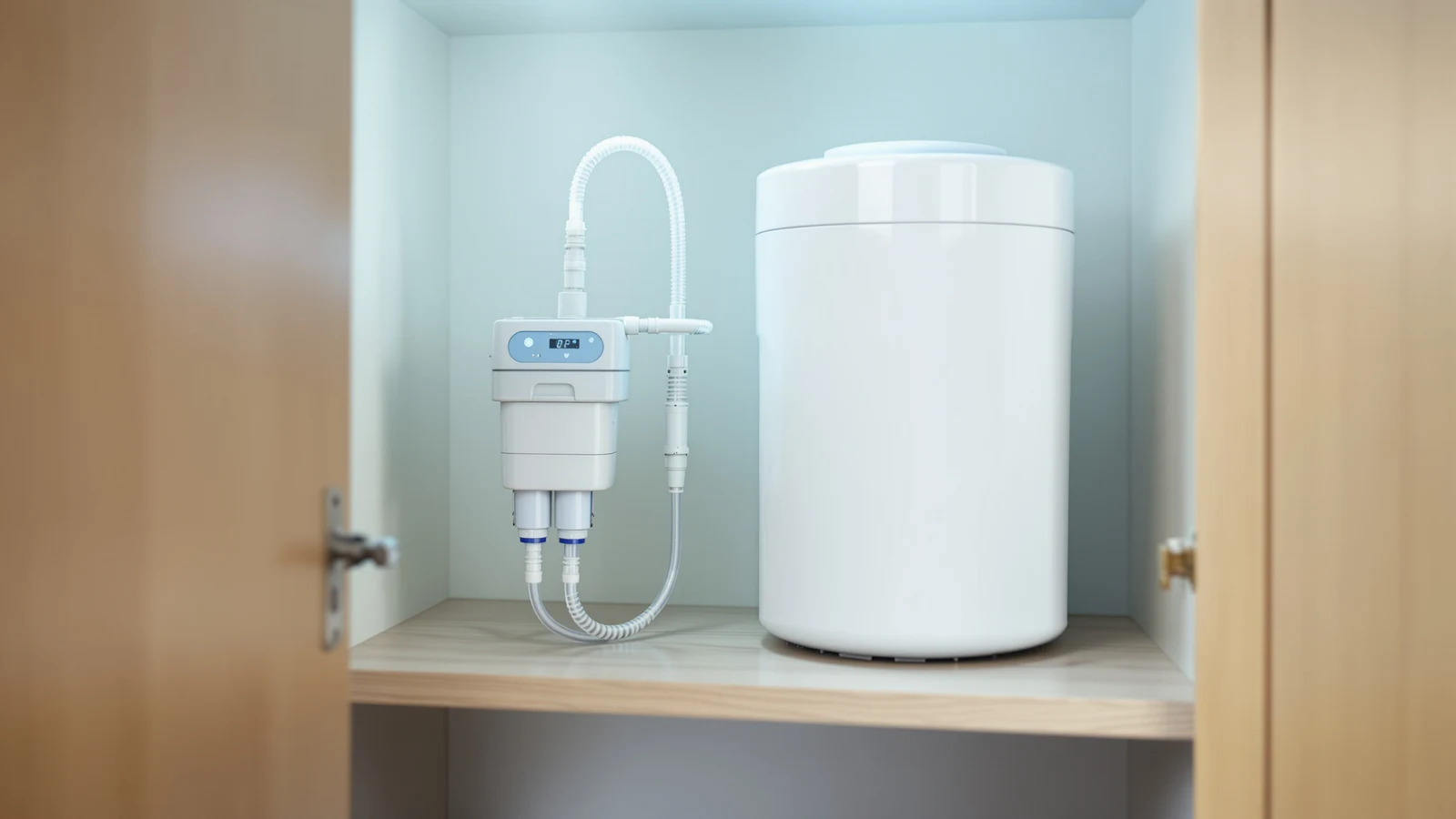
A permeate pump sits between the membrane's reject outlet and the drain, and it exists to capture that leftover pressure before it disappears down the pipe. Inside the housing is a small valve body split into two chambers by a diaphragm or piston. The outgoing reject water pressurizes one side; as it does, the mechanism physically shifts the other side, and that motion draws additional permeate out of the membrane and pushes it into the storage tank — on top of whatever the membrane was already producing under its own pressure. Once a cycle finishes, a set of check valves resets the pump and the reject water continues on to the drain exactly as it would have without one. No motor turns, no solenoid clicks, and no wire runs anywhere near it: the only energy involved is pressure that was already present in water headed to the drain regardless of what you do with it.
The best-known version of this part is Aquatec's ERP1000, the small plastic cylinder that turns up — sometimes labeled, sometimes bare — bolted to a tank or zip-tied to a cabinet wall in a meaningful share of residential tank systems sold over the past two decades. It is not the only brand that makes one, but it is the part most plumbers mean when they say "permeate pump," and the name worth typing into a search bar if a listing or manual mentions a pump without naming it. See our full picks for under-sink systems for how often it shows up across the current market.
Tank fill: how much fuller a pump actually gets you
A standard RO storage tank is not a bucket; it is a sealed bladder with air pre-charged on one side, and that air charge is the reason a plain gravity-fed system never quite fills all the way. As permeate collects on the water side of the bladder, it compresses the air charge and pushes back against the membrane. Production slows as that back-pressure climbs, and it keeps slowing until tank pressure gets close enough to the incoming feed pressure that the membrane effectively stalls. The long-standing rule of thumb in the trade for an unassisted tank is that it reaches somewhere around two-thirds of its rated volume before production has crawled to a near-stop — the remaining third is technically still available, but adding it would take an impractically long time, because the membrane is fighting almost its own feed pressure to put it there.
A permeate pump breaks that stall point. Because it adds permeate using the reject stream's own pressure rather than relying solely on the membrane pushing against rising tank back-pressure, it keeps working meaningfully closer to a full tank, and manufacturers of the part commonly cite roughly 50 percent more usable capacity from the same tank as a result. In practical terms, a tank that would have handed you two-thirds of a gallon on a three-gallon housing now hands you close to the whole three. That gap between a tank's printed size and what actually comes out of the faucet before it needs to recover is its own subject, and we work through the math system by system in our tank size comparison.
It also means a permeate pump is really a tank accessory, not a membrane accessory. It does nothing for a tankless, on-demand system, because there is no bladder fighting back-pressure to begin with — which is exactly the loophole the non-electric tankless designs later in this guide use instead of a pump.
The drain ratio, in real numbers
Drain ratio is the specification that tells you how many gallons go down the drain for every gallon that ends up drinkable, and it is where a permeate pump's benefit is easiest to put a number on. A basic tank system without one commonly runs 3:1 or 4:1 late in the fill cycle — as tank back-pressure rises, the membrane has to push harder for the same gallon of permeate, so more reject water is generated per gallon produced, not less. Three to four gallons down the drain for one gallon in the glass is a real, widely cited figure for that class of system, and it is the number that makes reverse osmosis look wasteful on a metered water bill.
Because a permeate pump recovers more of the incoming pressure instead of letting the membrane fight its own back-pressure, component manufacturers commonly cite wastewater reductions of up to 80 percent for a tank system that adds one — which moves a 4:1 ratio toward something closer to 1:1. That is the single biggest lever available on an existing tank system without replacing it.
The other route to a good ratio, and the one both non-electric picks below actually take, is skipping the tank and the back-pressure problem entirely. Frizzlife publishes a 4:1 pure-to-drain ratio for the M800 — four gallons of product water for every gallon sent to the drain, the inverse of the bad old number — achieved with no pump of any kind, because a tankless design never builds the back-pressure a pump would otherwise need to work against. Systems in that output range are also where high-capacity tankless units tend to live, since there is no tank to size for recovery time; a membrane rated for hundreds of gallons a day can simply keep up with demand directly.
Why it needs no electricity — and the one spec that can make it useless
The reason a permeate pump needs no plug is built into the mechanism, not a design choice someone could have gone the other way on: it runs entirely on the pressure differential between the reject stream and the tank, through a diaphragm and a set of check valves — the same broad category of part as the water-hammer arrestor already somewhere in your plumbing. There is nothing to wire, nothing to program, and nothing that draws standby power, which also means nothing inside it to fail electrically. On an install where the cabinet has no outlet, or where running one would mean an extension cord across the cabinet floor, that is a genuine advantage over any fix that requires a motorized booster pump.
The trade-off is that the mechanism needs enough incoming pressure to generate a usable differential in the first place. Too little feed pressure and the pump has nothing to push against; it simply stops helping, and the system reverts to filling exactly the way it would have without one. Most manufacturers specify a minimum incoming line pressure for the pump to engage at all, and the broader category of non-electric RO hardware leans on the same requirement for the same underlying reason. GLACIER FRESH, for instance, states that its own non-electric GFU03 wants at least 40 psi at the inlet to reach its rated 800 GPD flow, and explicitly flags that output drops below that line. A permeate pump is a smaller, cheaper part than a whole tankless system, but it shares that one weak point: on a house running low municipal pressure, an aging well pump, or a pressure-reducing valve set conservatively low, any non-electric solution under-performs, and the fix is a pressure booster — which does need a plug — not a different filter.
The picks
Three systems, and when a plain gravity tank is genuinely enough
None of the three ships with a bolt-on permeate pump — which turns out to be the useful lesson. One is a classic tank system that is honest about running on a plain shutoff valve; the other two solve the exact waste-water problem a permeate pump exists to fix by skipping the tank it would be attached to.
01Plain tank
iSpring RCC7-BN
The honest no-pump baseline
NSF/ANSI 58 · 75 GPD · 5 stages · tank · Regular
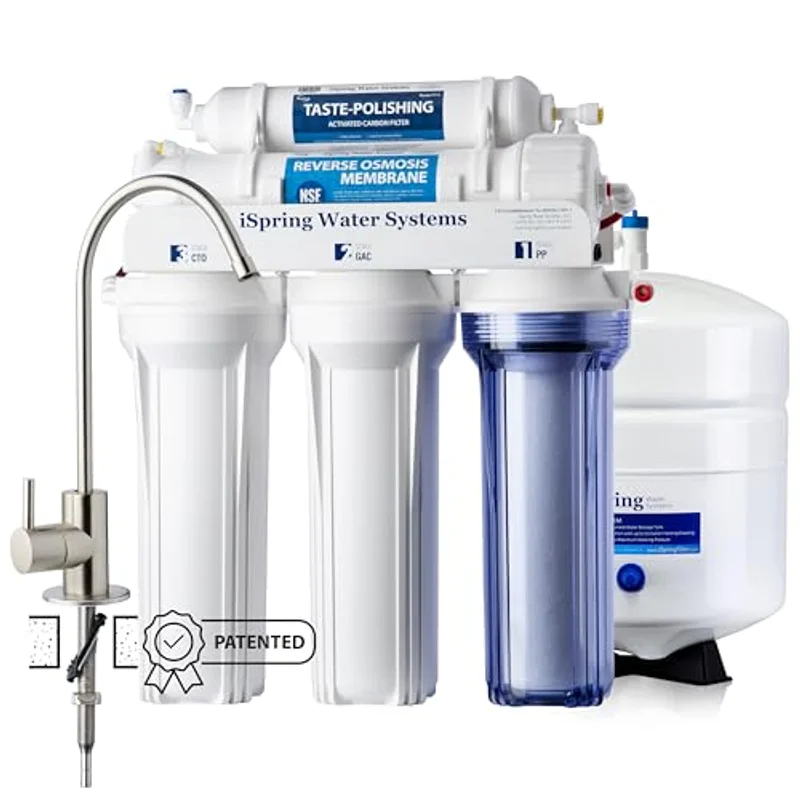
The RCC7-BN is a standard 5-stage, 75 GPD tank system, and neither iSpring's spec sheet nor its feature list for this listing mentions a permeate pump — so treat it as running on the basic automatic shutoff valve that stops production once the tank's back-pressure catches up with the incoming line, the two-thirds-full version described above rather than the pump-assisted one. What it offers instead is the simplest version of a tank system: a transparent first-stage housing you can actually see sediment load in, system-level NSF/ANSI 58 certification, and no power source required anywhere in the install. For a one- or two-person household that mostly drinks and cooks with the water rather than running it constantly, a 75 GPD membrane without a pump is rarely the bottleneck anything else in the kitchen will hit first.
02No tank, no pump
Frizzlife M800
A better ratio than most pumps get, without one
NSF/ANSI 58 & 372 · up to 900 GPD · 4:1 pure-to-drain · non-electric · tankless
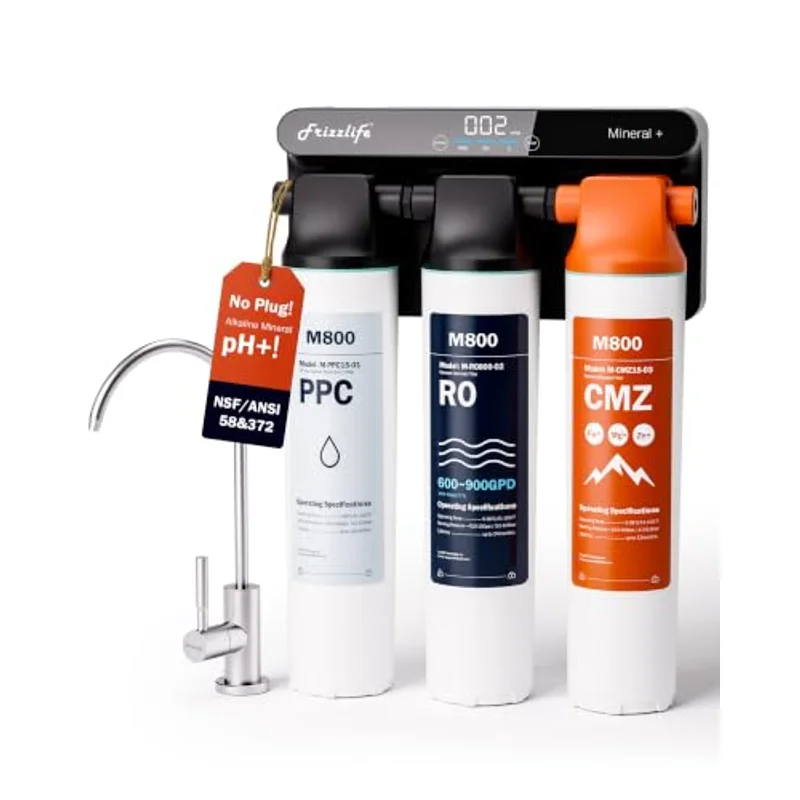
The M800 is a non-electric tankless design rated up to 900 GPD, and its published 4:1 pure-to-drain ratio beats what a permeate pump typically achieves on a tank system, without using one — there is no tank back-pressure to fight in the first place. It runs an auto-flush cycle that rinses the membrane automatically rather than waiting on a manual step, the same category of maintenance feature covered in our auto-flush guide, and its faucet shows live TDS and filter life, the kind of readout discussed in the smart-display comparison. It is a tall unit at 14.5 × 5.1 × 19.7 inches, and like every non-electric design it wants solid incoming line pressure to hit its rated output.
03Tightest cabinet
GLACIER FRESH GFU03
The tank problem removed, not patched
800 GPD · 5 stages · non-electric · tankless · U03-Classic
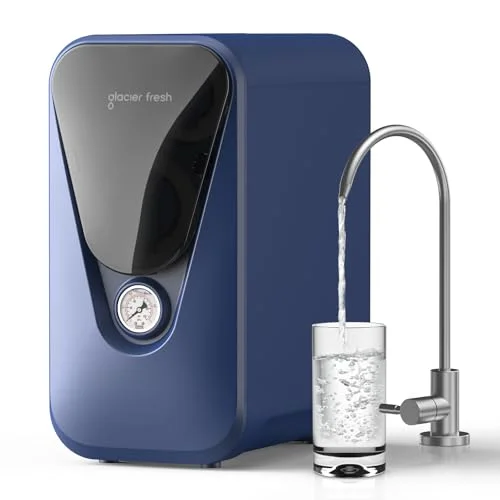
GLACIER FRESH's GFU03 takes the same tankless, non-electric route at 800 GPD, with a water-powered structure the brand says removes the external storage tank entirely and saves up to 70 percent of under-sink cabinet space compared with a tank-and-housings layout. Five filtration stages target a long contaminant list, and the one number worth writing down before buying is the one GLACIER FRESH itself publishes: at least 40 psi of incoming pressure to reach the rated 800 GPD flow, with output dropping below that line. Measure your line pressure before you measure your cabinet.
A plain gravity tank earns its keep more often than the marketing around permeate pumps suggests. If the household is small, the taps are not run constantly, and a tank that is practically two-thirds full on most days still outlasts the gap between uses, the extra moving part is solving a problem you were not going to notice. It is also the right call wherever incoming pressure is already marginal — a permeate pump needs a healthy pressure differential to do anything at all, and bolting one onto a weak supply line just adds a part that never engages. Where a plain tank stops being enough is a drain-ratio-sensitive household on a metered water bill, or a cabinet with genuinely no room for a tank — and that is exactly the gap the two non-electric tankless picks above were built to close, by removing the tank rather than assisting it.