Picks
Reverse osmosis for RVs and off-grid living: what actually works without shore power
By Ilane TallUpdated October 17, 2026Research-based
We're reader-supported: buying through our links may earn us a commission at no extra cost to you. We compare published specifications, certifications and prices — we don't run a testing lab.
Most of what gets written about reverse osmosis assumes a house that doesn't move: a wall to drill into, a p-trap to clamp a drain saddle onto, and an outlet that's live every time you turn the tap. None of that is guaranteed once the plumbing in question is bolted to a chassis instead of a foundation. A travel trailer or a boondocking rig breaks every one of those assumptions at once, and the systems built around them know it even if the listing copy doesn't say so.
A standard under-sink tankless RO system is designed to sit still. The membrane housing, the fittings, and the control board are rated for a fixed install — not for washboard gravel roads or the gentle sway of a trailer on the highway. A loosened compression fitting or a membrane housing shifted off its bracket is a kitchen leak at home; in a rig it's a cabinet full of water you don't discover until the smell shows up. The bigger problem is power: a tankless system's booster pump and control electronics expect continuous 110–120V AC for as long as it's making water, which means shore power or an inverter running the whole time. That's a fine assumption at a full-hookup site. It's a bad one the moment you're boondocking, and it's the single biggest reason a system that makes perfect sense under a kitchen sink doesn't belong in a rig.
None of this means RO water is off the table on the road — it means the form factor has to change. The rest of this guide covers what actually travels: why campground pressure is harder on a membrane than a stable city main, the countertop units that skip installation entirely, the one non-electric design that keeps working with the generator off, and the honest power math for running any of it on 12V or a small inverter. We close with the picks themselves, and the case for just packing a pitcher filter instead.
Campground water pressure doesn't behave, and a membrane counts every swing
A campground hookup isn't a municipal main feeding one house — it's a shared spigot off a park-wide line serving dozens of sites at once, and the pressure at that spigot depends on how many of your neighbors are showering, filling tanks, or running a sprinkler at the same moment you are. Readings that swing from under 20 psi during a crowded park's peak hour to well over 100 psi overnight, once the draw drops off, are common enough that an inline pressure regulator is near-universal advice in RV circles — not as a nice-to-have, but because unregulated city-water pressure is the single most common cause of blown fittings and split hoses in a rig's fresh-water system generally, before an RO membrane ever enters the picture.
An RO membrane is more sensitive to that swing than the rest of the plumbing. Most under-sink systems are speced around a fairly narrow feed-pressure band — commonly somewhere in the 40 to 85 psi range — and a membrane housing that spends a season cycling well outside that band on both ends ages differently than one that sat on a stable city main all year. High spikes stress seals torqued for a quieter life; pressure that sags too low starves the membrane of the force it needs to push water through, so output drops and whatever gets through carries a worse rejection ratio than the spec sheet promised. A booster pump is the standard fix for chronic low pressure in a stationary home, but it's worth weighing what that fix costs in a rig: another always-on pump drawing power for as long as the system runs, on top of everything else you're budgeting off a battery bank or a generator. That tradeoff is exactly the tension the rest of this guide is built around.
Carry your own regulator and a pressure gauge, test the spigot before you connect anything, and treat a park's stated pressure as a starting guess rather than a fact. It's a five-dollar habit that protects the rest of the system as much as it protects the membrane specifically.
What no-install buys you, and what it weighs
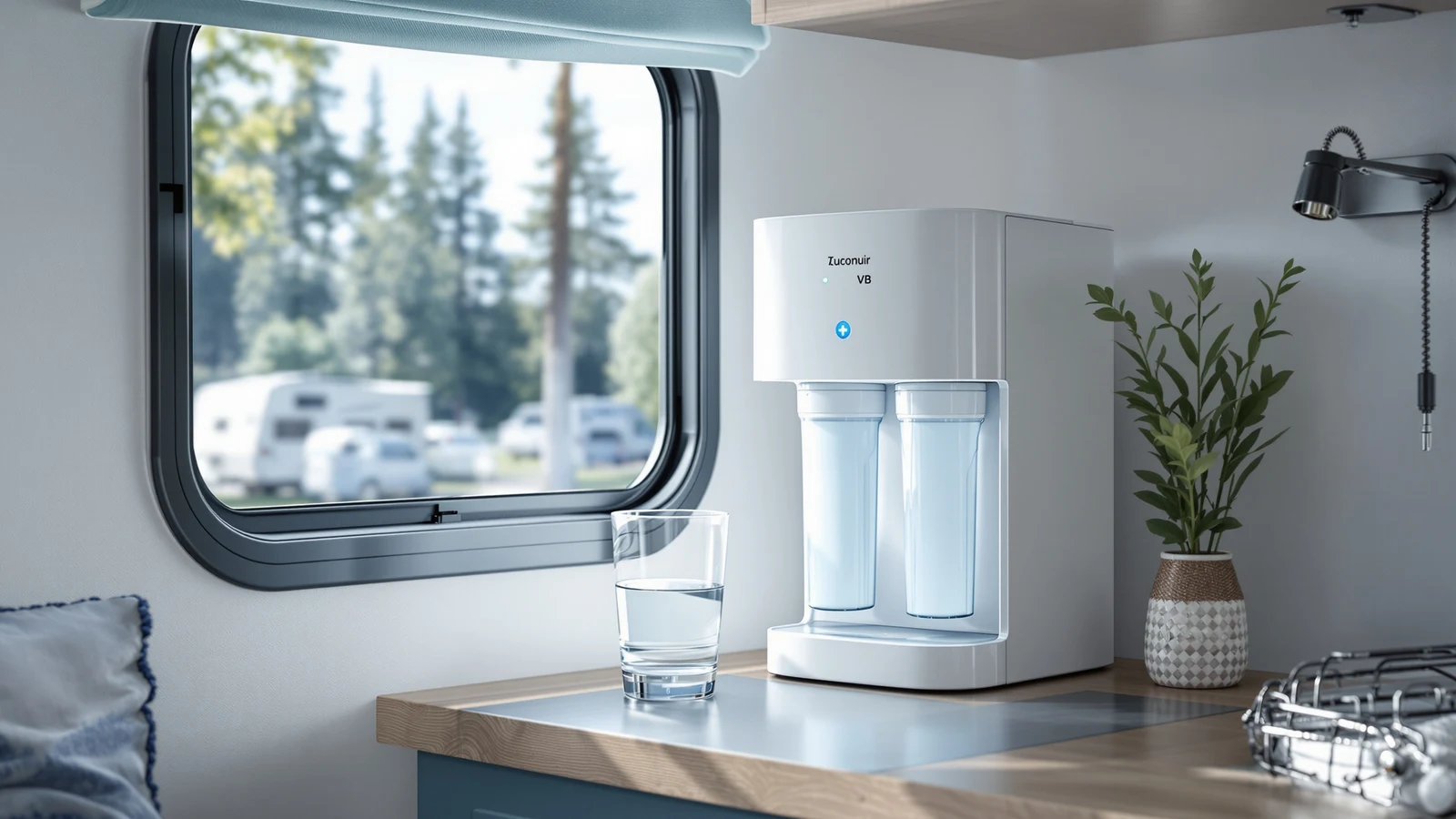
A countertop RO unit skips the two things that make an under-sink system a non-starter in a rig: nothing gets drilled into a composite countertop, and there's no drain saddle to clamp onto a p-trap. Reject water runs out a short hose into the sink instead of down a dedicated drain line — worth catching in a jug rather than letting it go straight down the galley drain and into a grey tank that fills faster on the road than it ever does at home; reject water has real uses once you're not just sending it away by default. Hookup is a diverter on the existing kitchen faucet, and the whole unit packs away into a cabinet or under a dinette seat between fill-ups — which is the actual point. No-install isn't a convenience feature here; it's the only way an RO system fits a kitchen that's also someone's living space.
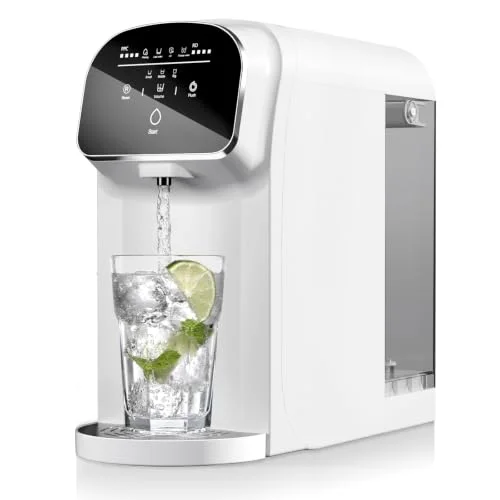
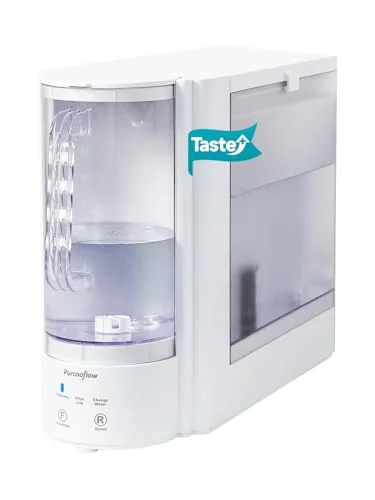
The Countertop Dual Carbon Reverse Osmosis Water Filtration System ($195.99) is the simplest version of that idea — a countertop unit built around dual carbon pretreatment stages ahead of the membrane, with no drilling and no permanent plumbing changes required. The Aigerri Countertop Reverse Osmosis Water Filter ($319.99) goes further and names the use case directly in its own listing: a 5-stage system with a UV stage, a 5:1 pure-to-drain ratio, no installation required, and RV use called out alongside home, kitchen and office. More stages isn't automatically the better buy — stage count on its own is a weak signal of performance, and the Aigerri's case rests on what those specific stages add, the UV polish and the drain ratio, not on the number five.
What neither listing states is weight, and weight is what actually matters once a unit gets packed, unpacked and stowed every trip rather than installed once and forgotten. RVs and travel trailers run on fixed payload and tongue-weight limits, and a countertop RO unit — reservoir, housings and all — adds real mass to that budget in a way a bolted-in tankless box never does after its one install day. Countertop units as a class commonly land somewhere in the high single digits to upper teens of pounds once you account for the reservoir; neither listing publishes a figure we can cite with confidence, so check the current item weight before it goes on the packing list, not after the rig is already loaded.
The non-electric exception: how it fills without a generator staying on
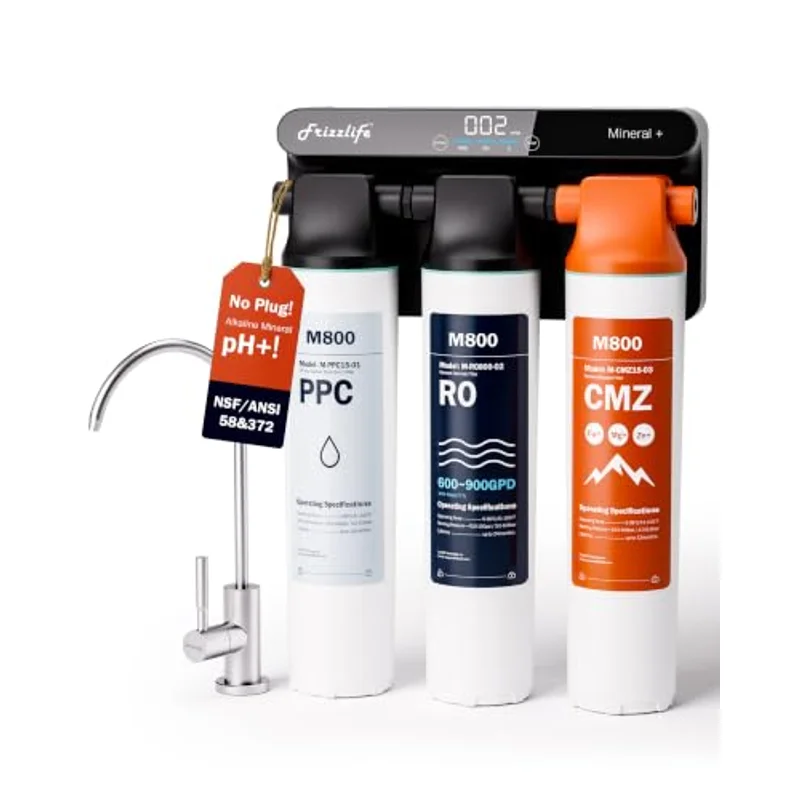
Everything in the section above still needs a wall outlet or an inverter running for as long as it's making water, because a countertop unit's pump and UV stage expect the same household AC they'd get sitting on a kitchen counter at home. The Frizzlife M800 Non-Electric Tankless Reverse Osmosis Water Filter ($289.99) is built around a genuinely different mechanism, and the name says so plainly: non-electric, tankless, rated up to 900 GPD, with alkaline mineralization, an auto-flush function, NSF/ANSI 58 and 372 certification, and a 4:1 pure-to-drain ratio. Non-electric means the system relies entirely on incoming line pressure to push water through the membrane — there's no booster pump and no control board drawing current, which is the only design choice that keeps an RO system producing water the moment an inverter is switched off for the night or a generator gets shut down to save fuel.
This is the same passive-pressure logic behind permeate pumps, the classic non-electric trick that uses the pressure differential between the reject stream and a storage tank to speed up a fill without spending a single amp-hour. A non-electric tankless design takes that idea further by removing the booster entirely rather than just working around a tank's refill lag — which also means its output is more exposed to whatever the feed pressure is actually doing at that moment, tying straight back to the campground-pressure problem above. An electric booster compensates for a weak feed by drawing more power; a non-electric system has no compensation to reach for, so a stable, adequately regulated hookup matters more here than it does for anything with a pump in the loop.
That trade is the whole case for this category on the road. You give up the output consistency an electric booster buys you at home, and in exchange you get a system that keeps working at 2 a.m. with the generator off and the battery bank left alone — which, for anyone actually off-grid rather than just camping with a hookup, is the only trade that matters.
Power budgets for 12V and generator setups, with the assumptions stated plainly
Of the three systems in this guide, only the Frizzlife M800 costs zero electrical power by design — its budget line is feed pressure and time, not amp-hours. The Countertop Dual Carbon and the Aigerri both expect standard household AC the way they would on a kitchen counter, which in a rig means routing them through an inverter off the house battery bank or a generator for as long as they're actively filtering.
Here's the honest math, assumptions stated up front rather than buried in a spec sheet neither listing actually publishes. Small countertop RO units with an added UV stage commonly draw somewhere in the range of 40 to 60 watts while filtering — a reasonable planning range for this class of appliance, not a confirmed figure for either specific product here. A twenty-minute fill cycle at that draw works out to roughly 13 to 20 watt-hours, trivial against what a small inverter generator can put out. The catch is that most generators have a minimum efficient load, so people rarely fire one up purely to make a few gallons of water; filtering tends to happen during a window the generator is already running for something else, like charging the house batteries. Running strictly off a 12V battery bank through an inverter instead, add another 10 to 15 percent for inversion losses when sizing a daily amp-hour budget — stepping 12V DC up to 110V AC is never free.
None of that arithmetic applies to the Frizzlife, which is exactly the point of including a non-electric option at all: it's the one pick here that doesn't show up anywhere on a power budget, which matters more than a GPD rating the moment the generator is off for the night.
Storing and winterizing a system between trips, so the first freeze doesn't ruin it
An RO membrane that freezes with water still in it is destroyed, full stop — the same expansion that splits a garden hose left out in January ruptures the thin-film layers inside a membrane, and unlike a hose, you can't just buy a new length at the hardware store. If the rig is parked outside over winter or sits unused for weeks in cold weather, draining the system fully — membrane included, not just the fresh-water tank and lines — needs to happen before the first hard freeze, a step that's easy to miss because it isn't on the standard RV winterizing checklist most shops hand out. Store the cartridges and membrane somewhere climate-controlled if you're pulling the whole unit for the season.
Dry storage has a smaller problem of its own: a membrane left damp rather than fully dried invites bacterial growth in stagnant water sitting in the lines. A short flush before the first use of a new season handles that — expect the first draw or two to taste slightly off as a result, which is the stagnant water clearing, not a sign the membrane failed over the winter.
If you're outfitting a rig on a budget and considering a used unit off a marketplace listing, freeze damage is exactly the kind of failure that doesn't show up until you pressurize the system for the first time — know what to check before you trust one rather than finding out on your first trip. And because you can't run to a hardware store from a boondocking site when a pre-filter clogs on a sediment-heavy spigot, a system that ships with a spare filter set — or simply packing spares yourself — earns its keep on the road in a way it never quite does sitting under a kitchen sink at home.
The picks
Three ways to get RO water without shore power
Ordered by how little they ask of your electrical system — from no power at all, to a countertop unit built for travel, to the simplest countertop format there is.
01True off-grid
Frizzlife M800 Non-Electric Tankless Reverse Osmosis Water Filter
The only pick here with a zero-amp power budget
$289.99 · non-electric · tankless · up to 900 GPD · NSF/ANSI 58 & 372 · 4:1 pure-to-drain
No booster pump, no control board, no power draw at all — it runs on incoming line pressure alone, which is the only reason an RO system keeps producing water after the generator's been shut down for the night. The tradeoff is that it leans on feed pressure more than anything with a booster would, so pair it with a regulator and don't expect top-line output from a weak or sagging campground spigot. Best suited to genuinely off-grid stretches where the power budget, not the counter space, is the constraint.
02Built for RV use
Aigerri Countertop Reverse Osmosis Water Filter, 5-Stage with UV
The one listing here that names RV use directly
$319.99 · 5-stage · UV · 5:1 pure-to-drain · no installation required
No-install and RV are both in the listing title rather than something we're inferring, and a 5:1 pure-to-drain ratio is a genuinely useful spec for a rig where reject water isn't disappearing down an unlimited municipal drain. The UV stage runs on standard household AC the same as the pump does, so budget it against the power math above rather than assuming it's free just because it skips installation. Pack it with the countertop unit's weight in mind, and confirm that figure on the current listing before it goes on the trip checklist.
03Simplest countertop
Countertop Dual Carbon Reverse Osmosis Water Filtration System
No UV stage to power, no installation either
$195.99 · countertop · dual carbon pretreatment · no installation
The lowest sticker price of the three and the least to go wrong electrically — dual carbon pretreatment ahead of the membrane, built for the counter rather than under a sink, with the same no-drill, no-drain-saddle setup as the Aigerri but without a UV stage adding to the power draw. We don't have a published GPD rating or weight figure for this specific listing beyond what's in its title, so confirm both on the current Amazon page before you buy if either is a deciding factor for your rig.
None of these three are the right call for every trip, and it's worth saying so plainly. For a weekend at a state park with a working hookup and a municipal supply you already trust, hauling an RO unit, managing reject water, and planning around winterizing it afterward is more setup than a two-night trip justifies. A simple pitcher filter handles basic chlorine taste and sediment well enough for a few days, needs no feed pressure and no counter space, and asks nothing of your power budget at all. RO earns its keep for a full season on the road, for boondocking off water sources you can't vouch for, or for anyone who genuinely doesn't trust the tap — not for a long weekend with a hose already hooked up. If budget rather than portability is the real constraint and the system is actually headed for a fixed kitchen rather than a rig, a renewed under-sink system is worth a look there instead. And if you're traveling with a dog or cat that normally drinks straight from the rig's water line, switching them to RO water for the trip is a smaller decision than it might feel like at the tap.