Best RO Systems
Home › Guides › Booster pump vs low water pressure
Guide

RO Systems With a Built-In Booster Pump: When Low Pressure Needs Help

We're reader-supported: buying through our links may earn us a commission at no extra cost to you. We compare published specifications, certifications and prices — we don't run a testing lab.

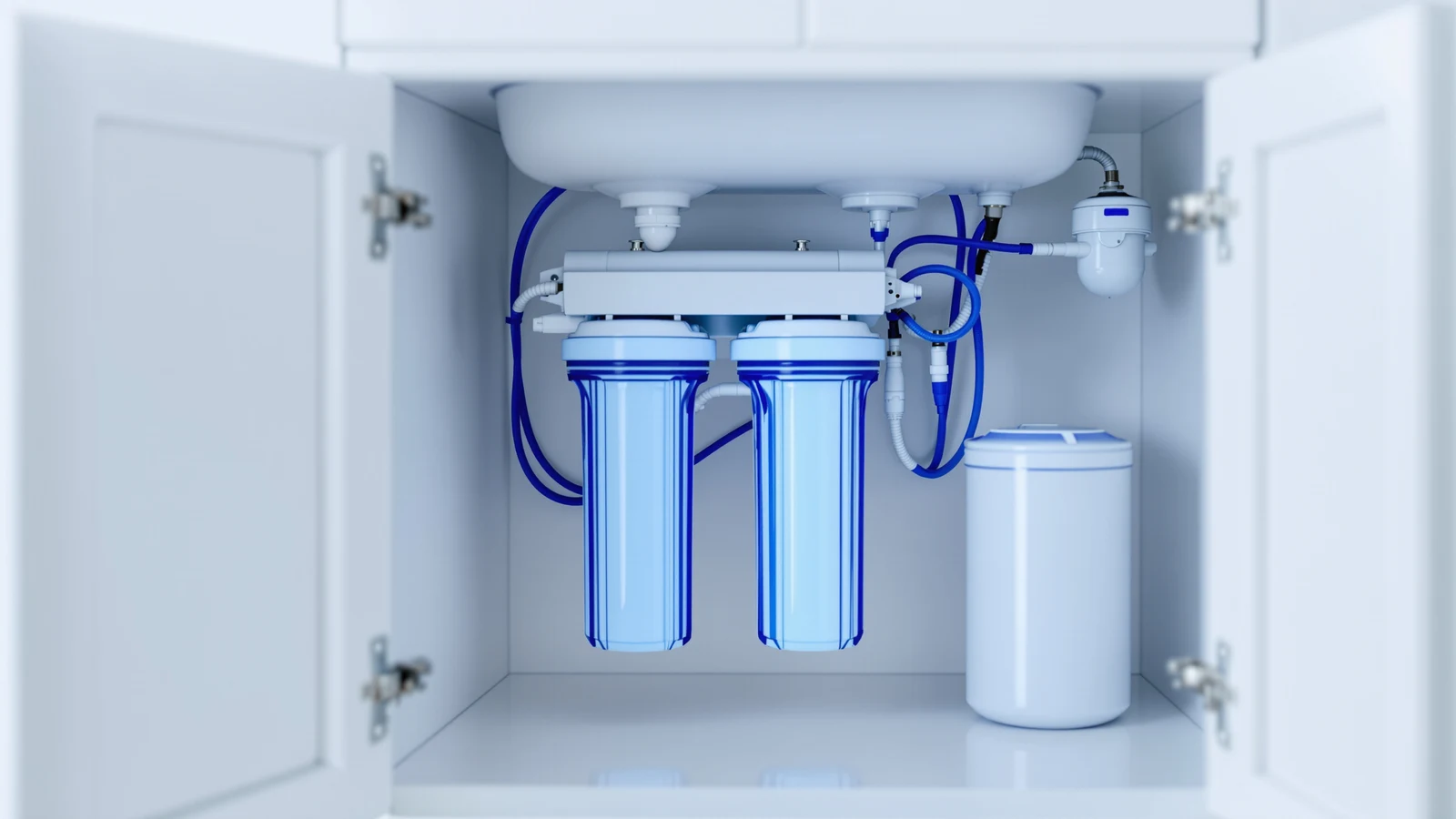
Under-sink reverse osmosis system with a small booster pump module mounted ahead of the membrane housing, inside a kitchen cabinet with low incoming water pressure

Every reverse osmosis spec sheet has a line most shoppers skip past: the minimum operating pressure. It usually reads somewhere in the 40 to 60 psi range, and it is not a footnote — it is the number the entire rest of the sheet was built on. The rated output, the drain ratio, the rejection percentage, all of it was measured with the feed line sitting inside that window. Drop below it and every other number on the box starts to drift from what actually comes out of the faucet.

The reason is physical, not marketing. Reverse osmosis works by pushing tap water through a membrane hard enough to overcome the water's own osmotic pressure — the natural tendency of dissolved minerals to pull water back across a membrane rather than let it through clean. Your home's incoming pressure is the only thing doing that pushing. A standard gravity-fed system has no pump of its own; the membrane does its job entirely on whatever psi the wall happens to deliver that day, plus whatever is left after it has already fought its way through a sediment filter and two carbon stages ahead of it.

Utilities are required to maintain a minimum pressure at the curb, but what leaves the main and what arrives at your kitchen cabinet are two different numbers. Distance from the pump station, elevation, pipe diameter, a shared riser feeding a dozen units, or simply everyone else on the block running a dishwasher at once — all of it subtracts psi before it reaches your RO inlet. A system engineered around a 45 to 60 psi assumption can be fed something closer to 25 or 30 psi in a surprising number of ordinary homes, and the gap between those two numbers is exactly what a booster pump exists to close.

What a booster pump physically adds ahead of the membrane

A booster pump is a small electric pump, typically a low-voltage DC diaphragm pump, wired into the system's plumbing after the sediment and carbon pre-filters and immediately before the membrane housing. Its only job is to raise the pressure of the water reaching the membrane, independent of whatever the house's static line pressure happens to be that day. It is powered through a small transformer plugged into a standard outlet, and it is typically controlled by a pressure switch that turns it on when the storage tank calls for water and off again once the tank is full — it is not meant to run continuously.

Among the three systems in this guide, the iSpring RCC7P-AK is the one built this way: its full product name includes "and Pump," and that pump sits exactly where a low-pressure household needs the help — ahead of the membrane, not somewhere decorative downstream of it.

It is worth being precise about why this is a motor and not simply a bigger storage tank, because the two get confused constantly. A storage tank is a buffer: it holds finished water so you have a reserve between refills, but it does nothing to change how fast or how completely the membrane can produce that water. If the feed pressure reaching the membrane is too low, a bigger tank just means a bigger reserve of a slow trickle, and the water that does cross under insufficient pressure carries more dissolved solids with it, since rejection quality is itself a function of the pressure differential. A bigger tank cannot restore a pressure differential that was never there; only something that actively adds psi — a pump — can do that. The fix for a pressure problem is a motor, not a bladder.

How to check your actual incoming water pressure before you buy either kind

You do not need to guess, and you should not buy either a pumped or a non-pumped system based on a guess. A screw-on pressure gauge for an outdoor spigot or a laundry hookup costs very little and takes under a minute to use: shut off every other fixture in the house, screw the gauge onto the nearest hose bib or washing-machine valve, open it fully, and read the static psi. Do this once in the morning and once in the evening if you can, since municipal pressure often dips at peak-demand hours when everyone nearby is drawing water at once, and a reading taken at 2 a.m. can look healthier than what your RO system will actually see most days.

If your home has no accessible spigot near the kitchen, the next best proxy is the pressure at the water heater's drain valve or a laundry connection on the same supply line, since pressure is largely uniform across a single-story home's cold-water branches. Most well-service companies and some municipal utilities will also take a reading as part of a routine call — ask for the number rather than a vague "it's fine."

Once you have a real figure, compare it against the minimum operating pressure printed on the system you're considering — commonly in the 40 to 60 psi range for a standard under-sink unit. A reading comfortably above that line means a conventional, non-pumped system will perform close to its rated output. A reading at or below it is the single clearest signal that the pumped option is not an upsell, it is the difference between a system that works and one that disappoints you quietly for years.

Who typically needs the motor

Three ordinary situations account for most low-pressure RO installs, and none of them involve a dramatic plumbing failure — they are just the normal condition of the supply.

Apartments and older municipal connections. Upper floors of multi-unit buildings routinely see lower pressure than ground-floor units on the same riser, and older buildings often run pressure-reducing valves set conservatively for the whole structure. Offices and break rooms on aging commercial risers run into the same wall — we cover that case in reverse osmosis systems for small offices and break rooms, where shared fixtures already compete for pressure before an RO unit joins the line.

Homes far from the main, or uphill from it. Elevation alone costs roughly 0.43 psi for every foot of rise between the main and your fixture, and distance adds friction loss on top of that. A house at the end of a long residential run, or sitting well above street grade, can be losing a meaningful chunk of the utility's curb-side pressure before the water even reaches the meter.

Wells with an undersized or aging pump. A well's pressure tank is typically set to cycle between two thresholds — the pump kicks on at the low end and shuts off at the high end — and a tank sized or set for general household use, cutting in around 20 psi, spends a meaningful fraction of its cycle below what an RO membrane wants to see. An aging pump that has lost some of its head over the years compounds the problem further.

Long pre-filter runs. Even a household that tests fine at the spigot can lose pressure by the time water reaches the RO membrane, if it has already passed through a whole-house sediment filter, a softener and the RO unit's own pre-filters in series. Each housing adds a little friction loss, and stacked together they can knock a borderline reading into pump territory even when the street-side supply is adequate.
The standard gravity-fed alternative, and where it simply stops

The APEC Water RO-90 and the iSpring RCC7-BN are both standard tank-fed systems in the conventional sense: they have no pump of their own and rely entirely on incoming line pressure to push water through their pre-filters, across the membrane and into the storage tank. The APEC RO-90 is rated at 90 gallons per day and the iSpring RCC7-BN at 75 gallons per day, and both figures — like every manufacturer's GPD rating in this category — assume the feed pressure sits inside the system's designed operating window.

A gravity-fed system does not fail abruptly when pressure drops below that window; it degrades. Output falls gradually: the tank takes longer to refill after a draw, the trickle at the faucet thins out, and rejection quality slips, since the pressure differential across the membrane does double duty — it both pushes water through and determines how much dissolved solids come with it. As incoming pressure keeps falling, the system reaches a point where feed pressure is barely above the combined back-pressure of a nearly full tank and the membrane's own osmotic resistance, and net production effectively stalls. There is no universal psi where that happens — it depends on the specific membrane and tank — but it is a real floor, and a household well below the manufacturer's minimum should expect to hit it.

One thing worth separating out here, because the two get conflated often: a non-electric permeate pump is a different device solving a different problem. It uses the pressure energy that would otherwise be wasted down the drain line to help push the tank fuller and faster, with no motor and no plug — but it does nothing to raise the pressure feeding the membrane itself. It is a smart fix for a slow-filling tank on an otherwise adequate supply, not a substitute for a booster pump when the incoming pressure is genuinely insufficient. We go through exactly how that mechanism works in permeate pumps explained.

Running cost, and the low hum of an always-on motor

A booster pump is not meant to run continuously — it cycles on when the storage tank calls for water and off again once the tank is full or the pressure switch is satisfied — so the electricity cost is modest. A small DC diaphragm pump drawing in the neighborhood of 25 to 40 watts, cycling for a cumulative hour or two across a typical household's daily water draw, adds up to a few dollars a year at typical US residential electricity rates. It is not the line item that decides whether a pumped system is worth it.

What owners notice instead is the motor itself. A small pump produces a low mechanical hum and a slight vibration while it is running, and in a quiet kitchen — particularly if the cabinet acts as a sounding board, or the pump is mounted directly against a cabinet wall without any isolation — that hum is audible. It is not loud, and most owners describe it as background noise rather than a nuisance, but it is a real difference from a gravity-fed system, which makes essentially no sound of its own.

Two trade-offs are worth weighing against that hum. First, a pump is one more motorized part with its own service life, running on a cycle separate from the filter-change schedule — worth considering alongside the warranty, and one more reason to check a pump's condition if you're looking at a used unit; we cover exactly what to inspect in buying a used reverse osmosis system. Second, a pumped system depends on continuous power: during an outage it produces nothing until the grid returns, where a gravity-fed system on a depressurized line simply slows down instead of stopping outright. Neither trade-off outweighs the alternative when your pressure genuinely can't support a gravity-fed system — but they are the honest cost of the motor, alongside the dollars.

The picks

When the motor is worth paying for, and when your pressure doesn't need it

All three systems come from established 5- and 6-stage RO families. The difference that matters here is not GPD or stage count — it's whether a pump sits ahead of the membrane.

ModelBest forStagesPumpPrice
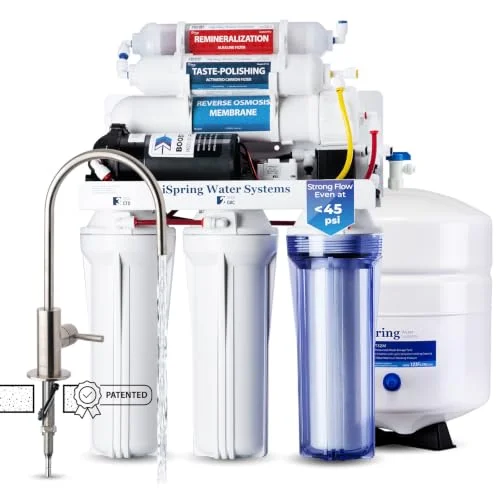
iSpring RCC7P-AKLow incoming pressure6-stage, alkalineYes$275.49Price
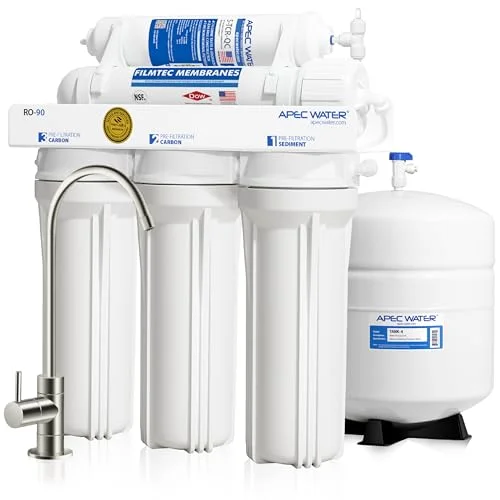
APEC Water RO-90Adequate pressure, higher output5-stage, 90 GPDNo$209.99Price
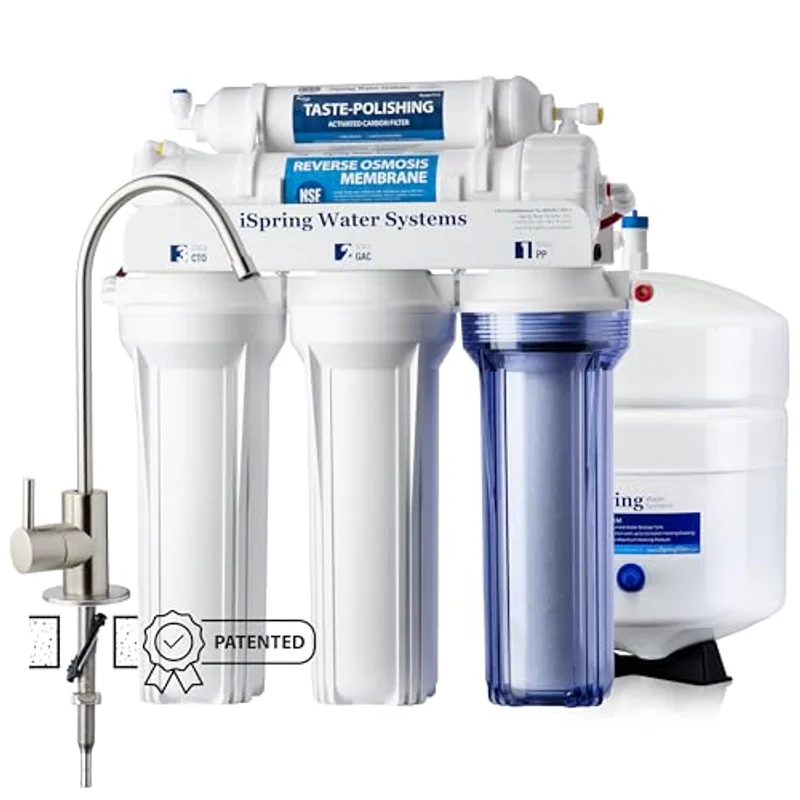
iSpring RCC7-BNAdequate pressure, standard budget5-stage, 75 GPDNo$178.49Price
01Low pressure

iSpring RCC7P-AK

The pick when your pressure test came back low
6 stages · alkaline remineralization · built-in booster pump · patented top-mounted faucet

This is the system in the lineup built for the scenario this guide is about: a booster pump wired ahead of the membrane, so a feed that would leave a gravity-fed unit underperforming instead gets the pressure boost it needs before it reaches the membrane housing. iSpring adds a sixth, alkaline remineralization stage on top of the standard five — worth knowing what that stage does and doesn't change, which we cover honestly in does alkaline RO water actually do anything. It shares the same patented top-mounted faucet design as the RCC7-BN, so the installation sequence is familiar even with the added electronics. It needs a nearby outlet for the pump's transformer, and at $275.49 it carries a real premium over the two non-pumped systems below — the cost of the motor that makes the rest of the specification sheet mean what it says on a weak supply.

iSpring RCC7P-AK 6-stage alkaline reverse osmosis system with built-in booster pump
$275
6-stage · pumpCheck price →
02Adequate pressure

APEC Water RO-90

The highest rated output here, if your supply can feed it
5 stages · 90 GPD · chrome finish · no pump

A standard gravity-fed system with a 90 gallon-per-day membrane rating — the highest of the three — and no pump of its own, which means that rating is only as real as your incoming pressure allows it to be. If your spigot test came back comfortably inside the typical 40 to 60 psi window, this is more capacity for less money than the pumped option, with one less motorized part to eventually service. If your reading came back low, the GPD number on the box is not the number you will actually see at the faucet, no matter how it's printed.

APEC Water RO-90 5-stage under-sink reverse osmosis system, chrome
$210
5-stage · 90 GPDCheck price →
03Adequate pressure

iSpring RCC7-BN

The standard-budget pick for a healthy supply
5 stages · 75 GPD · brushed nickel faucet · no pump

The non-alkaline, non-pumped sibling to the RCC7P-AK, and the simplest comparison point in this guide: same brand, same patented top-mounted faucet design, no sixth stage and no pump, at essentially the same price as the APEC RO-90. Worth reading side by side with its stablemate if you're also weighing brand reliability more broadly — our Waterdrop vs. iSpring vs. APEC comparison goes through how the three biggest RO brands differ on build, certification language and parts availability. Like the RO-90, its rated output assumes adequate incoming pressure — this is the system for a kitchen that already tested well, not one trying to work around a weak supply.

iSpring RCC7-BN 5-stage under-sink reverse osmosis system with brushed nickel faucet
$178
5-stage · 75 GPDCheck price →
FAQ

Common questions about RO booster pumps

How do I know if I need a booster pump?

Test your actual incoming pressure with a simple screw-on gauge at a spigot or laundry valve, with every other fixture shut off, and compare the reading against the minimum operating pressure printed on the system you're considering — typically 40 to 60 psi for a standard under-sink unit. A reading at or below that line, especially if you're on an upper apartment floor, far from the main, or on a well with an aging pump, is the clearest sign a pumped system will outperform a gravity-fed one in your kitchen.

What psi does a standard reverse osmosis system need?

Most gravity-fed under-sink systems are specified for roughly 40 to 60 psi of incoming pressure, and their rated gallons-per-day output assumes the feed sits inside that window. Below it, output doesn't stop abruptly — it degrades gradually, with slower tank refills and reduced rejection, until pressure drops low enough that net production effectively stalls.

Is a booster pump noisy or expensive to run?

It cycles on only when the storage tank calls for water, so electricity cost is a few dollars a year at typical rates. The more noticeable cost is a low mechanical hum while it's running, audible in a quiet kitchen, plus reliance on continuous power — a pumped system produces nothing during an outage, where a gravity-fed system on a depressurized line simply slows down instead.

Can I add a booster pump to a system that didn't come with one?

Aftermarket booster pump kits exist and can be plumbed ahead of the membrane housing on many standard systems, but that's a separate purchase, a separate transformer and outlet, and installation work the manufacturer didn't design or certify as a unit. Buying a system like the iSpring RCC7P-AK that ships with the pump integrated avoids that retrofit entirely.

Keep reading

Next, if you're still deciding