Does a UV stage on a countertop RO purifier actually matter?
We're reader-supported: buying through our links may earn us a commission at no extra cost to you. We compare published listing specifications, prices and general product-class facts — we don't run a testing lab, and nothing below is a star rating or a paraphrased review.
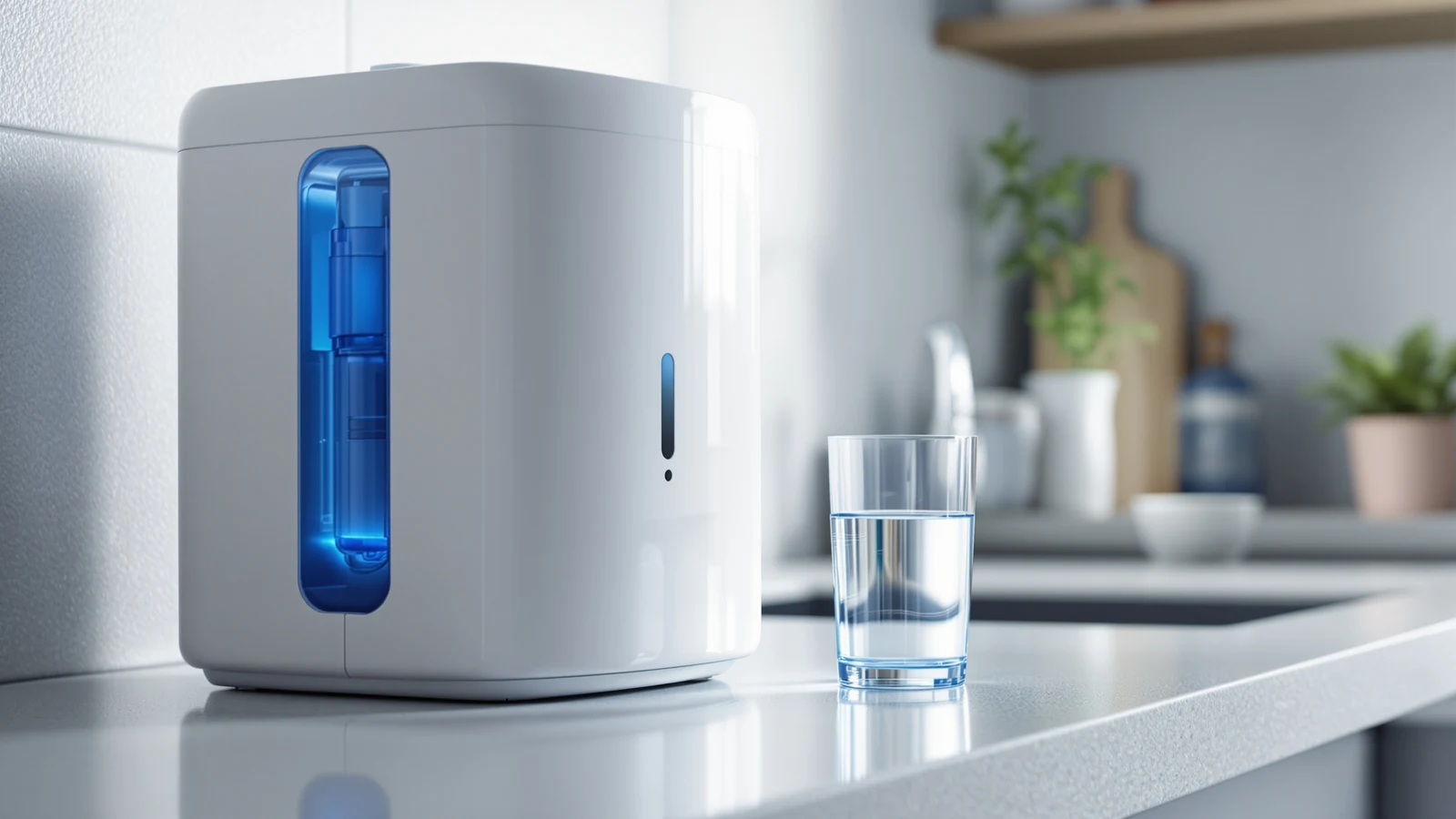
Three countertop reverse osmosis purifiers in this catalogue sit within fifty dollars of each other, and only one of them adds a UV-C stage: the NU Aqua 8-Stage Countertop Reverse Osmosis Water Filter System with UV at $199.94. The other two — the Waterdrop C2SL at $139.99 and the Countertop Dual Carbon Reverse Osmosis Water Filtration System from Purcooflow at $195.99 — skip UV entirely and still publish contaminant-reduction numbers tested by the same third-party lab, SGS. That's the actual question worth answering before you pay the premium: what is the lamp doing that the membrane in the other two isn't already doing, and is it the thing your water needs?
Start with the mechanism, because it's the part listings tend to blur. A UV-C stage in a sealed countertop unit is a disinfection step, not a filtration step. It sits after the membrane and any carbon stages — by the time water reaches the lamp, the physical filtering is already finished — and its job is to expose that already-filtered water to a germicidal wavelength of light as it passes through a chamber, long enough to damage the DNA and RNA of any bacteria or viruses still present. Nothing is removed, trapped, or pulled out of the water. An organism hit with an adequate UV dose is inactivated in place; it stays in the water exactly where it was, just unable to reproduce or cause illness. That's a meaningfully different job from what a 0.0001 micron RO membrane does, which is reject dissolved solids and contaminants by size and pressure, physically separating them from the water that passes through.
Placement matters specifically in a countertop format because of where the water sits before you drink it. These units don't dispense the moment you fill the feed tank — NU Aqua's own listing describes "a large internal tank" that "ensures you always have a steady supply ready for family use, cooking, or refills," which means purified water can sit in an internal reservoir for hours between draws, not just seconds. That dwell time, after the membrane has already done its job, is exactly the scenario a post-membrane UV stage is positioned to cover: anything introduced downstream of filtration, or anything that survived the membrane at a low enough rate to matter, has time to multiply in standing water before it reaches your glass. A UV lamp placed in that path addresses that specific window. It does nothing for the water's dissolved-solids content, its taste, or anything upstream of it — that was the membrane's job, finished before the water ever reached the lamp.
Reading "UV-C treatment removes dissolved solids" against what UV light actually does
The NU Aqua listing's own feature bullet reads, in full: "Advanced filters in the reverse osmosis countertop work together to remove sediment, chlorine, and heavy metals, while built-in UV-C treatment removes dissolved solids." Read literally, that sentence credits the UV lamp with a job that belongs to the membrane. It doesn't. Dissolved solids — the salts, minerals and ionic compounds that make up a water's TDS reading — pass through a UV chamber completely unaffected by the light inside it. UV-C disinfection is a photochemical process acting on the genetic material of living organisms; it has no mechanism for pulling an ion or a mineral out of solution. The only stage in any of these three systems capable of reducing dissolved solids is the RO membrane, which is doing that work before the water ever reaches a UV chamber, not because of it.
This is worth flagging not to single out one manufacturer for a dishonest claim, but because it's a useful lesson in reading a multi-stage filtration bullet point: these listings routinely compress the jobs of several distinct stages into one marketing sentence, and the sentence doesn't always assign credit correctly. "Removes sediment, chlorine, and heavy metals" in that same bullet is plausible work for a pre-filter and carbon stage. "UV-C treatment removes dissolved solids" is not plausible work for a UV lamp under any accepted description of how ultraviolet disinfection functions — it's describing the membrane's output and attaching it to the wrong stage. If a spec sheet gets the physics of one line wrong, the fix isn't to distrust the whole listing; it's to verify the parts you can check — the membrane's stated pore size, a named certification, a third-party test — rather than taking a single compressed sentence at face value.
The practical takeaway: a UV stage is additive insurance against microorganisms, not a second filtration pass against dissolved solids, hardness, or chemical contaminants. If a listing implies otherwise, it's describing the wrong mechanism for the wrong stage, not a feature that duplicates or strengthens what the membrane already does. For a broader look at how RO mechanics and ultrafiltration mechanics differ from each other — a distinction that gets conflated just as often — see our comparison of ultrafiltration and reverse osmosis under the sink.
The SGS-tested reduction numbers two non-UV systems publish without a UV stage at all
Here's what makes the comparison genuinely interesting rather than a simple feature checklist: the two systems without UV don't just skip the lamp, they lead with third-party test data the UV unit's own listing doesn't match. The Waterdrop C2SL's listing states it was tested by SGS to reduce 99.8% of PFOA, 99.7% of PFOS, 99.96% of microplastics, 99.83% of lead, 99.51% of chlorine, and 98.45% of fluoride, attributed to its 0.0001 micron RO membrane — a seven-stage system with no UV lamp anywhere in it. The Purcooflow Countertop Dual Carbon system makes a parallel but differently-scoped claim: its listing states the system is SGS-verified to meet NSF/ANSI 58 standards, and that testing covers removal of PFOS, PFOA, nanoplastic, chlorine and fluoride — though unlike the Waterdrop listing, Purcooflow's doesn't publish the specific percentage figures behind that claim.
That NSF/ANSI 58 line is itself a meaningful difference between the two non-UV systems, worth separating from the UV question entirely. NSF/ANSI 58 is the certification that specifically covers contaminant and TDS reduction performance. The Waterdrop C2SL's listing instead cites NSF/ANSI/CAN 372, which only certifies that the materials in contact with water are lead-free — it says nothing about how well the system reduces contaminants, even though Waterdrop separately backs that performance with its own SGS percentages. So between the two non-UV units, Purcooflow is the one explicitly claiming the performance-grade certification, while Waterdrop backs its performance claim with granular lab percentages instead of that specific certification. Neither approach is wrong; they're just different ways of substantiating the same underlying question, and worth reading separately rather than assuming one listing's certification language covers the same ground as the other's.
The NU Aqua listing, by contrast, doesn't publish a comparable figure for its own filtration stages. Its feature list states the system removes "sediment, chlorine, and heavy metals," but doesn't cite SGS testing, doesn't name a percentage for any contaminant, and doesn't reference NSF/ANSI 58 or 372 anywhere in the text we could source. That's not evidence the NU Aqua filters worse — plenty of systems perform well without publishing third-party figures — but it does mean that on the specific question of verified contaminant reduction, the two non-UV systems here are the ones with something documented to compare, and the UV system is the one asking you to take the filtration claim on faith while paying extra for the lamp on top of it.
The price difference between the UV unit and the two non-UV systems at a similar stage count
Line the three up by price and the UV premium looks small in one comparison and almost nonexistent in the other. Against the Waterdrop C2SL's $139.99, the NU Aqua's $199.94 is a $49.95 jump — but that gap isn't purely the UV lamp's price tag. NU Aqua's eighth stage, touch-panel display with filter-replacement reminders, and multiple cup-size selection are bundled into the same $49.95, so you can't isolate what the UV lamp alone costs any more than you could isolate a single feature's price out of any bundled listing. Against the Purcooflow Dual Carbon's $195.99, the gap nearly disappears: $3.95 separates a system with a UV stage and no published third-party contaminant testing from one with no UV stage and an SGS-verified NSF/ANSI 58 claim. At that specific $3.95 gap, the certification difference between the two listings is arguably the bigger factor in a buying decision than the presence or absence of a lamp.
We've seen this same pattern — a UV stage bundled with other upgrades rather than priced on its own — inside a single brand's lineup before, where it's easier to isolate. SimPure's own T1 and T2 tankless systems show what jumping from 400 to 600 GPD and adding UV costs when the comparison is apples-to-apples within one manufacturer, rather than across three different brands and feature sets the way this countertop comparison necessarily is. The broader lesson shows up elsewhere in this catalogue too: four systems rated at the same 500 GPD output price out very differently, and the gap rarely maps cleanly onto one spec line — it's almost always several differences bundled into a single sticker price, the same structural problem you run into trying to price a UV lamp in isolation here.
Where UV would matter more: well water and off-grid use versus municipal tap
None of this is an argument that UV is pointless — it's an argument that whether it's worth the money depends almost entirely on what's coming out of your tap before any of these three systems touch it. Municipal utilities disinfect at the treatment plant, typically with chlorine or chloramine, and are required to maintain a disinfectant residual through the distribution system under routine regulatory bacterial testing. Treated city water has already cleared a public-health bar for microbiology before it reaches a countertop unit's feed tank. Adding a UV stage on top of that is a second layer over a risk the utility has largely already managed — not wasted money, but not the highest-leverage dollar available at this price point either, especially set against the SGS-documented contaminant reduction the two non-UV systems here already provide for the same budget or less.
Private well water is the structurally different case. There's no utility treating it, no required disinfectant residual, and in most states no routine compliance testing performed on your behalf — the U.S. EPA does not regulate private wells, so testing and treatment decisions rest entirely with the owner. A shallow water table, a septic system or livestock operation upgradient, a history of nearby flooding, or a well that has ever returned a positive coliform or E. coli test are the standard cases for pairing any RO purifier with UV disinfection. Countertop units specifically overlap with exactly this audience, along with RVs, cabins and other off-grid setups, because the entire appeal of the format is that it needs no plumbing or dedicated line — the same no-installation convenience that makes a countertop unit attractive to a renter also makes it attractive to someone on a well with no interest in a permanent under-sink install. None of the three systems here states a non-electric design or a well-specific certification, so a well owner choosing among them should treat the UV stage as the one meaningfully different line item for that use case, not a tiebreaker on convenience features.
Worth naming is the standing-water scenario that cuts across both groups: a countertop reservoir that sits unused for a day or two — a vacation, a slow week, a cabin visited only on weekends — carries more microbiological uncertainty than water drawn the moment it's purified, regardless of whether the source was a well or a city main. Waterdrop's own broader product line, including its outlet-free T3 systems we cover in our comparison of the T3-C, T3-M and T3-T, illustrates how differently the same brand treats this trade-off across its catalogue — some models add UV, some don't, and the difference tracks the intended use case more than a flat rule about brand quality.
What each listing actually states
Prices as we recorded them. A dash means the listing does not publish a figure for that column — we aren't filling the gap with an estimate.
| Purifier | UV stage | Published filtration claim | Pure-to-drain | Price | |
|---|---|---|---|---|---|
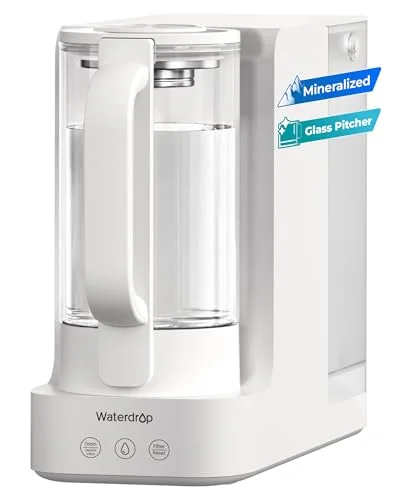 Waterdrop C2SL | No UV | SGS-tested: 99.8% PFOA, 99.7% PFOS, 99.96% microplastics, 98.45% fluoride | 3:1 | $139.99 | Price |
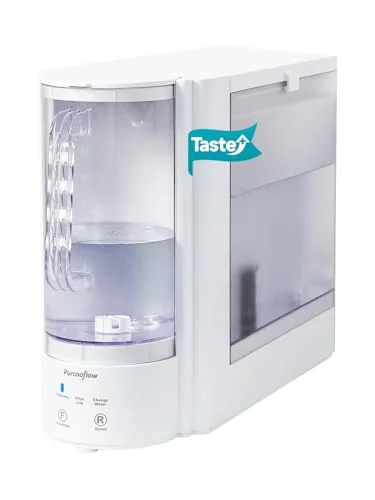 Countertop Dual Carbon | No UV | SGS-verified to NSF/ANSI 58; removes PFOS, PFOA, nanoplastic, chlorine, fluoride | 3.5:1 | $195.99 | Price |
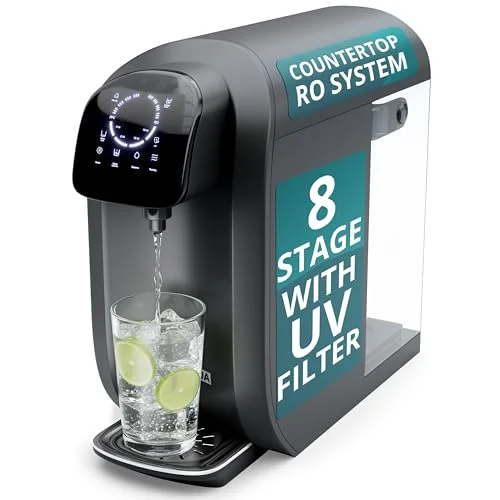 NU Aqua 8-Stage UV | UV-C stage | Removes sediment, chlorine, heavy metals — no SGS percentage or NSF/ANSI certification stated | 4:1 | $199.94 | Price |
One detail worth confirming before you buy any of the three: the NU Aqua ASIN here is listed under the size/variant "RO - Countertop," which confirms this specific listing is the standalone countertop configuration rather than an under-sink variant of the same product line. That's the only authority we have on that point — the listing's variant field, not an assumption about the product name.
The question to ask before paying for the extra lamp: what's actually in your water report
Every argument above resolves to the same practical step: check what's documented about your specific water supply before deciding whether $49.95 (against the Waterdrop) or $3.95 (against the Purcooflow) buys you something you need. If you're on a municipal connection, your utility is required to publish an annual Consumer Confidence Report disclosing what's been detected in the treated water and how it's disinfected — it's usually available on the utility's own website or by request, and it's the fastest way to see whether your specific service area has any recent history of boil-water advisories or bacteriological exceedances, which is a very different starting point than assuming "city water" means uniformly zero risk everywhere.
If you're on a private well, the standard guidance is an annual test specifically for coliform bacteria and E. coli, regardless of what treatment equipment is already installed — the EPA's lack of private-well oversight means that test is the only reliable way to know what you're actually filtering, and it's the single piece of information that would most directly justify paying for UV over banking the savings toward cartridges. This is general information, not a substitute for a state-certified water test or professional guidance specific to your property.
One more line item to factor in regardless of which system you choose: none of the three listings here state a replacement part number or price for their consumable stages — the UV lamp included. A UV lamp's germicidal output fades well before it visibly stops working, which is why manufacturers typically recommend an annual swap on the calendar rather than waiting for a failure you'd never notice by looking at the water. If you buy the NU Aqua, budget for that unlisted annual cost going in rather than discovering it later — the same caution we'd apply to any filter whose printed lifespan number deserves a second look, covered in our piece on how realistic 1-year, 2-year and 5-year filter claims actually are, and the same reason it's worth confirming you're buying the exact replacement part for your exact model rather than a close-enough substitute, which we go through in matching the exact replacement filter to your RO model.
What we'd actually do
On well-maintained municipal water with no advisories on record, we'd put the money toward the system with the clearer third-party substantiation rather than the lamp. The Purcooflow Dual Carbon's SGS-verified NSF/ANSI 58 claim, at $3.95 less than the NU Aqua, is doing more documented work for your water than an unlamped feature gap would suggest, and the Waterdrop C2SL's granular SGS percentages make a similar case at $50 less. Both skip UV and still publish more about what they actually remove than the UV unit does.
On a private well, off-grid setup, or any countertop unit that sits unused between visits long enough for standing water to be a real variable, the calculus changes — not because the NU Aqua's own filtration claims are better documented, but because the UV stage is addressing a genuine gap the other two don't cover at all. In that case, confirm an annual bacteria test backs up the decision, go in expecting an unlisted lamp-replacement cost, and treat "UV-C treatment removes dissolved solids" for what it is: a mis-stated line in an otherwise reasonable spec sheet, not a reason to doubt everything else the listing says. Also worth remembering that not every bundled countertop feature is worth its sticker premium — UV is a case where the premium can be justified by your specific water source; plenty of other bundled extras aren't.
And on weighing a newer name against an established one: Waterdrop's SGS percentages and broader product history give it more to check against than NU Aqua's shorter track record and unverified claim, which is one more reason the non-UV pick is the safer default absent a specific reason — a well, a cabin, a documented local water issue — to pay for the lamp instead.
Questions people ask about UV on countertop RO purifiers
Does UV-C light remove dissolved solids or TDS from water?
No. UV-C is a disinfection process that damages the DNA and RNA of bacteria and viruses using a germicidal wavelength of light; it doesn't filter, trap, or remove anything from the water, including dissolved solids. Dissolved-solids reduction is the job of the RO membrane, which does that work before water ever reaches a UV chamber. A listing that credits UV with removing dissolved solids is describing the membrane's job under the wrong stage.
Which of these three countertop purifiers publishes third-party reduction numbers?
The two without UV. The Waterdrop C2SL states SGS testing showing 99.8% PFOA, 99.7% PFOS, 99.96% microplastics, 99.83% lead, 99.51% chlorine and 98.45% fluoride reduction. The Countertop Dual Carbon system states SGS verification to NSF/ANSI 58 for PFOS, PFOA, nanoplastic, chlorine and fluoride, without publishing specific percentages. The NU Aqua 8-Stage UV listing states general categories removed but doesn't cite SGS testing or an NSF/ANSI certification number.
Is a UV stage worth the extra cost on municipal tap water?
Usually a smaller marginal benefit than on well water, because municipal utilities already disinfect at the treatment plant and maintain a disinfectant residual under routine regulatory testing. At the price points here, the $3.95 to $49.95 premium for the UV unit buys less documented contaminant protection than the two SGS-backed non-UV systems, which is worth weighing against the lamp specifically if your water source is already a treated municipal connection with no history of advisories.
Do I need UV if I use a countertop RO system on well water or off-grid?
The case is meaningfully stronger there. Private wells have no utility disinfection, no required residual, and in most states no routine compliance testing — the EPA doesn't regulate private wells, so an annual coliform and E. coli test is the standard way to know what's actually in your water. Countertop units are popular for off-grid and well use precisely because they need no plumbing, which makes the UV question more relevant for that audience than for someone on a well-documented city connection.