Best RO Systems
Home › Guides › Electric vs. non-electric
Buying guide

Electric vs. Non-Electric Reverse Osmosis: Do You Need a Dedicated Outlet?

We're reader-supported: buying through our links may earn us a commission at no extra cost to you. We compare published specifications, certifications and prices — we don't run a testing lab.

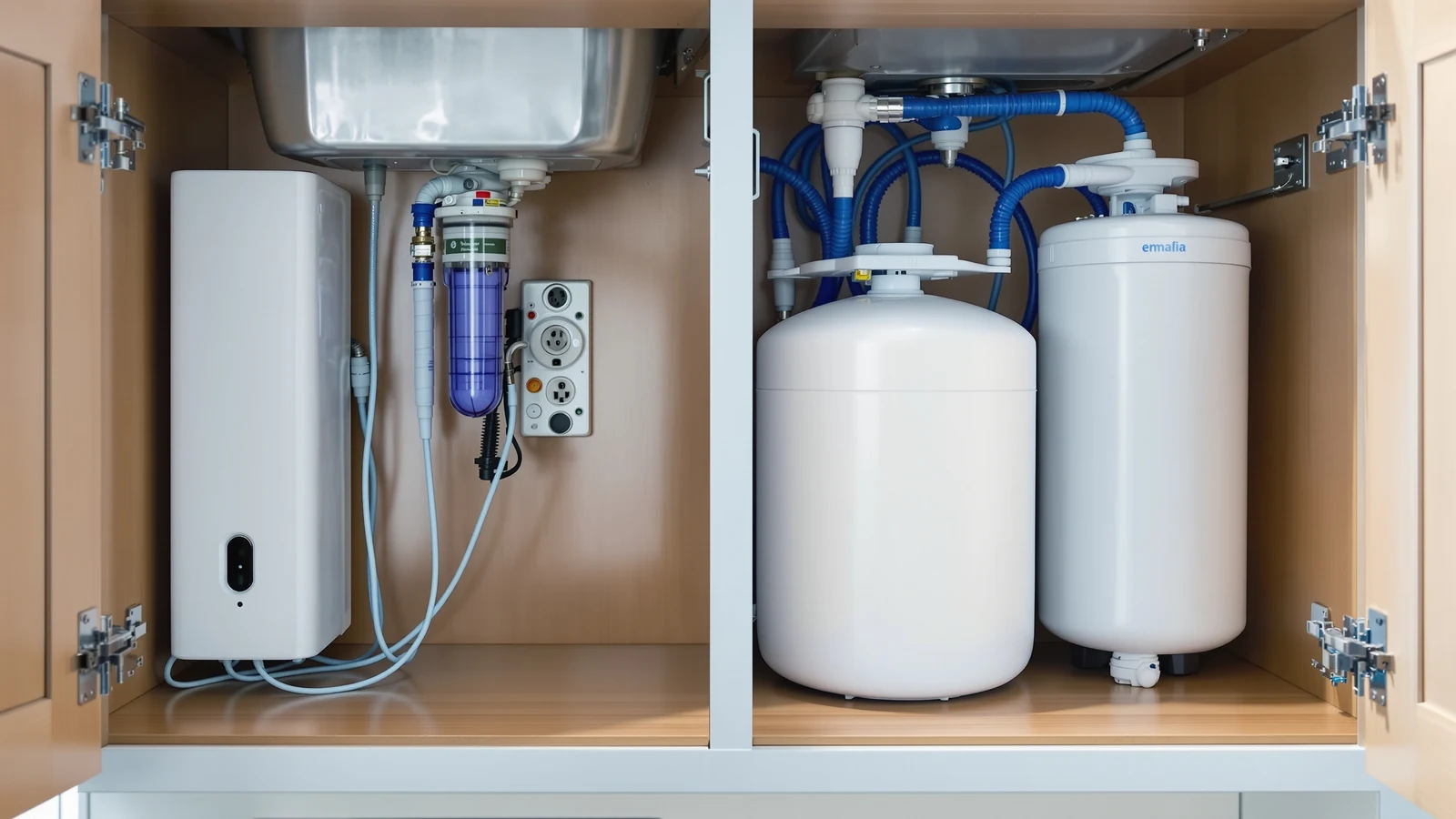
Under-sink reverse osmosis system installed beside a power outlet and a non-electric tankless unit installed with no cord, side by side inside a kitchen cabinet

Every listing for a modern reverse osmosis system leads with the same word: tankless. No bulky pressure tank, a slim box, an install that takes half a cabinet instead of all of it. What almost none of them lead with is whether that box needs a power cord — and buyers routinely assume the two facts are the same one. They aren't. Tankless describes what the system does with the storage tank: it removes it. It says nothing about whether the system uses a pump to make up for the tank's absence, and pump or no pump is the actual fork in the road for your electric bill and your cabinet layout.

The confusion is understandable, because most tankless systems on the market do carry a plug, and for a mechanical reason: a classic tank system stores pressurized water over hours, so it can afford to produce slowly. Remove the tank and the system has to make water fast enough to satisfy the faucet in real time, which usually means a booster pump pushing feed water through the membrane harder and faster than your home's line pressure alone would allow. That is the electric part of "tankless," and it is common — but it is an engineering choice, not a law of physics.

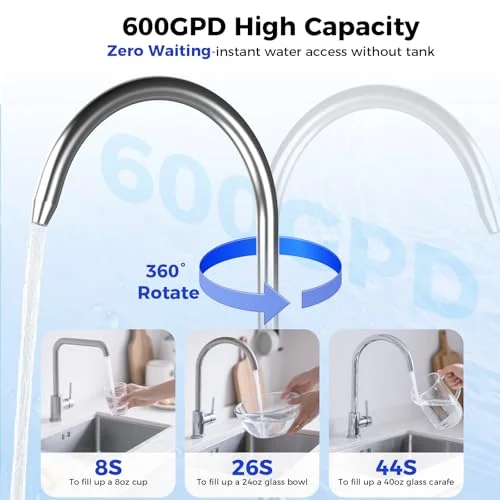
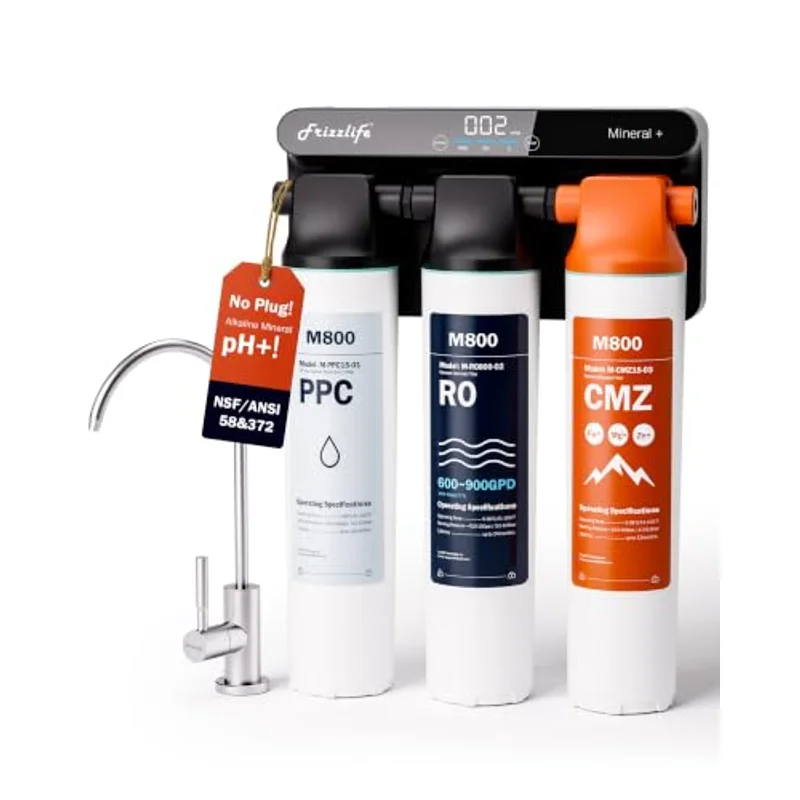
Proof of that sits in this site's own product list. The Frizzlife M800 (ASIN B0GL7SFR73) is tankless, rated up to 900 GPD, and its own listing title calls it non-electric. It gets there by leaning entirely on your home's incoming line pressure instead of a pump, which is also why its published drain ratio is 4:1 pure water to drain. On the other side, the VonWater 600GPD (ASIN B0DBGKN88S) is tankless too, at a comparable 600 GPD rating, and its listing does not state a plug-in requirement the explicit way some competitors do. That's the point: "tankless" alone does not tell you which bucket a given unit falls into, and the only way to know for certain is to read the power section of the specific listing before you buy.

So treat "tankless" as a statement about the storage tank and nothing else. Whether a given tankless system also needs an outlet is a second, separate question, and the rest of this guide is about answering it before the box is halfway installed under your sink.

Systems that explicitly need a dedicated outlet

Some systems don't leave the question open. The Waterdrop T3-C (ASIN B0F5TW4RWF), rated at 450 GPD, states it plainly in its own product title: Plug-in Required. When a manufacturer puts that phrase on the listing itself rather than burying it in a spec sheet, take it at face value and plan the install around a live outlet from day one, not as an afterthought once the unit is already plumbed in.

There are three mechanical reasons a tankless system typically ends up needing power:

  • A booster pump. This is the big one. Without a pressurized tank to draw from, a tankless system has to generate flow on demand, and many municipal water supplies don't deliver enough consistent pressure to push water through a reverse osmosis membrane fast enough on their own — especially at higher rated outputs like 450 or 600 GPD. A small pump closes that gap. It's the single most common reason a tankless box needs a cord.
  • An LED or digital display. Systems that show live TDS readings or a filter-life countdown on the faucet or the unit itself need power to run that electronics package, independent of whether they also have a pump. It's a small load next to a pump, but it's still a load, and it's a continuous one rather than an occasional one.
  • An automated flush cycle. Some systems run a periodic rinse of the membrane on a timer to clear out rejected solids and extend membrane life. Where that cycle is driven by an electric valve and controller, it needs power to fire on schedule.

A listing that simply says "plug-in required," like the T3-C's, doesn't always break out which of the three is doing the drawing, and we're not going to guess at an internal spec the manufacturer hasn't published. What matters for planning purposes is simpler: if any of those three features is present, budget for a standard grounded outlet under the sink. For background on why higher-output systems lean on pumps in the first place, our guide to what the GPD number really tells you covers how rated output relates to the pressure a system needs to hit it.

Systems that need none: gravity, line pressure, and a tank instead

The other side of the fork trades speed for simplicity. A classic tank-based reverse osmosis system, the design that predates "tankless" as a marketing word entirely, produces water slowly and stores it under pressure in a bladder tank for whenever you open the faucet. Because it isn't trying to satisfy the faucet in real time, it can rely on ordinary household line pressure to push water through the membrane — no pump, no controller, no cord.

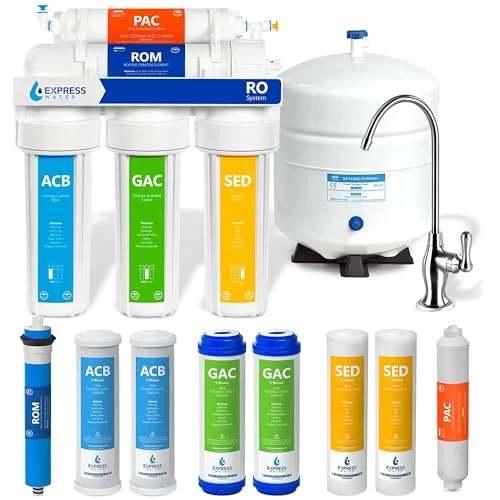
The Express Water RO5DX (ASIN B00J2DGTD8) is a straightforward example of this family: a 5-stage under-sink system rated at 50 GPD. That output figure is the tell. Fifty gallons a day is nowhere near what you'd need to fill a glass on demand the way a 450 or 600 GPD tankless unit can — instead, the system spends the hours between uses slowly refilling its storage tank at low pressure, and the tank is what actually answers the faucet when you turn it on. No pump is doing that work, which means no outlet is required anywhere near the install site.

The Frizzlife M800 belongs here too, and it's the more interesting case precisely because it isn't a classic tank system. It's tankless and non-electric, running purely on incoming line pressure at up to 900 GPD with a 4:1 pure-to-drain ratio. It proves the tank isn't actually what determines the power requirement — the pump is — and that a non-electric design and a tankless form factor aren't mutually exclusive, even though most of the market bundles them as if they were.

The practical upside of the whole non-electric category is straightforward: nothing under the sink needs to be within reach of a GFCI-protected outlet, nothing runs 24 hours a day drawing standby power, and there's one less point of failure if your kitchen circuit ever trips. What you give up, generally, is speed on the tank side, or, on the non-electric tankless side, the reassurance of a stated pump spec to compare against.
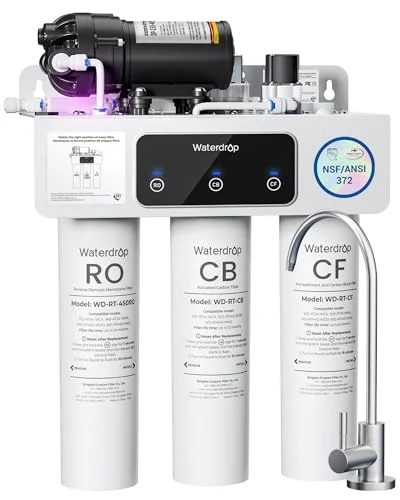
What a 24/7 plugged-in system actually costs on the electric bill

None of the electric systems in this comparison publish a standby wattage figure on their listings, so rather than inventing one, here's the honest way to think about the number, assumptions stated up front. A small pump doesn't run continuously — it activates only when you draw water, for the seconds it takes to fill a glass or a pot. What runs continuously is anything else on the circuit: a transformer stepping mains voltage down for the control board, and an LED or digital display if the unit has one. Devices in that class — small low-voltage electronics left plugged in around the clock — commonly draw in the neighborhood of 2 to 5 watts of standby power. Call it 3 watts as a working midpoint.

Run that assumption out for a full year: 3 watts × 24 hours × 365 days ≈ 26.3 kilowatt-hours. At the U.S. average residential electricity rate, which the Energy Information Administration has put in the neighborhood of $0.17 per kilowatt-hour in recent years, that works out to roughly $4.50 a year — less than a single takeout coffee, spread across twelve months. Active pumping draws meaningfully more, commonly 20 to 40 watts while running, but that's only for the seconds the faucet is open, so it barely changes the yearly total.

The number to actually take away isn't $4.50 specifically — it's that standby draw on this class of appliance is a rounding error next to the water bill, the filter bill, or the price of the unit itself. Where it's worth paying attention is the outlet itself: it needs to be grounded, and if the only spare receptacle under your sink is switched off at a wall switch you rarely use, the display will blink out every time someone flips that switch for an unrelated reason — an installation annoyance, not an energy one.

What happens to each type during a power outage

This is where the distinction stops being about cents on a utility bill and starts being about whether you have drinking water when the grid doesn't. The two families behave completely differently, and it's worth knowing which one you'd be relying on before the outage happens, not during it.

A plug-in system like the Waterdrop T3-C stops producing new water the moment power is lost, because the pump, display and any automated flush cycle all depend on it. Whatever water is already sitting downstream of the membrane is what you have until power returns. It won't refill itself in the dark no matter how long you leave the faucet open, because without the pump there's nothing pushing feed water through the membrane at the rate a tankless design needs.

A non-electric system is unaffected by the outage itself. The Frizzlife M800 and the Express Water RO5DX both rely on your home's incoming water line pressure, not household electricity, so as long as municipal (or well) water is still reaching the house, both keep producing filtered water exactly as before. The one caveat worth flagging honestly: if your home's own water supply depends on an electric well pump, the outage can take out your water pressure before it ever becomes a question of what your RO system needs — but that's a fact about your house's water source, not the reverse osmosis unit itself, and it applies whether the RO system plugged in or not.

For anyone who treats "water still works when the power doesn't" as a real requirement — well-water households, storm-prone regions, anyone who has sat through a multi-day outage — that fact alone is often reason enough to choose the non-electric column, before comparing prices or drain ratios.

Where to install a non-electric system when there's no spare outlet under the sink

Going non-electric removes the "is there a live outlet nearby" question entirely. But it trades one constraint for another: instead of hunting for power, you're hunting for physical space, since neither a storage-tank system nor a non-electric tankless unit is small.

A tank-based system like the RO5DX needs the most room of anyone here: three or four filter housings plus a separate pressure tank, typically most of a standard under-sink cabinet. If your cabinet is already crowded with a garbage disposal or a soft-water loop, that's the real limiting factor, not electricity. A non-electric tankless unit like the M800 is more forgiving on footprint — a single tall box — but it's worth measuring vertical clearance, including the depth behind the P-trap, before ordering.

When the cabinet genuinely can't fit either, the fix is the same one plumbers reach for regardless of power type: relocate the unit, not the faucet. Both tank and non-electric tankless systems can be mounted nearby — a basement joist, a garage wall backing the kitchen, a utility closet — with the feed, drain and dedicated RO faucet lines run to the sink instead of the system living directly beneath it. Because there's no plug involved, there's no electrical wire to route alongside those lines, often the difference between a weekend DIY project and one needing an electrician as well as a plumber. If the sink itself has no spare hole for the dedicated faucet, our guide on adding an RO faucet to a sink with no spare hole walks through the workarounds.

Non-electric systems are also the more sensible default for anyone who can't modify the property permanently, which is the case for most renters. No dedicated outlet to add, no wiring inspection, and a system that leaves nothing behind when you move because there was never a plug to begin with — our picks for renters lean on that same logic.

The picks

The picks, by power type

Four systems, two different answers to the same question. Prices as we recorded them — confirm the live price before buying.

SystemPower typeOutputPrice
Waterdrop T3-CElectric · plug-in required450 GPD, tankless$189.99Price
VonWater 600GPDNot stated — check listing600 GPD, tankless$153.99Price
Frizzlife M800Non-electricUp to 900 GPD, tankless, 4:1 drain$287.09Price
Express Water RO5DXNon-electric50 GPD, 5-stage, tank$179.99Price
01No outlet, highest output

Frizzlife M800

The rare tankless system that skips the plug entirely
Non-electric · up to 900 GPD · 4:1 pure-to-drain · NSF/ANSI 58 & 372 · alkaline mineralized

If the whole reason you're reading this guide is a cabinet with no spare outlet, or a preference for a system that keeps working when the power doesn't, this is the pick that answers both at once. It runs entirely on incoming line pressure, needs no cord, and still posts a 4:1 pure-to-drain ratio and up to 900 GPD of rated output — figures that usually belong to the electric side of this comparison. It is a tall single unit rather than a tank-plus-housings setup, so measure vertical clearance before buying.

Frizzlife M800 non-electric tankless reverse osmosis system
$287.09
Non-electric · tanklessCheck price →
02No outlet, lowest price

Express Water RO5DX

The classic tank-and-housings layout, at the lowest price here
Non-electric · 50 GPD · 5-stage · pressurized storage tank

A conventional 5-stage under-sink system that fills a pressurized storage tank slowly on line pressure alone, then answers the faucet from the tank rather than in real time. No pump, no display, no cord to route — the trade is cabinet space, since a tank plus multiple housings takes up more room than a single tankless box.

Express Water RO5DX 5-stage under sink reverse osmosis system
$179.99
Non-electric · tankCheck price →
03Confirmed plug-in

Waterdrop T3-C

When the listing states the outlet requirement up front
Plug-in required · 450 GPD · tankless

Unlike some tankless listings that leave the power question unanswered, the T3-C states "Plug-in Required" in its own title — the clearest signal you'll get before buying. Plan for a grounded outlet under the sink from the start of the install, not as a fix partway through.

Waterdrop T3-C reverse osmosis system, plug-in required
$189.99
Electric · tanklessCheck price →
04Check before buying

VonWater 600GPD

The reminder that "tankless" alone doesn't settle the question
Power requirement not stated in listing title · 600 GPD · tankless

At 600 GPD this sits in the output range where a booster pump is common, but its listing doesn't carry the explicit "plug-in required" language the T3-C does. Rather than assume either way, check the power section of the current listing before you buy — this is exactly the situation the rest of this guide exists to help you navigate.

VonWater 600GPD under sink tankless reverse osmosis water filtration system
$153.99
Tankless · verify powerCheck price →
Why you should trust us

Ilane Tall, research-based comparisons

This guide was researched and written by Ilane Tall for Best Reverse Osmosis Systems, an independent site that compares under-sink and countertop reverse osmosis systems on published specifications, certifications and price. We do not accept payment for placement, and every product mentioned here is one we track in our own product database with a sourced price and listing.

How we compared

Research, not a lab

We're honest about this: we don't physically test these systems and we don't run a testing lab. The electric-versus-non-electric distinction in this guide comes from each product's own listing title and published specifications — output rating, drain ratio, stated power requirement — plus general engineering facts about how booster pumps, displays and line-pressure systems work. Where a spec isn't published, we say so instead of estimating one.

FAQ

Common questions

Do all tankless reverse osmosis systems need an outlet?

No. Tankless describes the absence of a storage tank, not the presence of a power cord. Most tankless systems do use a booster pump to make up for not having a tank to draw from, and that pump needs power — but the Frizzlife M800 is a counter-example: tankless, rated up to 900 GPD, and explicitly non-electric, running on incoming line pressure instead. Always check the specific listing's power requirement rather than assuming from the word "tankless" alone.

What happens to an electric RO system during a power outage?

It stops producing new filtered water the moment power is lost, since the booster pump, any display and an automated flush cycle all depend on electricity. You're left with whatever water is already downstream of the membrane until power returns. A non-electric system, like the Frizzlife M800 or a tank-based system like the Express Water RO5DX, keeps working through an outage as long as your home's water line pressure is unaffected.

How much does it cost to run a plugged-in RO system all year?

Standby draw on this class of small electronics — a transformer and, on some units, a display — typically runs around 2 to 5 watts left plugged in continuously. At roughly 3 watts as a working estimate, that's about 26 kilowatt-hours a year, or roughly $4.50 at the U.S. average residential electricity rate. Active pumping draws more but only for the seconds the faucet is actually open, so it barely moves the annual total.

Can I install a non-electric RO system if there's no spare outlet under my sink?

Yes — a non-electric system needs no outlet at all, so that specific problem disappears. The remaining constraint is physical space and running the feed, drain and faucet lines, not power. If the cabinet itself is too small, both tank-based and non-electric tankless systems can be relocated to a nearby space, such as a basement or utility closet, with only water lines run to the kitchen sink.

Keep reading

Next, if you're still choosing