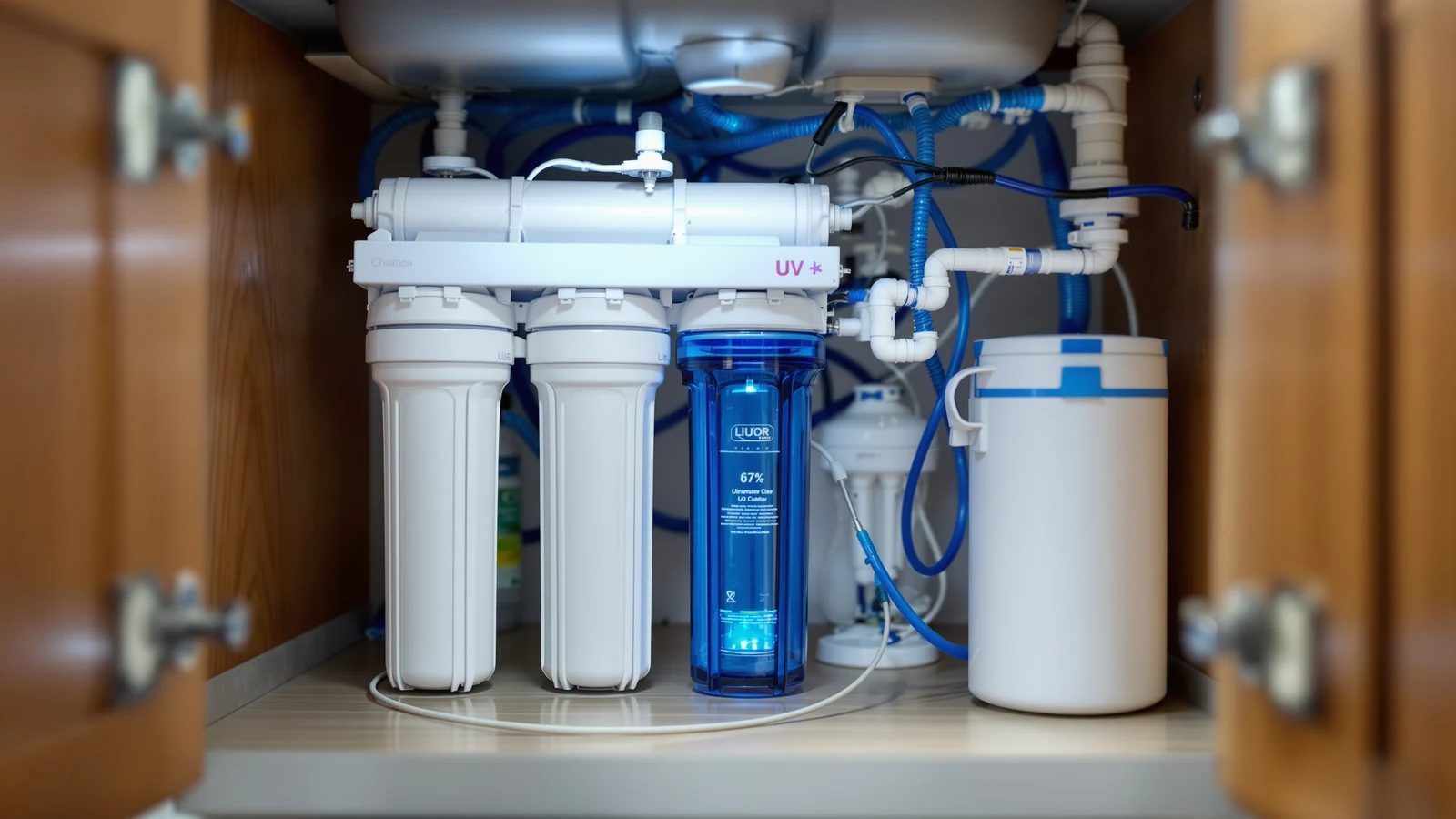
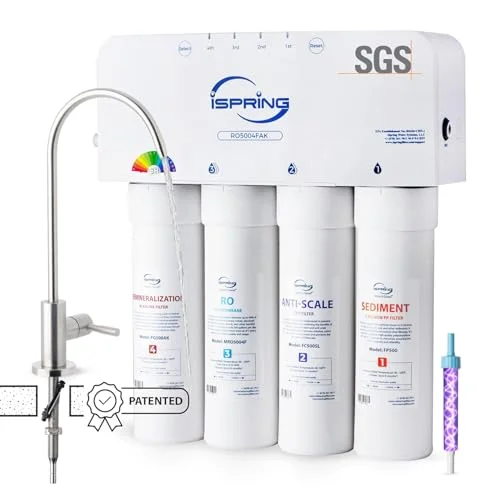
A reverse osmosis membrane is a wall built at almost the same scale as the things it's stopping. The active layer of a modern thin-film composite membrane is fine enough to reject the great majority of dissolved solids, and by the same size-exclusion mechanism it also blocks particles that are enormous by comparison: sediment, protozoan cysts like Giardia and Cryptosporidium, and effectively all bacteria, whose smallest common forms are still far larger than the membrane's rejection threshold. That's why an RO spec sheet leads with TDS reduction and PFAS testing rather than bacteria counts — by the time water has passed sediment, carbon and the membrane, live bacteria are already a minor case, not the headline threat.
What a membrane doesn't fully solve is a shorter list, and it's the reason UV exists as an add-on stage rather than something every system needs. Dissolved gases pass through more or less unimpeded — chlorine taste and odor compounds are small, uncharged molecules that don't reject the way a mineral ion does, which is why the carbon stages upstream of the membrane are doing that job, not the membrane itself. And then there's the one category that actually motivates a UV conversation: viruses. The smallest waterborne viruses sit close enough to the membrane's effective rejection size that manufacturers don't market RO membranes alone as certified virus barriers, even though real-world rejection is typically very good. That gap between "typically very good" and "certified" is the entire case for adding a UV stage.
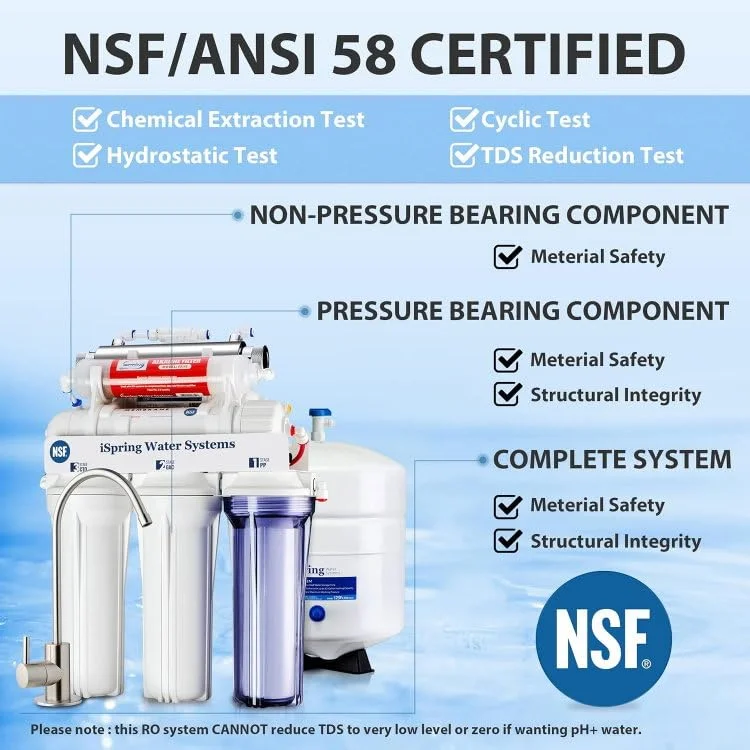
Certification bodies draw that line deliberately. NSF/ANSI 58 certifies that a reverse osmosis system reduces total dissolved solids and specific listed contaminants under standardized test conditions — it says nothing about microbiological performance. A claim about pathogen reduction specifically comes from a different standard entirely, built around disinfection rather than filtration. We break down what each certification stamp actually promises, and what it doesn't, in NSF 58 vs NSF 372 vs WQA — worth reading before assuming a "certified" badge on a box covers more ground than it does.
There's also a second, less-discussed way something can end up in water that already cleared the membrane: contamination introduced downstream of it, in the storage tank, the tubing run to the faucet, or through a faucet seal that isn't holding an air gap. Tank-based systems hold a few gallons of already-purified water in a bladder for hours or days between draws, which is convenient for flow but also gives anything that gets in — through a cracked fitting, a tank replaced without proper sanitizing, or a slow leak at the check valve — time to sit and, in the wrong conditions, multiply. We cover how that tank actually behaves, and what shortens its life, in the RO storage tank guide. A UV stage placed after the tank addresses exactly that scenario; one placed only ahead of the membrane would not.