"Reverse osmosis removes 99% of contaminants" is the line on the box in this category, and it's the kind of claim that's technically defensible and practically useless — it doesn't say which 99%, and it definitely doesn't say what's sitting in the other one percent. The honest version is longer, because an RO system isn't one filter doing one job. It's a membrane doing most of the work through two distinct mechanisms, a carbon stage doing a job the membrane genuinely can't do safely, and — for the handful of contaminants an intact membrane can't fully guarantee against on its own — an optional UV stage that most systems don't even include.
This page goes through what actually happens to lead, arsenic, PFAS, chlorine and biological contaminants once they hit a reverse osmosis system, and — because the honest answer to "does this remove X" is almost always "check the certification, not the product title" — how to read the standard behind a claim instead of the claim itself. We don't run a testing lab; everything below comes from how these mechanisms are documented to work and from the specific NSF/ANSI certifications published for the systems named in this guide.
How the membrane rejects — by size, then by charge
A reverse osmosis membrane is a sheet of thin-film composite polymer with pores small enough that describing them in microns undersells it: the working pore size is on the order of 0.0001 micron, roughly a thousand times smaller than the sediment filter sitting in front of it, and small enough to exclude almost anything with real molecular mass. Push tap water against that membrane under pressure and water molecules squeeze through while everything larger stays on the feed side, headed for the drain. That concentrate is exactly what leaves through the drain line, at whatever ratio the system is rated for — see our waste-water ratio guide for what that number means in practice. Size exclusion is the first mechanism, and it's the one every RO marketing page leads with.
It isn't the only mechanism, and skipping the second one is where a lot of buying guides go wrong. The membrane surface also carries a slight electrical charge, and dissolved ions in water carry their own. Sodium, chloride, calcium, sulfate — the stuff that makes water "hard" or salty — are charged, and the membrane repels them electrostatically in addition to blocking them by size. That double mechanism is why RO handles dissolved minerals and salts so much more thoroughly than a carbon filter ever could; carbon adsorbs organic compounds and chlorine well, but it does essentially nothing to dissolved sodium or arsenic.
The charge mechanism has a predictable blind spot: a contaminant that is small, uncharged and doesn't ionize readily in water is harder for a membrane to reject than one that's either larger or charged. Boron is the textbook example — small, weakly ionizing, and one of the few dissolved contaminants where RO membranes routinely post their lowest rejection numbers, sometimes in the 50–70% range depending on feed pH, against 95%-plus for something like sodium. Fluoride follows a related but different pattern: it is a monovalent ion, so it does carry a charge, but a small monovalent ion rejects less completely than a larger or multiply-charged one. Where a membrane comfortably rejects 95%-plus of calcium or sulfate, fluoride rejection more typically lands in the 85–92% range depending on the specific membrane and operating pressure. That's still a large reduction, and far beyond what a carbon filter alone would achieve, since carbon doesn't touch dissolved fluoride at all — but it isn't the same essentially-complete rejection the membrane delivers for larger, multiply-charged contaminants. It's a useful illustration of why treating "reverse osmosis rejection" as one flat percentage understates how much the specific contaminant matters. NSF/ANSI 58, the standard covering RO system performance, is built around this reality — it certifies total dissolved solids (TDS) reduction as an aggregate number under defined test conditions, not a promise that every individual dissolved substance is rejected equally.
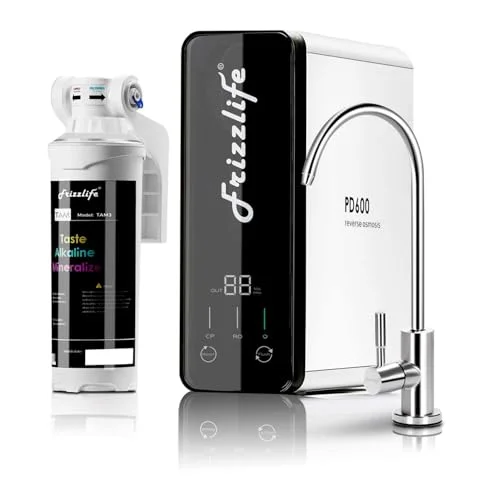
Dissolved metals are close to the best-case scenario for an RO membrane, because most of them show up in water as charged ions — exactly what the electrostatic half of the rejection mechanism is built for. Lead is the clearest example: it enters tap water almost entirely as Pb²⁺ leached from old service lines, solder or fixtures, a doubly-charged ion that a properly functioning membrane rejects at a high rate. This is also the contaminant that NSF/ANSI 53 — the "health effects" standard, distinct from 58 — is built around, and it's why a system's lead-reduction claim should point to a 53 certification rather than a general reverse-osmosis sales line. Of the three systems in this guide, the Frizzlife PD600-TAM3 is the one certified to NSF/ANSI 53 in addition to 58, 42 and 372 — the standard most relevant to a lead or arsenic claim specifically, and something worth checking for on any system where a heavy-metal claim matters to the purchase.
Arsenic is the more interesting case, because it doesn't behave as one contaminant — it behaves as two, and the difference matters most for anyone on well water. Arsenic V (pentavalent, arsenate) is negatively charged at typical water pH and rejects well, often above 95%, for the same electrostatic reason lead does. Arsenic III (trivalent, arsenite) is largely uncharged at neutral pH and rejects far less predictably — a genuine limitation, not a marketing myth. It's the reason municipal and private treatment protocols for arsenic often include an oxidation step to convert arsenic III into arsenic V before it reaches a membrane, and it's worth knowing before assuming any RO system handles well-water arsenic equally regardless of which form is present. If arsenic is a known issue in a private supply, a water test that specifies which form is present — not just a total arsenic number — is the input that actually tells you whether an RO system alone is sufficient.
Other heavy metals — cadmium, chromium, mercury, barium — follow the same general pattern as lead: dissolved, charged, and well-suited to what an RO membrane already does by mechanism. None of the three products in this guide publish a heavy-metal-specific reduction percentage beyond what their NSF certifications imply, which is normal — the certification itself is the evidence, not a number printed on the box — and it's worth checking the specific standard behind a claim (53 for health effects like lead and arsenic, not 372, which only certifies lead-free materials in the system's own construction) before taking a heavy-metal claim at face value.
PFAS: what the certifications actually claim
PFAS — the family of "forever chemicals" that includes PFOA and PFOS — is the contaminant category where marketing language and certified language diverge the most, so it's worth being precise about which one you're reading. Reverse osmosis is genuinely effective against most PFAS compounds: the molecules are large enough that size exclusion does most of the work, a mechanism separate from any specific stage a manufacturer bolts on. That's the general, defensible statement. It is not the same thing as a certified claim.
A certified PFAS reduction claim means the system was tested by an accredited lab against NSF/ANSI 53 or the newer PFOA/PFOS-specific protocols added to NSF/ANSI 58, using defined influent concentrations of specific compounds — typically PFOA and PFOS, sometimes a wider list — and met a stated reduction percentage. That's narrower and more useful than "reverse osmosis removes PFAS" as a category claim, because PFAS isn't one molecule. Long-chain compounds like PFOA and PFOS, the ones most certifications actually test for, reject well. Short-chain PFAS — PFBA, GenX and similar replacement compounds now showing up as long-chain versions get phased out — are smaller and more water-soluble, and reject less predictably across membrane types. A certification against PFOA and PFOS says nothing about a short-chain compound that was never part of the test.
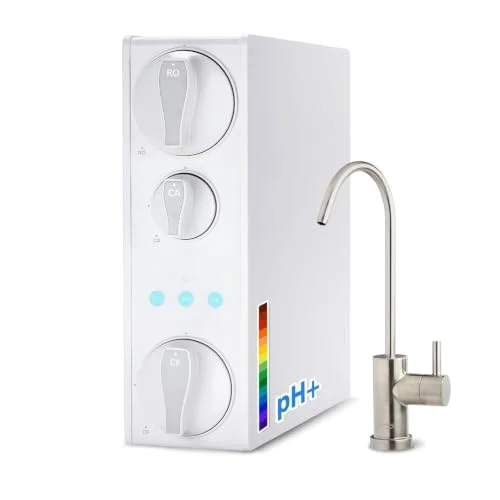
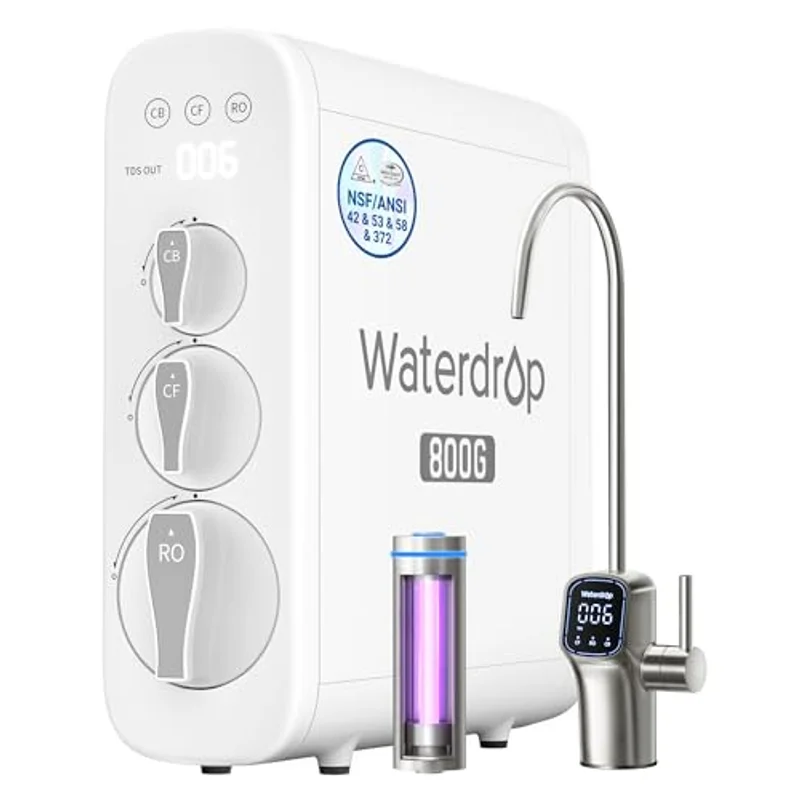
The Frizzlife PD600-TAM3 in this guide is marketed with a PFAS/PFOA reduction claim alongside its NSF/ANSI 58, 53, 42 and 372 certifications. The useful move as a buyer isn't to take the marketing line at face value or dismiss it outright — it's to check the specific certification listing (NSF's own database, or whichever body is named on the product page) to confirm which compounds and what percentage the claim actually covers, the same way you'd read a nutrition label rather than a slogan on the front of the box. Neither the iSpring RO500AK's NSF 58 certification nor the Waterdrop G3P800's listing in this guide specifies a PFAS reduction claim we could independently verify, which is a gap worth noting rather than filling in with an assumption — general RO size-exclusion still applies to both, but "no advertised PFAS claim" and "certified not to remove PFAS" are different things, and neither is the same as "certified to remove PFAS."
Chlorine, taste and why carbon comes first
Chlorine is where the membrane is deliberately not the first line of defense, and understanding why explains the entire stage order of every system in this guide. Municipal water is chlorinated specifically because it's an effective, cheap disinfectant — which is exactly what makes it a problem for a thin-film composite RO membrane. Free chlorine oxidizes that polymer layer, degrading it gradually rather than clogging it, and the damage doesn't reverse. A membrane running behind an exhausted carbon stage isn't failing to remove chlorine on its own behalf; it's the reason the membrane needs replacing months or years ahead of schedule, and it's the kind of damage covered in more depth in our membrane replacement guide.
That's the entire reason activated carbon sits ahead of the membrane in every one of these systems rather than being an optional add-on. Granular activated carbon, usually followed by a carbon block, adsorbs chlorine and the taste-and-odor compounds that come with it before the water ever reaches the membrane. It's also the stage responsible for most of what a person actually notices about RO water — the "tastes cleaner" reaction people report has more to do with chlorine and organic taste compounds being stripped out here than with anything the membrane does afterward, since dissolved minerals affect mouthfeel far less than chlorine affects taste.
The one thing to watch is that carbon exhausts silently. It doesn't clog or show a pressure drop the way a sediment filter does — it simply stops adsorbing once its capacity is used up, with no visible sign. That's a maintenance point more than a filtration one, but it's directly relevant here: a certification like NSF/ANSI 58 tests the system as a whole assembly with fresh cartridges, which means the protective role carbon plays for the membrane is only baked into a system's rated performance for as long as the carbon stage is actually still working. Replacing pre-filters on schedule isn't housekeeping around the RO claim — it's part of what keeps the RO claim true, and it's a large part of why how long a system actually lasts comes down to the cheapest cartridges, not the membrane.
Bacteria and viruses: where UV belongs
On pore size alone, an intact RO membrane should be an effective barrier to bacteria and most viruses — the working pore size is smaller than a typical bacterium and in the same range as many viruses. In practice, "on pore size alone" is doing a lot of work in that sentence, which is why reverse osmosis isn't treated as a certified biological barrier the way UV disinfection is.
The gap isn't the membrane material itself; it's everything around it. O-ring seals, housing threads, a hairline scratch on the membrane surface, or a system that's sat unused and un-sanitized for months can all create a bypass path that a spec sheet's pore-size number doesn't account for. None of the three products in this guide carries a biological-treatment certification — the relevant one is NSF/ANSI 55 for UV disinfection systems, not 58 — and that's normal: under-sink RO systems generally aren't marketed as biological barriers because municipal water is already disinfected before it reaches your tap, which is the assumption every one of these systems is built around.
That assumption breaks down for private well water, which is exactly where UV stages earn their place. A well isn't chlorinated upstream, so if bacteria or viruses are a real possibility in the source water, the honest answer isn't "the RO membrane probably handles it" — it's adding a validated barrier that's actually tested and certified for that specific job. A UV stage rated to NSF/ANSI 55 Class A delivers a specified dose of UV light immediately before or after the RO stage, and unlike the membrane's incidental size exclusion, it's a treatment step designed and certified around microbial reduction specifically. We go through which systems build that stage in properly, and where it's worth adding to a system that doesn't have one, in our guide to reverse osmosis systems with UV. On municipal water with a normal chlorine residual, this is mostly an academic distinction; on a well, it's the single biggest gap the three systems in this guide don't close on their own.
Reading a certification instead of a marketing page
Every claim in the sections above comes back to the same practical skill: knowing which NSF/ANSI standard is actually doing the work behind a bullet point, because the numbers aren't interchangeable and manufacturers aren't always careful about which one they lead with.
- NSF/ANSI 42 — aesthetic effects. Chlorine, taste, odor and particulates. This is a "does it taste and smell better" standard, not a health-contaminant one.
- NSF/ANSI 53 — health effects. Covers contaminants with a documented health effect — lead, arsenic (with the caveats above), cysts, VOCs, and, on some certifications, PFOA/PFOS. If a health claim matters to a purchase decision, this is the number to look for, not 42 or 372.
- NSF/ANSI 58 — reverse osmosis systems. Certifies an RO system's TDS-reduction performance as a whole assembly, under defined test conditions. This is the core performance standard for the category, and it's what a "reverse osmosis system" claim should be backed by at minimum.
- NSF/ANSI 372 — lead-free materials. Frequently confused with a performance certification, and it is not one. It certifies that the system's own wetted components — the plastics and metals the water actually touches — don't themselves leach lead. A system can carry a 372 certification and nothing else, which tells you the hardware won't add lead to the water, and nothing about whether it removes lead that was already there.
The three systems in this guide illustrate the range. The Frizzlife PD600-TAM3 carries all four standards — 58, 53, 42 and 372 — the most complete certification stack of the three, and the reason it supports the widest set of specific claims, PFAS/PFOA included, subject to checking the exact compound list as covered above. The iSpring RO500AK is certified to NSF 58, which covers its core TDS-reduction performance but doesn't by itself extend to a specific contaminant like lead or PFAS the way a 53 certification would; if remineralization after the membrane is the deciding feature, our guide to the best alkaline reverse osmosis systems goes through more options with that stage built in. The Waterdrop G3P800's listing in this guide doesn't specify an NSF certification we could verify — which doesn't mean the system underperforms, only that any contaminant-specific claim about it should be confirmed on the current listing rather than assumed from its output rating or price.
The practical habit worth building: when a product page makes a specific contaminant claim, look for the standard number next to it, then check whether that number is a performance standard (53, 58) or a materials standard (372). A marketing page's job is to make you feel confident quickly. A certification number's job is to be checked.