Despite landing on a similarly low mineral count, reverse osmosis and distillation don't share a single step. One is a filtration process happening at room temperature under pressure; the other is a phase-change process happening at a rolling boil. That mechanical difference is exactly what explains the different gaps each one leaves.
Reverse osmosis: pressure against a membrane
Tap water — pressurized by your home's plumbing, or boosted by a small internal pump on many countertop units — is forced against a thin-film composite membrane whose effective pore size is small enough to reject the large majority of dissolved ions, minerals, heavy metals and larger organic molecules while still letting water molecules through. The water that makes it across is the purified stream, called permeate. The water that carries the rejected material away is the reject or concentrate stream, and it goes down the drain rather than into your glass — which is why under-sink RO systems publish a drain ratio, and why running one always uses more tap water than it delivers as finished drinking water.
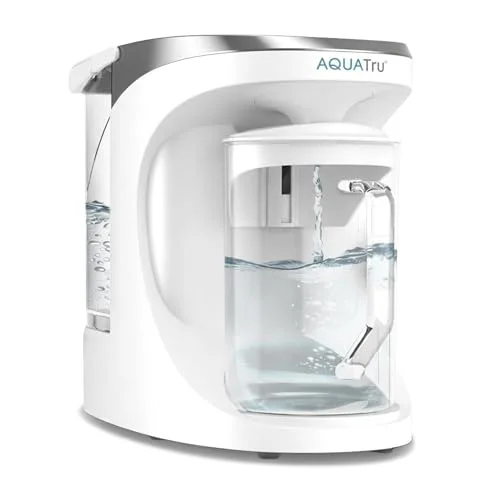
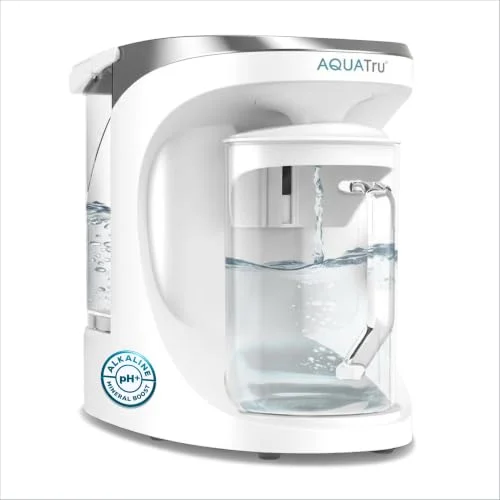
A membrane on its own is a poor match for dissolved gases and for chlorine specifically, which degrades the thin-film material over years of exposure. That's why practical RO systems build carbon stages around the membrane instead of relying on it alone: carbon ahead of the membrane strips chlorine before it can cause damage, and carbon after it polishes taste. Both AquaTru units in the picks below describe themselves as 4-stage systems for this reason — the membrane is one stage among several, not the whole story.
Distillation: boiling water away from everything else
Distillation is mechanically older and simpler: water is heated to its boiling point in a chamber, the steam is routed through a condensing coil, and the condensed water is collected as distillate. Water boils at 212°F (100°C) at sea level, and the great majority of what's dissolved in tap water — calcium, magnesium, sodium, chloride, silica, and heavy metals such as lead and arsenic — does not vaporize anywhere near that temperature, so those substances stay behind while the water itself leaves as vapor. That's why a countertop distiller develops a visible mineral scale ring over weeks of use, and why the process also leaves behind essentially all bacteria and protozoa, which don't evaporate either. There's no membrane, so there's no reject stream and no drain ratio to publish.