Best RO Systems
Home › Guides › How long a reverse osmosis system lasts
Guide

How long a reverse osmosis system lasts

We're reader-supported: buying through our links may earn us a commission at no additional cost to you. We compare published specifications, certifications and prices — we don't run a testing lab.

Cutaway view of an under-sink reverse osmosis system showing sediment, carbon and membrane cartridges of different ages

Ask how long a reverse osmosis system lasts and you'll get a single number back — five years, ten years, "it depends" — and every one of those answers is wrong in the same way. An RO system isn't one object with one lifespan; it's four or five parts running on four or five different clocks, bolted into the same cabinet and sold under one sticker price. The sediment filter you'll change this year has nothing in common, lifespan-wise, with the faucet you'll probably never think about again. Plan around the parts, not the product, and the five-year cost stops being a surprise.

Here is the breakdown, part by part, shortest-lived to longest.

  • Sediment filter — six to twelve months. A spun or pleated polypropylene cartridge catching sand, rust and particulate before it reaches anything expensive — the cheapest part, and the one doing the most physical work.
  • Carbon stages — six to twelve months. Usually granular activated carbon then a carbon block, stripping chlorine and taste. Carbon doesn't clog the way sediment does — it exhausts silently, which is why taste, not appearance, is the signal to watch.
  • The RO membrane — two to three years. The part that actually performs reverse osmosis, and the longest-lived of the consumables — roughly four times the interval of the pre-filters protecting it. It doesn't clog; it slowly fouls and loses rejection capacity, a different failure mode needing a different diagnostic — more on that below.
  • Post-carbon and remineralization — nine to twelve months. A final polish before the faucet, plus, on alkaline systems, a mineral stage adding calcium and magnesium back after the membrane strips them out. Whether that stripping matters is a separate question we work through in reverse osmosis vs. distilled water.
  • The storage tank bladder — five to ten years, or the life of the system. On tank-style systems, the bladder holding pressurized product water between draws is a mechanical part, not a filter, on a much slower clock — we go through the pressure side separately in the RO storage tank guide.
  • Tubing, fittings and valves — five to ten years, check rather than assume. Push-to-connect fittings and quarter-inch tubing rarely fail on a schedule; they fail when a line kinks or a ferrule dries out. Worth a visual check at every filter change.
  • The dedicated faucet — the longest-lived part in the cabinet. A well-made RO faucet is mostly metal and a ceramic disc valve, with nothing inside that fouls or fatigues on the filters' schedule. Barring a worn seal, expect it to outlast every cartridge you'll buy for it — the whole thesis of this page. Adding one where a sink has no spare hole is covered separately.

The parts you touch most often are the cheapest, and the part you never think about was never going to fail on you. The exception is the membrane: expensive enough to matter, and the one component people either replace too early out of habit, or too late because nothing was watching it.

What actually shortens a membrane

Three things do almost all of the damage to a membrane, and none are about brand or price.

Chlorine. Free chlorine attacks a thin-film composite membrane directly — degrading the material rather than just clogging it, and the damage doesn't reverse. The carbon stages upstream exist to strip chlorine before it reaches that surface, so an exhausted carbon block isn't a taste inconvenience, it's the fastest route to a dead membrane. Carbon gives no visual warning when it's spent, which is why a calendar-only habit gets punished hardest here.

Feed pressure. A membrane is rated to perform within a manufacturer-specified inlet pressure range, and that range sets the ratio of water pushed through versus rejected to drain. Chronic low household pressure changes that ratio in a way the membrane wasn't designed to run at continuously — the same reason the waste-water ratio printed on a spec sheet is a best-case number, not a guarantee.

Feed water TDS and hardness. Every membrane has a published rejection figure for total dissolved solids, tested at a defined feed concentration. Push harder or higher-TDS water through it — well water, heavy mineral content — and you accelerate scale formation on the membrane surface, a fouling problem distinct from ordinary rejection decline. It's also why "two to three years" is an average, not a promise: a membrane on hard feed water can be done well inside that window, while one on soft, treated municipal water can run past it.

All three are upstream conditions, not membrane quality. A mid-tier membrane looked after with fresh carbon, adequate pressure, and reasonable feed water will typically outlast a premium membrane running behind an exhausted pre-filter. For the full diagnostic walkthrough and the sequence for changing one without flooding the cabinet, see our membrane replacement guide.

Signs it's going before the indicator says so

A filter-life indicator, where a system has one, measures throughput against a rated capacity — gallons or months, whichever comes first. What it can't see is your specific water and habits, so treat every indicator as a reminder to go check, not a verdict. Four signals catch a failing part before the counter does, each pointing at a different component.

A TDS ratio that's drifted, not just a reading. A single total-dissolved-solids reading from the RO faucet means almost nothing alone — it's only meaningful against a baseline. Measure feed water and product water, compute (feed − product) ÷ feed, and compare against the reading taken when the membrane was new. A ratio that's fallen from the high 90s into the 80s and stays there after changing the pre-filters is the membrane talking, not a fluke.

Flow falling off before the display admits it. On a tank system, the tank takes noticeably longer to recover after a draw. On a tankless system, time how long it takes to fill a known volume against the rated flow on the spec sheet. Falling flow usually means a clogged sediment stage rather than a dying membrane — the cheaper cartridge, and catching it early keeps it from becoming a membrane problem.

Taste changing while the counter still shows life left. Taste is almost always a carbon-stage story, not a membrane one — carbon exhausts silently rather than clogging visibly, so a returning chlorine note means the carbon is spent regardless of what a gallon counter says. Water that tasted clean one season and stale a few months later, on a filter with capacity left, is the textbook exhausted-carbon symptom.

More waste water for the same draw, or water that runs cloudier before clearing. A rising ratio of drain water to product water, or product water slower to run clear, both point at scale or fouling building somewhere in the stack — worth cross-checking against what your system's rated ratio is supposed to be.

None of this requires a lab. A cheap TDS meter, a stopwatch, and attention to taste and clarity catch a failing membrane or spent carbon well ahead of a counter that only knows gallons, not your water.
What five years actually costs

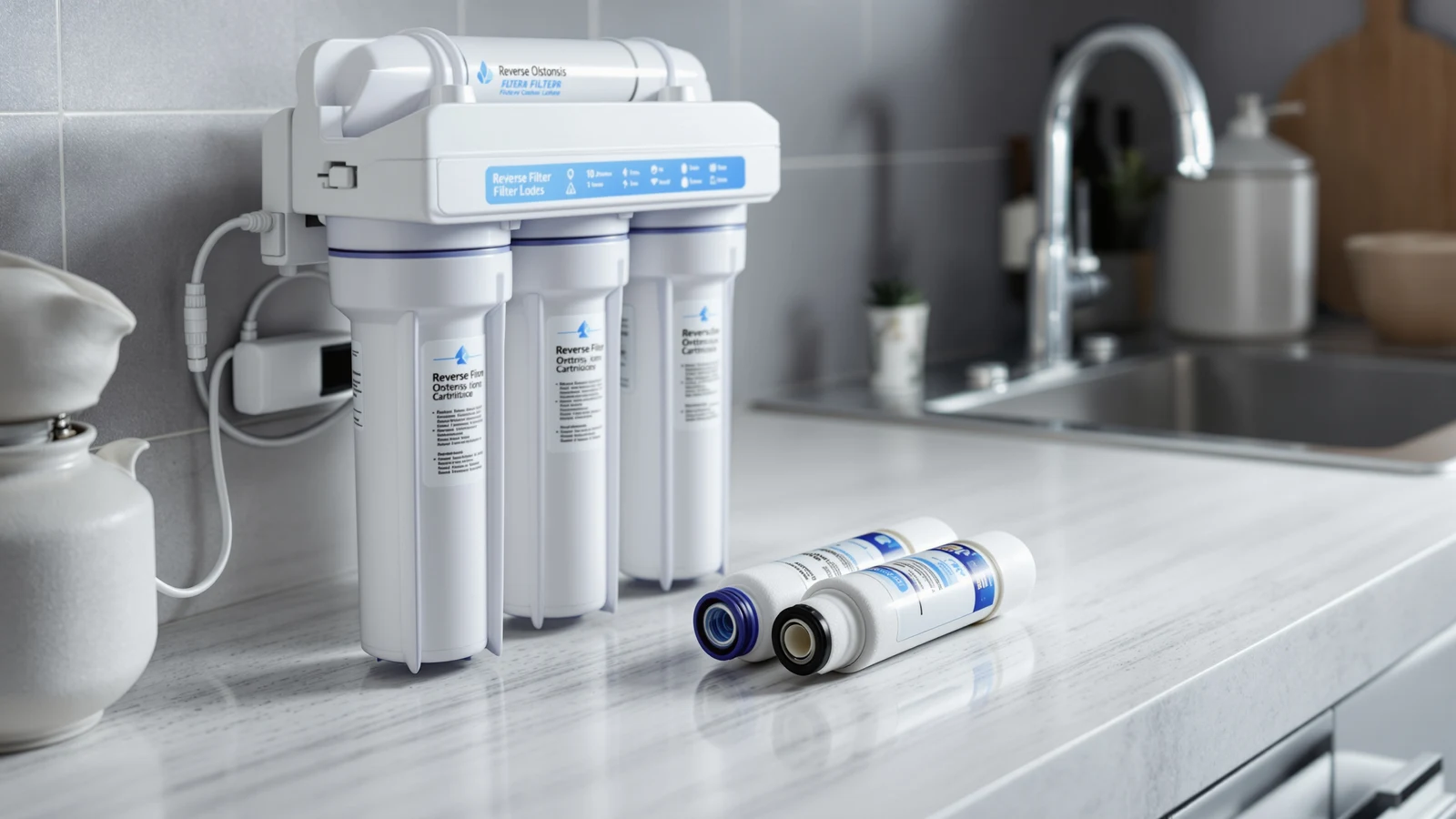
Run the component lifespans above out to five years and the shape of the bill becomes obvious: sediment and carbon changed roughly ten times, post-carbon and remineralization roughly five to six times, the membrane once or twice, and — if the tank, tubing and faucet were installed correctly and left alone — nothing spent on any of them at all. The consumables carry the entire five-year cost; the mechanical parts are close to a one-time purchase.

We've already published the full cartridge-by-cartridge math for several systems, including the Waterdrop G3P600 that appears in our picks below: at $29.99 for its twist-in front filter on a six-month schedule, that's about $59.98 a year for the front stage alone, or roughly $299.90 over five years before the membrane and rear carbon block — sold as separate cartridges on a longer cycle — are added on top. The full breakdown, system by system, covers where that number comes from and why it's a floor rather than a total.

For the other two systems in this guide's picks, we're not going to pretend to a precision we don't have. Waterdrop's G5P700A-PRO listing and iSpring's RO5004F-AK listing both describe the system and its stage count, but neither publishes a replacement-cartridge price we could independently source and verify at the time of writing. That's not a knock on either system — it's the same gap we flagged for two other systems in our cost breakdown, and it means the honest answer, before you buy, is to check the current listing for a named replacement filter and its price rather than assume it will land near what a comparable system costs to run. A five-year total built on an assumed cartridge price isn't a five-year total; it's a guess with a decimal point.

The one number that holds regardless of which system you buy: a membrane replaced once or twice in five years, against pre-filters replaced eight to ten times over the same span, is the arithmetic behind this guide's opening claim. Whatever the sticker price, the part that actually performs reverse osmosis is the one you'll touch least — provided the pre-filters and sanitizing step ahead of it are done on time, which is the next section.

Sanitizing, and why skipping it costs a membrane

Every filter change opens a sealed, pressurized system to open air, and that's the moment bacteria gets a way in — on wet plastic threads, a damp cartridge seat, or a housing left open a few minutes longer than it needed to be. The system then goes back to sitting pressurized and dark, often for six to twelve months until the next change. That combination — an entry point plus a long, dark, stagnant environment — is exactly what a biofilm needs to establish itself, and once it's inside the housings it doesn't stay confined to the cheap parts.

A biofilm that reaches the membrane doesn't just make water taste or smell off. It fouls the membrane surface the same way scale does, permanently reducing rejection capacity — which means a maintenance step skipped to save ten minutes at the sediment housing can cost the most expensive cartridge in the system months or years early. This is the direct link between a step that looks like housekeeping and a component that looks like hardware.

The fix costs a few dollars and adds ten minutes to a job you're already doing:

  1. Shut off the feed valve and relieve pressure by opening the RO faucet until it stops running, before any housing comes off.
  2. Change the cartridges as normal, keeping the empty housings covered rather than left open to the room any longer than necessary.
  3. Add food-grade sanitizer to the housings — unscented household bleach at the diluted ratio the system manufacturer specifies, or a dedicated food-grade sanitizing solution, following the specific instructions that came with your system rather than a generic ratio.
  4. Reassemble and run the sanitizing solution through the system to the faucet, then let it sit for the contact time specified in the manufacturer's instructions — typically a matter of minutes, not hours.
  5. Flush thoroughly before drinking, running enough product water to drain that no sanitizing agent remains, then run the first tank or two to drain rather than to a glass, the same flush step you'd use after any cartridge change.

None of that is optional the way a cosmetic step is optional. It's the maintenance equivalent of the carbon stages themselves: cheap, easy to skip, and the reason a membrane dies early when it's skipped anyway.

The picks

The picks, by filter schedule

Three systems worth knowing about for how they handle the maintenance clock this guide is about — not a ranking of which is "best" overall.

01Tracks its own schedule

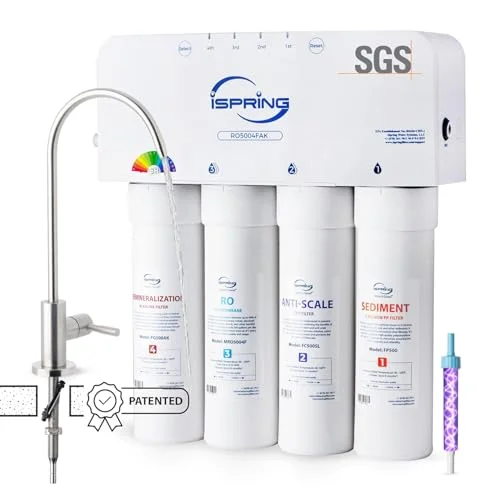
iSpring RO5004F-AK

For not having to guess when a stage is due
500 GPD · Tankless · UV stage · Alkaline remineralization · Filter Life Monitor · 2:1 pure-to-drain

iSpring builds this one around exactly the problem this guide is about: a Filter Life Monitor that tracks usage instead of leaving you to remember a change date. It adds a UV stage on top of the standard filtration chain — worth reading alongside our guide to RO systems with UV if that's the feature drawing you to this one — plus alkaline remineralization after the membrane, and a 2:1 pure-to-drain ratio that's efficient by the standards laid out in our waste-water ratio guide. SGS testing backs the PFAS and TDS reduction claims. What we don't have is a sourced replacement-cartridge price — confirm the current filter costs on the listing before buying if the five-year bill matters to your decision.

iSpring RO5004F-AK UV alkaline tankless reverse osmosis system with filter life monitor
$419.99
Tankless · 500 GPDCheck price →
02Alkaline mineral schedule

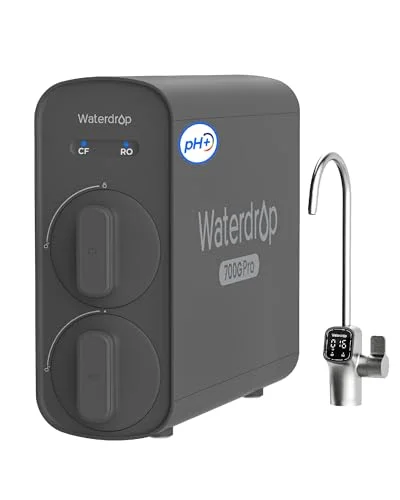
Waterdrop G5P700A-PRO

For a remineralization stage on its own maintenance clock
700 GPD · Alkaline Mineral pH+ · 700 Gallon

The higher output here — 700 GPD against the 500 to 600 GPD of the other two picks — means fewer draws stress the system per gallon delivered, which matters if the household is large. The Alkaline Mineral pH+ stage puts minerals back after the membrane strips them, on the shorter nine-to-twelve-month clock that post-membrane stages run on generally, separate from the membrane's own two-to-three-year interval. As with the iSpring above, we could not source a specific replacement-cartridge price for this listing — treat that as a question to answer before buying, not after.

Waterdrop G5P700A-PRO alkaline mineral pH+ reverse osmosis system
$359.99
700 GPD · AlkalineCheck price →
03Known twist-in cost

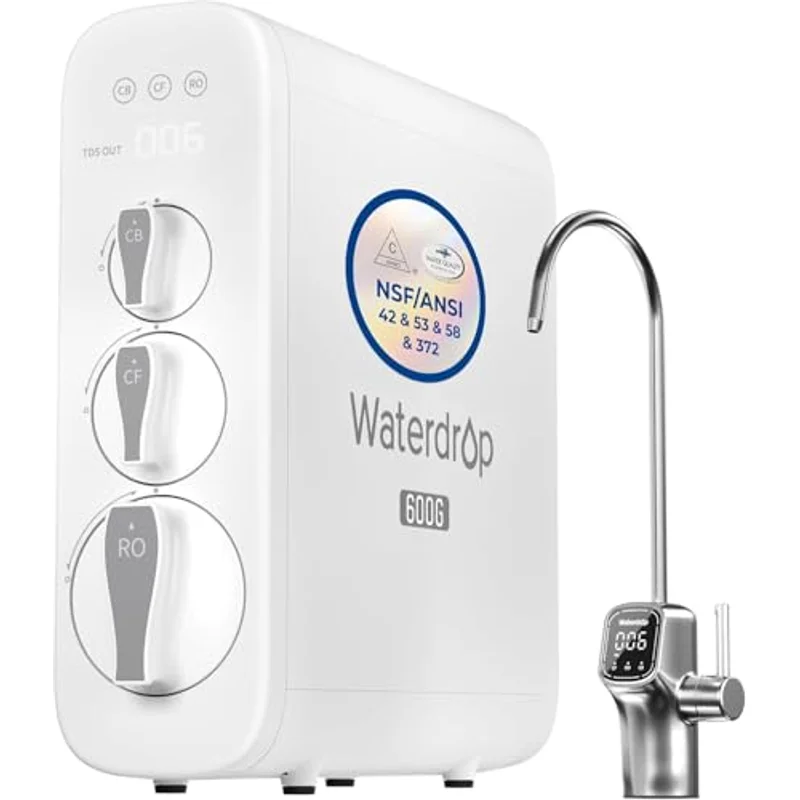
Waterdrop G3P600

For a filter schedule with a price we've already verified
600 GPD · Tankless · Twist-in front filter · ~$59.98/yr front-stage cost

Unlike the two picks above, we've already priced this one out in full in our filter replacement cost guide: a G3-N1CF twist-in front filter at $29.99, rated six months or 550 gallons, works out to roughly $59.98 a year for that stage alone. The trade-off for that known number is the same as every proprietary-cartridge system — one manufacturer sets the price and there's no generic alternative — but at least it's a number you can budget against rather than one you have to go find.

Waterdrop G3P600 tankless reverse osmosis system
$429.00
Tankless · 600 GPDCheck price →
FAQ

Common questions

How long does a reverse osmosis system actually last, overall?

There isn't one number, because the parts don't wear at the same rate. Sediment and carbon stages run six to twelve months, post-carbon and remineralization nine to twelve, the membrane two to three years, and the tank bladder, tubing and faucet are built to run five to ten years or the life of the system with no scheduled replacement at all. "How long the system lasts" is really a question about how long you keep servicing the consumables — the mechanical parts rarely give out first.

Which part usually fails first?

The sediment filter or the carbon stage, and that's by design — they're the cheapest cartridges and they're meant to absorb the wear so the membrane doesn't have to. The risk isn't that they fail first; it's failing to notice when they're exhausted, since a spent carbon block gives no visual warning and lets chlorine reach the membrane, which is a far more expensive problem.

How do I know a membrane is failing before a filter-life indicator says so?

Measure the TDS rejection ratio — (feed minus product) divided by feed — against a baseline taken when the membrane was new, rather than trusting a single reading or a gallon counter. A counter only measures throughput against a rated capacity; it can't see your specific water quality or usage pattern, so a ratio that's drifted down and stays down after you've changed the pre-filters is the more reliable signal.

Is sanitizing really necessary every time I change filters?

Yes, and skipping it is one of the more expensive shortcuts available in RO maintenance. Opening a housing exposes it to airborne bacteria, and the system then sits pressurized and dark for months until the next change — the exact conditions a biofilm needs to establish. A biofilm that reaches the membrane fouls it the same way scale does, permanently reducing rejection capacity, so a step that costs a few dollars and ten minutes is cheap insurance against replacing the most expensive cartridge in the system early.

Keep reading

Next, if you're planning around the maintenance clock